CIO of The North

9.9K posts

CIO of The North banner
CIO of The North

CIO of The North

@MNupdate

FO CIO. Markets, global economy, local (Minnesota) news. Opinions expressed are my own and do not express the views or opinions of my employer

Minneapolis, MN Katılım Eylül 2011
2.3K Takip Edilen2.3K Takipçiler
CIO of The North
CIO of The North@MNupdate·
Chris Hohn and John Armitage sold all their MSFT to Bill Ack
English
0
0
3
503
Lara Trump
Lara Trump@LaraLeaTrump·
Team CHYYYYYNA 🇨🇳🇺🇸
Lara Trump tweet media
Čeština
4.8K
1.9K
21.5K
2.2M
CIO of The North retweetledi
Jeff Timmer
Jeff Timmer@jefftimmer·
@AntiToxicPeople He so thoroughly stupid he has zero idea that his constant rants like this, cognitive tests, etc are constant displays of both the breadth and depth of his stupidity.
English
4
16
184
1.8K
CIO of The North retweetledi
Steve Dallas
Steve Dallas@AgingPrep·
What happens to your market value when you pivot to rural imbeciles and wealthy idiots.
Steve Dallas tweet media
English
0
1
1
226
CIO of The North
CIO of The North@MNupdate·
Will be fun when Boaz Weinstein/Saba forces a PSUS liquidation for the persistent Ackman discount.
English
0
0
1
325
CIO of The North
CIO of The North@MNupdate·
@AlderLaneEggs @SecScottBessent It’s not shady if he follows the IRS rules. He probably has a diversified PA and is just contributing it to seed his ETF that will own the same things/have same strategy
English
0
0
0
83
CIO of The North retweetledi
Mark Hammond
Mark Hammond@MarkHam80780803·
“The Death Star is under attack. Where is Vader?” “He’s in the ballroom, sir.”
Mark Hammond tweet media
English
87
2K
20.8K
245.8K
CIO of The North retweetledi
Eric Balchunas
Eric Balchunas@EricBalchunas·
Gabe Plotkin (of GameStop fame) is launching the “Snowball ETF” at some point prob soon and it wil be a 351 conversion, way to get rid of embedded cap gains. Nice piece on it today from @denitsa_tsekova & @isabelletanlee
Eric Balchunas tweet media
English
19
18
224
178.5K
CIO of The North retweetledi
Jonathan Lemire
Jonathan Lemire@JonLemire·
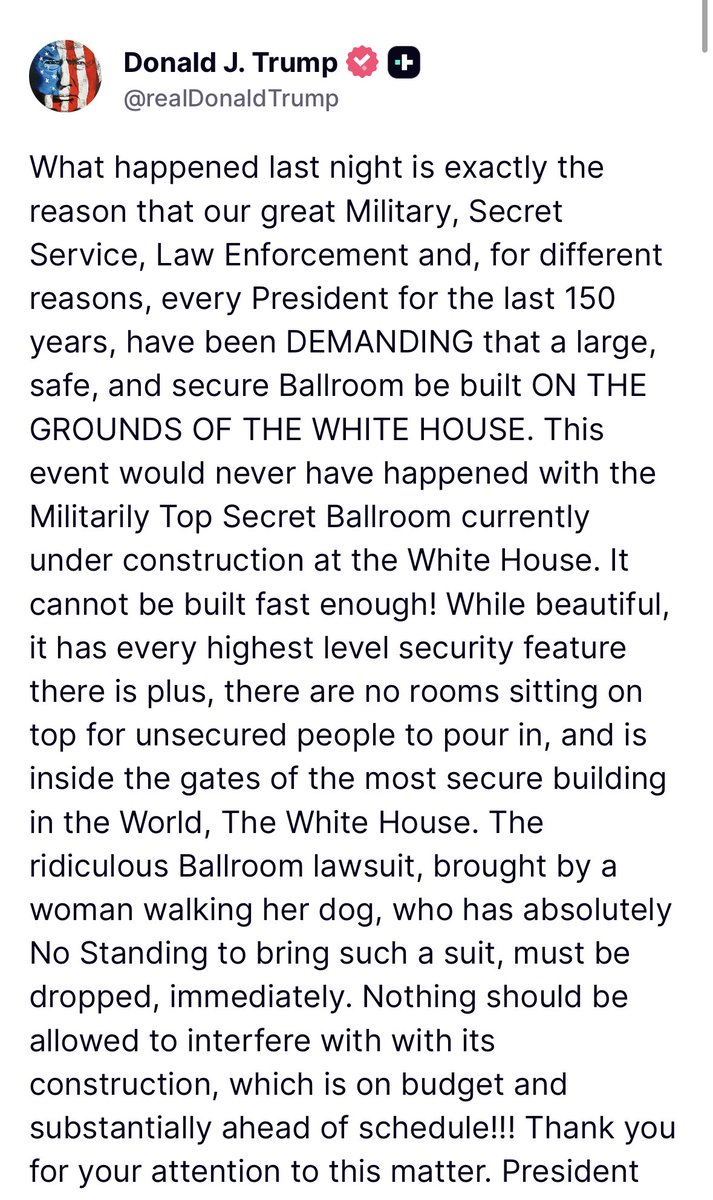
President Trump, in his first post this morning after last night’s WHCD shooting, renews his call for his White House ballroom
Jonathan Lemire tweet media
English
360
207
651
136.6K
Parag
Parag@Parag_Oilman·
@DanielSLoeb1 @DanielSLoeb1 I’m a petroleum engineer and a professional in the industry. This reads as scientific-sounding, but physically inconsistent babble. This is not how water drive reservoirs work.
English
14
10
606
25.2K
Daniel S. Loeb
Daniel S. Loeb@DanielSLoeb1·
This is correct. Iran can’t simply turn off its oil production due to issues of water encroaching its wells. From Claude: This is a well-known technical challenge in petroleum engineering. If Iran were to deliberately curtail or shut in production across its major fields, water infiltration (also called water influx or water encroachment) would be a serious and potentially irreversible problem. Here’s why: The Core Mechanics Most of Iran’s giant fields — Ahvaz, Gachsaran, Marun, Aghajari — are carbonate reservoirs under natural water drive. Aquifers underlying or flanking the reservoir rock are under pressure, and they push water upward into the pore space as oil is produced. When you stop producing oil, you remove the pressure sink that was keeping water at bay. The aquifer doesn’t stop — it keeps pushing. Specific Technical Problems 1. Water Coning and Cresting In vertical and horizontal wells respectively, shutting in production removes the drawdown that was managing the water-oil contact. When production resumes, the water-oil interface may have moved upward significantly, meaning wells that were previously clean producers now produce predominantly water. 2. Irreversible Aquifer Encroachment Carbonate reservoirs like Iran’s have highly heterogeneous permeability — fractures, vugs, and matrix. Water preferentially invades high-permeability channels (fractures) during a shut-in, bypassing oil in the matrix. This oil becomes residually trapped and is extremely difficult to recover later. The damage is often permanent. 3. Wellbore Flooding In wells that are shut in rather than properly killed, water can migrate up the wellbore itself, particularly in older or poorly-cemented completions. Resuming production from a water-filled wellbore requires costly workover operations and risks formation damage. 4. Pressure Redistribution and Cross-Flow In multi-zone completions (common in Iran’s stacked carbonate pays), shutting in causes pressure to equilibrate between zones. Water from a water-bearing zone can cross-flow into an oil-bearing zone downhole, contaminating it without any surface signal. 5. Reservoir Pressure Maintenance Complications Iran has been injecting water into many of its fields (e.g., via the NIOC EOR programs) specifically to maintain pressure and slow natural aquifer encroachment. A sudden shut-in disrupts the carefully managed injection/production balance, potentially causing localized pressure spikes or collapses that further destabilize the water-oil contact geometry. The Scale Problem Iran’s fields are among the largest and most complex carbonate systems in the world, some with very active aquifers. The Asmari and Bangestan formations have notoriously high natural water drive energy. Unlike sandstone reservoirs where water movement is relatively slow and predictable, fractured carbonates can see very rapid water breakthrough once the equilibrium is disturbed. Practical Consequence A prolonged shut-in — even of a few months — across major Iranian fields could permanently impair ultimate recovery factors, potentially stranding hundreds of millions of barrels of recoverable oil. This is why, even during sanctions regimes, Iran has tried to maintain at least minimum production levels rather than fully shutting fields in. The engineering cost of a cold shut-in followed by restart is enormous, and the reservoir damage may not become fully apparent until years later when water cuts rise to uneconomic levels. It’s a meaningful deterrent to any strategy that contemplates a clean “off switch” for Iranian production.
Gary Brode@Gary_Brode

The Strait of Hormuz Reverse Uno Card When Raji Khabbaz and I were running Silver Arrow Investment Management, whenever we were trying to figure out why something happened, he was unsatisfied the explanation that people are sometimes stupid and institutions are often stupid. He correctly thought that people usually have a good reason (at least to them) for doing something even if it appears to make little sense to an outsider. More importantly, he thought that “sometimes people are stupid” was a lazy answer that was dismissive. As investors, it was our goal to understand what was happening, not to ignore it. Recently, I’ve written that many of President Trump’s critics are making the same error. When Iran closed the Strait of Hormuz, the narrow waterway that previously transported 20% of the world’s oil supply, the price of oil rose. Gas prices in the US have risen in response. Many screamed that this was an obvious move by the Iranian regime and insisted President Trump should have known it was something they’d do. How could he not know?! In 2002, the US Navy conducted war games they called the Millennium Challenge. One side represented Iran. The other represented the technologically superior US Navy and included an aircraft carrier, warships, and cruisers. The US Navy side had a substantial advantage in firepower. Retired Marine Corps Lieutenant General Paul K. Van Riper used asymmetric warfare tactics to wipe out the US side in one day. Had this been a real fight, the US would have lost 20,000 servicemen. The result was such an embarrassment that the Navy re-floated the sunk ships, changed the rules of engagement to ensure a US victory, and started the challenge again. These games were not a secret. They have been widely covered in the mainstream media and have been the subject of a New York Times documentary. Over the past two decades, I have seen the Millennium Challenge discussed in my daily financial news reading at least a dozen times. The event has its own Wikipedia page. Regardless of your opinion of President Trump, do you really believe that neither he, nor anyone in the White House, nor any of his military advisors, nor Secretary of War, Hegseth knew about this? I realize that many of you reading this have strong negative emotions regarding President Trump. I’m not asking you to like or respect him. I’m just suggesting that “he’s stupid and has no idea what he’s doing” is not good analysis. This is a point I’ve made in this space in the past. Early in the war, Iran closed the Strait which placed economic pressure on the rest of the world. Despite the fact that it was Iran mining the Strait and shooting at the ships that attempted to navigate it, many countries expressed anger at the US and Israel. This was the outcome Iran wanted. Then, the regime decided to allow friendly ships to pass if they paid a fee. The fees were about $1/barrel of oil, or about $2MM per large container vessel. (Many of these fees were paid in Bitcoin, something macro analyst, @peruvian_bull, explained in an excellent post within the past week.) This looked like worst-case scenario for the US. Iran succeeded in closing the Strait and causing economic problems all over the world, then found a way to profit from their own actions. Then, President Trump played his “reverse uno” card. He correctly realized that it wasn’t just the rest of the world that depended on free passage through the Strait of Hormuz, and that it was Iran that had the most exposure. Iran is a big oil producer, and oil exports account for 80% of Iran’s exports, 60% of government revenue, and 25% of its GDP. It turns out that Iran has more economic exposure to this narrow waterway than anyone else. President Trump sent the US Navy to form a blockade. He closed the Strait himself ensuring no more $2MM/vessel charges and an inability for Iran to export oil. Iran is close to filling its own storage. Once its oil tanks are full, the regime has two choices, either capitulate and come to an agreement with the US, or to stop producing from its own wells. The problem with the second choice is that it’s difficult to reverse. Stopping production on an active oil well tends to damage it and it’s hard to re-start later. Iran now has a limited amount of time to find a course of action before 25% of its GDP becomes permanently(ish) impaired. While no one in the US likes paying more for gas, prices were much higher just four years ago in 2022 and around $4/gallon in 2008, 2011, and 2012 when $4 had more purchasing power than it does now. The US is a net energy exporter with an economy that has survived higher prices in the past. Foreign ships are turning away from the Strait of Hormuz and sailing to Texas and other southern US ports to fill up at premium prices. I’m not suggesting that this is great for the US; but rather, that the US is well-suited to manage the situation while Iran is about to be faced with a massive long-term problem. Finally, Iran maintains control of the country using extensive human infrastructure. There are police everywhere monitoring protests, internet usage, the attire of citizens, and the hair of Iranian women. That level of control is expensive and the government just lost 60% of its revenue. I’m wondering how long they’ll keep doing their jobs without paychecks. I don’t know how this conflict will end. What I do know is that President Trump and the US Navy have turned Iran’s biggest strategic strength into a giant weakness. Sometimes people do stupid things. And sometimes, we just aren’t seeing the reasoning behind those actions. Last week, one of DKI’s interns wrote, ”The bottom line is that (financial analysis) can tell you what the market’s pricing in, but it’s your job to figure out why”. Right now, the mullahs are facing a difficult decision. It will be interesting to see what comes next.


English
64
80
581
780.4K
Ivan the K™
Ivan the K™@IvanTheK·
<--Thinks Trump is planning an attack using TACO as a cover.
English
8
3
43
5.6K
Sean
Sean@sean91237·
@MNupdate I think there are a lot of negatives to these strategies. I assume Jane St models their flows and had a good idea on predicting their order flows.
English
1
0
9
3.7K
CIO of The North
CIO of The North@MNupdate·
AQR L/S tax loss harvesting caught in the Avis short squeeze is wild. Probably not what they signed up for. Getting the full Porsche/VW experience.
English
20
5
254
66.9K
CIO of The North
CIO of The North@MNupdate·
Leveraging to intentionally create tax losses might have more risk than expected. (Probably not a huge position for them)
English
2
0
19
5.3K
Dustin Grage
Dustin Grage@GrageDustin·
I was talking with one of our security guys the other day who protected conservative journalists during Operation Metro Surge. His quote: “Don’t let anyone tell you Portland is worse than Minneapolis.” He’s right.
English
15
54
521
6.7K