
Montana Classical College

9.5K posts

Montana Classical College banner
Montana Classical College

Montana Classical College

@MTClassical

A New Institution in a Time of Trouble https://t.co/vuuU20AV6s I provide aristocratic tutoring, small courses, and gc reading groups.

Katılım Haziran 2021
895 Takip Edilen7.7K Takipçiler
Sabitlenmiş Tweet
Montana Classical College
A couple of thoughts: The main truth that Justin gets at is that the great books are NOT for everyone. Part of the reason for broad great books outreach (from non-slop accounts) is to find the talented who didn't discover them or good teachers and get them connected to both. Having a good teacher at some point is indispensable. I tried reading some great books before I had a good teacher and got very little for my effort. Once I had the incredibly good fortune to encounter such teachers, my ability to engage with great books increased 1000 fold. I cannot express my gratitude enough to them for helping me see farther and deeper than I ever could alone. A terrible error in his post (and some of his replies) is to think of the great books as a "hobby" or thing that you do when you don't have a project, that is just sort of good. This presupposes the superiority of producing an artifact over doing intrinsically good things. Thinking is invisible and you may have little to show for it that can be praised as opposed to someone writing a book or creating a podcast or anything thing else. Great books help us see the fundamental questions which are coeval with man as man. They help us see the fixed limits to how much perfection is possible in political life. They provide the sustenance and vocabulary of our moral imagination. They are the material from which one can build a way of life around--the philosophic life, which is to say, the pursuit of wisdom. Without wisdom or at least some glimpes of it, one leads their life blindly, just grasping at shadows on the wall. The other thing I think he gets right is that we assume that reading books means that we automatically improve. That certainly isn't the case. Again, without a teacher or a friend who wants to wrestle with the questions with you...unless you have terribly high native intelligence, you will be at a loss. Many people do read books from lists so that they can adorn themselves with prestige. The "I am a well read chud" kind of energy which led into Readers Digest becoming a thing in the first place, so that you could name drop at cocktail parties. That which defines our character is what we do. So reading books is good--but what we do in light of reading is what matters. As Dostoyevsky more or less intimates at the end of Brothers K, if you could make a few people in your life feel genuinely remembered and hence loved, you would have done more than most. This is the most powerful argument against reading too much, namely if reading comes at the expense of accomplishing this. But then this is to raise the question of the best of way of life and whether it is principally accomplished by theory or by action--which is to say whether through unassisted human reason accessing nature (theory) or by humans choosing to do God's will by denying their own (action).
Justin Murphy@jmrphy

The Great Books trend of the past 5 years has been a total catastrophe. The simple fact is that Plutarch and Homer and Virgil et al. do have radical insights buried in there, but at the same time most of these books are truly boring and lame and most people pretend to like them, cannot really digest anything, and get absolutely nothing from them! The trend is overwhelmingly powered by these books' aspirational quality; it's like a luxury heritage brand that conveniently only costs $15 a pop. The people on social media who've made brands around how great all these books are, often they are trying to *express* something about *themselves*, which is nice, but does not change how lame and boring the lion's share of these books are! You don't have to pretend to love them! If you're teaching undergrads that's great, or doing real research, fine. But this in no way means that everyone should read these books; it does not even mean that the smartest and most educated adults today need to read these books. The bits of radical alpha in them are great to find, explore, and write about if you are in the .01% of people who are called to do such things, but there is really zero reason why anybody else should read any of these books. Frankly, many of these authors are even somewhat primitive and infantile compared to the best thinkers of modernity. Plato and Aristotle have tons of provocative alpha worth getting, but also they were retarded on many topics, especially religion. The Romans were even worse in many ways. But all of this gets shrouded in the cult of Great Books. There have never been more people professing to love the Great Books, and mass public culture has never been lower brow than it is today. A ton of larping and precious little education, virtually zero novel insight, has come out of this movement.
English
5
1
26
2K
Montana Classical College retweetledi
A. T. P. G.
A. T. P. G.@engeignos·
Lovely anecdote of Pythagoras in Diogenes Laertius
A. T. P. G. tweet media
CY
3
8
87
3.8K
Arthur
Arthur@hiraethdao·
@MTClassical Should ideally be both if you read the ancients in a psychological or mystic way.
English
1
0
1
17
Montana Classical College retweetledi
Montana Classical College
Montana Classical College@MTClassical·
Ancient artist / playwright (concerned principally with displaying a permanent truth) vs. romantic artist (concerned principally with emotional authenticity as a pathway out of the stifling herd animal conformity). The ancient artist looks outward and the modern Romantic looks inward. I think that the older view is a healthier orientation toward creating art.
English
3
4
20
1.1K
Lucky
Lucky@becoming_virtue·
@MTClassical All they need is a bad call from a ref in one of their gay little soccer games and boom, revolution.
English
1
0
1
50
Montana Classical College
"Remember that by historical standards, you are gay." Democracy quietly presupposes that if every person who voted "yes" had a sword and are the majority, and every person who said "no" had one, the majority could compel the minority by force. No one is ready for the sword.
Curtis Yarvin@curtis_yarvin

You’re just looking at a big herd of sheep. 21st-century crowds mean nothing because we have lost the basic human capacity for mass violence. A “demonstration” matters because it is an incipient mob—500,000 people can do anything they want. Except they can’t and they won’t

English
1
0
5
461
Montana Classical College
Never finish a book again! You can have your phone out the whole time that you have your book out and check in on X in between reading and audio recording what would have been your annotations. Follow the account below so that you can use this neat trick...
Lily@LThy953252

@MTClassical Been here. Once you train analytical thinking, impossible to enjoy pure pleasure reads. Built NoteX: capture book insights in audio while reading deeply, organized notes automatically. Dive deep without friction. notex.onelink.me/8OE5/0596wtfe

English
1
0
6
610
Montana Classical College retweetledi
Lance Legion
Lance Legion@LancesLegion·
America's 250th is this year. I will release a writing I have for it as far as my thoughts on what it means to me, Americans, the world, where we are, and where we should and will go. I recommend you write your thoughts. Let the world hear the song of your hearts.
English
1
2
51
937
Montana Classical College retweetledi
Plato's Trojan Horse
Plato's Trojan Horse@PlatosTrojanH·
1/ Empedocles, in the generation before Plato, described natural processes through two cosmic forces: Philia (Love, binding) and Neikos (Strife, separating). Configurations that worked persisted. Those that failed perished. This was a theory of selection in the fifth century BC.
English
2
1
6
350
Montana Classical College retweetledi
Lomez
Lomez@L0m3z·
Really good conversation with @curtis_yarvin and @christopherrufo. We evaluate Trump II, diagnose the the GOP, and eventually find critical points of disagreement, namely over the question of whether the idea of America, its founding, and its mythologies are worth preserving.
BlazeTV@BlazeTV

"They pray to a flag that is controlled by their enemies." On the latest episode @christopherrufo and @L0m3z, @curtis_yarvin explains why he cares about saving America despite his purported disagreements with the Founding ideology:

English
54
37
559
63.5K
Montana Classical College
@miltonappl3 Isn't ch. 1 already a pretty enticing beginning? Until you get slammed with ch. 32 (cetology) and then a great get filtered not realizing what they had signed up for. I personally think that abridged editions should get rid of the plot and keep only the cetological chapters.
English
1
0
5
244
milton
milton@miltonappl3·
If you haven't read Moby Dick I'm pretty sure the chapter called The Masthead (35?) can stand alone as an essay (really can't they all?) and is worth your time (as they all are). Just be careful bc you might just read the whole thing which is really more of an encyclopedia about information science than a novel, and you won't know what just happened to you when you're done so you'll talk about it to anyone who looks like they might pay attention and you'll be that guy.
English
9
3
71
3K
Montana Classical College retweetledi
Athenian Stranger
Athenian Stranger@Athens_Stranger·
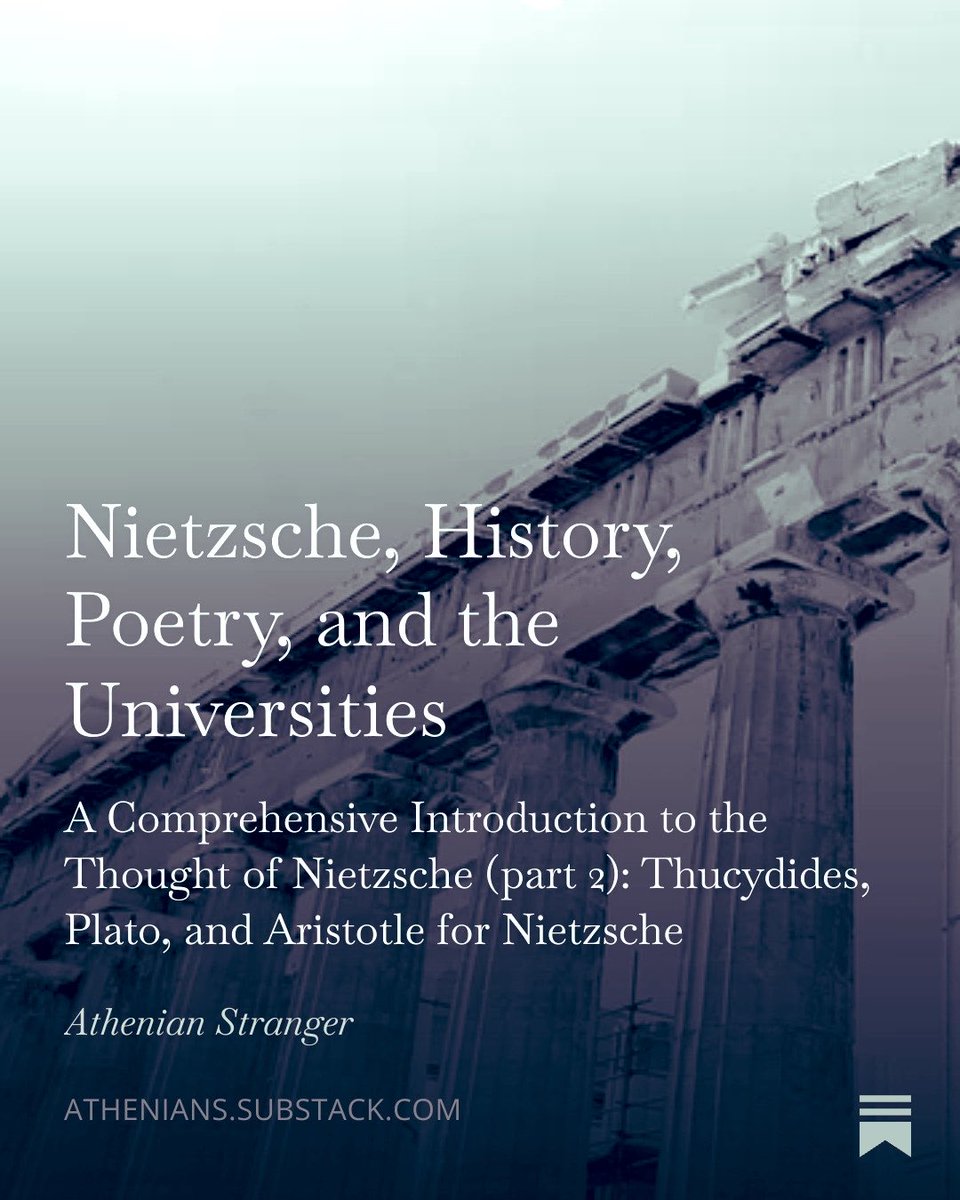
Nietzsche’s Poetry: Thucydides, Plato, and Aristotle —Nietzsche on “interpretation” and History —The “old quarrel” of poetry and philosophy in Plato: “Theology” as “the Ancients and Moderns” —Greatness of Soul and Poetry in Aristotle —The Sicilian expedition in Thucydides
Athenian Stranger tweet media
English
2
7
63
9.7K
Montana Classical College
@raggedy_manican @StephenPiment Can you explain how moral and social depth are somehow equivalent, or if they are falsely identified as one another, what they are in turn and how they are different? I know that is a big question, but I don't know what you mean without asking it.
English
0
0
0
28
notker
notker@raggedy_manican·
When people speak of the moral depth of Homer, they mean social depth, equating the two (not unfairly). Vergil has no social depth. He's a stylist and so has formal weight. His greatness is only vaguely sensed without an immersion in Hellenistic poetics: obscure allusions that only other espteric readers would catch. One famous example: invitus, regina, tuo de litore cessi (Aeneid 6.460) References invita, o regina, tuo de vertice cessi (Catullus 66.35) Which references a lost fragment from Callimachus' Aetia, referring to the lock of Berenice being made into a constellation (apotheosis). Homer is superior. Few dispute that. Vergil is a reader's poet.
English
1
0
0
21
Stephen Pimentel
Stephen Pimentel@StephenPiment·
Homer, Virgil, Plutarch, Plato, and Aristotle are all superb and far more worth reading than a large majority of recent books.
English
54
57
737
23.5K
Montana Classical College
Talking to @HerodoteanD ... the clear next step to understanding Melville's final view--as least as it is presented in Moby-Dick--is to carefully track each mention of fate and the like, and see what Ishmael means in each individual instance. Is fate providential or necessitated or is it something else? It looks one way sometimes and another at other times. Are the "fates as stage managers of the world" the same fate that Ishmael seems to embody in the closing 4 chapters?
English
1
1
8
416
Montana Classical College retweetledi
Kurt Steiner
Kurt Steiner@Kurt_Steiner·
Your great great grandma helping the war effort by sliding into some poor soldier’s DMs who’s stuck on some god-forsaken island in the Pacific where all he does is sweat like a pig and gas up planes three times a week during the big war.
Kurt Steiner tweet media
English
11
14
290
9.8K
Montana Classical College retweetledi
Lyceum Institute
Lyceum Institute@LyceumInstitute·
On Reading the Great Books « A Philosophical Happy Hour inquiring after the merits of reading the Great Books and understanding the environment of the reader » The recovery of classical education, much in vogue today, has often been identified with the recovery of the Great Books. This is understandable: Plato, Aristotle, Augustine, Boethius, Dante, Aquinas, Shakespeare, Newman, Dostoevsky, and others do not contain mere history or a “tradition of ideas”. They present perennial questions and profound depths of insight concerning being and truth, life and death, the human good, the soul, society, God, language, beauty, and purpose.  Reading them seriously aspires to heights, contrary to the shallowness, distraction, and numbness which dominates contemporary culture. But this raises a further question: is reading the Great Books enough? Read more at the link: lyceum.institute/news-and-annou…
Lyceum Institute tweet media
English
0
7
19
4.4K