Sabitlenmiş Tweet

Why do European peoples reject refugees?
In my opinion, European peoples have no right to object to the presence of refugees or to demand their deportation. Before speaking about rejection, they must first direct their anger toward their governments, which interfered in the affairs of Third World countries and participated in destroying them and overthrowing their regimes.
Take my country Libya as a clear example. In 2011, NATO and the European Union attacked Libya under the pretext of spreading democracy, but the result was catastrophic: a destroyed state, collapsed institutions, security chaos, and looting of resources. Libyan funds were frozen in Europe, and even seized and stolen. In Belgium alone, Libyan funds are estimated at around 14 billion dollars, which today is equivalent to about 30 billion dollars.
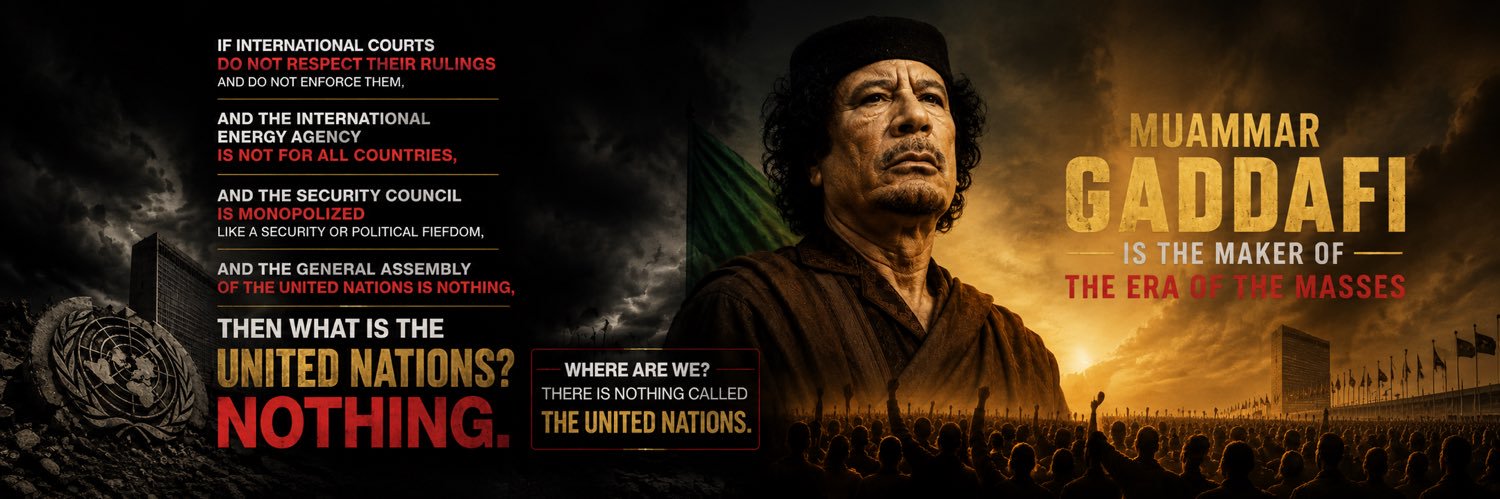
It did not stop there; Gaddafi was killed, thousands of civilians fell, and the country was left open without real sovereignty. The Libyan coast turned into a main gateway for migration toward Europe, which is a direct result of this intervention. Therefore, the waves of migration that Europe suffers from today are not a random event, but the result of reckless foreign policies.
Therefore, it is not logical for European peoples to complain about refugees while ignoring the root cause of the problem. You participated—directly—in creating these conditions, and now you are rejecting their consequences.
Moreover, the asylum and migration system itself was never completely innocent. In earlier periods, it was used as a political tool to host opponents of certain regimes, especially in the Arab world, in order to pressure or overthrow them. When it served Western interests, there was no problem with refugees; rather, they were welcomed. But today, after these countries that refuse to submit to the West have been destroyed, the discourse has changed and the refugee has become an unwanted burden.
Even Gaddafi himself had warned Europeans about the consequences of these policies, and expressed his rejection of turning uncontrolled migration into a security and economic threat, but the West did not listen, because it saw in it an immediate interest.
The problem therefore is not only in governments, but also in the peoples who remain silent, justify, or ignore. If you reject refugees today, then first begin by holding your governments accountable for their foreign interventions and their political and military subordination to major powers such as the United States, France, and Britain.
The relationship between us and you could have remained simple: between us are the sea and the air; we do not attack you, nor do you interfere in our affairs. But what happened is exactly the opposite, and its consequences are clearly visible today.
Libya is not just a country for its people; it is a homeland that holds a place in the hearts, and its people believe that what befell it was neither in vain nor by coincidence. Many believe that what happened to it in terms of destruction and ruin cannot pass without accountability, and that divine justice does not overlook injustice no matter how long it takes.
Countries may be destroyed, wealth plundered, and regimes toppled, but nothing is lost with God. Therefore, those who destroyed Libya and participated in its suffering may think they are safe today, but from the perspective of faith and justice, there is no injustice without an end, and no harm without accountability.
What is happening in the world today of crises, migrations, and turmoil is not separate from those policies that changed the fate of entire peoples. And as many believe, God’s justice is broader than to be measured by time or human power, and He alone is capable of restoring balance when everything is disrupted, and when some think that what they have done has ended without accountability.
#Vluchtelingen
#RefugeeCrisis #AsylumBelgium
#Asielzoekers #AsylumSeekers #Vluchtelingencrisis #Belgium #Bruxelles
English