Alessandro Maran

58.5K posts

Alessandro Maran banner
Alessandro Maran

Alessandro Maran

@MaranAlessandro

Parlamentare dal 2001 al 2018. Appassionato di politica estera (e di jazz). Di recente ho imparato a volare.

Grado (Go) Katılım Mayıs 2011
3.5K Takip Edilen6.1K Takipçiler
Sabitlenmiş Tweet
Alessandro Maran
Alessandro Maran@MaranAlessandro·
Perché tra i paesi europei, l’Italia è quello che attribuisce più responsabilità all’Ucraina per la guerra e la mancata pace? Cos’è che ha trasformato l’Italia in un paese che si beve ogni fandonia del Cremlino? In libreria dal 30 settembre.
Alessandro Maran tweet media
Italiano
5
20
55
0
Alessandro Maran retweetledi
Darth Putin
Darth Putin@DarthPutinKGB·
There is one universal rule. Whenever Moscow is thrown out of a country, mass celebrations happen
English
64
1.3K
7.7K
76.6K
Alessandro Maran retweetledi
Kaja Kallas
Kaja Kallas@kajakallas·
The breakdown of international law is evident in today’s two preeminent global crises — Russia’s war of aggression against Ukraine and the war in the Middle East. A new world is now in the making, characterised by competition and coercive power politics; a world order dominated by a handful of military powers who aim to establish spheres of influence. This is why the EU’s support for the UN now is more vital than ever. My statement at the @UN Security Council ↓
English
1.6K
1.3K
4.9K
602.2K
Alessandro Maran retweetledi
Antony Blinken
Antony Blinken@ABlinken·
President Trump is constrained by markets and munitions to find an off ramp in the war with Iran. Thus far, our tactical successes have come at the cost of strategic failure. See below for my conversation with @FareedZakaria
English
169
463
2.1K
231.4K
Alessandro Maran retweetledi
Marco Fattorini
Marco Fattorini@MarcoFattorini·
Péter Magyar: «La Russia è un rischio per la nostra sicurezza. Nella storia ungherese abbiamo già sperimentato l'orso russo. L'Europa deve prepararsi. L'Europa deve proteggersi e difendersi».
Italiano
179
707
4.1K
58.9K
Alessandro Maran retweetledi
Institute for the Study of War
NEW| The United States is simultaneously imposing a blockade on Iranian ports while taking steps to open the official transit route through the Strait of Hormuz for shipping not transiting to or from Iran. The US blockade of Iranian ports began at 10:00 AM ET on April 13. The US blockade focuses exclusively on maritime traffic entering or leaving any Iranian ports, including Iranian ports in the Persian Gulf and the Gulf of Oman. US Central Command (CENTCOM) stated on April 12 that US forces will not impede freedom of navigation for vessels transiting through the strait to or from non-Iranian ports. Iranian officials have threatened to respond to the US blockade of Iranian ports. An Iranian military spokesperson stated on April 13 that no port in the Persian Gulf and the Gulf of Oman “will be safe” if the security of Iranian ports is “threatened.” Supreme Leader Military Affairs Adviser Mohsen Rezaei similarly threatened that Iran would counter the blockade. US negotiators, including Vice President JD Vance, Special Envoy to the Middle East Steve Witkoff, and Jared Kushner, left Islamabad, Pakistan, after the United States and Iran did not reach an agreement during talks on April 11 and 12. The Iranian negotiating delegation similarly left Islamabad on April 12. A US official and regional source told Axios on April 13 that Egypt, Pakistan, and Turkey will continue discussions with Iran and the United States to “bridge the remaining gaps.” These mediators aim to facilitate another round of negotiations between Iran and the United States before the two-week ceasefire ends on April 21.
Institute for the Study of War tweet media
English
14
193
541
65K
Alessandro Maran retweetledi
Nona Mikhelidze
Nona Mikhelidze@NonaMikhelidze·
👇
ART
2
10
81
1.4K
Alessandro Maran retweetledi
Hillary Clinton
Hillary Clinton@HillaryClinton·
Trump has become fully unhinged and we should talk about it.
English
0
5.6K
30K
2.6M
Alessandro Maran retweetledi
Ursula von der Leyen
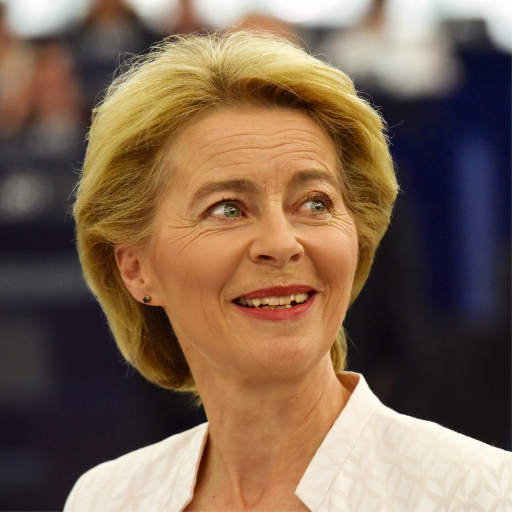
Ursula von der Leyen@vonderleyen·
Today, Europe is Hungarian. We are stronger. More united. To the people of Hungary - you've done it again. You have spoken. You have chosen Europe. It's a victory for fundamental freedoms.
English
5.9K
4K
21.1K
671.1K
Alessandro Maran retweetledi
Damien Rieu
Damien Rieu@DamienRieu·
Absolument tous les commentateurs français, qu’ils soient dissidents ou grands publics, vous racontent la même histoire : les USA se sont plantés et l’Iran a totalement gagné la guerre. Mais à l’étranger, certains experts ont une lecture différente. L’avenir dira qui a raison, mais voici le résumé, pour que vous puissiez vous faire votre propre opinion : 1️⃣ La Chine doit encaisser le choc du prix + est obligée de changer de station service. Droguée au pétrole iranien sous sanctions donc pas cher, elle encaisse immédiatement une explosion des coûts industriels (plastiques, fibres, intrants), des tensions sur les chaînes d’approvisionnement, et une hausse des prix à l’export. Dépendance critique révélée : une part majeure de son énergie transitait par un point d’étranglement contrôlé par un acteur instable. Elle est obligée de changer de fournisseur et de se tourner vers son concurrent US qui se frotte les mains. 2️⃣Activation du levier iranien = auto-neutralisation L’Iran utilise son unique carte : bloquer Ormuz. Effet réel : •frappe ses propres clients (Asie) •déclenche une diversification accélérée •incite à la création d’infrastructures de contournement permanentes Conséquence structurelle : perte irréversible de centralité stratégique. Le levier devient caduc dès son utilisation. 3️⃣ Réallocation rapide au profit des États-Unis Le marché réagit sans inertie : redirection vers le pétrole américain. Effets immédiats : •hausse record des exportations US •captation de la demande asiatique •rôle de fournisseur d’équilibre consolidé Sans compter que les USA contrôlent le stock Venezuela. Les États-Unis passent de participant à pivot du système carburant. 4️⃣ Transformation du système énergétique mondial. Mutation profonde : •fin de la dépendance critique au chokepoint Ormuz •montée des routes alternatives (pipelines Golfe → mer Rouge / Oman) •bascule vers des producteurs flexibles Le choc devient catalyseur d’un nouvel équilibre durable. 5️⃣ Reconfiguration géopolitique accélérée Intervention décisive de l’Arabie saoudite dans la séquence politique américaine. Un appel de Mohammed ben Salmane a infléchi la décision de Donald Trump : abandon d’un cessez-le-feu total au profit d’un cessez-le-feu temporaire. En échange de la poursuite de la pression sur l’Iran : •financement direct massif de l’effort de guerre américain (100 milliards) •investissements structurants dans l’économie US et achats d’armement •normalisation avec Israël conditionnée à l’affaiblissement de Téhéran •projet de corridor énergétique Arabie saoudite → Ashdod (Israël) •formation d’un bloc régional de défense sous parapluie américain •contrôle naval conjoint des détroits stratégiques •préparation d’un “après-Iran” (reconstruction, repositionnement politique) Le conflit devient levier de refonte régionale, pas simple affrontement bilatéral. 6️⃣ Trajectoires différenciées •Iran : effondrement progressif (revenus, influence, stabilité interne). Horizon : marginalisation. •Chine : choc court terme, adaptation forcée, diversification. Dépendance stratégique déplacée vers les États-Unis. •États-Unis : gagnant systémique. Renforcement économique, énergétique et géopolitique simultané. •Golfe : consolidation comme hub énergétique restructuré et stabilisé. 7️⃣ Conclusion •un levier géographique (Ormuz) est activé •cette activation détruit sa propre valeur •le système se reconfigure autour d’acteurs capables d’absorber et rediriger les flux Résultat final : transfert du centre de gravité énergétique vers les États-Unis, exposition de la vulnérabilité chinoise, et déclassement accéléré de l’Iran dans l’ordre régional et mondial.
Damien Rieu tweet media
Français
315
829
2.6K
181.8K
Alessandro Maran retweetledi
Guido Vitiello
Guido Vitiello@guidotweet·
Un pensiero ai garantisti per il No che hanno sacrificato l’uovo oggi della separazione delle carriere per il timore della gallina domani della inarrestabile deriva orbaniana. Un calcolo politico davvero geniale e lungimirante
Italiano
64
75
483
17.9K
Alessandro Maran retweetledi
Anne Applebaum
Anne Applebaum@anneapplebaum·
Orban concedes defeat. The support of Trump, Vance, Putin, Lavrov, Weidel, Milei, Le Pen, Fico, Babis and many others could not overcome Hungarian anger at a stagnant, corrupt regime #block-69dbf1ff8f08ff62487f805e" target="_blank" rel="nofollow noopener">theguardian.com/world/live/202…
English
660
7.5K
22.3K
1.6M
Alessandro Maran retweetledi
Marta Ottaviani
Marta Ottaviani@martaottaviani·
From tomorrow we will analyze the data and understand whether #Magyar is a new #Orbán in disguise. But tonight we celebrate. Long live the #Ue, long live the Hungarian people. And a small musical tribute for them youtu.be/yON0G0HLmIU?si…
YouTube video
YouTube
English
0
10
58
2.4K
Alessandro Maran retweetledi
Bill Kristol
Bill Kristol@BillKristol·
All honor to the Hungarian people for showing the way.
English
97
803
7.4K
115.4K
Alessandro Maran retweetledi
Ursula von der Leyen
Ursula von der Leyen@vonderleyen·
Ma este Európa szíve erősebben dobog Magyarországon. Europe’s heart is beating stronger in Hungary tonight.
Magyar
4.2K
3.3K
28.1K
2M
Alessandro Maran retweetledi
Nona Mikhelidze
Nona Mikhelidze@NonaMikhelidze·
Orban ha perso, e con lui hanno perso anche Putin, Trump e i loro vassalli sovranisti. Viva l’Unione Europea 🇪🇺
Italiano
1
150
898
9.4K
Alessandro Maran retweetledi
Institute for the Study of War
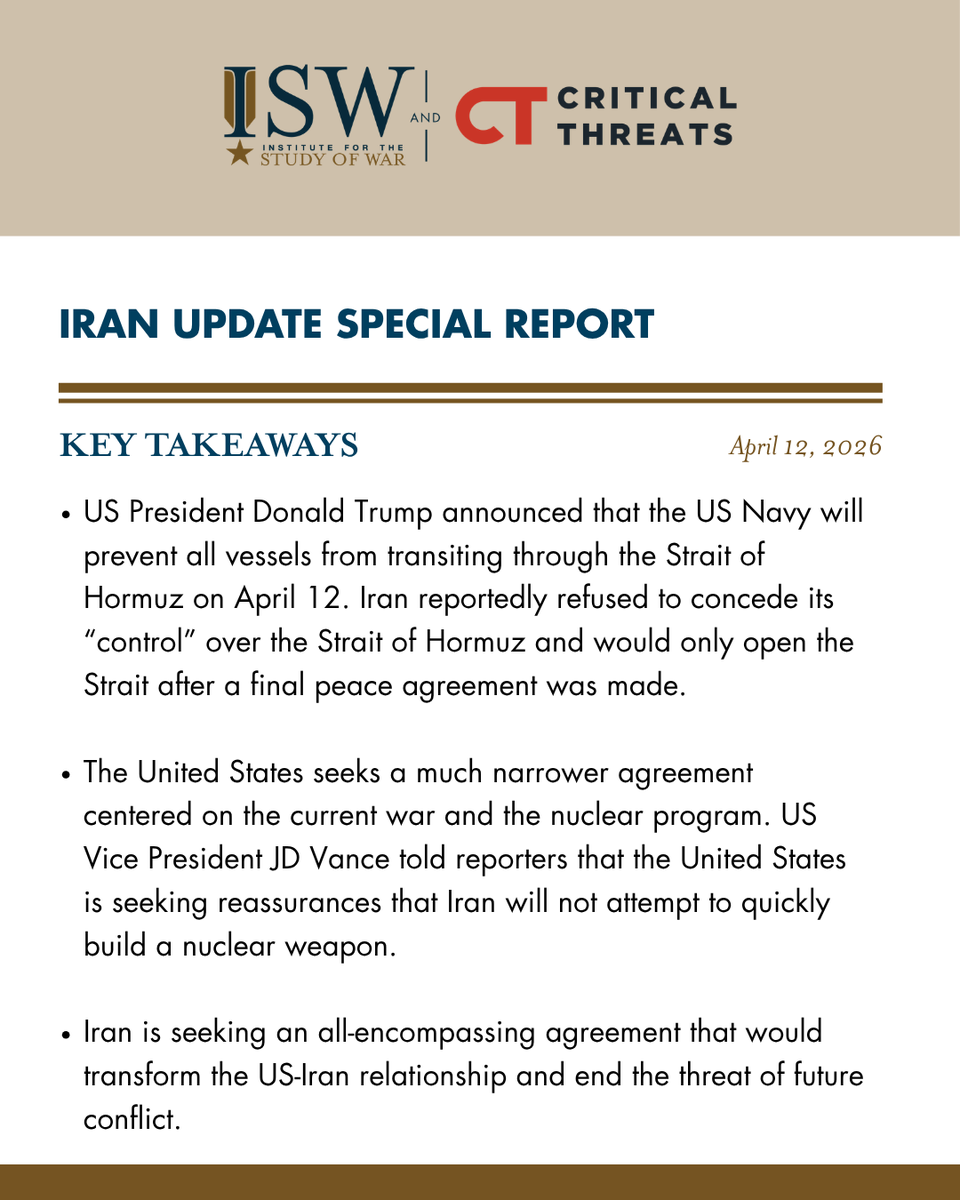
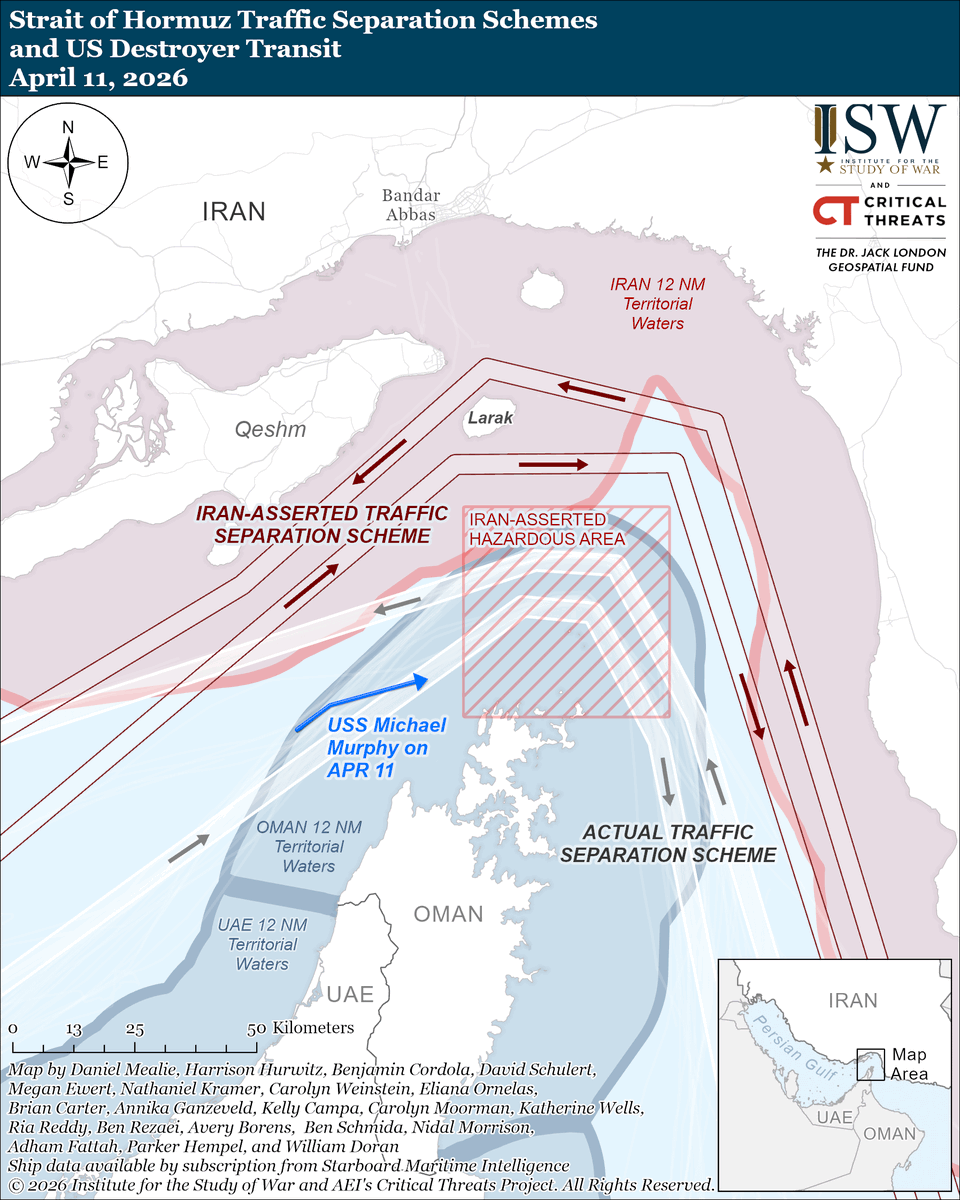
NEW: US President Donald Trump announced that the US Navy will prevent all vessels from transiting through the Strait of Hormuz on April 12 after US negotiators left Islamabad without a US-Iran deal. Iran reportedly refused to concede its “control” over the Strait of Hormuz, which is Iran’s primary source of leverage, and would only open the Strait after a final peace agreement was made. Trump said that the US Navy will begin destroying the mines that Iran laid in the Strait. Iran is using the threat of its naval mines, of which there are reportedly fewer than a dozen, to keep the price of oil and shipping insurance as high as possible for as long as possible without conducting attacks that would cause the ceasefire to collapse. Trump also said that the United States will interdict every vessel that has paid tolls to Iran. Iran has been using the threat of attacks and naval mines to force ships to use Iranian territorial waters to traverse the Strait, which allows Iran to shakedown these ships for fees as part of a protection racket. The lack of progress in the negotiations is unsurprising—Iran is seeking an all-encompassing agreement that would transform the US-Iran relationship and end the threat of future conflict. Iran brought over 70 diplomats, parliamentarians, Islamic Revolutionary Guards Corps (IRGC)-adjacent figures, and high-level economic technocrats to the negotiations, which underscores Iran’s wide-ranging negotiating intentions. The United States seeks a much narrower agreement centered on the current war and the nuclear program. US Vice President JD Vance told reporters on April 12 that the United States is seeking reassurances that Iran will not attempt to quickly build a nuclear weapon. The US and Iranian negotiators did not reach an agreement on an Iranian counterproposal to US demands that Iran give up its highly-enriched uranium stockpile, according to Iranian officials. ISW-CTP will provide further analysis on the war with Iran in its April 12 Iran Update.
Institute for the Study of War tweet mediaInstitute for the Study of War tweet media
English
23
162
566
110.4K