
Sabitlenmiş Tweet
Marchi
2.8K posts


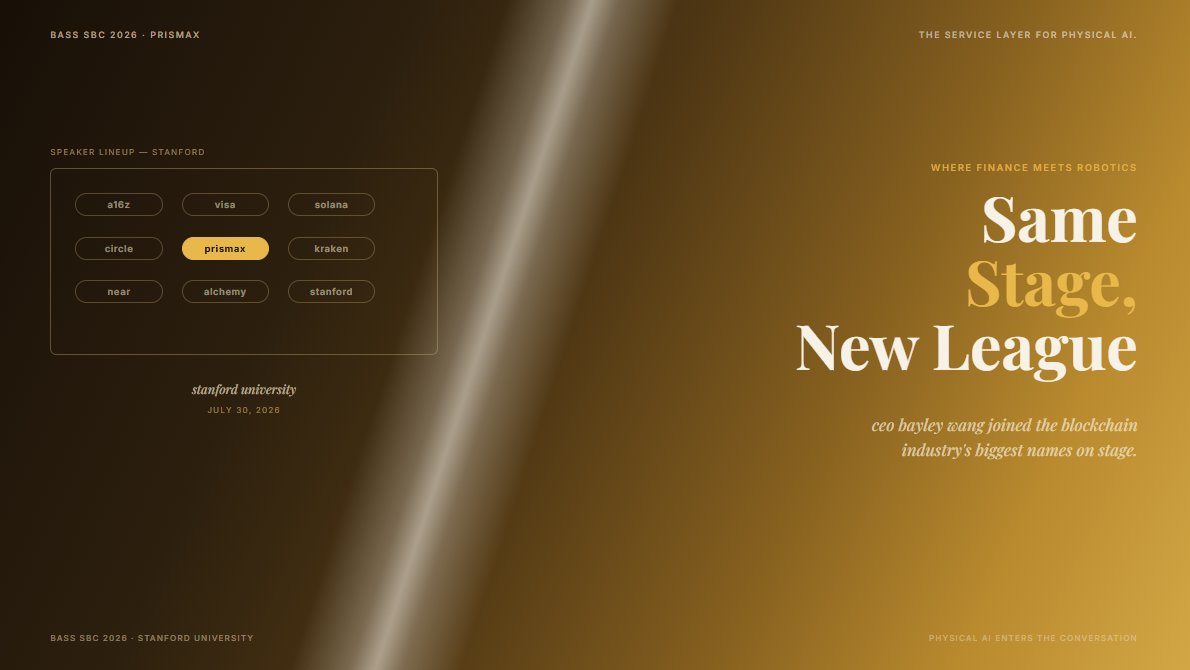
on july 30, stanford hosted bass sbc 2026
a blockchain ecosystem summit that brought together heavyweights like a16z, visa, solana, circle, near, kraken and alchemy
bayley wang, ceo of @prismaxai, also spoke.
why is this important?
because bass isnt a robotics conference or a web3 get-together for enthusiasts. this is a place where finance, blockchain and ai are discussed in a common language
physical ai was invited there not as an exotic topic, but as part of a broader conversation about where the industry is heading.
this is a small but telling sign: the topic of "robots + data + blockchain" is no longer a niche topic for a small circle and is beginning to be perceived by serious players as part of the overall picture.
the prismax team was on-site at stanford all day, interacting with people in person and not just appearing on the program.
for a project at such an early stage, being on the same speaker list as a16z and visa isnt just a nice tweet
it carries reputational weight.
PrismaX@PrismaXai
We're live at BASS SBC 2026. Come find our booth to say hi to the team (and Baby Owen). Don't miss Bayley on the China & Open Source AI panel at 5:10 PM PT, alongside Matt White of the @linuxfoundation and @eraqian of @OSCampus. See you there!
English
open intelligence stack: why gradient calls it a single stack and not a suite of products
@Gradient_HQ has parallax, echo, lattica and gradient cloud
at first glance, they seem to be just a collection of different tools
they describe it differently: as a unified architecture called the open intelligence stack (ois)
the point is that each product covers a different stage of the same task
lattica is responsible for communication between devices
its like a nervous system. parallax takes this communication and turns it into inference
distributing the model across different machines and managing them as a single service
echo does the same for training
separating training from inference so they dont compete for the same resources
gradient cloud is a ready-made entry point for companies that dont want to understand hardware
the formula is train → serve → own
train a model, deploy it and truly own it
without renting from openai or anthropistic.
the team behind this is researchers from berkeley, hkust and eth zurich
intelligence should be a common good, not the privilege of a few corporations.

English

Exchange listings come and go.
What matters is when access becomes native.
With Coinbase now supporting native injective-protocol:native, users no longer interact with a wrapped representation of the asset. They enter the Injective ecosystem directly, making staking, governance, onchain markets, AI applications, and tokenized assets one seamless step away.
That's the kind of infrastructure upgrade that quietly compounds over time.

Injective 🥷@injective
Native $INJ is officially live on @coinbase, the largest U.S. crypto exchange. Coinbase users can now trade INJ and move it directly into the Injective ecosystem through seamless deposits and withdrawals. Unmatched access for $INJ is finally here.
English

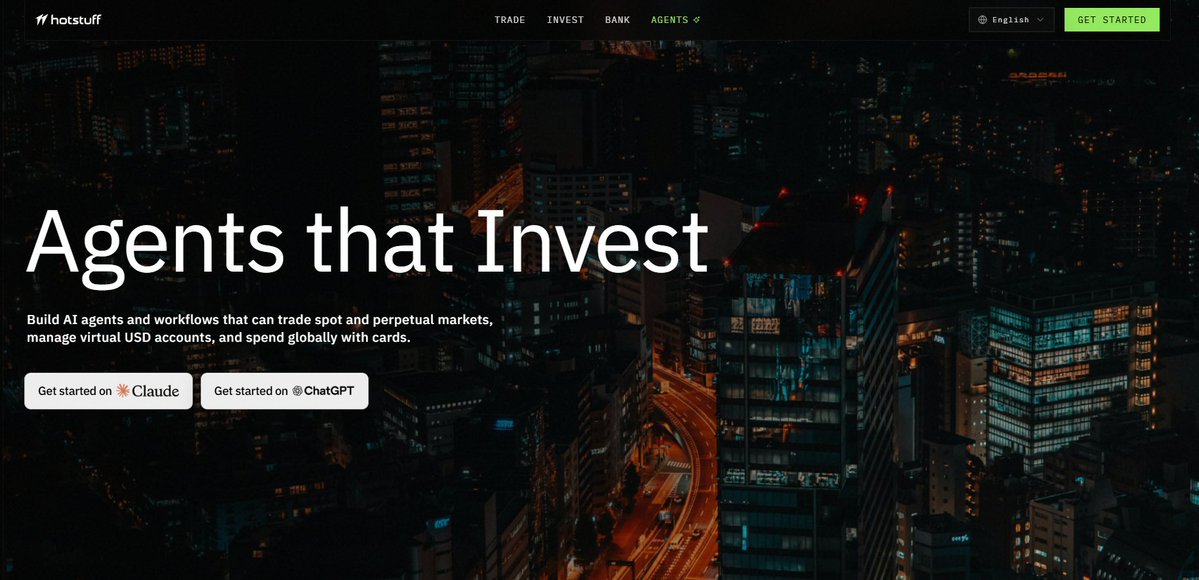
Hotstuff x Claude was just the beginning
ChatGPT agents are now live on @tradehotstuff too
your trading account is now inside both @claudeai and @ChatGPT
describe what you want → agent executes it → 24/7, your rules
✧ what agents can actually do
> instant stop-loss on every open position
> portfolio autopilot - rebalance weekly by your allocations
> buy the panic - deploy cash when S&P drops 3% + VIX above 25
> payday investor - auto-invest % of salary before you spend it
> drawdown circuit breaker - reduce risk if portfolio drops 10% from peak
no more watching charts
the agent watches for you and acts when conditions hit
your rules with your models
→ hotstuff.trade/en/agents
English

The God of Darkness Knull - DDG art 1/1 & graffiti
This masterpiece took two days to create, one day for the graphic art 1/1.
The second day I was looking for a wall and making graffiti.
The story of Knull the God of Darkness ⬇️
@DedGorgez #DropDedGorgez


English

>Your feed showed you this post
@fomo
I've been actively using their app for the past week and during this time I realized I wanted to share more about it
Let's start with the main idea:
Instead of opening dozens of tabs, monitoring X, Telegram, Discord and constantly worrying about missing something important - just use Fomo
Fomo tries to bring everything that matters into one place and make the information easier to consume
It's a useful thing because after a week of using it, I caught myself switching between different sources much less often
I open the app, quickly check what's happening in the market and around the projects I'm interested in and most of the time that's already enough
There is no feeling that the app is trying to keep you inside at any cost. On the contrary u open it, see what's important right now and move on
I like this approach much more than endless algorithmic feeds that try to show you everything at once
>Although, if you're seeing this post, I guess the feed still managed to show you something useful :)
I'm only starting to dive deeper into the project, but my first impression has been really positive. That's why I decided to start sharing Fomo here
I'll keep using the app, testing new features, and keep you updated on anything interesting I find along the way

English


$0.028 per request. 19 tokens in, 1,122 tokens out.
Here's what a real Claude Opus 5 bill actually looks like.
Ran a live prompt on @commonstack_ai instead of trusting the sticker price:
• Prompt - 19 tokens, $5/M, $0.000095
• Completion - 1,122 tokens, $25/M, $0.02805
• Cache read / write - $0.50/M and $6.25/M, not used this run
commonstack.ai/model-library
• Total: $0.028145. Throughput: 69.86 tok/s.
No credit card to test it - model ID anthropic/claude-opus-5, same library as Kimi K3 ($3/$15) and everything else.
Opus 5 is priced at $5/$25 per million - the same as the old Opus 4.8 it replaced.
Unlike Kimi K3, this run had zero reasoning-token cost, so the entire bill sat in prompt + completion.
Worth checking which cost driver actually applies to your use case before assuming it's the same pattern as a reasoning model.
English

the secret nobody selling you a "$97 prompt bundle" wants you to know is simple: the perfect prompt does not exist
your AI agents need a rigid system of graphs and workflows instead of a single fragile prompt
but
if you are still manually tweaking words and trying to guess the right instructions for your automation nodes, you are wasting time
once your workflow architecture is built, you need to transition from prompt engineering to loop engineering
true automation isn't about guessing the right instruction on the first tryit is about building a closed, automated system that makes an attempt and measures it against a strict metric
it reflects on its own failures in plain text, and rewrites itself iteratively
the magic happens when you introduce an archive,a memory layer that saves every attempt and score, turning random trial-and-error into directed evolution
you don’t engineer the final answer anymore
you engineer the automated machine that arrives at that answer while you sleep
the prompt is sold for cash
the self-improving loop that finds it sits on GitHub for free
check out this brilliant masterclass on how to build loops that turn random trial-and-error into directed evolution
vorty@vorty279
English
English

GM GUYS🍌🍌🍌
this is my first art for @MonkeyHoodNFT , what do you think? I hope you like it
@JungleSmith1 @Nomadic_Rookie @thecaptaingates

English
opus 5 vs sonnet 5: a live comparison on commonstack
anthropic released claude opus 5 this week (july 24th) and is positioning it simply: almost the same level of intelligence as the top-end fable 5, but at half the price.
the price hasnt changed since the previous version, opus 4.8: $5 for 1m input tokens and $25 for 1m output tokens.
i ran the same prompt "explain quantum computing in simple terms" on both opus 5 and the slightly older sonnet 5 (released in june) right in the commonstack playground
the numbers show a noticeable difference.
sonnet 5 is significantly cheaper: $2/$10 for 1m
opus 5 is $5/$25
in terms of speed in this particular run, sonnet delivered even more tokens per second 93 tps versus 80 for opus, although its first token arrived a little later (3.6 seconds versus 2.7 for opus)
in fact, opus 5 isnt a fasteeer sonnet, but a model for more complex tasks at a price close to the standard price.
if you need top-tier reasoning and agent performance, opus is the one.
if price and speed on simple tasks are more important, sonnet still holds its own.
these numbers are from one run, not a benchmark, but they're a fair indication.
rw ./@gradientintern
Claude Opus 5, the latest frontier from Anthropic is now on @commonstack_ai It performs at SOTA for many coding and knowledge evaluations while coming in half the price of Fable 5. Build now with the best in class production execution.
English
what happens if the operator makes a mistake?
a logical question about @prismaxai: you're controlling a real robot through a browser, not a toy simulator.
what if your hand shakes and the robot hits or breaks something?
its important to understand two different things here.
first, the hardware. any system with real robots that are controlled remotely is built with default limitations: speed limits, protection against sudden jerks and the ability to perform an emergency stop.
this is standard practice in the industry for any teleoperation platform, not just prismax.
second, and this is specific to prismax itself, the data. if the operator makes a mistake and records a faulty demonstration, this recording isn't automatically included in the model.
its evaluated by the eval engine, and other users can verify it via proof-of-view. that is, a bad attempt simply won't pass the quality filter.
so the system is protected on both sides: the hardware limits physical risk and the eval engine and proof-of-view prevent bad data from moving further down the pipeline.
operator error isn't a disaster or the end of the world, but simply a demonstration that won't get the required rating.

English

Hear me out
Solana Blitz hackathon
But a full week instead of just the weekend

English
$0.075 per request. 99% of it was reasoning tokens.
Here's what a real Kimi K3 bill actually looks like.
Ran a live prompt instead of trusting the pricing page:
• Prompt - 116 tokens, $3/M, $0.000348
• Completion - 3 tokens, $15/M, $0.000045
• Reasoning - 4,997 tokens, $15/M, $0.074955
commonstack.ai/model-library
• Total: $0.075348. Throughput: 29.93 tok/s.
No credit card to test it - model ID moonshotai/kimi-k3, sitting right next to Claude Opus 5 ($5/$25) in the same library.
Pro-tip:
Before trusting any "$X per million tokens" sticker price on a reasoning model - check the reasoning-token count first.
That's where 99% of your bill actually comes from.
English
gradient and privacy-preserving inference: data that never goes away
parallax, gradient's distributed inference engine, has one principle that holds everything together: privacy isnt an option, but an architectural decision.
how it works:
when you run a model through parallax, the data and memory remain local, on your device or in your cluster. the request doesnt go to someone else's server, no one logs it and no one can return it when requested
simply because the server never had that data.
but locality is only half the battle.
the second part is verifiability. the system records every calculation step, so the inference result can be double-checked to ensure that the model actually calculated what it was supposed to and didn't cut corners or spoof the answer.
verification is built into the protocol, with minimal overhead about 1% of the full inference.
privacy and trust are not two separate requirements, but one and the same architecture.
the data is yours, the verification is yours and no one else can see anything in the middle.

English
simulation vs. reality: why prismax isnt focusing on virtual environments
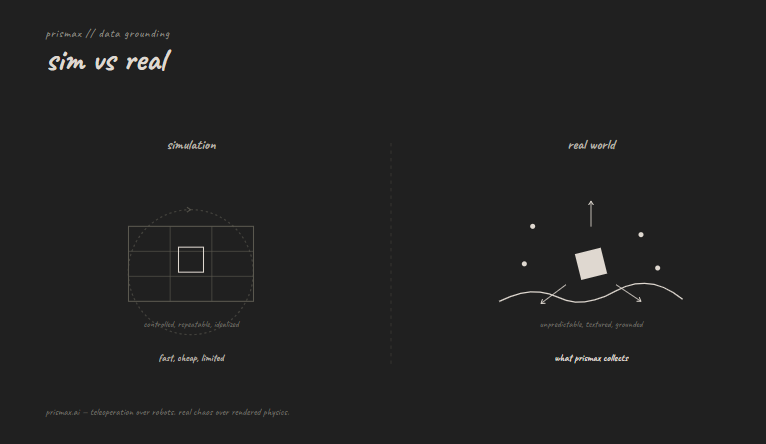
in robotics, there are two ways to collect training data: put a robot in a simulator or let it operate in the real world.
simulation is cheap and fast. you can run millions of trials overnight without wasting hardware or human time.
the problem is that the simulation is perfect. the lighting is even, the physics are predictable and objects behave as the developer intended.
the real world doesnt work that way.
an object can slip, the light can fall awkwardly, or the surface can be slippery.
thats why @prismaxai is focusing on teleoperation over virtual environments: only real robots, real operators and the real chaos of the physical world.
this is the same "grounding" without it, a model can learn beautiful rules that break down in reality.
simulation has its place in the industry as a whole, it scales early experiments well, but its precisely this "dirt" of the real world that it cant provide.
prismax fills precisely this gap: data that cant be faked with computer graphics.
English
prismax vs. physical intelligence: two different answers to the same question
both companies are solving the same problem: robots lack sufficient data for proper training, but their approaches are opposite.
physical intelligence (also known as pi) is a team from google deepmind, stanford and berkeley, founded in 2024. they are building a single, giant generalist model called π0, which is designed to control any robot.
the money involved is enormous: $70m at the start, then $400m, then $600m and the company is now valued at around $11b.
the data for this model is collected by the company itself and its partners closed loop, a small circle of demonstrators.
@prismaxai takes a different approach: not a single superteam with a billion-dollar budget, but an open network where data is collected by anyone through teleoperation and contributions are accounted for through proof-of-view and token incentives.
in other words, pi is betting on the scale of capital and a single, giant brain.
prismax is betting on the scale of the community and decentralized data collection.
both strategies are viable, theyre just two different ones.
ways to close the same data gap in robotics

English
machine internet: what gradient is building beyond ai
@Gradient_HQ calls itself an ai project, but if you look deeper, theyre building something more fundamental
the team describes their network as a "new machine internet" - open, sovereign and running on millions of everyday devices
decentralized intelligence must have three pillars: compute, communication and orchestration. these three primitives form gradient's "machine internet"
computation is provided by parallax, distributed inference across thousands of nodes worldwide.
communication is provided by lattica, a peer-to-peer protocol for transferring data between devices.
coordination is handled by echo, a framework for distributed training and model alignment.
it all started with sentry node, ordinary browser extensions that turned people's phones and laptops into network nodes.
today, its a fully-fledged infrastructure, building not only ai but any distributed computing system.
the point is that gradient sees itself not as a competitor to openai, but as an alternative to the internet of data centers, where the infrastructure is maintained not by corporations, but by the users themselves.

English
gliquid
im not good in crypto analyze, am i doing right?
ty app.liquid.trade for comfortable interface

English
who owns the data in prismax
when tesla or boston dynamics collect data from robots, that data remains within the company
the operator simply completes the task and leaves, the dataset belongs entirely to the corporation
@prismaxai operates on a different logic
the operator recorded the demonstration via teleoperation
its not just "working for a paycheck". the contribution is recorded, evaluated through proof-of-view and the eval engine and rewarded through prisma points.
this means that the person who created the data remains part of the data economy, not just a one-time contributor who was kicked out after a shift.
this is fundamental to the web3 model:
the right to a share in the final product belongs not only to the platform, but to everyone who actually participated in the creation of the dataset.
centralized labs are physically unable to build such a fair and transparent system for accounting for the contributions of thousands of people simultaneously.
this is the essence of decentralized incentives, data is created en masse, but the benefits are not concentrated in a single location.
if the contribution is accounted for, trust in the system grows, which means the quality of the data it receives also improves.

English