
Sabitlenmiş Tweet
Mark Moriarty
5.4K posts


Mark Moriarty
@MbyM
Positive sum. Corp Strategy & Experimental Bets @Stripe. @YCombinator Fellow. Founded @AwesoundApp. Ex @McKinsey. Quotes @WellPhrased. SLA: 98%+ good vibes
Cork 🇮🇪 → San Francisco 🇺🇸 Katılım Temmuz 2010
1.7K Takip Edilen1.6K Takipçiler
Mark Moriarty retweetledi

When I built menugen ~1 year ago, I observed that the hardest part by far was not the code itself, it was the plethora of services you have to assemble like IKEA furniture to make it real, the DevOps: services, payments, auth, database, security, domain names, etc...
I am really looking forward to a day where I could simply tell my agent: "build menugen" (referencing the post) and it would just work. The whole thing up to the deployed web page. The agent would have to browse a number of services, read the docs, get all the api keys, make everything work, debug it in dev, and deploy to prod. This is the actually hard part, not the code itself. Or rather, the better way to think about it is that the entire DevOps lifecycle has to become code, in addition to the necessary sensors/actuators of the CLIs/APIs with agent-native ergonomics. And there should be no need to visit web pages, click buttons, or anything like that for the human.
It's easy to state, it's now just barely technically possible and expected to work maybe, but it definitely requires from-scratch re-design, work and thought. Very exciting direction!
Patrick Collison@patrickc
When @karpathy built MenuGen (karpathy.bearblog.dev/vibe-coding-me…), he said: "Vibe coding menugen was exhilarating and fun escapade as a local demo, but a bit of a painful slog as a deployed, real app. Building a modern app is a bit like assembling IKEA future. There are all these services, docs, API keys, configurations, dev/prod deployments, team and security features, rate limits, pricing tiers." We've all run into this issue when building with agents: you have to scurry off to establish accounts, clicking things in the browser as though it's the antediluvian days of 2023, in order to unblock its superintelligent progress. So we decided to build Stripe Projects to help agents instantly provision services from the CLI. For example, simply run: $ stripe projects add posthog/analytics And it'll create a PostHog account, get an API key, and (as needed) set up billing. Projects is launching today as a developer preview. You can register for access (we'll make it available to everyone soon) at projects.dev. We're also rolling out support for many new providers over the coming weeks. (Get in touch if you'd like to make your service available.) projects.dev
English
Sign up with Stripe.
Securely.
projects.dev
If you’re a service that wants to piggy-back on Stripe’s anti-fraud / KYC, and have *Stripe users* signing up for your product: please get in touch.
x.com/patrickc/statu…
Angelo 🇵🇷@ngeloxyz
One more thing! Via Stripe Radar, you can use their (very robust) KYC services to help with anti-fraud for provisions on the services. The MAIN reason Railway hides our free plan is fraud. This lets us give more Railway to more people who need it.
English

@MbyM We love Stripe collabs 🙂 See you soon at Sessions!
English
Thanks for collab with us on projects, Colin and team!
Colin | clerk.com@tweetsbycolin
The sneaky important thing that @stripe got right with Projects is that they operate as a Federated Identity Provider (effectively "Sign in with Stripe" for agents) They verify users, and Clerk trusts them, so there's no manual signup at Clerk. It's *way* less friction.
English
Mark Moriarty retweetledi
Mark Moriarty retweetledi

what services should we add next to @stripe projects? (please reply to this tweet, and we'll prioritize accordingly!)
English
Mark Moriarty retweetledi

hate signing up for the same dozen services you need for any project / business?
now stripe cli can sign you up with:
- database
- auth
- analytics
- and more!
plus centrally managed billed of those services bc why not
Stripe@stripe
English
Mark Moriarty retweetledi

I've wanted to rebuild my side project for over 10 years. While I was out to lunch, my agent rebuilt Happiness Jar with its retro 2013 design, replaced my hand-rolled auth with @clerk, migrated me to @neondatabase, and deployed the app to @vercel, all with Stripe Projects.
It’s early days and we’d love your feedback as we improve.
Stripe@stripe
English
Mark Moriarty retweetledi

When I was consulting for @HBO Silicon Valley, zero-loss compression was the holy grail Richard Hendricks chases that perfect middle-out algo could shrink everything w/out breaking a single bit.
Google just did something even more practical for the AI era: TurboQuant compresses LLM key-value caches down to 3 bits per value using random orthogonal rotation + PolarQuant scalar quantization & optional 1-bit QJL residual correction.
=>> 6× memory reduction, up to 8× faster attention (on H100), & 0 degradation on LongBench, Needle-in-a-Haystack, and RULER for models like Gemma. No retraining, no calibration needed.
Fiction just got out-engineered by reality. 😅💚💚

Google Research@GoogleResearch
Introducing TurboQuant: Our new compression algorithm that reduces LLM key-value cache memory by at least 6x and delivers up to 8x speedup, all with zero accuracy loss, redefining AI efficiency. Read the blog to learn how it achieves these results: goo.gle/4bsq2qI
English
Mark Moriarty retweetledi

people say we're still in the toy phase for x402 and agentic commerce, but the future is clear

English
If you’re in the Bay Area and interested in learning math (proofs) with Lean, follow Rado.
Rado Kirov@radokirov
This experiment continues into 2026. I learned a lot through running this so far and blogged a bit about it here - rkirov.github.io/posts/lean_wor…. The focus remains formalized math with Lean, but supporting different projects. If you are interested - luma.com/l9pe6n7y
English
Native checkout, powered by Stripe.
Meet the user where they are.
(If you’d like to build shoppable ads/experiences within your platform, please get in touch!)
John Collison@collision
Businesses can now sell directly within an ad or browsing session on Facebook, powered by the Agentic Commerce Protocol and @stripe stripe.com/newsroom/news/…
English
Was demoing this feature to new hires during onboarding.
The $1.17 came from a sale made seconds earlier :)
English
it ain't much but it's honest work
profile.stripe.com/moriarty/nx6ck…
English
Mark Moriarty retweetledi

The Anthropic mini IPO is unfolding and you already missed a 15x return
The stock is named VCX by Fundrise and just went up 1,500% in 5 days on the NYSE
It’s a fund holding:
- Anthropic = 21%
- OpenAI = 10%
- SpaceX = 5%
- Databricks = 18%
- Anduril = 7%
$VCX has a NAV of $19 per share. This morning it just traded at $312.
That means the market is valuing a $650 million fund at $5.4 billion 🤯
Investors are paying an 8x premium just to touch these companies.
Why? Because the most important companies being built right now refuse to go public. And people are so desperate for exposure that they will pay almost anything to get it.
The private markets are sitting on trillions in value that public investors have been locked out of and this stampede tells you everything about how much hype there will be around these IPOs.
I hope this speeds things up


English
Mark Moriarty retweetledi

We used to double software time estimates back in the day.
Now we half it.
English
Mark Moriarty retweetledi


"Adding more “management” agents often hurts performance, just like in human orgs."
Yuchen Jin@Yuchenj_UW
Many people think it was 1 agent writing 3M+ lines of code. It's not. It was hundreds of concurrent agents. Key learnings from Cursor’s blog: - Letting many agents self-coordinate as peers does not work - Clear roles work better: planners, workers, judges - GPT-5.2 performs better on long-running tasks; Opus 4.5 tends to stop early and take shortcuts. - Adding more “management” agents often hurts performance, just like in human orgs. Turns out, scaling agents looks a lot like scaling companies.
English
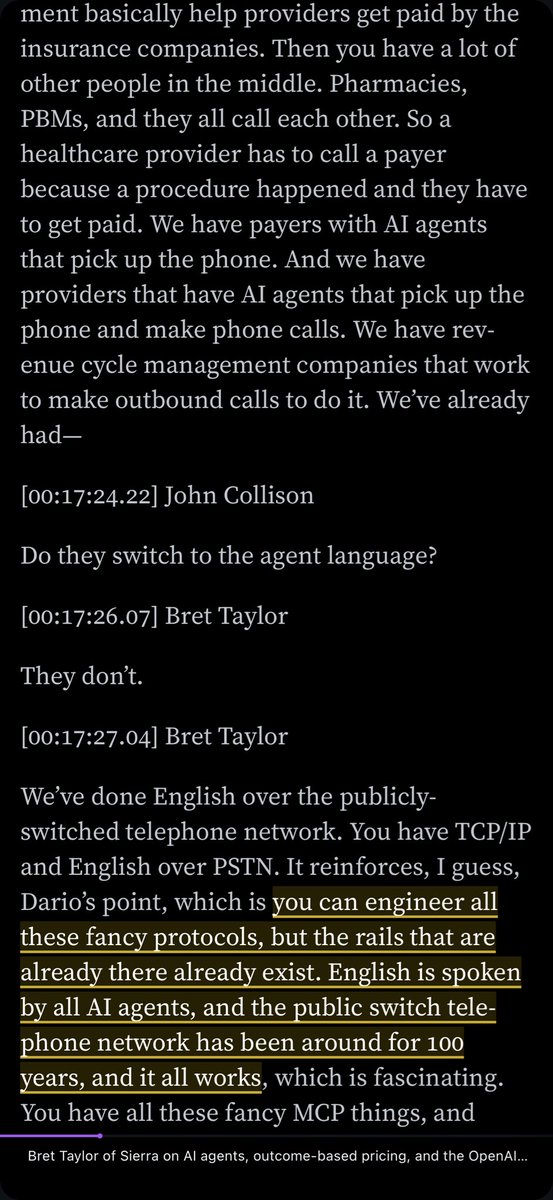
“Use phone calls if there’s no API”, reminds me of the recent @collision @btaylor cheeky pint
substack.com/home/post/p-19…
English
Ireland's statistics office used to track pint prices, but stopped in 2011.
Fair play @mattcortland
Cc @ernietedeschi!
The Rundown AI@TheRundownAI
AGI has been achieved in Ireland. Artificial Guinness Intelligence. Engineer Matt Cortland built an AI voice agent named Rachel, gave her a Northern Irish accent, and pointed her at every pub in the country. Over St. Paddy's weekend, she rang 3,000+ of them to ask one question: how much for a pint of Guinness? How he built it: ElevenLabs for the voice, Twilio and an old Irish SIM to place the calls, Google Places API to map 5,200+ pubs across all 32 counties, and Claude to parse the transcripts for prices. 2,052 picked up. Barely any even realized she was AI. The whole operation ran him about €200. The result is a live price index he's calling the Guinndex. Ireland's statistics office used to track pint prices, but stopped in 2011. An engineer with a weekend and a voice agent just picked up where they left off.
English