

JRids
1.2K posts


MLCOA - Most Likely Course of Action
- Iran does not comply with the 48-hour ultimatum
- US strikes select Iranian power infrastructure - enough to demonstrate credibility, not enough to collapse the grid
- Iran retaliates against US Gulf energy assets - Brent spikes above $120
- Both sides quietly signal willingness to negotiate through Qatar or Oman back channels
- Fragile ceasefire emerges within 30 - 60 days
- Hormuz partially reopens under informal US naval escort
- Iranian regime remains in power - weakened but intact
- Underlying issues unresolved: Hezbollah, Hamas, nuclear ambitions
- Oil settles in $90–100 range, region enters cold peace
- Next flashpoint: 18–24 months away
English

Here's the best case scenario for this war:
- The Iranian regime capitulates
- It is replaced by a transition Government, as the country prepares for its first election since 1952
- The U.S. gets more control of the Strait of Hormuz, giving it an edge over China in the AI race (i.e. energy race)
- Iran goes back to its secular roots with a blossoming economy, normalizing relations with Israel
- Hezbollah gives up its weapons, and Israel pulls out of Lebanon
- Lebanon goes through a period of rapid economic growth as it gradually normalizes relations with Israel
- Syria's President succesfuly unifies the country, and begins rebuilding as Israel pulls out of remaining territory
- The Houthis move away from Iran and begin normalizing relations with neighboring Gulf nations
- Hamas give up their weapons, and we finally start seeing progress towards a two-state solution
I know this is a pipe dream, but hey, let's be optimistic for once
English
JRids retweetledi

The Hormuz Hypothesis – What If the U.S. Navy Isn’t in a Hurry To Reopen The Strait?
gcaptain.com/the-hormuz-hyp…
English
@shanaka86 Shanaka, add to this equation Brazil, please, and see how huge the problem gets.
English

Everyone is covering the Hormuz crisis as a list of problems. Energy. Fertiliser. Shipping. Insurance. Each gets its own headline. Each gets its own analyst. Each gets modelled independently.
That is exactly why every model is wrong.
The crisis is not a list. It is a loop. And the loop is feeding on itself in ways that no linear framework can capture. Follow the chain.
Gulf sulfur supply is cut. Nearly half of global seaborne sulfur trade is Gulf-dependent. Without sulfur there is no sulfuric acid. Without sulfuric acid there is no phosphate processing. China sees its own phosphate production threatened and bans exports through August. Global phosphate tightens. Blended fertiliser costs spike. Corn economics collapse relative to soybeans. American farmers shift 1 to 2 million acres away from corn. Corn supply tightens. But the ethanol mandate does not care. The Renewable Fuel Standard requires 15 billion gallons of corn ethanol annually, consuming roughly 43 percent of the US corn crop regardless of price. Ethanol demand is inelastic. Corn gets squeezed from both the supply side and the demand side simultaneously. Corn prices rise. Feed costs rise. The protein cascade flips. US cattle herd sits at 86.2 million head, a 75-year low. Poultry and pork were benefiting from cheap feed. That reverses when corn crosses $5 per bushel. The entire animal protein complex margin-compresses. Meat prices rise. Food import bills for developing nations swell. Egypt, already facing $29 billion in external debt repayments, cannot absorb it. Pakistan, where debt service consumes a devastating share of tax revenue, cannot absorb it. Sub-Saharan Africa’s $90 billion 2026 debt wall leaves zero fiscal space. Sovereign stress worsens. The fiscal capacity for fertiliser subsidies erodes. Application rates fall further. Yields drop further. Grain markets tighten further. Import bills rise further.
The loop closes. And starts again. Tighter each cycle.
Now layer the channels nobody is modelling.
Iran struck a desalination plant in Bahrain on March 8. Kuwait depends on desalination for 90 percent of its drinking water. The Gulf holds 42 percent of global desalination capacity, co-generated with power infrastructure under active bombardment.
Australia imports virtually all its urea, two-thirds from the Gulf. Its entire heavy freight network runs on AdBlue, which is 32.5 percent high-purity urea. No urea, no AdBlue, no freight movement, no groceries delivered. A Gulf drone dictates whether Sydney supermarkets stock shelves.
Southeast Asian aquaculture, 68 percent of the world’s farmed fish, depends on soybean meal for the majority of feed costs. Soy is repricing as corn-to-soy acreage shifts alter the entire oilseed complex.
US cotton acres declining 3.2 percent to 9.0 million. Bangladesh imports over 95 percent of raw cotton and faces simultaneous synthetic disruption from the same petrochemical shutdown. The garment sector generating 85 percent of export earnings is being hit from three directions.
And underneath all of it: PE, PP, PET, aluminium, tinplate, glass. All rising simultaneously. Adding several percentage points to retail food prices through a channel no farm futures contract tracks.
The Fed meets tomorrow with core PCE at 3.0 to 3.1 percent and GDP growth deteriorating. Markets price at most one rate cut in December. The central bank that is supposed to stabilise prices is watching fourteen transmission channels reprice simultaneously through a single chokepoint it has no tool to reopen.
This is not fourteen separate crises. It is one system consuming itself.
Full analysis: open.substack.com/pub/shanakaans…

English
JRids retweetledi
#8M Imagens da telerreportagem da TV Tupi registram o feito da aviadora Ada Rogato. Pioneira da aviação no Brasil, ela percorreu sozinha a América do Sul, levando aos governos de vários países mensagem oficial de autoridades brasileiras.
Os registros mostram o Cessna pousando no Campo de Marte para reabastecimento. Em seguida, Ada foi rumo à Piracicaba, onde várias homenagens aguardavam por ela para celebrar sua façanha. Ada Rogato voltou, assim, ao ponto de partida, carregando consigo novas medalhas e novas flâmulas recebidas durante a viagem.
Em parceria com a Fundação de Amparo à Pesquisa do Estado de São Paulo, a Cinemateca Brasileira apresenta o PROJETO TEMÁTICO FAPESP: HISTÓRIA, AUDIOVISUAL E PRESERVAÇÃO, que promove a preservação, catalogação, digitalização e difusão de telejornais e cinejornais, incluindo a coleção da primeira emissora de televisão brasileira, a TV TUPI.
PROJETO TEMÁTICO FAPESP - Processo n. 2022/06032-0.
🎥 Acervo Cinemateca Brasileira / Fundo Tupi
@AgenciaFAPESP @PesquisaFapesp @ecauspoficial
Português

Difícil defender o governo da Venezuela ...
Tá difícil ....
Português
@MarioNawfal Question is not how to take it but how to hold it intact.
English
🚨🇮🇷🇺🇸 🚨🇮🇷🇺🇸 How would the U.S. invade Iran's financial heart, Kharg Island?
Kharg Island is 20 square kilometers of rock in the Persian Gulf.
It is also 90% of Iran's oil export capacity. Every supertanker. Every pipeline terminal. Every dollar Iran earns from crude... it moves through Kharg or it doesn't move at all.
Taking Kharg doesn't just hurt... it fiscally amputates it.
Which is why an invasion would be the most consequential military operation in the Middle East since the original Gulf War. And why it's almost certainly already being war-gamed right now.
Here's how it looks.
Phase One: Suppression
Kharg doesn't fall without air dominance first. Iran has layered air defenses on and around the island. Radar installations, SAM batteries, IRGC air defense units.
Before a single boot touches sand, you're running a sustained SEAD campaign. Suppression of Enemy Air Defenses. F-35s, electronic warfare aircraft, Tomahawks from submarines already positioned in the Gulf.
This takes days, not hours. The island has to be functionally deaf and blind before the next phase begins.
Phase Two: Naval Isolation
Kharg sits 25 kilometers off the Iranian mainland. That's close enough for shore-based missile batteries to make any surface approach a kill zone without proper suppression.
The U.S. Fifth Fleet (already the dominant naval force in the Gulf) establishes a blockade perimeter. IRGC fast boats, Iran's asymmetric naval doctrine, become the primary threat here. Small, fast, swarming. They've trained for this exact scenario for twenty years. Expect losses.
Phase Three: Assault
This is where it gets ugly. Kharg is garrisoned. The IRGC die defending them, and they've built the infrastructure for exactly that. A Marine amphibious assault or Israeli special operations insertion (likely both) hitting the terminal facilities, the loading platforms, the pipeline infrastructure. Room-to-room, bunker-to-bunker, in a facility designed to burn if it falls.
The terminals themselves are the problem. Kharg's oil infrastructure is enormous, exposed, and catastrophically flammable. The strategic logic of taking Kharg assumes you take it intact. A burning Kharg helps nobody. Which means the assault has to be fast enough to prevent demolition but precise enough not to ignite it yourself.
Phase Four: The Morning After
Here's what nobody's discussing.
If Kharg falls intact, Iran loses its economic lifeline overnight. The regime's ability to fund proxies, pay its military, keep the lights on... severed. That's the optimistic scenario.
If Kharg burns (accidentally or deliberately) you've just removed 1.5 million barrels a day from global supply permanently, until infrastructure is rebuilt. Months. Maybe years. On top of a market already running on depleted strategic reserves.
You came to win the war. You might have just won yourself a global recession.

Mario Nawfal@MarioNawfal
🇮🇱🇮🇷 Israel says it’s expanding strikes across Iran, targeting command-and-control (C2) nodes in western and central regions. Recent waves reportedly hit 200+ regime targets, including missile launchers and IRGC command centers across the country. The strikes are aimed at disrupting Iran’s military coordination and response capabilities. Targeting C2 infrastructure can significantly slow operational decision-making during conflict. Source: @sentdefender
English

Eu chamo o Flávio de balão japonês.
Isso é uma expressão muito comum na política e o que aparece nas pesquisas é exatamente esse movimento.
Vai se desfazer politicamente antes do início do processo eleitoral
Português

Alexandre se afasta, investigações esfriam, Bolsonaro é solto, FUX anula a P toda contra ele e demais condenados pelo criminoso, Toffoli pede pra sair, derrubam indicação de Bessias ao Supremo, 2027 o Bolsonaro que assumir indica 3 ministros, sendo um deles Pacheco.
Você assinaria esse deal?
Português

Muitos não perceberam, mas uma nova ordem mundial entrou em curso.
Português
@MarioNawfal What about those numbers saying that only 12% of China's oil imports comefrom the region?
English
Here’s a clear explanation of why Trump attacked Iran, and why I think the war will end soon.
The war isn't about nuclear weapons. It's not about helping the Iranian people. It’s not about doing Israel’s bidding. And it's not about Iran being a threat to the U.S.
It's about China.
China imports 45-57% of its oil through the Strait of Hormuz. Iran has the capacity to shut it down.
A U.S.-aligned Iran means an Iran that would choke off that strait if there's ever a real power struggle between Washington and Beijing.
And there already is one.
The U.S. and China have been locked in a tariff war for over a year now.
Also remember when China threatened export controls on rare earths, encompassing any company anywhere in the world that uses Chinese rare earths?
Yes, China essentially said that any company that uses their rare earths (China refines 85-90% of the world’s supply) must seek their permission before exporting their products.
This means if a German manufacturer uses rare earths fro China to create chips for American companies, China can block the export of these chips.
That’s how much leverage China has over the U.S., and that’s dangerous, especially if China finally decides to reunify with Taiwan.
So controlling the Strait of Hormuz becomes critical for the U.S.
It's the same reason Trump wants China out of the Panama Canal. The same reason Venezuela matters.
The same reason he's eyeing Greenland, where shipping routes to China pass through melting Arctic ice.
Energy is everything now. The AI arms race is the most important strategic competition on the planet.
Limiting China's access to energy is how the U.S. wins that race, and anyone who believes in freedom and democracy should want America to win.
China is investing heavily in domestic energy, building nuclear reactors, solar farms, wind power. They're leapfrogging the rest of the world.
But they still import the majority of their oil. And a significant chunk of it comes through the Strait of Hormuz.
Iran was reportedly nearing a deal for supersonic anti-ship cruise missiles from China, which would make it easier for Iran to threaten shipping in the Strait and strike U.S. naval vessels.
That accelerated the timeline.
Trump's comment today about doing in Iran what he did in Venezuela makes perfect sense in this context. He wants influence over who comes next.
A regime that's workable for Washington.
If he succeeds, this would be a massive strategic win for the U.S. and for Trump.
English


A passagem do candidato à Presidência, senador Flávio Bolsonaro, pelos fóruns da Faria Lima ligou a luz de alerta.
A quase unanimidade dos que participaram das conversas saiu assustada com a superficialidade do candidato.
Apenas algumas tiradas populistas e algumas ideias genéricas de um próximo governo liberal trouxeram um estado de espanto.
Nenhuma questão bem definida, nenhum projeto mais profundo; apenas a bandeira de corte de gastos e investimento na área de segurança é pouco. Quase nada.
É certo que, entre os ouvintes, quase todos eram animados defensores da opção Tarcísio. E até agora não entendi por que não foi esta a opção da direita.
Mas a verdade mostrou um candidato superficial, frágil, quase sem rumo para uma batalha que todos sabem ser difícil.
A avaliação dessa passagem pelos pontos do mercado não foi boa. Todos admitem. Até os que se dispõem a “lutar até o fim”.
Depois da viagem ao Oriente Médio e à Europa, esta passagem pela Faria Lima deixou um ar de perplexidade e muita gente sem ter o que falar.
Português
@GenFlynn @GamaSaragama77 Thank you, General! We need all eyes on this election especially knowing how the Brazilian electoral process works and the electronic machines we use. We need his turning point to change the course of our destiny for a brighter one!
English

This is an incredibly important national election. The consequences of a victory for freedom and democracy are immense for the people of Brazil (as it will be for the people of Venezuela when they can fairly vote). This is vital not only for the entire southern hemisphere but for the world.
Think;
1. A vote for freedom is a vote against communism
2. A vote against communism is a vote against globalism
3. A vote against globalism is a vote for all the freedom loving people on the planet.
George@BehizyTweets
BREAKING: Flavio Bolsonaro, the son of former President Jair Bolsonaro, is currently leading in new polls against the incumbent socialist president, Lula Da Silva. 🔵 Flavio Bolsonaro - 48.1% 🔴 Lula da Silva - 41.9% Flavio wins in a head-to-head against Lula in October.
English
@ThayzzySmith @VlogdoLisboa Estavam conversando com Washington desde antes da metade do ano passado! Sabiam exatamente o que iria acontecer!
Português

🇻🇪🇺🇸‼️ÚLTIMAS NOTÍCIAS: Delcy admite que, após a captura de Maduro, os Estados Unidos deram a ela, a seu irmão Jorge Rodríguez e ao Ministro do Interior Diosdado Cabello 15 minutos para atender às exigências de Washington; caso contrário, seriam mortos.
O vídeo mostra altos funcionários do governo reunidos com influenciadores pró-governo para coordenar a narrativa pública em torno dos eventos mais dramáticos que o país vivenciou em décadas.
Na gravação, Delcy Rodríguez — que assumiu o cargo de presidente interina após a captura de Maduro e que anteriormente era vice-presidente — aparece falando ao megafone para os presentes. Rodríguez afirma que, após a prisão do ex-presidente pelas forças americanas, ela, seu irmão Jorge Rodríguez e o Ministro do Interior Diosdado Cabello receberam um ultimato: tinham apenas 15 minutos para atender às exigências de Washington ou seriam mortos.
Português
@areamilitarof Não é essa senhora, e o irmão, que já estavam em tratativas com Washington desde meados de 2025? E agora vem com essa conversa para se justificar?
Português

Vazam vídeo da presidente interina da Venezuela, Delcy Rodriguez, em reunião à portas fechadas, dizendo a influenciadores pró-governo que as forças americanas ameaçaram matar altos funcionários caso eles não cooperassem após a captura de Maduro: “Estamos enfrentando uma potência nuclear”.
Rodríguez afirma que ela e outras figuras importantes tiveram apenas 15 minutos para atender às exigências de Washington, alegando que a “pressão e a chantagem foram constantes”.
Quem vazou o vídeo? Ainda é um mistério.
Português
@GugaNoblat Ele.nao.baixou a bola.
Ele ganhou a disputa pela Groelândia
Português
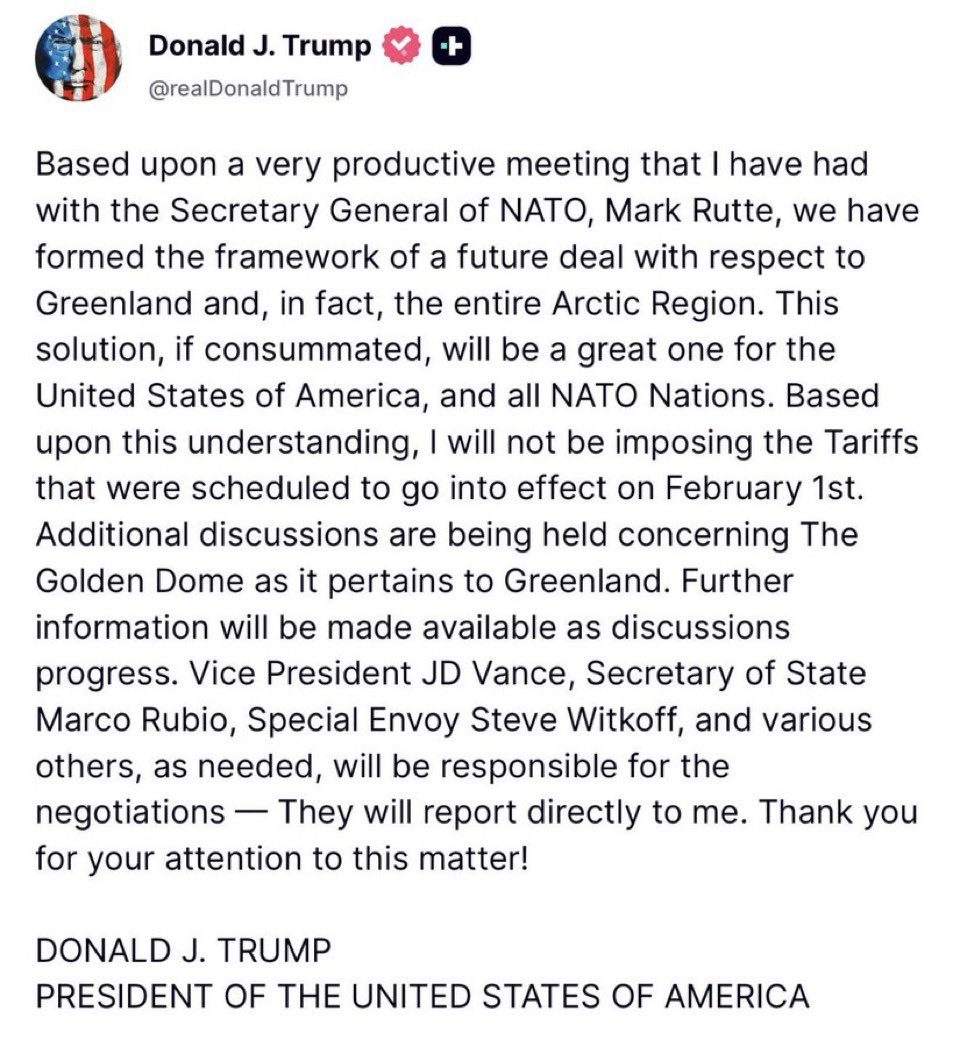
Trump já amarelou, o famoso chickens out. Não taxará mais os países europeus que mandaram soldados para proteger a Groenlândia. Também não pensa numa solução militar. Baixou a bola rapidinho dessa vez
Português

Sempre confie em passar o dia assistindo lives de profissionais que entendem do assunto.
Samir Bannout da Silva Jr 🇦🇲@iiskenderian
Realmente a gente nunca vai saber onde eles estavam
Português
JRids retweetledi

A necessidade de blindar os parlamentares diante do avanço do Judiciário político
Um dos pilares da democracia representativa é a separação entre os Poderes. Essa arquitetura foi concebida para conter abusos: ao Legislativo cabe criar as leis, ao Executivo governar, e ao Judiciário aplicar e interpretar as normas. No entanto, o Brasil atravessa um processo de corrosão desse equilíbrio. O Judiciário, que deveria atuar como árbitro, tem se colocado como protagonista; que deveria zelar pelas regras, passou a intervir como agente político. Essa inversão afeta diretamente a soberania popular exercida pelo Parlamento.
Os parlamentares representam de forma direta a sociedade. Cada voto recebido traduz a vontade do eleitor. Essa legitimidade, porém, tem sido enfraquecida quando decisões judiciais passam a perseguir, punir ou constranger deputados e senadores que ousam levantar pautas contrárias ao sistema vigente. O que antes fazia parte da disputa normal de ideias no campo político passou a ser deslocado para o terreno judicial. Nesse cenário, não é mais o eleitor quem decide se um projeto deve prosperar ou não: a decisão acaba submetida ao filtro de ministros que nunca receberam votos.
A judicialização da política cria uma distorção grave. Ao transformar divergências políticas em “crime”, o Judiciário impõe barreiras antidemocráticas sobre a atividade parlamentar. A mensagem implícita é inequívoca: é possível falar, desde que não se questione a ordem estabelecida; é possível propor, desde que não se ameace os interesses do sistema. Na prática, o Judiciário se coloca como guardião de um status quo que já não se sustenta pela adesão popular, mas pela força da coerção institucional.
Diante desse quadro, torna-se cada vez mais claro que blindar os parlamentares contra a ingerência judicial não é um privilégio, mas uma medida de proteção institucional. Blindagem não significa impunidade. Significa assegurar a liberdade de ação política, garantindo que deputados e senadores possam propor, debater e votar sem o risco de retaliação por parte de juízes ou tribunais. Significa devolver ao eleitor a confiança de que sua voz, expressa nas urnas, não será neutralizada em gabinetes de Brasília.
A história mostra que sempre que um poder ultrapassa seus limites constitucionais, a liberdade da sociedade é colocada em risco. No Brasil, o Judiciário vem se consolidando como um poder paralelo, sem voto, sem controle e sem limites claros. Esse processo mina a democracia representativa, pois o povo elege, mas quem decide, em última instância, são magistrados não eleitos. Se essa lógica não for contida, qualquer liderança política ou movimento de renovação institucional ficará inviabilizado no médio prazo.
A blindagem, portanto, é condição de sobrevivência para a política independente. Não se trata de escudo pessoal para parlamentares, mas de mecanismo essencial à preservação da democracia diante da captura do Estado por um poder que se autonomizou e passou a atuar como ator político. Sem essa barreira, todo esforço de renovação institucional estará condenado ao fracasso, pois o Judiciário já demonstrou disposição de inviabilizar lideranças que desafiem o sistema.
Em síntese: blindar os parlamentares é blindar a voz do eleitor contra o silenciamento judicial. É garantir que o peso das urnas prevaleça sobre despachos individuais. É assegurar que as disputas políticas voltem a ser resolvidas onde devem ser resolvidas: no debate público, no voto e nas ruas — não em tribunais que assumem para si a prerrogativa de decidir quem pode ou não fazer política no Brasil.
Português
JRids retweetledi

A eleição do Brasil de 2022 foi limpa, confia porra !!!!!!! 🤡🤡🤡🤡🤡🤡🤡🤡🤡
Mike Benz@MikeBenzCyber
Here’s a shocking statistic you may not know. USAID more than doubled its spending on Brazil as soon Bolsonaro won their 2018 election. This was not because Brazil suddenly needed twice the aid. The money was spent on projects in Brazil to undermine Bolsonaro.
Português