Michael Westacott

3.8K posts

Michael Westacott

Michael Westacott

@Mic_James_W

Just humbly sharing my opinions

Katılım Aralık 2021
3 Takip Edilen81 Takipçiler
Michael Westacott
Michael Westacott@Mic_James_W·
@fermatslibrary Speaking of primes this might be a bit of a silly question but just as we define imaginary numbers into existence that aren't real numbers could we define a number system into existence where prime numbers can be factored into two or more 'fairytale' whole numbers?
English
0
0
0
14
Fermat's Library
Fermat's Library@fermatslibrary·
There are 26 "minimal primes" in base 10. Every prime in base 10 contains one of these as a subsequence: by deleting some digits while keeping the rest in order, you can always get a prime from this list. For example, 1901 → 19 and 151 → 11.
Fermat's Library tweet media
English
6
16
92
20K
Michael Westacott
Michael Westacott@Mic_James_W·
@SpachusAus Yes, and given house prices are what people not even born yet shouldn't be paying then most investors should still be pretty grateful with a 25% fall - would still have an overvalued house. By the way sorry I've been very quite - am slowly winding down my time on social media.
English
0
0
0
21
Spachus Aus
Spachus Aus@SpachusAus·
We saw a post on X yesterday where it said property prices will drop up to 2%. Have you seen the state of the global economy and bonds? It's going to be 25% minimum. Anyway if you have gained 50%+ in the last 5 years, what's the big deal? #auspol
English
38
5
170
15K
Michael Westacott
Michael Westacott@Mic_James_W·
@PhilosophyOfPhy The universe never ceases to amaze me. I know this sounds very cliche but it's so true - it really really does never cease to amaze me.
English
0
0
0
7
Philosophy Of Physics
Philosophy Of Physics@PhilosophyOfPhy·
The universe was never dark and silent. Our bodies were just built with the wrong senses. Think of standing in a dark forest. You cannot see the animals moving around you, but you hear leaves shaking somewhere in the darkness. Neutrinos are those hidden footsteps. They pass through stars, planets, and your own body almost without touching anything. Cosmic X-rays are the violent screams of black holes, neutron stars, and matter falling into extreme gravity. The 2002 Nobel Prize in Physics honored scientists who taught us to listen to these invisible messages. Physics does not require the universe to speak in human senses. It only requires us to build the right ears. What we once called empty darkness was never empty at all. It was information arriving in a language our bodies could not read. The next revolution in astronomy was not only seeing farther. It was realizing that reality had been talking through ghost particles and invisible light all along. We were not surrounded by silence. We were surrounded by signals.
Philosophy Of Physics tweet media
English
6
18
77
3.3K
Michael Westacott
Michael Westacott@Mic_James_W·
@Dearme2_ Never be too busy to fulfill the meaning of life: discover truth and appreciate beauty, have meaningful relationships and connections, and find God.
English
0
0
0
6
Dear Self.
Dear Self.@Dearme2_·
I’m so sick of hustle culture… I just want to live, be healthy and rest.
English
17
19
174
5.6K
Talk Church
Talk Church@churchtalkative·
The Gospel is not “God understands.” The Gospel is “repent and believe.”
English
10
32
246
5.1K
Michael Westacott
Michael Westacott@Mic_James_W·
@itsme_urstruly Never be too busy to fulfill the meaning of life: Discover truth and appreciate beauty, have meaningful relationships and connections with others, and find God.
English
0
0
0
7
Wholesome Side of 𝕏
Wholesome Side of 𝕏@itsme_urstruly·
I think one of the most underrated luxuries is just having enough time to think, read, wander around, and romanticize your own life a little.
English
15
43
360
11.2K
Michael Westacott
Michael Westacott@Mic_James_W·
@Math_files Mathematics is the playground of the mind and its beautiful elegant results enrich the soul.
English
0
0
0
13
Math Files
Math Files@Math_files·
The Gaussian integral is a masterpiece of mathematics—its beauty is felt, not seen.
Math Files tweet media
English
19
133
894
26.2K
Michael Westacott
Michael Westacott@Mic_James_W·
@StefanMolyneux Albert Einstein writes a love letter to his wife. It doesn't contain any physics. Therefore Albert Einstein probably was a legendary figure rather than a real historical person.
English
0
0
0
11
Freedomain - with Stefan Molyneux, MA
If the Bible was dictated by an omniscient God, please tell me what is in the Bible that couldn’t have been known at the time.
English
267
6
180
93.1K
Michael Westacott
Michael Westacott@Mic_James_W·
@StefanMolyneux The Bible was not meant to be a divine encyclopedia - rather it was meant to tell a broad story about God's plan to save humanity.
English
0
0
0
9
Freedomain - with Stefan Molyneux, MA
You are infinitely less knowledgeable than God - imagine dictating a book to people 2,000 years ago, and everything that you could include that they knew nothing about. None of that is in the Bible.
English
153
9
173
17.3K
Michael Westacott
Michael Westacott@Mic_James_W·
@pickover To put things in perspective: 1/TREE(3) + 1/(2(TREE(3))) + 1/(3(TREE(3))) + ... will eventually overtake TREE(3)/(1+(1/TREE(3))) + TREE(3)/(1+(1/TREE(3)))^2 + TREE(3)/(1+(1/TREE(3)))^3 + ...
English
0
0
0
18
Cliff Pickover
Cliff Pickover@pickover·
What's your personal feeling about this? The harmonic series 1 + 1/2 + 1/3 + 1/4 + ... grows without bound, but so slowly that 12,367 terms are needed to make the sum greater than 10. [mathematics, math, maths]
Cliff Pickover tweet media
English
41
9
117
10.5K
Michael Westacott
Michael Westacott@Mic_James_W·
@ExploreCosmos_ Dark matter or normal matter I guess the big mystery is why does any matter/energy exist at all - or to the more broad question (more a philosophy question than a physics question) why is there any existence of anything whatsoever?
English
0
0
0
12
Erika 
Erika @ExploreCosmos_·
Dark matter remains one of the central unresolved problems in cosmology. We see its gravitational influence in galaxy rotation curves, gravitational lensing, galaxy clusters, and the large-scale structure of the Universe, but we still do not know what it is made of. In the standard cosmological model, dark matter is usually treated as cold and collisionless: its particles move relatively slowly compared with light and pass through one another without interacting, except through gravity. That framework, Lambda Cold Dark Matter, works very well on large cosmic scales, but it can run into tension when we look at smaller, denser structures. A new idea focuses on self-interacting dark matter, or SIDM. In this model, dark matter particles do not simply ignore one another. They can collide, exchange energy, and gradually reshape the internal structure of dark matter halos. Under the right conditions, these interactions can trigger what is called gravothermal collapse, causing dark matter to contract into very dense, compact clumps. The study suggests that these clumps could have masses of roughly a million Suns and might explain several puzzling observations that standard cold dark matter has difficulty accounting for. What makes the proposal interesting is that the same mechanism could help explain three apparently separate astrophysical mysteries. The first involves the gravitational lens system JVAS B1938+666, where a distant galaxy is distorted into an Einstein-ring-like structure by the gravity of a foreground galaxy. Observations suggest there is an additional very dense object perturbing the lensing pattern, but its nature is not obvious. A compact clump of self-interacting dark matter could provide the required gravitational influence without needing to be a normal luminous object. The second case concerns the GD-1 stellar stream, a long stream of old, metal-poor stars in the Milky Way halo. GD-1 shows gaps and a spur, as if something massive and compact passed through it and disturbed the stream. This kind of feature can act like a fossil record of an invisible gravitational encounter. A dense SIDM clump could be the unseen perturber that carved those irregularities into the stream. The third case is Fornax 6, a globular cluster in the Fornax dwarf galaxy, one of the Milky Way’s satellite galaxies. Fornax has an unusually rich population of globular clusters for a dwarf galaxy, and Fornax 6 is especially interesting because it is more metal-rich and likely younger than the others. The study proposes that a dense dark matter clump could act as a gravitational trap, sweeping up passing stars and helping form or preserve such a compact stellar system. The broader implication is not that dark matter has been “solved,” but that self-interacting dark matter may offer a common explanation for small-scale structures that otherwise look unrelated: an anomaly in a distant gravitational lens, a scar in a Milky Way stellar stream, and an unusual star cluster in a nearby satellite galaxy. That is scientifically attractive because a good model should not only explain one isolated object after the fact; it should connect different phenomena through the same physical mechanism. Here, the proposed mechanism is the formation of dense, core-collapsed SIDM halos. Still, this remains a theoretical interpretation, not a direct detection of dark matter particles. The value of the work is that it makes self-interacting dark matter more testable: if such dense clumps exist, they should leave gravitational fingerprints in lensing systems, stellar streams, and satellite galaxies. Future observations could therefore strengthen or weaken the case. For now, the study adds to a growing argument that dark matter may not be completely passive and collisionless. It may have its own internal physics, and that hidden physics could be written into the structure of galaxies. 👉 share.google/gC0f1lgDyKdRA9…
Erika  tweet media
English
43
53
297
6.4K
Michael Westacott
Michael Westacott@Mic_James_W·
@LensScientific Do we really know the probabilities? There could be quintillions (millions of trillions) of other planets out there but if the probability of life developing on even the favorable ones is say 1 in 10^50 for instance, then the chance of other life out there would be insanely low.
English
0
0
0
10
The Scientific Lens
The Scientific Lens@LensScientific·
The Fermi Paradox asks a simple question: if the universe is so vast and likely filled with intelligent life, why haven’t we found any sign of it?
The Scientific Lens tweet media
English
58
12
52
3.1K
Michael Westacott
Michael Westacott@Mic_James_W·
@Math_files Yep, numbers 'created' into existence in a sense - or did we actually discover them?
English
1
0
0
720
Christian Tweets
Christian Tweets@JesusSavesUs777·
Happy Easter! Jesus is Risen!
Christian Tweets tweet media
English
111
1.4K
14.3K
85.1K
Michael Westacott
Michael Westacott@Mic_James_W·
@philosophymeme0 God is an eternal & also necessary being - different to the universe which (most evidence suggests) had a beginning and in any case is contingent.
English
0
0
0
26
Michael Westacott
Michael Westacott@Mic_James_W·
@JesusSavesUs777 The meaning of life is to discover truth & beauty, have meaningful relationships & connections with others, live a healthy life, appreciate the wonder of God's creation, and to find God.
English
0
0
0
26
Michael Westacott
Michael Westacott@Mic_James_W·
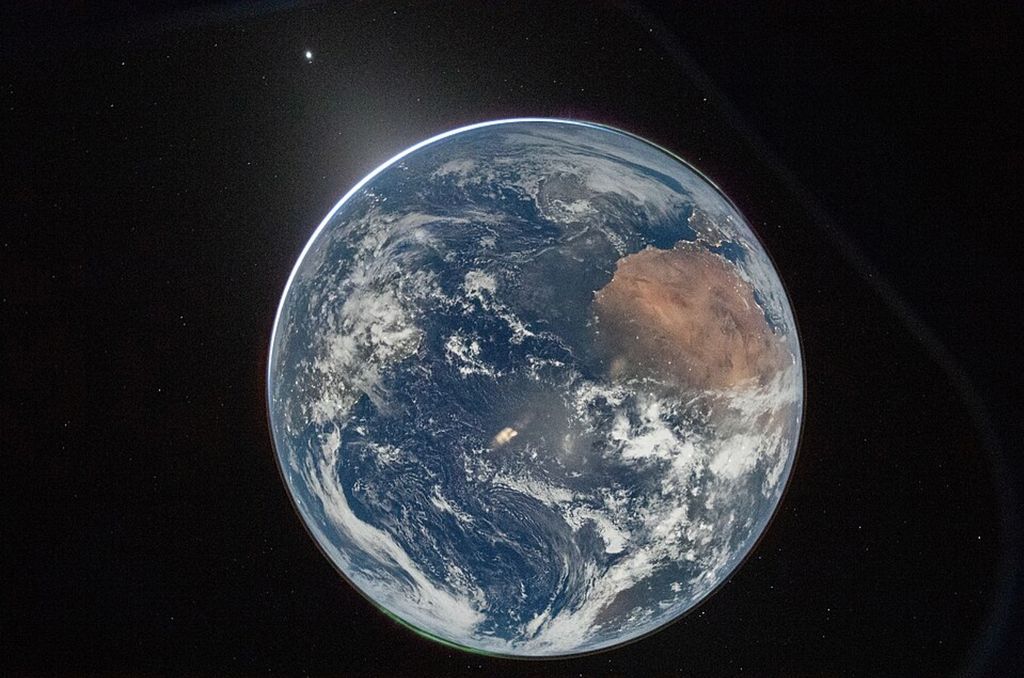
@fermatslibrary That's our home - that's it - that's us (and the millions of other species that live here). A rare habitable ball floating through hostile space. If we stuff it up well what have we? Good planets are darn hard to find & interstellar space travel is one heck of a long journey!
English
0
0
1
312
Fermat's Library
Fermat's Library@fermatslibrary·
"Hello, World" 🌍 Reid Wiseman captured this of Earth from Orion after Artemis II's translunar injection burn on April 2, 2026. The last time a human took a photo like this was "The Blue Marble," Apollo 17, December 7, 1972.
Fermat's Library tweet media
English
13
50
342
23.8K
Black Hole
Black Hole@konstructivizm·
Before Dawn: This is what Mars looks like a few hours before sunrise. This image was taken by the Perseverance rover. The bright star in the sky is actually one of the Red Planet's moons, Deimos. It's smaller than Phobos and orbits farther out, so its apparent size in the local sky is 1/10th the size of the Sun, and its brightness is only slightly brighter than Venus's in Earth's sky.
Black Hole tweet media
English
4
17
111
7.2K