

Mike Lambert
2.1K posts

Mike Lambert retweetledi

Analyzing the Architecture of Global Trade: An Overview of the CSCGraph Platform
Understanding a modern supply chain requires more than just tracking a shipping container. It requires a cross-disciplinary look at corporate ownership, international trade law, industrial production, and historical pricing. CSCGraph* is a platform designed to consolidate these disparate data layers into a single, navigable knowledge graph.
The platform currently maps approximately 2.96 million entities and 4.41 million relationships, providing a structured framework for analyzing how goods and capital move across the globe.
1. The Knowledge Graph Framework
Unlike standard relational databases that store data in isolated tables, CSCGraph utilizes a graph topology built on Neo4j. This structure is optimized for "path-finding" problems—such as tracing a commodity from a raw material extraction site through various processing stages to its final destination.
The graph is categorized into eight primary node types, including:
• Trade Entities: 174 countries and over 1,000 global ports.
• Economic Classifications: 6,940 commodity codes (HS System) and 839 industrial sectors.
• Corporate Data: Nearly 3 million legal entities linked by parent-subsidiary ownership edges.
2. Data Synthesis and Resilience
The platform's utility relies on the harmonization of 13 distinct open data sources. By bridging these datasets, the system can link a price spike in the World Bank's "Pink Sheets" to specific bilateral trade flows in UN Comtrade or production shifts in FAOSTAT.
A critical component of this architecture is the DBOS (Database Operating System) backend. Because global datasets are massive and prone to timeouts during ingestion, the system uses crash-resilient workflows. Each step of the data transformation is checkpointed to a PostgreSQL database, allowing the system to resume from a point of failure without corrupting the graph state.
3. AI-Driven Investigation
To make this volume of data accessible, the platform integrates a specialized Investigation Agent (utilizing Claude 3.5 Sonnet). Rather than requiring the user to write Cypher (graph query language), the agent is equipped with a toolset of 28 functions.
This allows the system to:
• Compute Market Analytics: Calculate market concentration (HHI) and supply chain dependencies.
• Dynamic Mapping: Convert query results into geographic arcs and facility markers using deck.gl.
• Automated Visualization: Generate Sankey diagrams and industrial input-output charts based on live graph data.
4. Expanding the Data Horizon
While the platform already hosts over 50,000 price records, the roadmap includes a significant expansion of its data intake. Future updates are set to integrate real-time news feeds to correlate geopolitical events with supply chain disruptions, alongside an expanded array of global price indices and environmental satellite data (such as Climate TRACE facility emissions). These additions aim to move the graph from a historical record to a near-real-time monitoring tool.
Current Development and Roadmap
CSCGraph currently provides a functional baseline for trade, price, and corporate analysis. By providing a unified schema for global economic data, CSCGraph offers a transparent, reproducible method for mapping the complexities of the global market.
*This is the current Early Alpha name of the platform and it may not be its final.
Disclaimer: All information found here is for informational, entertainment or educational purposes only and should not be construed as personal investment advice. Conduct your own due diligence, or consult a licensed financial advisor before making any investment decisions.
English
@popov_dmitriy @RayDalio @ricardo_hausman @cesifoti @adam_tooze @graphchain @TheARCHAI_ So powerful!
English
Mike Lambert retweetledi

An ambitious idea with huge potential. CSCGraph is building one big map of global trade. With reliable data and smart AI analysis, it could become a powerful tool for understanding the world economy! 🌍
@RayDalio @ricardo_hausman @cesifoti @adam_tooze
@graphchain @TheARCHAI_
GraphChain@graphchain
Analyzing the Architecture of Global Trade: An Overview of the CSCGraph Platform Understanding a modern supply chain requires more than just tracking a shipping container. It requires a cross-disciplinary look at corporate ownership, international trade law, industrial production, and historical pricing. CSCGraph* is a platform designed to consolidate these disparate data layers into a single, navigable knowledge graph. The platform currently maps approximately 2.96 million entities and 4.41 million relationships, providing a structured framework for analyzing how goods and capital move across the globe. 1. The Knowledge Graph Framework Unlike standard relational databases that store data in isolated tables, CSCGraph utilizes a graph topology built on Neo4j. This structure is optimized for "path-finding" problems—such as tracing a commodity from a raw material extraction site through various processing stages to its final destination. The graph is categorized into eight primary node types, including: • Trade Entities: 174 countries and over 1,000 global ports. • Economic Classifications: 6,940 commodity codes (HS System) and 839 industrial sectors. • Corporate Data: Nearly 3 million legal entities linked by parent-subsidiary ownership edges. 2. Data Synthesis and Resilience The platform's utility relies on the harmonization of 13 distinct open data sources. By bridging these datasets, the system can link a price spike in the World Bank's "Pink Sheets" to specific bilateral trade flows in UN Comtrade or production shifts in FAOSTAT. A critical component of this architecture is the DBOS (Database Operating System) backend. Because global datasets are massive and prone to timeouts during ingestion, the system uses crash-resilient workflows. Each step of the data transformation is checkpointed to a PostgreSQL database, allowing the system to resume from a point of failure without corrupting the graph state. 3. AI-Driven Investigation To make this volume of data accessible, the platform integrates a specialized Investigation Agent (utilizing Claude 3.5 Sonnet). Rather than requiring the user to write Cypher (graph query language), the agent is equipped with a toolset of 28 functions. This allows the system to: • Compute Market Analytics: Calculate market concentration (HHI) and supply chain dependencies. • Dynamic Mapping: Convert query results into geographic arcs and facility markers using deck.gl. • Automated Visualization: Generate Sankey diagrams and industrial input-output charts based on live graph data. 4. Expanding the Data Horizon While the platform already hosts over 50,000 price records, the roadmap includes a significant expansion of its data intake. Future updates are set to integrate real-time news feeds to correlate geopolitical events with supply chain disruptions, alongside an expanded array of global price indices and environmental satellite data (such as Climate TRACE facility emissions). These additions aim to move the graph from a historical record to a near-real-time monitoring tool. Current Development and Roadmap CSCGraph currently provides a functional baseline for trade, price, and corporate analysis. By providing a unified schema for global economic data, CSCGraph offers a transparent, reproducible method for mapping the complexities of the global market. *This is the current Early Alpha name of the platform and it may not be its final. Disclaimer: All information found here is for informational, entertainment or educational purposes only and should not be construed as personal investment advice. Conduct your own due diligence, or consult a licensed financial advisor before making any investment decisions.
English
Mike Lambert retweetledi
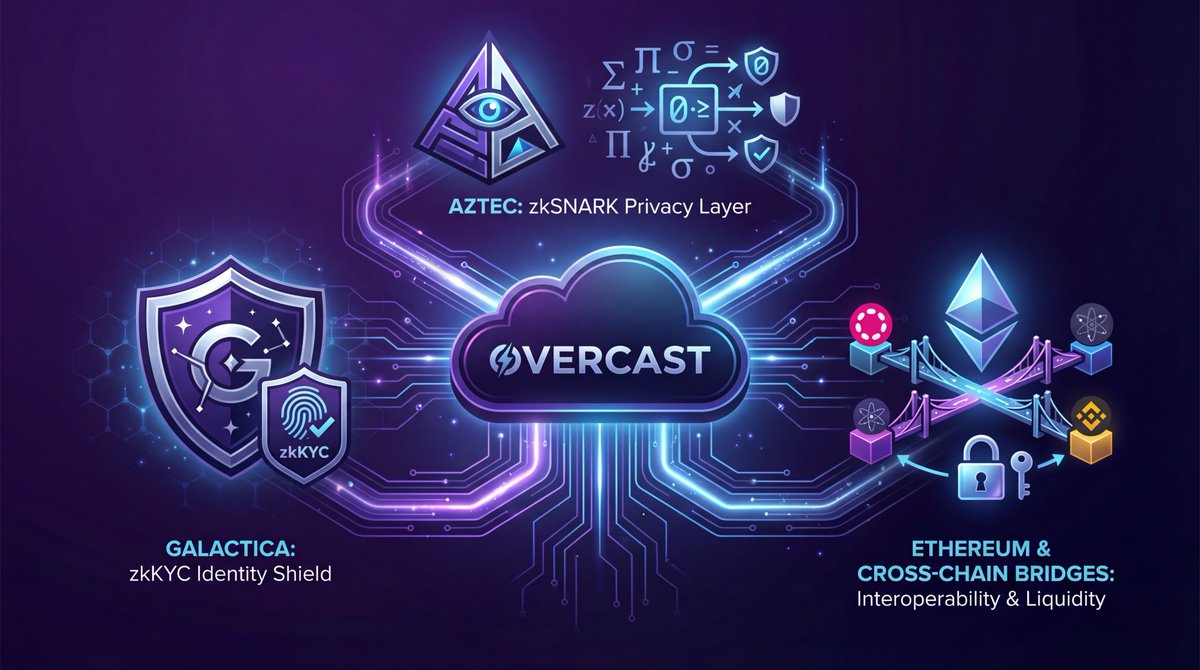
🚨@Overcast_zk solves the blockchain trilemma:
❌ Privacy WITHOUT compliance = regulatory risk
❌ Compliance WITHOUT privacy = transparency tax
❌ Both WITHOUT cross-chain = limited adoption
3 protocols combining:
⚡ @Overcast_zk
🛡️ @GalacticaNet
🔐 @aztecnetwork
Thread🧵👇
English
Mike Lambert retweetledi

Did you guys read the @Overcast_zk manifesto yet?
👇
overcast.fi/Manifesto.pdf
English
Mike Lambert retweetledi

Something huge is cooking 🔥
The complete Tech Stack for the Internet of Agents is arriving 🧪
@GalacticaNet @aztecnetwork @graphchain @TheARCHAI_ @Tetra_Chain
Overcast@Overcast_zk
Overcast Manifesto Abstract A foundational asymmetry characterizes the coming migration of commercial activity to autonomous systems. While the volume of machine-driven transactions—agentic commerce, institutional B2B payments, cross-jurisdictional capital allocation, programmable wage disbursement is projected to expand by two orders of magnitude this decade. The settlement infrastructure upon which this activity depends remains structurally misaligned with the requirements of autonomous commercial actors: it lacks programmable finality, offers no transactional privacy, and provides no mechanism for embedded compliance at the protocol level. Blockchain rails offer the programmability and finality that autonomous systems require, but attain utility as institutional infrastructure only when augmented by privacy. Privacy, in turn, cannot achieve widespread adoption without programmable compliance. This article argues that determinism, privacy, and embedded compliance (zkKYC) constitute a trilemma that any settlement layer for institutional digital commerce must solve and that solutions addressing only one or two of these requirements will fail to achieve production-scale adoption. 📗Full Manifesto: overcast.fi/Manifesto.pdf 📙Tech Paper: overcast.fi/Technical_Pape… 🌐Website: overcast.fi
English
@KookCapitalLLC You might have seen it but thought you might enjoy this anyway 🙂
instagram.com/reel/DUn4jvnkf…
English
@jessepollak Check out $ARCHAI -quietly building the tech stack to enable AI agent economy. The current MC is just $1.5 mln - a real hidden gem. Ask Grok about it! @TheARCHAI_
English

Mike Lambert retweetledi
You know you found a winner when Crypto leaders are talking 2-5 years on 🌎 Stage but the Agentic Internet has already been built and ready to be shipped 🧪
10 reasons why @TheARCHAI_
@GalacticaNet @graphchain
are way ahead of the curve and will dominate the Internet of Agents 🔥
1/ DBOS Execution Engine 💎
• PhD-level distributed systems
• Exactly-once semantics
• Auto-recovery from failures
• Kafka-level durability WITHOUT Kafka
• Durable checkpoints at every step
→ Agents NEVER lose state
2/ Haskell IR Codegen 🔒
• Compile-time type safety
• Impossible to have schema drift
• Zero runtime type errors
• Formal methods applied to agents
→ Production-safe by design
3/ Universal MCP Integration 🌍
• Native Model Context Protocol
• Google UCP compatible (Jan 11 announcement)
• Access to Shopify, Walmart, Target, Best Buy
• $1.1T+ e-commerce TAM
→ Only MCP-native agent platform
4/ x402 Micropayments 💰
• HTTP 402 protocol for agents
• Pay per API call, per computation
• Atomic payment guarantees
• Agent-to-agent commerce
→ Monetize EVERYTHING
5/ Multi-Chain Native 🌉
• Base (primary deployment)
• TON blockchain (700M Telegram users)
• LiFi integration (30+ chains)
• Chain-agnostic agents
→ Access ANY blockchain
6/ Military-Grade Security 🔐
• ECDH + AES-GCM-256 encryption
• Perfect forward secrecy
• Zero-trust architecture
• Unique keys per execution
→ Bank-level security
7/ Visual Flow Programming 🎨
• React + XYFlow interface
• Drag-and-drop agent building
• Type-safe node system
• Real-time debugging
→ No-code + Pro-code
8/ Enterprise Infrastructure ✅
• PostgreSQL + Drizzle ORM
• Docker/K8s ready
• Real-time WebSocket streaming
• Complete audit trails
→ Production at scale
9/ Strategic Integrations 🤝
• Galactica zkKYC (privacy + compliance)
• WenFi/Blum (90M users)
• LiFi (cross-chain)
• 700M+ Telegram (TON)
→ Day 1 distribution
10/ Ecosystem Tools 🛠️
• MCP marketplace (Smithery)
• LunarCrush + Token Terminal data
• TON blockchain access
• Growing developer ecosystem
→ Network effects
@base @coinbase @BaseHubHB better believe @PeppenTweeting & His Army of Agents are coming. Just a matter of Wen 👀
Altcoin Daily@AltcoinDaily
CEO of Circle: In 3 to 5 years "literally billions" of AI agents will use crypto and stablecoins to move value at lighting speed.
English
@_RichardTeng This is what $ARCHAI is building with Galactica and other partners. A full tech stack to support the AI agentic economy. Ask Grok to assess the potential - it’s mind blowing!
@TheARCHAI_
English

Crypto and AI complement each other.
CfC St. Moritz@cfcstmoritz
🚨 OUTLOOK 2026: Blockchain and AI are rewiring financial infrastructure, and the opportunity is massive. ▫️Jenny Johnson, CEO @FTI_Global ▫️@_RichardTeng, CEO @binance ▫️@bgarlinghouse, CEO @Ripple ▫️@chrismaurice, Co-Founder and CEO @YellowCard_app ▫️Robert Harrington, Head of Crypto and Digital Assets @cantorfitzgerld ▫️@drwconvexity, Founder and CEO @DRWTrading #cfcstmoritz
English
@AIonBase_ This is what $ARCHAI is building with Galactica and other partners. A full tech stack to support the AI agentic economy. See their manifesto below. Ask Grok to assess the potential - it’s mind blowing.
GraphChain@graphchain
🤖The Internet of Agents Manifesto 1. We are building the TCP/IP stack for the Internet of Agents - GraphChain. Spanning from orchestration to interoperability and inter-agent transaction settlement, GraphChain is the middleware between LLMs and AI Apps 2. The use cases of AI agents that make sense are coding, commerce, and research - trading, shopping, etc. 3. In all cases determinism and guaranteed execution are critical 4. Reputational systems are key to the future of these systems as well 5. For commerce in particular programmable settlement and compliant privacy are key - commercial agents need to settle - the DeFi rails are perfect for it - but the settlement needs to be private 6. The combined market size is measured in trillions of dollars, while the impact on human civilization as a whole will be similar to that of internet itself 7. We have built a framework that integrates all the best the contemporary AI landscape has to offer while encompassing all the system properties that we believe will be essential for mid-term success of the internet of agents - guaranteed execution, determinism, formal agentic logic, private settlement and identity 8. It is called GraphChain ⛓️GraphChain is the orchestration and settlement infrastructure for the age of agents. ✅It provides: 1. Streams as the fundamental data primitive—a universal abstraction for data flows 2. Trustless delegation enabling users to give agents spending authority with cryptographic guarantees 3. A private settlement system where data and agent services are modular and can be monetized through x402 payments 4. Durable workflows ensuring downtime resistance and robust SLA 5. Formally verified execution through Haskell-based specification 6. A reactive derivation platform where changes propagate reliably through verified transformations 7. Complete observability over every agent action and resource consumption 8. Native protocol integration including MCP servers as first-class stream sources 9. Blockchain-native architecture for verification, settlement, reputation and privacy 📕Read the full Technical Manifesto here: gist.github.com/yakud/9f48ccd4… Website: graphchain.ai Github: github.com/chaingraphlabs Deck: graphchain.ai/deck.pdf
English

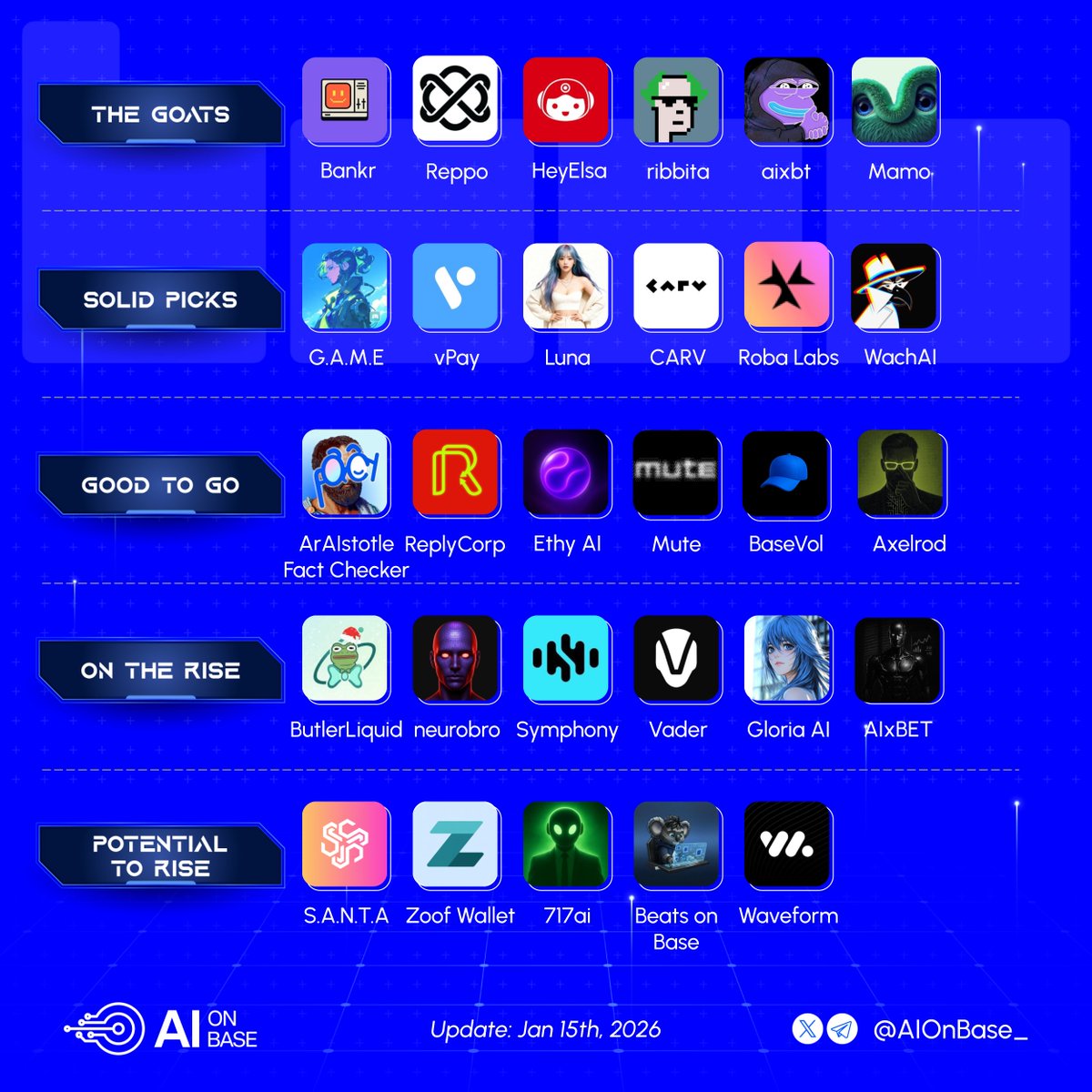
AI Agents on Base Tier List • Week 3 🟦
ERC-8004 launches tomorrow.
Identity, discovery, reputation for AI agents. All onchain. Combines with x402 to handle the full stack (identity + payments).
The pieces are coming together. Question is whether anyone builds something useful with them.
What's worth paying attention to? 👇
English
Check out $ARCHAI - they built the best AI infrastructure tech in Web3 - partnering with Galactica and others to build the foundation for the AI agentic economy.
The current FDV is just $1.5 mln - crazy low. Ask Grok to assess the tech - you will be amazed.
$ARCHAI
0xD3b0b58eC9516e4b875a075328E2CB059d4d54dB
English

i'm pretty bored rn
so i catch myself trying to force a trade
just looking for a trade, any trade
the key is to recognize when you feel this way and control yourself
you should already be in your high conviction trades
sitting, waiting, doing nothing
be patient
(its hard)
English
Check out what $ARCHAI and Galactica are doing. Galactica is providing zero knowledge proof mechanism and ArchAI orchestrates the agents with their GraphChain framework. The current FDV is just $1.5 mln - crazy low. Ask Grok to assess the tech - you will be amazed.
$ARCHAI
0xD3b0b58eC9516e4b875a075328E2CB059d4d54dB
English

Agree privacy will be key - check out what $ARCHAI and Galactica are doing. Galactica is providing zero knowledge proof mechanism and ArchAI orchestrates the agents with their GraphChain framework.
The current FDV is just $1.5 mln - crazy low. Ask Grok to assess the tech - you will be amazed.
$ARCHAI
0xD3b0b58eC9516e4b875a075328E2CB059d4d54dB
English

Why:
- used Tornado Cash? -> straight to jail
But
- using Railgun, no jail?
Both are privacy tools but where is the line between legal and straight-to-jail tech?
Joestar⭐@JoestarCrypto
English
Mike Lambert retweetledi

@milesdeutscher AI agent driven economy will continue to evolve from simple agents to a full orchestration and continuous learning. The teams providing infrastructure for this will greatly benefit, while those that move slowly will be outpaced.
English
What's one of your crypto predictions for 2026?
(will reply to as many as I can and say if I agree or disagree).
x.com/milesdeutscher…
Miles Deutscher@milesdeutscher
English

🔥 Treasury burned: basescan.org/tx/0xfc9d14001…
➡️ Transfer to Galactica: basescan.org/tx/0x842a3ea01…
ARCH AI@TheARCHAI_
⭐️ARCHAI is thankful to the Galactica.com team for their contribution. We are likewise excited to note our shared vision for both, the future of the Internet of Agents and the community-first spirit of the open source software development. 📈ARCHAI's AIKING pool, as initially envisioned, will be the pool merging the incentives of projects launching using ChainGraph framework. However, it won't be through launchpad deals. ARCHAI encourages contributions to this pool from anyone who benefits from the stack we have collectively built - in the spirit of open source software development and are grateful to the Galactica.com team for showing an example and kickstarting this trend. 🪙We are also excited to announce further ARCHAI token burns. After these burns, ARACHAI will be close to a full community ownership. We will, however, retain the foundation tokens to have flexibility to direct the incentives to development of other features than those that are aligned with the Galactica.com roadmap. 🔥 Treasury Burn: The Treasury (6.5% of the initial supply) is to be burned. This reflects our decision to align ARCHAI’s core development efforts directly with Galactica, streamlining our resource model. basescan.org/address/0xbb3e… ⏩ Foundation Realignment: 1% of the initial supply from the Foundation is being moved to the gUBI on Galactica (24 months linear vesting starting Jan 3, 2026). basescan.org/address/0xd73e… ⏩ Community Growth Realignment: 1% of the initial supply from Community Growth is also being moved to the gUBI on Galactica. basescan.org/address/0xc39c… 📊 Updated Supply Metrics - Total Burned $ARCHAI: 24.2% - Foundation: 5.5% - Community Growth: 2.0% archai.gitbook.io/archai/tokenom… 🤝 By aligning our resources with Galactica’s privacy-compliant infrastructure and reputation systems, we are ensuring that the ARCHAI community sits at the heart of a secure, sovereign, and scalable agentic web.
English
@RWAwatchlist_ $TOKEN will rocket this year - real great tech, backed by Floki.
English
Which RWA projects are worth holding this year🤔
English