@Steelersdepot People don't know jack about squat. Look at historical draft "grades" vs performance after 3 years. An exercise in being loud on social media.
English
Michael MacDonald 🍁
1.4K posts

@MikeMacMike01
Entertainment reinforces what you already know, and tells you that you're right. Art suggests that what you know is wrong, and that your beliefs may be similar.

⚡️This is the exact cope that every profession produces in the first eighteen months of AI disruption and it’s wrong for the same reason it’s always wrong. The McKinsey guy is making the last stand argument. The machines can do the tactical work but they can’t do the strategic work. The real skill is narrative, taste, judgment, knowing when to kill a slide. Those things require experience, human intuition, years of development. AI can’t replicate them. So the profession is safe at the top even if the bottom gets automated. This argument is offered by every professional in every field right before their profession gets restructured. The lawyers say the real skill is negotiation and judgment. The doctors say the real skill is bedside manner and diagnosis under uncertainty. The writers say the real skill is voice and taste. The designers say the real skill is understanding the client. Every one of them is pointing at the part of their job that currently can’t be automated and declaring that’s where the value always was. They’re wrong for a specific structural reason. The parts of their job that AI automates are the parts that fund the parts that AI can’t automate. The junior consultant building the deck is how the partner gets leverage to do the strategic thinking. Take away the deck building and the economic structure of the firm collapses. You can’t have a partner making partner money doing only narrative work because narrative work alone doesn’t scale to the revenue that supports the partnership. The leverage came from the associates. Remove the associates and the partner’s economics don’t work. The McKinsey guy is describing a two tier system where narrative remains valuable and slide production becomes commoditized. He thinks this means the narrative people survive. What actually happens is that McKinsey’s fees depend on charging clients for the full pyramid of associates and managers and partners, and if the associate layer can be replaced by AI, clients stop paying for it. Which means the partner is suddenly charging narrative consulting rates without the leverage fees that made his compensation possible. The deeper issue is that narrative is not as hard to automate as he thinks. What he’s describing, knowing when to kill a slide, knowing when the executive summary is overloaded, knowing that the client needs to feel the problem before the solution, these are pattern recognition tasks. They require experience because humans learn them through repetition over years. AI systems are absorbing that same pattern library through training on thousands of successful and unsuccessful decks, client responses, deal outcomes. The narrative layer he thinks is uniquely human is the next layer to fall. It might take three years instead of one, but it’s not permanently defended. The “fingerprint” of AI decks is real right now because the current generation of tools is naive. Three boxes, generic icons, bullet points that sound impressive but mean nothing. Yes. That’s version one of the tool. Version two will look different. Version three will look different again. The fingerprint he’s identifying is a temporary artifact of current model training, not a permanent signature of machine generated output. Within 18 months the decks AI produces will be indistinguishable from the ones senior consultants produce because the models will be trained specifically on the good ones.



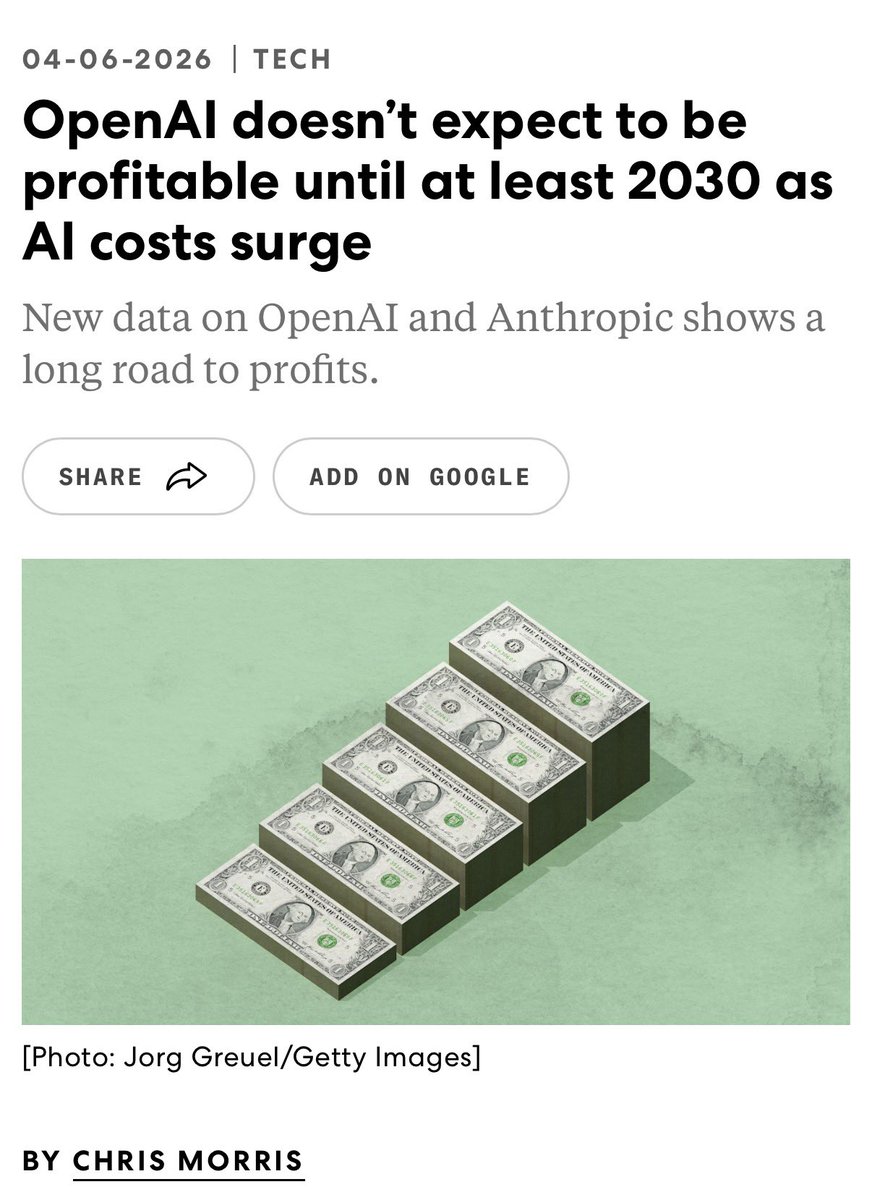
Yes, it’s a bubble. OpenAI will spend $121B in 2028 on compute. won’t turn profit until at least 2030. prepare your GPUs.


As far as I can tell diffusion is happening unusually rapidly in education, health, and law - which really puts a damper on arguments that regulation will slow AI diffusion.

Nike on its last legs as stock price plummets after woke push blows up in its face trib.al/1hnDYb1

BREAKING: Iran and Oman are drafting a protocol to "monitor transit" through the Strait of Hormuz. Details include: 1. Iran says tanker traffic through Hormuz will be "supervised and coordinated” with Iran and Oman 2. Iran says "these requirements will not mean restrictions, but rather to facilitate and ensure safe passage" 3. This is reportedly a "post-war draft" and aimed to "prevent aggression in the future" 4. Iran says that even in peaceful conditions, traffic should be monitored It appears Iran is positioning for long-term control of the Strait of Hormuz.




🚨 RAM prices are plummeting after OpenAi failed to fulfill its commitment to purchase 40% of World supply and terminated its $71 billion SKHynix promise. $MU