I just connected Claude to 40+ sportsbooks in real time.
Not a ChatGPT prompt.
Not a way to sell picks.
This is a real edge-finding system.
Built on 2M+ data points per night and 3+ years of infrastructure no one else has.
Comment "OPTIMAL" to test for free.
je vous partage les repos GitHub qui ont le plus explosé en finance cette semaine
> premier (+9.3K ★) est un framework multi-agents LLM avec analystes, chercheurs, risk managers qui débattent avant d’ouvrir une position. compatible avec GPT-5, Claude, Grok, Gemini (github.com/TauricResearch…)
> une team d’agents LLM avec chacun un rôle : bull, bear, fondamentaux, technique, risk. ce qui se rapproche le plus d’un vrai hedge fund AI sur GitHub (github.com/virattt/ai-hed…)
> assistant de trading autonome, choisit ses propres modèles, récupère ses données de marché, décide quand trader (github.com/NoFxAiOS/nofx)
> le plus gros dataset public sur l’historique des trades Polymarket + Kalshi : 36GB (github.com/Jon-Becker/pre…)
> un CCXT pour les prediction markets : une seule API pour Polymarket, Kalshi, Limitless, Myriad (github.com/pmxt-dev/pmxt)
c'est très intéressant de directement intégrer certaines de ces features dans vos bots, les 2 derniers repos le sont particulièrement pour ceux qui build sur les prediction markets
50,000 MATCHES, 47 FEATURES, ONE ML MODEL. THIS IS HOW I PREDICT TENNIS
ATP ranking - first thing I didn't use. Updates once a week, doesn't distinguish surfaces.
60% accuracy, not bad, but it doesn't give you an edge on the market.
Elo by surface. Djokovic on clay and Djokovic on grass two different players. This one decision: 60% -> 65%
Fatigue: total games over 14 days, weighted by recency. Yesterday's five-setter weighs 4x more than a match 10 days ago. Legs remember everything. +1.5%
Recovery time: one played last night at 11pm, the other rested two days. Market gives equal odds. Model doesn't. +0.5-1%
Seeding: one plays his first match today, his opponent already played 3. Adapted to the balls, court, altitude. An edge the market ignores. +0.5-1%
What the model found useless: height, weight, nationality, aces per match.
XGBoost - takes all features together, Elo + fatigue + recovery + seeding + 40 more, and finds connections a human can't see.
68% accuracy. Ceiling in men's tennis - 70%. Bookmakers are also at 70%, but they take margin. I don't.
Calibration took 3 months. 12,000 matches out of sample. Tuned thresholds, recalculated weights, removed overfitting.
Now I see edge that's impossible to see with your eyes.
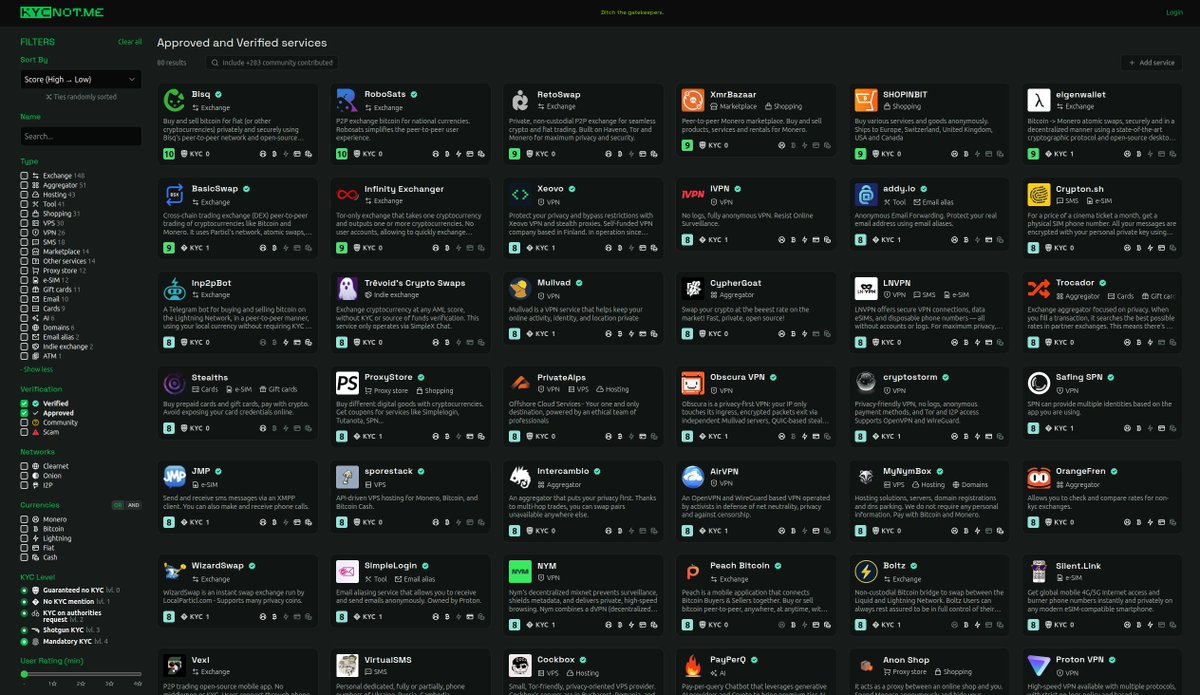
KYC-Free: 100+ Crypto Exchanges, 40+ Aggregators & 200+ Online Services
@kycnot is a directory for non-KYC services. It started with a focus on crypto exchanges and aggregators, but now you will also find many other services there, including Hosting, VPNs, e-SIM, AI Tools and many others:
Claude Code just quietly killed the entire startup team model.
Yeah — I said it.
No hiring.
No standups.
No 10-person Slack chaos.
Just this:
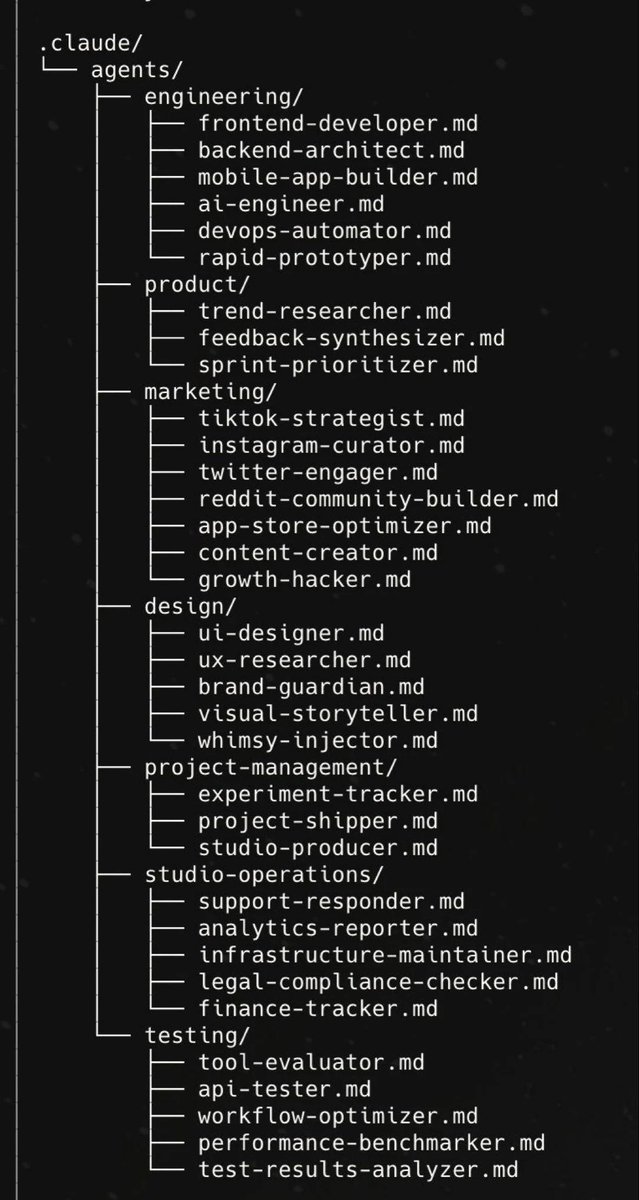
A .claude/agents/ folder with 30+ specialized agents.
Each one = a single markdown file with ONE job.
→ Engineer
→ PM
→ Marketer
→ Designer
→ Legal
→ Finance
→ QA
All replaced.
By one person.
With commands like:
"Hey rapid-prototyper, build this."
"Hey growth-hacker, get me users."
"Hey compliance-checker, are we safe?"
This isn’t a tool.
It’s a one-person startup operating system.
And right now — almost no one is using it.
That’s the edge.
Bookmark this before your competition does. 🔖
For people who keep asking what to build
- Build your own operating system
- Build your database
- Build your virtual machine
- Build your web server
- Build your own game engine
- Build your compiler
- Build your own programming language
- Build your own browser
- Build your own blockchain
- Build your own encryption algorithm
- Build your own CPU emulator
- Build your own file system
- Build your own container runtime
- Build your own package manager
- Build your own shell
- Build your own window manager
- Build your own GUI toolkit
- Build your own text editor
- Build your own IDE
- Build your own version control system
- Build your own network protocol
- Build your own operating system kernel in assembly
- Build your own scheduler
- Build your own memory allocator
- Build your own hypervisor
- Build your own microkernel
- Build your own compiler backend (LLVM target)
- Build your own query language
- Build your own cache system (like Redis)
- Build your own message broker (like Kafka)
- Build your own search engine
- Build your own machine learning framework
- Build your own graphics renderer (rasterizer or ray tracer)
- Build your own physics engine
- Build your own scripting language
- Build your own audio engine
- Build your own database driver
- Build your own networking stack (TCP/IP implementation)
- Build your own API gateway
- Build your own reverse proxy
- Build your own load balancer
- Build your own CI/CD system
- Build your own operating system bootloader
- Build your own container orchestrator (like Kubernetes)
- Build your own distributed file system
- Build your own key
-value store
- Build your own authentication server (OAuth2/OpenID Connect)
- Build your own operating system scheduler
- Build your own compiler optimizer
- Build your own disassembler
- Build your own debugger
- Build your own profiler
- Build your own static code analyzer
- Build your own runtime (like Node.js)
- Build your own scripting sandbox
- Build your own browser engine (HTML/CSS/JS parser and renderer)
- Build your own blockchain consensus algorithm
- Build your own zero
-knowledge proof system
- Build your own operating system for embedded devices
This AI trick is printing money 💰 💰
No face
No effort
Just results
I made $41,300 from TikTok Shop using an AI model.
Pretty AI girl + smart plan = 500K+ views per video
This is not luck. It’s a system.
I made a simple guide for you
RT + Comment "TikTok"
Follow @Ejaz_bashir1 So I can send the guide.
If I were starting my long journey in web3 security all over again — this is exactly the path I
would take.
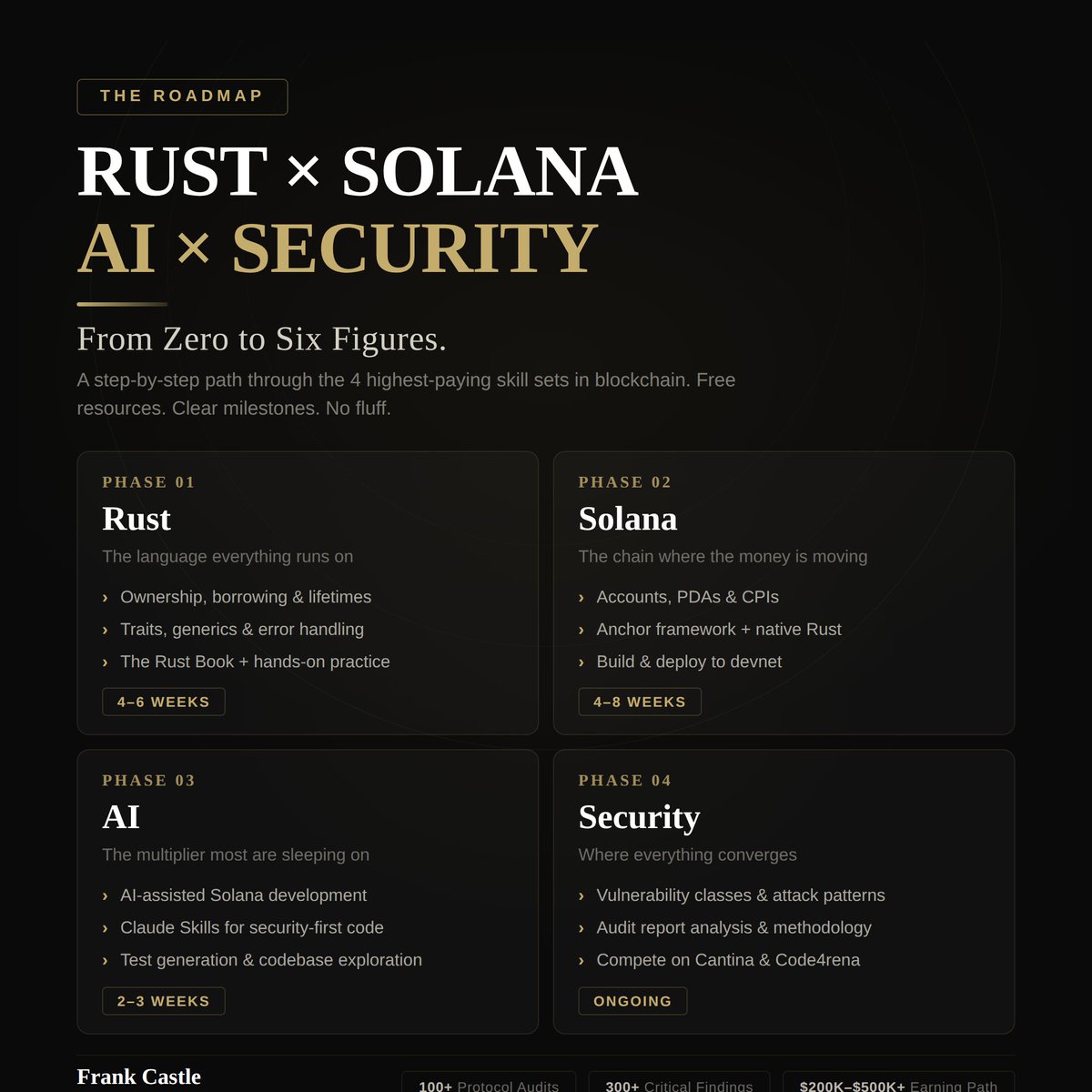
This is the most comprehensive roadmap you'll find for breaking into Security + AI on Solana.
A step-by-step path through the 4 skills that are paying $200K–$500K+ in blockchain right now
— and there still aren't enough people who can do them.
Rust. Solana. AI. Security.
🧵
🔒🌐 NOSTR VPN
Un vrai réseau privé mesh VPN 100% décentralisé, sans aucun compte Google, Microsoft ou Apple, accessible à TOUT LE MONDE !!
Avant, Tailscale t’obligeait à passer par un compte tiers centralisé. Ça a profondément énervé @marttimalmi (alias Sirius, l’un des tout premiers devs Bitcoin qui a bossé avec Satoshi)
🛠️ Du coup il a créé Nostr VPN :
Sur l'interface tu vois en direct :
👁️ Le statut avec le VPN
👁️ Ton identité Nostr et ton appareil
👁️ Le Mesh ID pour ton réseau privé
👁️ Un QR code pour ajouter tes autres machines en un scan
Le génie c'est que tout passe par les relais Nostr pour la découverte et la signalisation, puis ça monte un tunnel WireGuard (via boringtun) ultra-rapide et sécurisé...
Zéro serveur central
Zéro entreprise au milieu
Zéro tracking
👉 Avantages : gratuit, open-source, zéro confiance exigée, ultra-privé, résistant à la censure, MagicDNS intégré, et ça marche déjà nickel entre plusieurs Macs et Linux
👉 Inconvénients : encore jeune (développement très actif), pour l’instant uniquement macOS (Apple Silicon + CLI) et Linux
Le projet vient tout juste de sortir, pour tous ceux qui en ont marre des solutions centralisées c'est prometteur !
#OpenSource
If you're building with AI agents and don't know about this repo, you're missing out
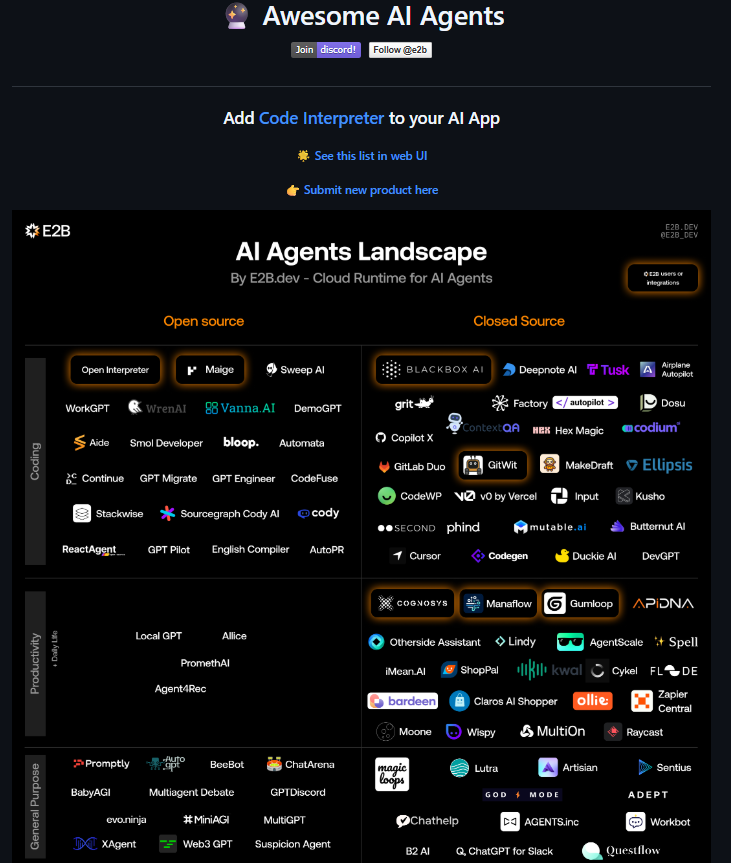
github.com/e2b-dev/awesom… - a curated list of autonomous AI agents that has 25.8k stars & keeps growing
covers everything from coding agents to research agents to personal assistants open source and commercial
the AI agent space is moving so fast that a list like this is basically a live map of where the frontier is
X402 VS Stripe MPP: 3 Key diferences
Two AI agent payment protocols solving same problem but very different bets.
1. What currencies they support
> x402: Stablecoins only, primarily $USDC. Designed for sub-cent crypto micropayments at internet speed.
> MPP: stablecoins and fiat. Cards, wallets, BNPL. @Visa extended it for card-based payments. @lightspark extended it for Bitcoin Lightning.
2. How a payment actually works
> x402: Agent hits a paywall, server returns 402 with payment details, agent pays in USDC, gets access. Entire flow inside one HTTP request. No human in the loop.
> MPP: Agent requests a service, protocol negotiates payment method and amount, settles in stablecoin or fiat depending on what the merchant accepts.
Also supports sessions, continuous payments for ongoing agent work, not just one-off transactions.
3. The core philosophical difference
> x402 bets that crypto becomes the default payment layer for the open web. The protocol is intentionally simple, open, and chain-agnostic.
> MPP bets that whoever controls the existing payment rails wins. Stripe already processed $1.9 trillion in 2025. MPP is an extension of that infrastructure into the agentic economy.
4. What this actually means
> x402 is the path where crypto wins by becoming invisible infrastructure.
> MPP is the path where traditional finance absorbs crypto and AI agents transact on Stripe's rails like everyone else already does.
The protocol that gets default developer adoption defines how the agentic economy moves money.