MotionMountain - Physics for Others

2.9K posts

MotionMountain - Physics for Others banner
MotionMountain - Physics for Others

MotionMountain - Physics for Others

@MotionMountainP

Free physics books in several languages. Free papers on maximum force, simplifying and unifying physics https://t.co/SywdGtEjci https://t.co/FCEvC6iMNU

Earth, like all butterflies Katılım Şubat 2019
527 Takip Edilen386 Takipçiler
Sabitlenmiş Tweet
MotionMountain - Physics for Others
The tiny theory of physics uses a single principle based on strands to deduce general relativity and the full standard model of particle physics with massive neutrinos, including coupling constants, particle masses, and experimental predictions. researchgate.net/publication/39…
English
3
1
5
766
MotionMountain - Physics for Others
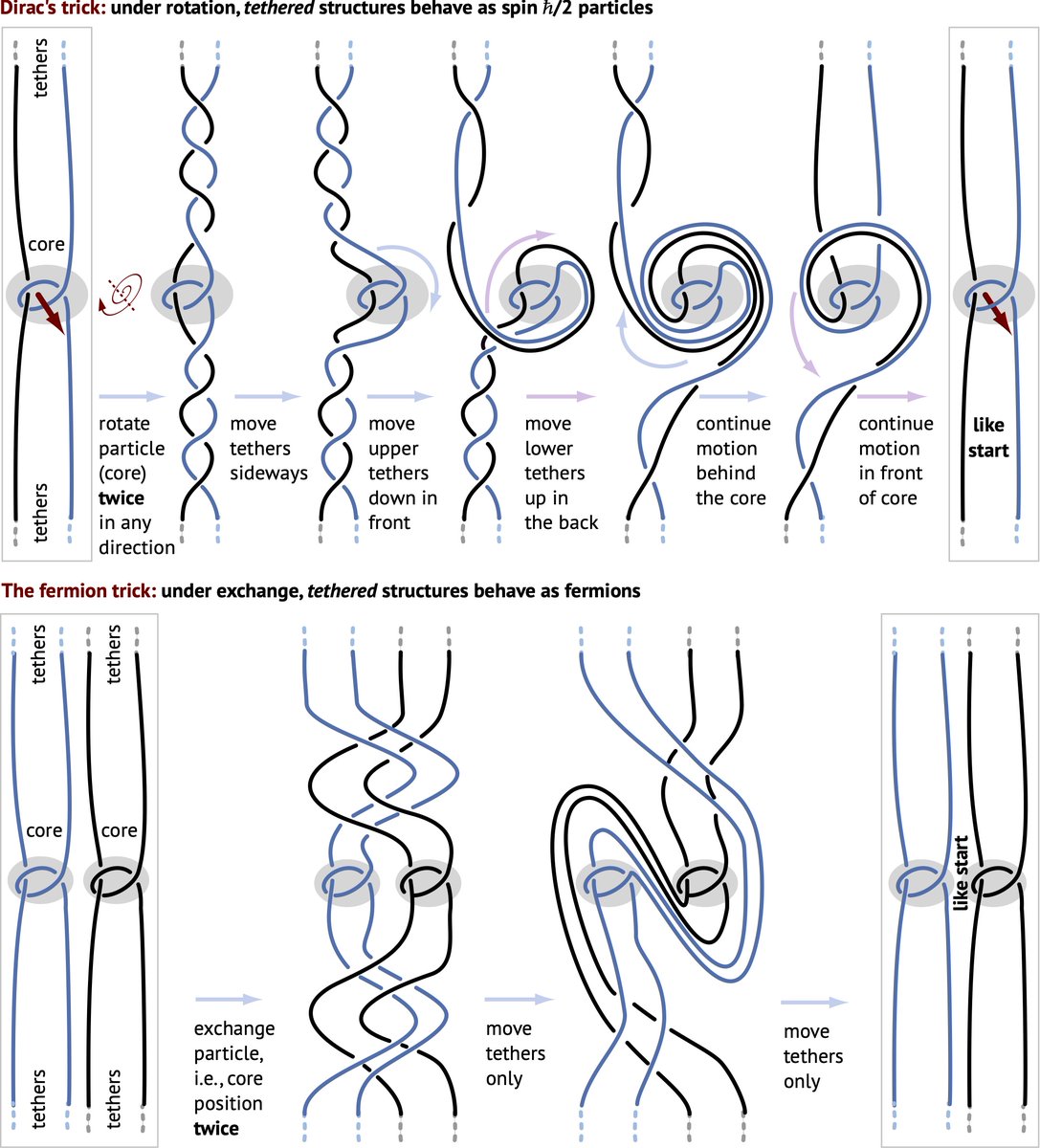
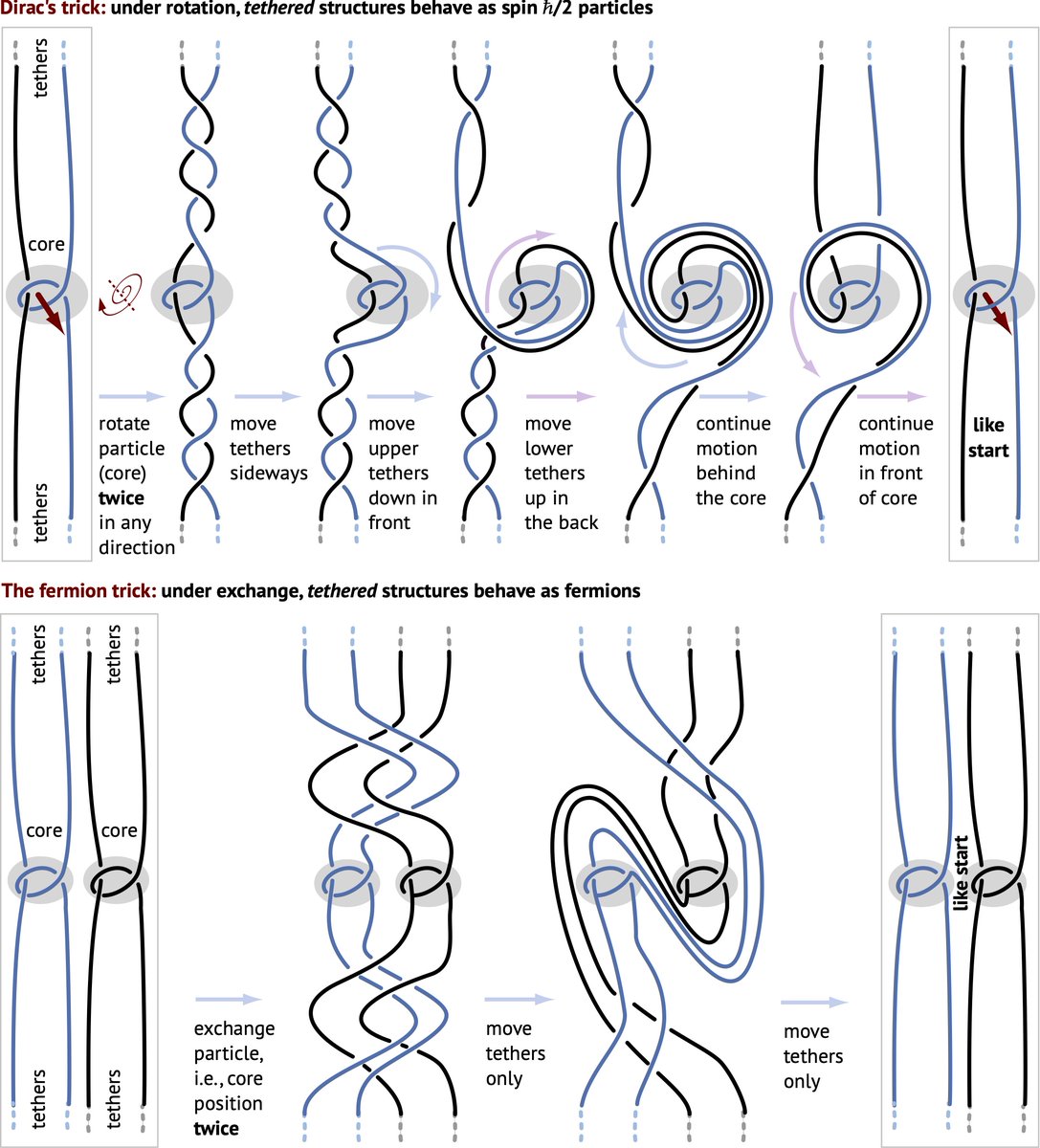
@CSchroeder125 @Rainmaker1973 Below is Dirac's explanation for the spin-statistics theorem for fermions, in simple terms: objects with tethers have spin 1/2 and are also fermions. Just imagine that the tethers are invisible. I collect alternative explanations. If you know a paper about yours, I'll cite it.
MotionMountain - Physics for Others tweet media
English
1
0
0
8
Chris Schroeder
Chris Schroeder@CSchroeder125·
@MotionMountainP @Rainmaker1973 Sorry, you've got to seek from this point on. The workloads of this conversation must be balanced, but if you're asking these types of questions I think you'll find the answers (soon).
English
1
0
0
5
Massimo
Massimo@Rainmaker1973·
Golden ratio unfolds [🎞️ infinite intellect]
English
19
368
2K
207.4K
Chris Schroeder
Chris Schroeder@CSchroeder125·
x.com/i/status/20393… Does this help? This is the same logic as the original post but perhaps more intuitive because it uses a 3D model. Each 90 degree "step" commits to the dimensional layering. In this cuboidal design, 8 steps (720) degrees produces a full "dimensional jump" from the original source (i.e. turns the cube into a tesseract). Explanation: Imagine a Rubik's Cube Original Design = 1 cube 1 x 1 = 1 (treat this as homebase; 'h'). Every time the cube rotates 90 degrees (r) it falls on a new side, and whenever it falls on a new side the # of cubes (h) doubles (1 to 2, 2 to 4, 4 to 8...). How many rotations (r) would it take to create a Rubik's Cube (3x3x3)? 0th Dimension (1 point/cube; dot) 1D (2 points/cubes; line) 2D (4 points/cubes; square) 3D (8 points/cubes; cube) ------------------------------------------ 4D (16 points/cubes; tesseract) <-- 8 points within; 8 outside. 5D (32 points/cubes; ... hyperspace+) <-- 16 points within; 16 points outside. ... etc. 8 (rotations) is the solution. 8*90 (degrees) = 720. Hence, my original statement that two full turns (2*360 degrees) produces the explanation for spin-1/2 particles, as presented by Fermi-Dirac. If you know what a "gimbal lock" is, it's similar to that (but I won't bore the details). NOTE: I chose "h" specifically because of it's relevance to Planck's Constant (h) and Limit. Instead of growth, imagine (h) being so small that there is no more "stuff" to reveal (i.e. return to original design). Does the pattern end? Not really, we just trade "unveiling" to "unravelling" when quantum foam gets messy. Sloterdijk provides an excellent explanation on it in his "Spheres" trilogy.
Mathematica@mathemetica

6 × (1² + 2² + … + n²) = n(n+1)(2n+1) No algebra. Just glowing acrylic blocks stacking into pure geometric perfection.

English
1
0
0
16
MotionMountain - Physics for Others retweetledi
MotionMountain - Physics for Others
The tiny theory of physics uses a single principle based on strands to deduce general relativity and the full standard model of particle physics with massive neutrinos, including coupling constants, particle masses, and experimental predictions. researchgate.net/publication/39…
English
3
1
5
766
Samuel Hammond 🦉
Samuel Hammond 🦉@hamandcheese·
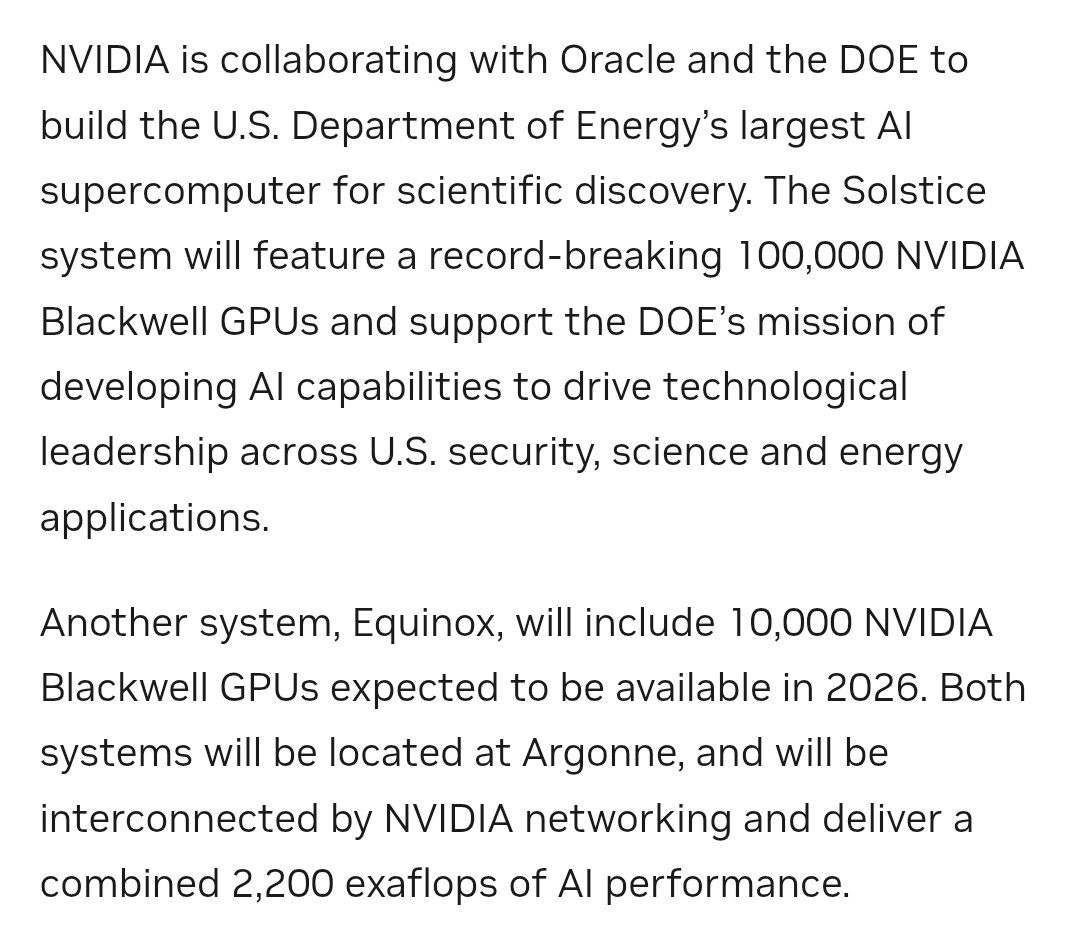
I remember when this was announced but didn't fully appreciate the size. That's a hell of a cluster. The Department of Energy will basically be a frontier AI company.
Samuel Hammond 🦉 tweet media
English
21
52
495
53.9K
John Preskill
John Preskill@preskill·
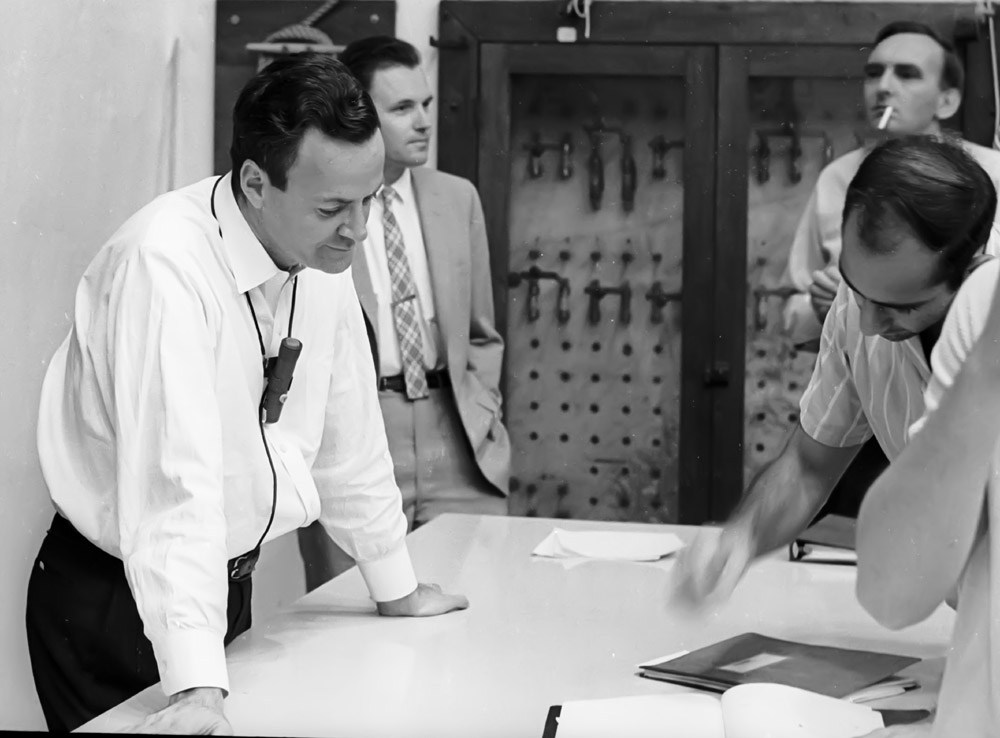
"I couldn't reduce it to the freshman level. That means we don't really understand it." RPF to David Goodstein, who had asked for a simple explanation of the spin-statistics theorem. (Later, Feynman changed his mind, and explained it by twisting his belt.) #Feynman100
English
3
23
65
0
Richard Behiel
Richard Behiel@RBehiel·
Interesting. After reading “Pauli and the Spin-Statistics Theorem” by Duck and Sudarshan, I’ve become convinced that spin-statistics is essentially magic, that it’s a foundational rule of nature which comes to us without explanation. Studying QFT, spin-stat is invoked right from the start. But there are these various intuitive “proofs” put forward by Feynman and others, which are tempting but not rigorous. So, one of the things I would look for in a unified model of physics, would be some explanation of *why* spin-statistics is a thing. Are you saying that such an explanation exists within differential geometry? If so, where can I find that explanation?
English
2
0
2
106
Eric Weinstein
Eric Weinstein@EricRWeinstein·
Got to sit down with @ChrisWillx, for several hours in a cinematic. post-apocalyptic garage. Reminded me of a particular "sit-down" from the end of the Sopranos. Chris is one of the best in the space & I always enjoy his unique style. Hope you will too! youtu.be/PYRYXhU4kxM?si…
YouTube video
YouTube
English
431
513
3.9K
234.8K
World Scientific
World Scientific@worldscientific·
Rooted in the work of Nobel Laureates like Pauli, Dirac and Heisenberg, this book explores the spin–statistics theorem, a fundamental principle that governs the behavior of matter, from atoms to stars. Click the banner below to get your copy today!
English
1
1
7
432
Chris Schroeder
Chris Schroeder@CSchroeder125·
@Rainmaker1973 This is a visually elegant explanation on why spin-½ particles obey Fermi-Dirac statistics (I.e. requires 720 degrees).
English
1
0
1
183
MotionMountain - Physics for Others
@PhilosophyOfPhy The story is wrong. Feynman knew Dirac's explanation, that tethered structures behave as spin 1/2 (same after rotation by 4pi, not after rotation by 2 pi) and as fermions (same after double exchange, not after single exchange):
MotionMountain - Physics for Others tweet media
English
2
0
0
2.1K
Philosophy Of Physics
Philosophy Of Physics@PhilosophyOfPhy·
A Caltech colleague once asked Feynman to explain why spin-½ particles obey Fermi-Dirac statistics in a way a freshman could understand. Feynman agreed enthusiastically and promised to prepare a freshman-level lecture. A few days later, he returned sheepishly and admitted defeat: “I couldn’t do it. I couldn’t reduce it to a freshman level. That means we really don’t understand it.” He used this as a teaching principle, if you can’t explain something simply, you probably don’t understand it yourself. This story circulated quietly among faculty and students as a humbling reminder that even Nobel laureates should test their own knowledge against the ability to communicate clearly. It reflected his broader disdain for “cargo cult” teaching and his commitment to stripping away pretense in the classroom.
Philosophy Of Physics tweet media
English
54
208
1.3K
353.8K
MotionMountain - Physics for Others
The text and the challenge inside it also show how useless present Ai systems are for fundamental physics. They cannot reason logically. The arguments present Ai systems produce are just sycophantic to authorities: this is the complete opposite of what science is.
English
0
0
0
26
MotionMountain - Physics for Others
@PeterDiamandis Or train MDs that miss and neglect grand challenges such as (1) eliminate microplastics from peoples' bodies or (2) eliminate metabolic diseases or (3) make people healthy?
English
0
0
0
17
Peter H. Diamandis, MD
Peter H. Diamandis, MD@PeterDiamandis·
If AI can now solve math, discover physics and chemistry breakthroughs faster than human PhDs, why are we still training humans to be physicists? Serious question. Should education shift from 'learn to do X' to 'learn to direct AI doing X'? The wrong direction costs a generation their careers.
English
873
139
1.3K
478.2K
Mustafa
Mustafa@oprydai·
most people read physics. few actually solve it. • you can watch lectures • read textbooks • understand concepts and still fail when faced with a real problem. because physics is not recognition. it is construction under constraints. 1000 solved problems in modern physics vy ahmad a. kamal forces you into the real game: → take a messy situation → choose the right model → apply the math → reach a result that either works or collapses again. and again. and again. after enough problems: formulas stop being symbols they become tools intuition stops being vague it becomes mechanical you stop asking “what is this?” and start knowing “what to do.”
Mustafa tweet media
English
14
182
1K
31.4K
PTI Canada
PTI Canada@Alam1972·
@BrettPetter @Fareeha786 @KashifMD It’s a unification of electroweak and magnetic forces. There are many others who took part in this theory, he wasn’t alone. Don’t Bragg too much. Only reason he was awarded Nobel because of his Anti-Islam ideology.
English
2
0
0
31
Petter Brett
Petter Brett@BrettPetter·
Ask any Pakistani today… they may not know a single word about the electroweak unification theory for which Abdus Salam won the Nobel in Physics, but they surely know he was an Ahmadi — and that alone makes him a target for insult. This is #AhmadiApartheid. @Fareeha786 @KashifMD
English
6
71
190
3.4K
MotionMountain - Physics for Others
@r0ck3t23 Many problems still lack ideas to solve them. Take the still missing explanation of the value of the electron mass. Let's start a project on this topic. Without the answer, we do not know where the colours around us come from.
English
0
0
0
22
Dustin
Dustin@r0ck3t23·
Terence Tao is the greatest living mathematician. Fields Medal at 31. Solved problems that had been open for a century. Widely regarded as the sharpest analytical mind alive. And he just told you the thing your entire career is built on is now worthless. Tao: “AI has basically driven the cost of idea generation down to almost zero.” For five hundred years, the idea was the prize. The theory. The hypothesis. The flash of insight a physicist chased for twenty years in a lab before it landed. That was the bottleneck. That was what tenure rewarded. That was what Nobel committees were looking for. Gone. A model can generate a thousand candidate theories for a scientific problem in an afternoon. Not noise. Not garbage. Plausible, structured, publishable-grade hypotheses. A thousand of them. Before dinner. The idea used to be the scarcest resource in any room. Now it is the cheapest. But Tao went somewhere most people are not ready to follow. Tao: “Verification, validation, and assessing what ideas actually move the subject forward… that’s not something we know how to do at scale.” Sit with that. We automated creation. We did not automate truth. We can produce ten thousand explanations for a phenomenon. We cannot tell you which ones are real. That is not a gap. That is a chasm. And it is the most important unsolved problem on Earth right now. Tao: “Human reviewers… they’re already being overwhelmed actually.” The entire scientific apparatus was built for a world where a single paper took months to produce. Peer review. Journal boards. Consensus forged over years of replication and debate. That infrastructure was never designed for what just hit it. Journals are flooded. Reviewers are buried. The filters that separated signal from noise for decades were engineered for human-speed output. They are now absorbing machine-speed volume. And they are cracking under it. Tao compared it to the internet. The internet drove the cost of communication to zero. That did not produce clarity. It produced an ocean of noise with islands of signal buried somewhere inside. AI just did the same thing to knowledge itself. Infinite generation. Zero verification. The person who can produce ideas has never mattered less. The person who can prove which ideas are true has never mattered more. That is the inversion nobody is processing. Every company, every lab, every institution is racing to generate more. Faster models. Bigger outputs. More theories. More code. More content. Nobody is building the system that tells you which of those outputs are actually correct. And that is the only system that matters. Whoever solves verification at scale does not win a market. They become the filter that all of science, all of engineering, all of human discovery flows through. The bottleneck of the last five hundred years was producing the answer. The bottleneck of the next fifty is knowing whether the answer is real. And right now, according to the greatest mathematician alive, we do not know how to do that at the speed the machines demand. That is not a research problem. That is the race beneath the race. And almost nobody has entered it.
English
182
572
2.2K
523.5K
Holocipher
Holocipher@fractal_verse·
“Somebody figured out [Real*] physics is just too dangerous to do in the university setting…” *to be able to freely and openly challenge all concepts of physics, and invent new ideas on old concepts.. We have been stuck in a well constructed self reinforced circular loop/dogma
English
29
54
294
8.8K