Mr Depala

1.3K posts

Mr Depala banner
Mr Depala

Mr Depala

@MrDepala

Director of Maths and whole school numeracy at Highlands School, Enfield. Opinions are my own and not the views of my employer

Enfield, London Katılım Nisan 2018
525 Takip Edilen358 Takipçiler
Mr Depala
Mr Depala@MrDepala·
@mathsbox1 If I could prepare retrieval questions in advance and track which ones I've used. E.g. with a yr7 group I know which topics I'm teaching for the year I would like to be able to prepare the questions in advance, save them for future and track which topics I've covered. 🙂
English
0
0
5
315
Mathsbox
Mathsbox@mathsbox1·
Maths Teachers — If you could add a feature/resource type/section onto Mathsbox that would save you time or improve your lessons, what would it be? 👇 Would love to hear your ideas.
English
9
9
7
4.7K
Mr Depala retweetledi
Dr Frost Resource Team
Dr Frost Resource Team@DrFrostResource·
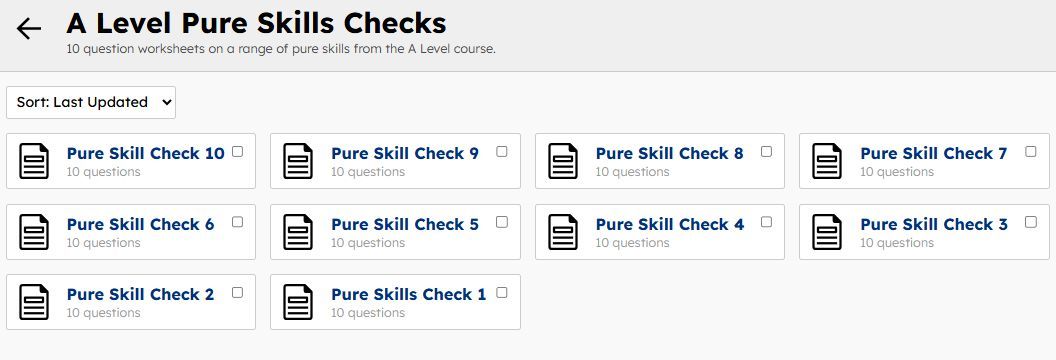
📢 New A Level Maths Resource! Our A Level Skills Check worksheets are here - 10 worksheets covering a wide range of pure skills. Perfect for: ✔️ Spotting knowledge gaps ✔️ Targeted practice ✔️ Exam revision A must-have in the run-up to exams! ✏️👇 buff.ly/zWyJ5rw
Dr Frost Resource Team tweet media
English
1
4
14
1.1K
Mr Depala retweetledi
Anand Sanwal
Anand Sanwal@asanwal·
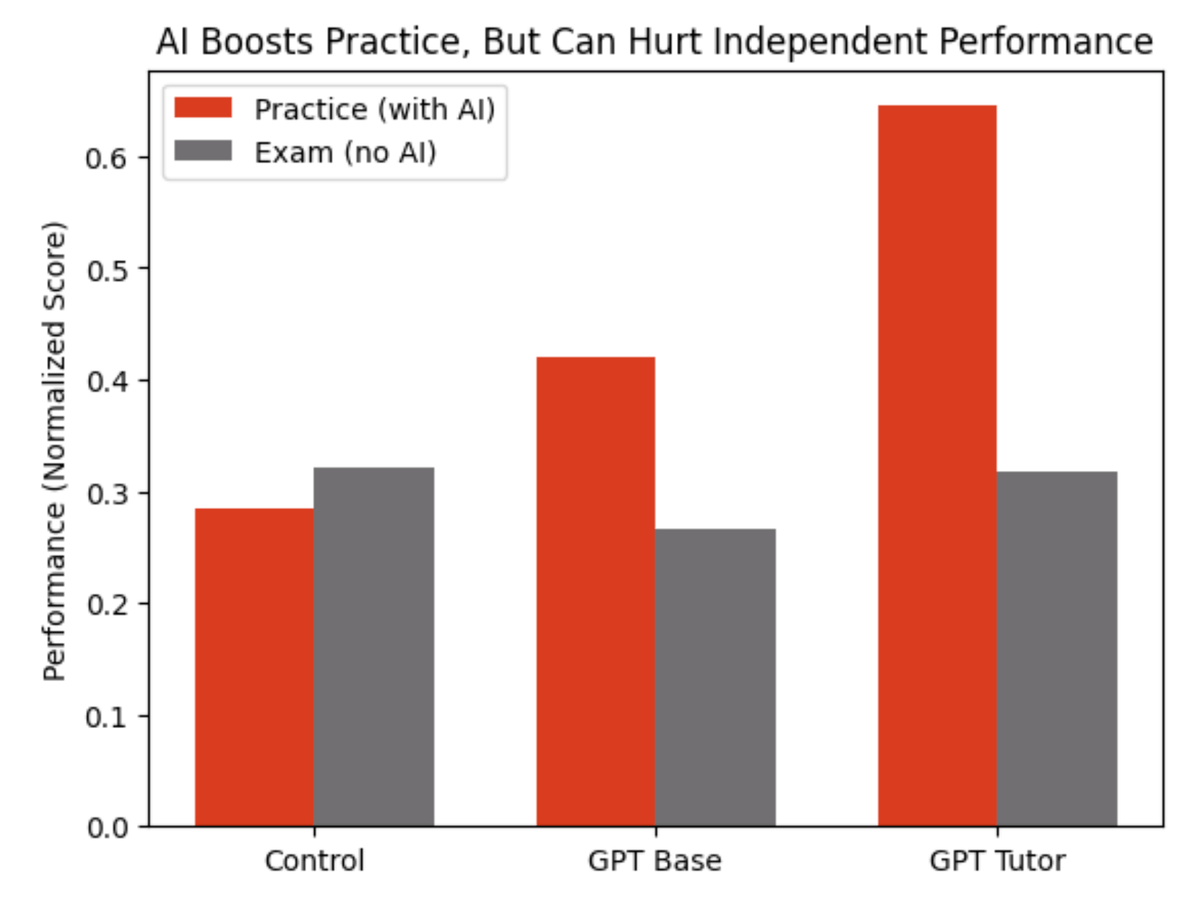
Wharton researchers gave nearly 1,000 high school math students access to ChatGPT during practice problems Result: chatGPT is the perfect trap. Look at the red bars. Students with ChatGPT crushed their practice sessions. The basic ChatGPT group solved more problems and those on the "tutor" version did even more. Now look at the gray bars. That's the exam. No AI allowed. The ChatGPT group scored 17% worse than kids who practiced with zero technology. And the fancy tutor version? No better than working alone. The researchers called AI a "crutch." When they analyzed what students actually typed into ChatGPT, most of them just wrote - “What’s the answer?” The kicker: students who used ChatGPT believed it hadn't hurt their learning. They were confidently wrong. This is the AI trap in education. Outsourcing your thinking. Of course, lots of half-baked AI literacy curricula being rolled out in schools now Let’s of course ignore that basic literacy (the ability to read) is possible for <50% of 8th graders Source: Bastani et al. (2025), "Generative AI Can Harm Learning," PNAS
Anand Sanwal tweet media
English
217
1.2K
4.1K
753.8K
Mr Depala retweetledi
Daniel Bennett
Daniel Bennett@BennettMaths·
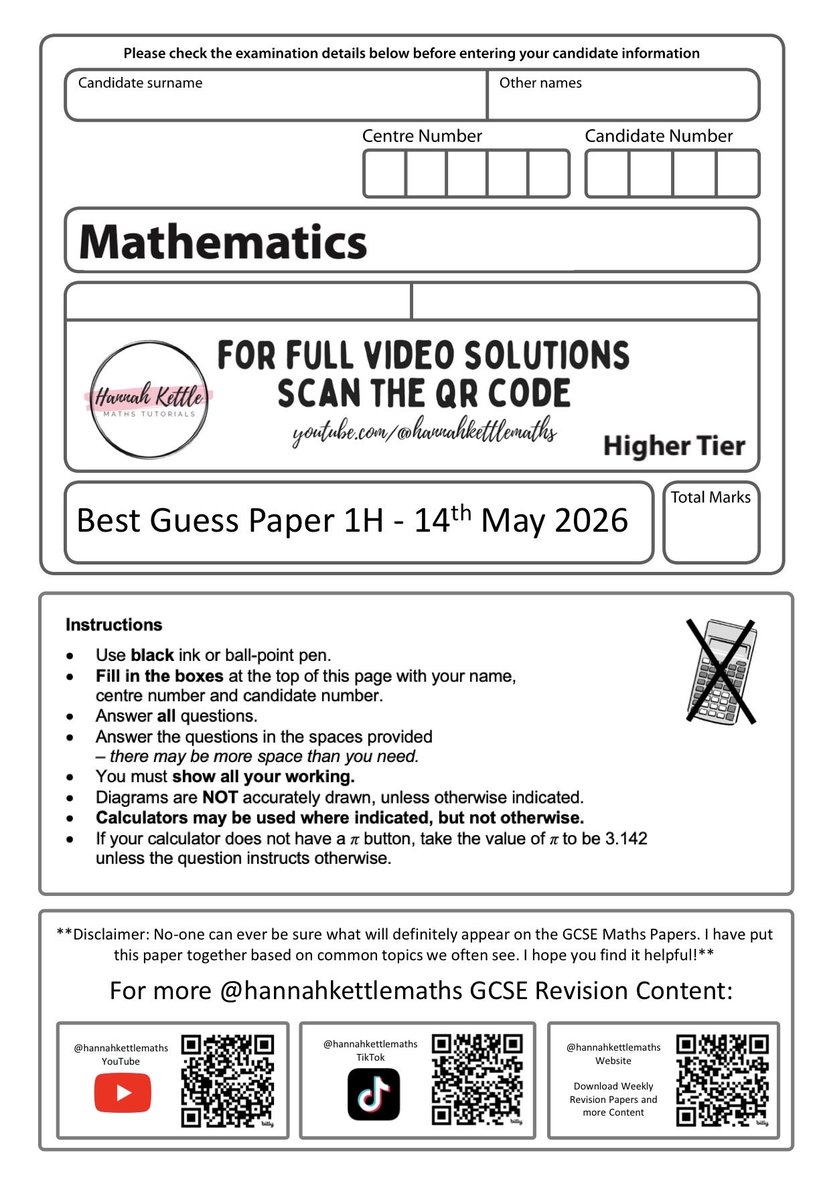
The BennettMaths GCSE predicted papers are available for Edexcel and AQA. There are papers for Higher and Foundation. A full TikTok live walkthrough is happening the night before the paper one! bennettmaths.com/gcse-maths-rev…
Daniel Bennett tweet mediaDaniel Bennett tweet media
English
2
18
66
4.1K
Mr Depala retweetledi
onmaths
onmaths@onmathsuk·
Revisionators are now live!!! Randomised multiple choice Maths GCSE questions. As always, these are completely free! Link in comments
English
1
6
11
1.1K
Mr Depala retweetledi
Mr D @ Maths
Mr D @ Maths@Mr_D_Does_Maths·
“Pushing for x” GCSE Maths papers (x = 4, 5, 7) for Easter revision 📈 Designed to help students push up a grade. Using in my school, but happy for others to use too 👍 QR → playlist (videos added before end of break). 👇 drive.google.com/drive/folders/… 3 sleeps to go! 🐣
English
3
14
68
6.1K
Mr Depala retweetledi
Dr Frost Resource Team
Dr Frost Resource Team@DrFrostResource·
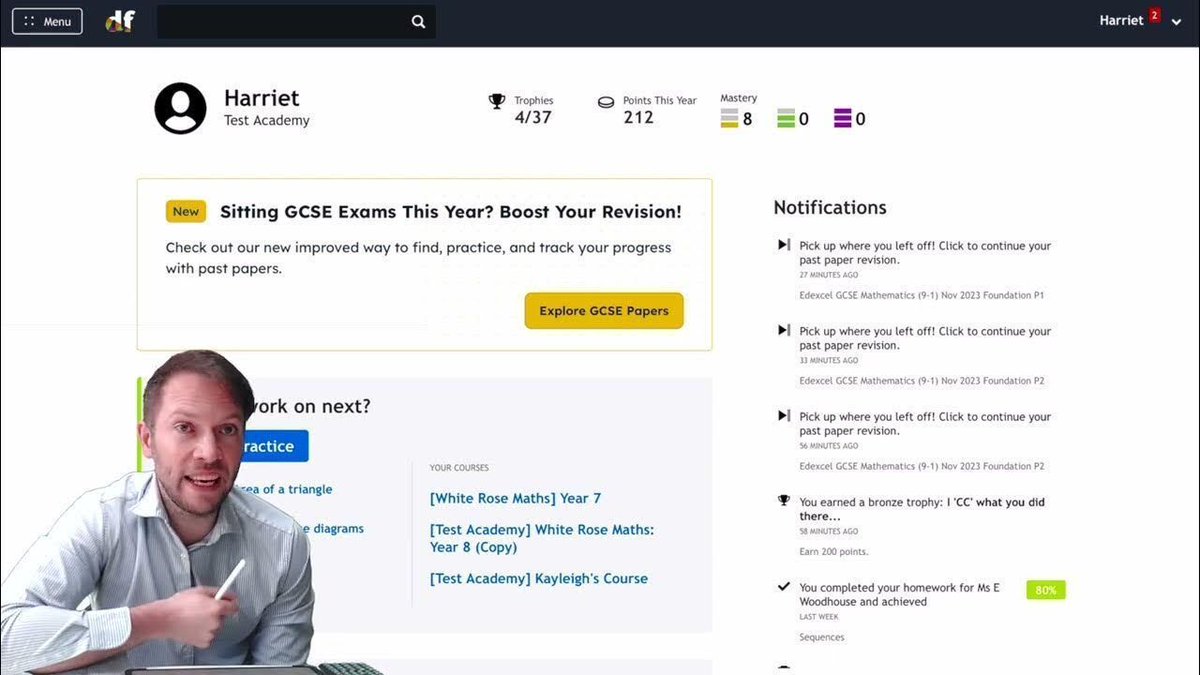
Want your GCSE students completing more past papers?! 😱 It's now easier for students to find & practise past papers on Dr Frost. Watch Jamie demo how students can track progress & build confidence for exams. 📺: buff.ly/8CG9i9d 🔗 Try it here: buff.ly/v5H112C
Dr Frost Resource Team tweet media
English
0
5
11
1.5K
Mr Depala retweetledi
Dr Frost Resource Team
Dr Frost Resource Team@DrFrostResource·
📚 A Level Full Coverage Revision These worksheets bring together questions that span the entire Year 1 and Year 2 A Level content - helping students practise every key question type they could face in exams. Year 1: buff.ly/XSq42wv Year 2: buff.ly/vOlnz2K
Dr Frost Resource Team tweet media
English
0
15
34
3K
Mr Depala retweetledi
vixhaℓ
vixhaℓ@TheVixhal·
Prime numbers are the reason your credit card is safe. When you buy something online, your payment information is encrypted using a system called RSA encryption, and its entire security rests on one simple mathematical fact: Multiplying two large prime numbers together is easy. However, reversing the process and figuring out which two primes were multiplied is effectively impossible. For example, it's trivial for a computer to compute: 12,451 × 18,637 = 232,048,387 But going the other way is much harder. If I hand you 232,048,387 and ask you to find its prime factors without telling you where to start, it becomes a genuinely hard problem. Now scale those primes up to numbers with hundreds of digits, which is what RSA actually uses, and even the fastest computers on Earth would take longer than the age of the universe to crack it by brute force. What makes this philosophically strange is that RSA encryption is built on a problem mathematicians haven't proven is actually hard. We believe factoring large numbers is fundamentally difficult. But nobody has ever proved that no shortcut exists. It is possible, however unlikely, that someone could discover a clever algorithm tomorrow that breaks all encryption instantly, exposing every bank account, every private message, and every government secret simultaneously. This is one of the greatest unsolved problems in mathematics, known as P vs NP. It asks whether problems that are easy to verify are always also easy to solve. If the answer is yes, meaning P equals NP, modern encryption collapses entirely.
English
76
420
3K
691.9K
Mr Depala retweetledi
Sam Bowman
Sam Bowman@s8mb·
I found the official Get Information about Schools website a bit clunky, so I made a new one with Claude Code. You can: - Set a postcode and see all schools within a radius of that you've chosen, filtered by type of school. - Filter and rank by the old one-word Ofsted ratings, with a link to the Ofsted page for each school. Where available, the sub-ratings are also viewable. - Filter and rank by percentage of students on free school meals. - View how full up schools are (number of pupils vs capacity). Let me know what you think! Happy to add new features and info that might be helpful. school-finder-uk.netlify.app
Sam Bowman tweet media
English
61
43
681
98.6K
Mr Depala retweetledi
Adam Boxer
Adam Boxer@adamboxer1·
Ok, time for a bit of nuance on the whole behaviour thing, and it starts with the fact that Yes, I think discipline is important Yes, I think rules are important Yes, I think consequences are important BUT Yes, I also absolutely *hate* all of the above. >
English
13
67
407
204.3K
Mr Depala retweetledi
Prem Soni
Prem Soni@ValueWithPrem·
15 things to do with your father while he is still alive. I lost mine 8 years ago. 1. Ask him what he was like at your age because once he was the same age you are right now & Watch his face light up as he tells you stories from when he was younger 2. Record his laugh when he tells one of his signature jokes. Someday you will replay the video over and over just to hear it again 3. Ask him about the proudest moment of his life. (Odds are he will say when you were born) 4. Ask him his favourite songs Listen to them together, laugh, sing and be happy. These will become your most cherished memories in years to come 5. Take a picture of him doing something he loves. Watching tv, gardening, playing the guitar, anything. When you look back these will be the pictures that will make you smile the most 6. Tell him you love him even if it's something you don't normally do. 7. Tell him you are proud to be his son/daughter This will mean more to him than you realise (even if he doesn't show it) 8. Listen to music from his youth and watch him turn from dad into a young man again 9. Take a short video of him talking about something random sacred Someday even the ordinary things he said become 10. Bring up something you are thankful for from years ago 11. Ask him what it was like for him growing up 12. Call him for no reason Don't take being able to do this for granted. Someday you would give anything to hear his voice again. 13. Take a picture of just the 2 of you together 14. Ask him to show you an old photo of him because seeing him young will remind you that he wasn't always Dad 15. Tell him something you are struggling with, no matter what age you are Because even when your grown it means the world to him to feel like he can still help Let him give you advice, even if you don't need it because one day you will give anything to hear his voice guiding you again
English
212
2K
11.5K
2.1M
Mr Depala retweetledi
Corbettmaths
Corbettmaths@Corbettmaths·
GCSE Maths 2026 - 121 Days To Go
English
0
9
23
2.6K
Mr Depala retweetledi
Matt Burnage
Matt Burnage@MJBurnage·
The proposed changes to progress 8 are a big worry, and I think they are likely to negatively impact the sector. Here are my big concerns:
English
9
14
52
53.3K
Mr Depala retweetledi
Carl Hendrick
Carl Hendrick@C_Hendrick·
Learning is a compounding game. It’s about steady growth over time not momentary performance. This is why retrieval practice, daily review, and spacing are so powerful. They convert momentary effort into lasting advantage. We often judge students by where they are now. Their test scores, their reading level, their grade placement etc. But often we are testing the illusory gains of cramming not learning. What really matters is the trajectory: the rate at which they are learning. And learning is not additive, it’s synergistic. Knowledge doesn’t simply stack piece upon piece; it interacts. Vocabulary unlocks comprehension, comprehension fuels background knowledge, and background knowledge accelerates the acquisition of more vocabulary. The cycle feeds itself. Changing long term outcomes means designing for growth rates, not snapshots. That means prioritizing daily reading, retrieval practice, cumulative review, and structured vocabulary instruction. activities that produce small but steady gains but often don’t feel like it. It also means intervening early, because once a compounding gap opens, it is brutally hard to close. Interventions often fail when they treat outcomes, not growth rates. Daily reading habits exemplify the Matthew Effect in education where small behavioral differences compound into dramatic learning disparities. Students who read consistently encounter vastly more words than sporadic readers, creating cascading benefits in vocabulary, comprehension, and cognitive processing that extend far beyond the reading itself. Like compound interest, these modest daily choices accumulate into substantial gaps in academic achievement, transforming seemingly minor habits into powerful predictors of lifelong educational success.
Carl Hendrick tweet media
English
21
122
449
30.6K