

Mutawa.eth (♢,♢)🦇🔊🐼
3.4K posts

Mutawa.eth (♢,♢)🦇🔊🐼
@MutawaAhmed
ethereum worshipper. I would love to see the universe more connected economically, mentally, and emotionally. ⛓🧠🍄
ethereum Katılım Haziran 2012
956 Takip Edilen384 Takipçiler

is Vitalik a better king or prophet?
king - 3/5 board seats at EF, sets the organization direction & ETH network roadmap, competition, hard power
prophet - spiritual/moral leadership, posts about values, public goods, zk research, infinite games, soft power
English

🚀 Unleashing the next-gen upgrade to EVMole: Control Flow Graph Reconstruction!
Outperforming every solution in both accuracy & speed 🔥 – perfect for deep smart contract audits.
Demo: evmole.xyz | Code: github.com/cdump/evmole

English
@Schlagonia @yearnfi Is there anything new from their end that worth to learn from or adapt?
English

Amazing to keep watching protocols spend months of dev time, and who knows how much money to rebuild what @yearnfi has been doing for years.
And what they could have deployed themselves in an afternoon using Yearn V3
Just build on #YV3
chrisb.eth 🦇🔊@chrisbducky
I've been asked a few times in the last 24 hours since the 12M TVL post in 3 days (now over 15M today) what is the Lazy Summer Protocol and why is it different, so i'll try and explain here... TLDR; The Lazy Summer Protocol offers Automated Yield across DeFi's highest quality protocols on Ethereum, @base and @arbitrum. It has AI Powered Keepers which continually monitor and rebalance the supported Vaults offering users the best available yields within set risk parameters, managed by @BlockAnalitica. Right now, it supports @aave, @compoundfinance, @eulerfinance, @0xfluid, @GearboxProtocol, @SkyEcosystem and @sparkdotfi with $USDC, $USDT and $ETH Vaults available. One of the major differences though to many yield aggregators though is the modular nature of the protocol, and with it, three main components which make up the protocol, reduce it's risk for users and increase its performance; 1) The Vaults - These are ERC4626 vaults, which are governed by the SUMR token and it's community. SUMR token holders decide which protocols and pools/markets each Vault supports. They do not manage the risk though, this is done separately by an independent risk manager... 2) The Risk Manager - this is @BlockAnalitica, a completely independent party that manages all the risk parameters of each Vault, and it's supported markets. From deposit caps on the vault, to maximum exposure to any single market - both in fixed token terms, and as a % of TVL. But also limits on the maximum in and out flows during any single rebalance. Importantly, the Risk Manager cannot choose which markets to onboard, this is only Governance. However if it does not agree with a governance decision to onboard a certain protocol - they have the power to never give it a deposit cap great than 0. A hugely important factor to consider for user, as the risk manager is managing exposure risk for the users, and not trying to chase profits for the SUMR token holders. The risk manager also has no power to rebalance the protocols, so although they may set the caps, the authorised keepers still need to perform the rebalances and are again, another seperate independent party... 3) The Keepers - The keepers in the network rebalance the Vaults, and in the Lazy Summer Protocol, it uses an array of AI Agents to autonomously rebalance the protocols and markets within the Vaults to the best performing yields, within the risk parameters set by the Risk Curator. Unlike many yield aggregators which rely on humans and multisigs to perform the rebalancing, these automated AI Agents react almost instantly within the cooldown limits set by the Risk Manager, to enable users to be constantly earning the best yield available, within the risk caps. Having these three components, each independent and separate from the other, with their own powers, but also strict, onchain limitations, allows for an incredibly powerful protocol - both from a yield generation point of view, but also from a risk management perspective for the user. Each component is basically an expert in their agreed area, from the vault development and operation, through to Risk and then to the keepers. And one of the best things about the design of the protocol is then the simplicity we can create from a UI point of view on summer.fi
English
@chrisbducky Great work. Question, have you considered Yearn V3 vaults? What was the limitations of it?
English

I've been asked a few times in the last 24 hours since the 12M TVL post in 3 days (now over 15M today) what is the Lazy Summer Protocol and why is it different, so i'll try and explain here...
TLDR; The Lazy Summer Protocol offers Automated Yield across DeFi's highest quality protocols on Ethereum, @base and @arbitrum. It has AI Powered Keepers which continually monitor and rebalance the supported Vaults offering users the best available yields within set risk parameters, managed by @BlockAnalitica.
Right now, it supports @aave, @compoundfinance, @eulerfinance, @0xfluid, @GearboxProtocol, @SkyEcosystem and @sparkdotfi with $USDC, $USDT and $ETH Vaults available.
One of the major differences though to many yield aggregators though is the modular nature of the protocol, and with it, three main components which make up the protocol, reduce it's risk for users and increase its performance;
1) The Vaults - These are ERC4626 vaults, which are governed by the SUMR token and it's community. SUMR token holders decide which protocols and pools/markets each Vault supports. They do not manage the risk though, this is done separately by an independent risk manager...
2) The Risk Manager - this is @BlockAnalitica, a completely independent party that manages all the risk parameters of each Vault, and it's supported markets. From deposit caps on the vault, to maximum exposure to any single market - both in fixed token terms, and as a % of TVL. But also limits on the maximum in and out flows during any single rebalance.
Importantly, the Risk Manager cannot choose which markets to onboard, this is only Governance. However if it does not agree with a governance decision to onboard a certain protocol - they have the power to never give it a deposit cap great than 0. A hugely important factor to consider for user, as the risk manager is managing exposure risk for the users, and not trying to chase profits for the SUMR token holders.
The risk manager also has no power to rebalance the protocols, so although they may set the caps, the authorised keepers still need to perform the rebalances and are again, another seperate independent party...
3) The Keepers - The keepers in the network rebalance the Vaults, and in the Lazy Summer Protocol, it uses an array of AI Agents to autonomously rebalance the protocols and markets within the Vaults to the best performing yields, within the risk parameters set by the Risk Curator.
Unlike many yield aggregators which rely on humans and multisigs to perform the rebalancing, these automated AI Agents react almost instantly within the cooldown limits set by the Risk Manager, to enable users to be constantly earning the best yield available, within the risk caps.
Having these three components, each independent and separate from the other, with their own powers, but also strict, onchain limitations, allows for an incredibly powerful protocol - both from a yield generation point of view, but also from a risk management perspective for the user. Each component is basically an expert in their agreed area, from the vault development and operation, through to Risk and then to the keepers.
And one of the best things about the design of the protocol is then the simplicity we can create from a UI point of view on summer.fi


English
Mutawa.eth (♢,♢)🦇🔊🐼 retweetledi

This is a solid demonstration of Railgun's privacy pools mechanism ( papers.ssrn.com/sol3/papers.cf… ) working in practice, allowing Railgun to avoid serving proceeds of crime without using any snooping / backdoors.
How it works:
* Anyone can deposit into Railgun.
* After you deposit, there is a 1 hour period during which various algorithms detect whether or not the deposit likely came from what the algorithms consider to be criminal activity.
* If your deposit passes the filter, then after 1 hour you can use ZKPs to withdraw privately (but ideally wait longer to get a good-enough anonymity set).
* If your deposit fails the filter, then you can only withdraw back to your own address. There is no risk that your funds will get frozen/seized, you just can't benefit from the privacy pool.
If you disagree with Railgun's filters, anyone is free to fork and make their own pool with their own rules, though if you can't get reasonably wide public support you're going to have a tiny anonymity set.
railway.xyz
Vladimir S. | Officer's Notes@officer_secret
Eventually, @zkLend has suffered a $9.5M exploit on the Starknet network. Stolen funds were bridged to Ethereum and laundered via Railgun, but due to protocol policies, the funds were returned to the original address by Railgun!
English
@BradStanfieldMD Congratulations! Glad that they are all safe.
English



@ETHDubaiConf @ETHAbuDhabiConf @Uniswap @unichain @redstone_defi Wow. I’m always impressed by how you adapt to the latest onchain tech. I still remember when you supported multi-chain when it wasn’t common.
English

Our tickets are live on @uniswap's fresh @unichain! 🦄🔥
Big props to Uniswap for bringing <1-sec tx, 95% less gas, cross-chain vibes, less MEV & more DeFi love.
Shoutout to @redstone_defi for those oracles on day 1!
Snag your ticket for ETHDubai25, it's gonna be a vibe! 🎟️🚀
English
Mutawa.eth (♢,♢)🦇🔊🐼 retweetledi

My bat signal 🦇🔊 will return when ETH is ultra sound again, soon enough™.
ETH supply currently grows 0.5%/year. That's 1%/year of issuance minus 0.5%/year of burn. To become ultra sound again, either issuance has to decrease or the burn has to increase. I believe both will happen, let me explain :)
ETH vs BTC
Before diving into Ethereum's issuance and burn, quick interlude on ETH vs BTC.
Internet-native money is an enormous opportunity, think tens of trillions of dollars. Monetary premium rarely accrues at scale. You need a truly attractive asset with outstanding properties for society to coordinate around.
At first approximation moneyness is a zero-sum game. Gold is primed for demonetisation in the internet age. There are only two candidates to supplant it and win internet money—BTC and ETH. Nothing else comes close. IMO the determining Schelling points are credible neutrality, security, and scarcity.
Since the merge, ETH is definitely scarcer than BTC. It's remarkable BTC supply grew 666K BTC, worth $66B, all while ETH supply stayed flat. Today BTC supply grows 0.83%/year, 66% faster than ETH. And for those looking ahead, as I explain below, ETH supply is poised to decrease again.
Scarcity is important, but ultimately the fight for internet money will likely be settled by security. Ironically, the famous 21M BTC cap is to blame. BTC issuance is going to zero—that's Bitcoin's strongest social contract. In a few halvings, issuance will be so small as to be irrelevant.
Here's a shocking stat: in the last 7 days only 1% of miner revenue came from Bitcoin fees. Yes, 99% came from issuance. And that's despite 4 halvings that reduced issuance by 16x, and despite 15 years of search for transactional utility on Bitcoin.
IMO the Bitcoin blockchain is cooked. It takes roughly $10B and access to 10GW to permanently 51% attack Bitcoin. The cost is peanuts for nation states. As for the power, Texas—a single state of a single country—can produce 80GW. The BTC security ratio is 200-to-1, it's a $2T asset secured by $10B of economic security.
Any shortable instrument correlated to BTC mining incentivises an 51% attack attack. There's $20B of Bitcoin mining stocks—those would insta-nuke. There's $40B of open interest on BTC perps—direct short exposure. Not to mention potential short exposure through the $100B in ETFs and the $100B in MSTR.
Will BitVM solve the fee problem? Any BitVM bridge is an incentive to 51% attack Bitcoin. Indeed, a 51% attacker can censor fraud proofs over the challenge period and drain BitVM bridges. Ironically, BitVM is arguably a direct attack on Bitcoin. And no, Bitcoin doesn't have social slashing to recover from 51% attacks.
What if the BTC price grows by 10x, flipping gold, is Bitcoin safe then? Let's say this happens in the next 11 years. BTC would be a $20T asset but issuance would shrink 8x because of the three halvings. The security ratio would grow beyond 1000-to-1. IMO this is untenable especially as BTC institutionalises, becomes more liquid, and ultimately become easier to short in size. Imagine $1T of perp open interest but just $10B of economic security.
Can Bitcoin somehow fix itself before it's too late? Bitcoin is the epitome of blockchain ossification. Can it have 1%/year tail issuance? Ha, good luck fighting the 21M cap! Maybe Bitcoin can switch to PoS and rely on minimal fees? PoS is sacrilege. Maybe Bitcoin can change to another PoW algorithm? Nope, that nuclear option won't help. Maybe Bitcoin can have big blocks and sell data availability at scale? Ser, a holy war was fought over small blocks.
If you made it this far and understood the above, congrats. Even today few appreciate how screwed Bitcoin PoW is long term and what the ramifications are for BTC the asset. This is a frontrunable opportunity but it requires patience. The time frame is not 1 month or even 1 year—it's 10 years.
Talking about long time frames, the Lummis proposal to lock BTC for 20 years is kinda insane—Bitcoin will be smoked by then. Worse, if the US were to hold trillions in BTC it would directly incentivise US enemies to muster a 51% attack. Contrary to popular belief, Bitcoin is not remotely resistant to nation states—China and Russia can pull off a 51% attack with ease.
ETH issuance
Ok, back to ETH :) The current issuance curve is a trap. Unfortunately, like Bitcoin's issuance, Ethereum's issuance was misdesigned. It guarantees 2% tail APR, even if 100% ETH is staked. Every rational ETH holder is incentivised to stake as staking costs are significantly lower than 2%.
We all lose when most ETH stakes:
→ ETH displacement: Liquid staking tokens like stETH and cbETH displace pristine ETH as unit of collateral. This injects systemic risks—custodial risks, slashing risks, governance risks, smart contract risks—into the core of defi. This displacement also erodes ETH as a unit of account, with further knock-on effects to monetary premium.
→ real yields and taxes: Real yield, i.e. the yield adjusted for supply growth, decrease as more ETH stakes. When 100% of ETH stakes all ETH holders get equally diluted. Worse, income taxes are drawn on nominal yield. It would be a tragedy of the commons for no staker to enjoy positive real yield and for all ETH holders to suffer billions of dollars per year of tax sell pressure.
IMO the issuance curve should drive discovery of a fair issuance rate through staker competition—no arbitrary 2% floor. This means the issuance curve must eventually decline and return to zero with increased ETH stake. My suggestion is "croissant issuance".
Croissant issuance is a simple half-oval with two parameters:
→ soft cap: The staking fraction where issuance returns to zero. To me a 50% staking soft cap feels credibly neutral and pragmatic. In particular it's large enough to address discouragements attacks.
→ peak issuance: The theoretically-maximal issuance borne by ETH holders. An arbitrary round number like 1%/year will do as ultimately the equilibrium rate would be market-set.
EF researchers have studied issuance for years—IMO there's rough consensus the current curve is broken and needs to change. Navigating the social layer to change issuance won't be easy. This is an opportunity for a champion to rise to the occasion and coordinate change to mainnet over the next couple years.
ETH burn
IMO the sustainable way to burn vast amounts of ETH is to scale data availability. It's much more lucrative to have 10M TPS with each transaction paying $0.001 in DA than it is to have 100 TPS at $100/tx.
Yes, the data availability supply shock from EIP-4844 that introduced blobs temporary lowered total burn. This is the nature of supply and demand. When demand for DA catches up expect the blobs to burn hard. The Pectra hard fork, in a couple months, will double blob count. The short-term goal is growth and I expect lots of it.
For the next couple years it will be a cat-and-mouse game between supply and demand as full danksharding is deployed. I wouldn't be surprised if this year we see hundreds of ETH per day of blob burn, and then that burn suddenly collapsing again with peer DAS in the Fusaka fork.
Zooming out, we're here to build infrastructure for the next decades and centuries. Fundamentals will play out over years. Whether it's Bitcoin security, ETH issuance, or the ETH burn, stay patient and have conviction :)


English
Mutawa.eth (♢,♢)🦇🔊🐼 retweetledi

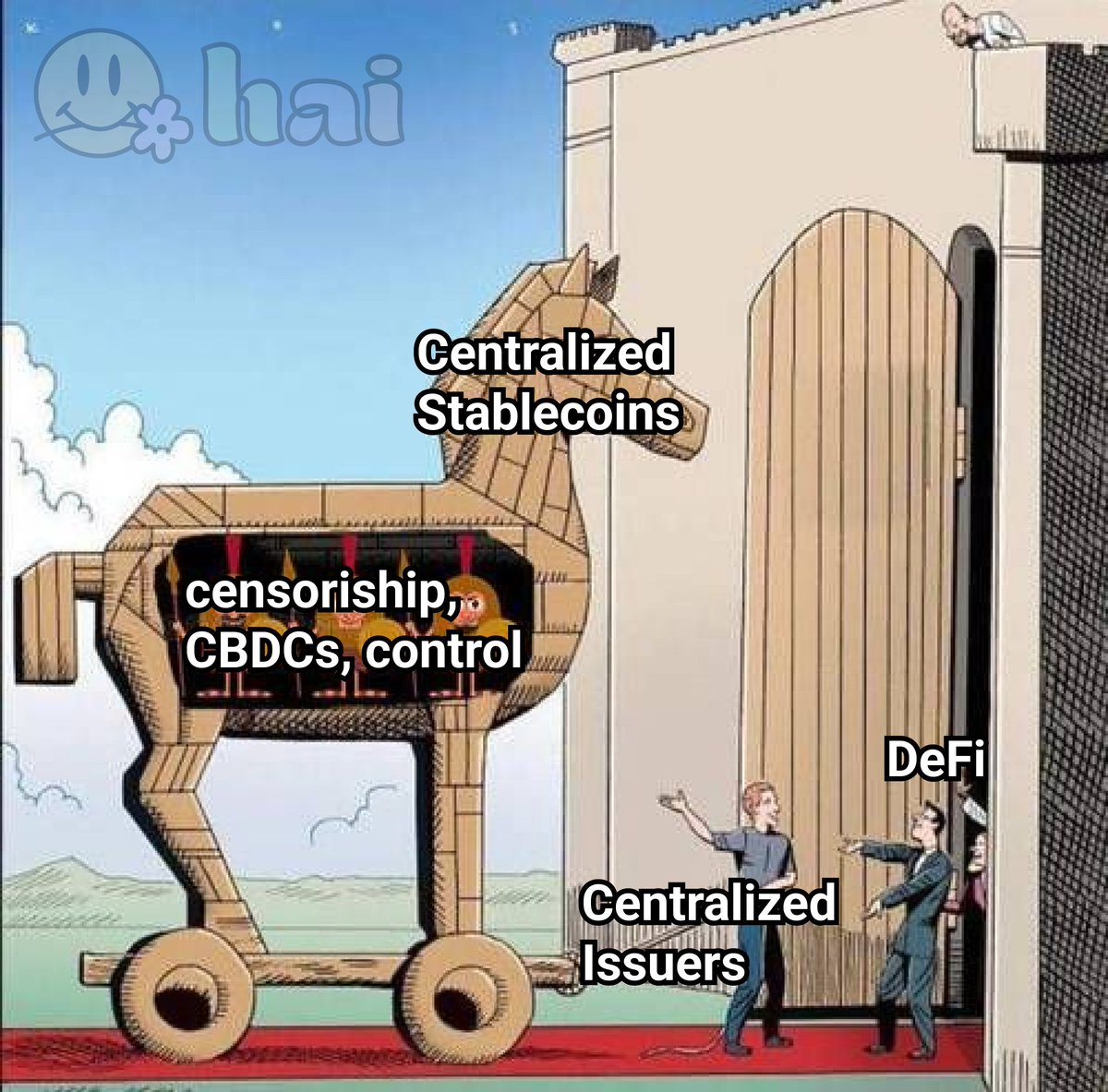
Projects like @reflexerfinance and @letsgethai are important for DeFi to truly succeed.
If we as a community, as native Ethereans, don't unite to support more experimentation & diversification then the dystopian future we've all read about will become more than a warning.
8/
English
Mutawa.eth (♢,♢)🦇🔊🐼 retweetledi

Freedom is priceless, but my freedom cost a lot of money. My house arrest was only possible thanks to the work of lawyers, who were paid from your donations. My fight is not over yet and for a final and confident victory I still need your help. Please support our fight here ➡️codewithoutfear.eu
#FreedomToCode

English
Mutawa.eth (♢,♢)🦇🔊🐼 retweetledi

Here are the 4 steps to get started building in Ethereum, a guest thread by @PatrickAlphaC
1. Understand why
2. Take a course, learn the tools
3. Apply your knowledge
4. Continue to learn & build
Let's unpack this so you can become a monster developer or security researcher 👇
English
Mutawa.eth (♢,♢)🦇🔊🐼 retweetledi

Apple gets it. Robots are going to be everywhere, but they won’t look like robots. Check out their new paper ELEGNT.
I believe this is the future of everyday objects: helpful and human.
English
@alex_pertsev @FreeAlexeyRoman Great! And all the best in your defense.
English
Mutawa.eth (♢,♢)🦇🔊🐼 retweetledi
Dear Friends, on Friday 7 February at 10 am I will be free! It is not real freedom, but it is better than prison. Today, a Dutch court suspended my pretrial detention under the condition of electronic monitoring. This will give me a chance to work on my appeal and fight for justice. Thank you to everyone who supported me and who made this possible!
#FreedomToCode
English

Mutawa.eth (♢,♢)🦇🔊🐼 retweetledi

Paradigm will be donating $1.25M to help fund Roman Storm’s legal defense
The prosecution’s case threatens to hold software developers criminally liable for the bad acts of third parties, which would have a chilling effect in crypto and beyond
We must stand with @rstormsf
Roman Storm 🇺🇸 🌪️@rstormsf
My name is Roman Storm, and I am one of the founders of Tornado Cash, a non-custodial privacy protocol. I am being prosecuted for writing open-source code that enables private crypto transactions in a completely non-custodial manner. This prosecution represents a terrifying criminalization of privacy. The charges against me threaten to criminalize software development itself. If successful, the implications could extend far beyond the crypto industry, impacting every software developer. I face up to 45 years in prison on charges including operating an unlicensed money-transmitting business, conspiracy to commit money laundering, and sanctions evasion. This case has already had a chilling effect on developers working on software tools. Recently, a developer filed a lawsuit against the DOJ, seeking relief because my case has made them fearful of releasing new software. x.com/lewellenmichae… Additionally, there is significant confusion around the 1960 charge (operating an unlicensed money-transmitting business), as different government agencies have conflicting interpretations of the law. x.com/amandatums/sta… “This prosecution threatens to criminalize software development itself,” said Keri Axel of Waymaker LLP, my legal counsel. American entrepreneur and politician @VivekGRamaswamy commented, “You can’t go after the developers of code. What you actually need to do is go after individual bad actors who are breaking the laws that already exist.” x.com/benzingacrypto… Multiple amicus briefs have been filed in support of my defense by the DeFi Education Fund (@fund_defi), Coin Center (@coincenter), and Blockchain Association (@BlockchainAssn): defieducationfund.org/_files/ugd/84b… coincenter.org/app/uploads/20… theblockchainassociation.org/wp-content/upl… The 5th Circuit Court has already ruled that Tornado Cash sanctions were unlawful: x.com/AlexanderFishe… However, the DOJ has dismissed this ruling as irrelevant: storage.courtlistener.com/recap/gov.usco… My trial is set for April 14, 2025.
English
@fubuloubu @ApeFramework @banteg @vyperlang My pleasure! That’s the least I can do to help you guys 🥲
English

English

Testing will never be the same.
Titanoboa by @vyperlang is now available in Ape via our new ape-titanoboa plugin! 🐍🤝🦍
Read our full article on it and see how you can 2x your testing with just one plugin:
@apeworx/introducing-ape-titanoboa,-the-new-standard-in-testing" target="_blank" rel="nofollow noopener">paragraph.xyz/@apeworx/intro…
English
@fubuloubu @ApeFramework @banteg @vyperlang I prefer a step by step walk through. It’s easier to follow, like a tutorial. But I understand it takes longer to make and usually covers unrelated content (some prerequisites) just to cover a full workable example.
English
@MutawaAhmed @ApeFramework @banteg @vyperlang You prefer it as a reference doc? Or preferred it was more a step-by-step walk-through? Our current organization we have both the reference, and higher-level user-guides meant to guide through particular use cases that (we think) are common
English
@fubuloubu @ApeFramework @banteg @vyperlang I’m not sure if it was last summer or longer. But the docs seemed different now. Generally it looks like a reference doc (which is more important) rather than a step by step walk-through to its features.
English
@MutawaAhmed @ApeFramework @banteg @vyperlang About how long ago was this? In the middle of last year, we revamped the docs pretty significant to try to help with this, but Ape does a lot of things and sometimes we miss the mark.
Regardless, our Discord community is really friendly! It can help you through most problems.
English