Nancy Duarte

14.5K posts

Nancy Duarte banner
Nancy Duarte

Nancy Duarte

@nancyduarte

CEO @Duarte & best-selling author. Passionate about persuasion and visual stories used in business. Love hugs from hubby, three kids, and two grandsons.
Mountain View, CA Katılım Mayıs 2008
1.7K Takip Edilen49.8K Takipçiler
Nancy Duarte
Nancy Duarte@nancyduarte·
You are a virologist and know pandemic expert. Tell me everything you know about hantavirus virus
English
0
0
1
906
Nancy Duarte
Nancy Duarte@nancyduarte·
“Storytelling isn’t really my job.” I hear it from finance leaders. From engineers. From HR. From the people who think story is just spin, fiction, or fluff you add at the end to make things sound nice. But every job influences someone. Finance is trying to get funding approved. HR is trying to change behavior across an organization. Engineering is trying to get a project across the finish line. That’s all influence. And influence is storytelling. You’re moving someone from one belief to another. From one decision to a different one. From inaction to action. That’s the work of a story. You don’t need to stand on a stage or start with “once upon a time.” But you do need to understand where your audience is right now, where you need them to go, and what they need to hear to get there. So if your job involves moving a human being from one behavior to another, then yes. Storytelling is your job.
English
1
6
10
1.5K
Nancy Duarte
Nancy Duarte@nancyduarte·
When decision makers say this phrase, it usually means you got a “no”... “We’ll circle back.” You’ve probably seen it happen. A leader walks into a meeting with solid data, a clear ROI, and months of work behind them. Their recommendation seems like a no-brainer, but stakeholders still pass on it. When this happens, it’s usually not the idea itself that failed them. Decision makers don’t accept ideas just because they’re good. If that were the case, you wouldn’t have this problem. They accept ideas that solve their problems and advance their goals. Most leaders walk into high-stakes meetings unknowingly making themselves the “hero” of their presentation. They focus mostly on their idea, their research, and their solution. But the leaders who consistently get “yeses” make the stakeholders the hero. They tailor their presentations to what the people in the room need to hear, how they need to hear it, why it matters to them personally, and how it helps them accomplish their goals. We recently made an entire course revealing our full framework for creating presentations that convince stakeholders. It gives you the same framework we’ve used to help leaders secure 9-figure deals, rally teams around massive change initiatives, and win millions in budget approvals. Link to the course: drte.co/42LbHQV
English
0
1
5
409
Nancy Duarte
Nancy Duarte@nancyduarte·
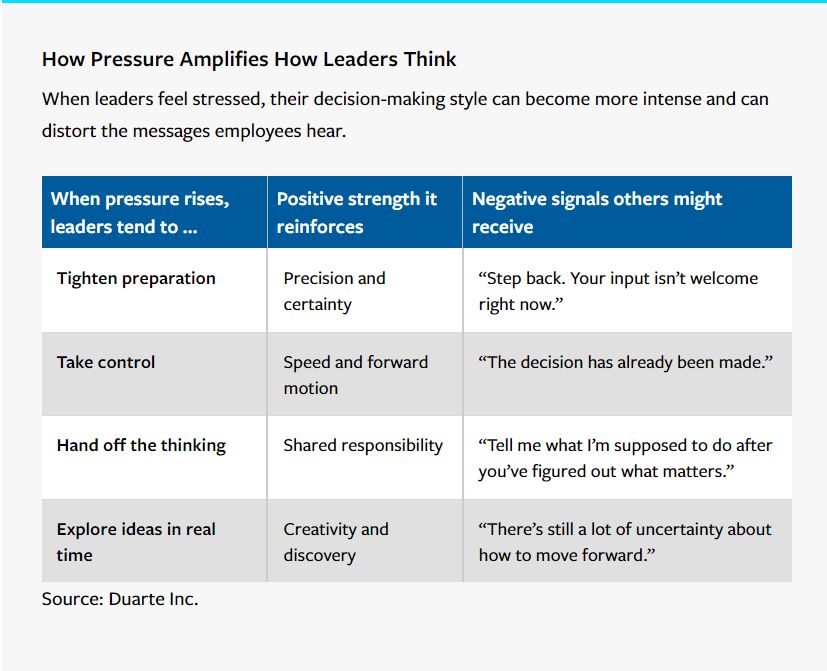
Many leaders spend so much time “perfecting” their presentations that they overlook what actually determines buy-in… The conversations in meetings where tough issues are being discussed. That’s where even some of the most skilled leaders see their communication break down. Even with sound thinking and an air-tight case, the room can still go quiet, and decisions can stall. When this happens, leaders usually look for a flaw in their execution. But they rarely examine one of the most common causes: Pressure. When the stakes rise in a meeting, leaders lean harder into the thinking process that made them successful. And what usually serves them starts working against them in the room. The leader who values precision gets tighter. Their team concludes their input isn’t welcome. The leader who values speed gets more decisive. Their team assumes the outcome is already determined. The leader who values exploration opens up more options. Their team struggles to understand what’s actually been decided. In each case, the leader leaves the room confident, but the team leaves confused. Leaders who handle these high-stakes moments best don’t try to overhaul how they communicate. They learn to recognize how their thinking shifts under pressure and make small, deliberate adjustments before the room goes sideways. I wrote about this in detail for @mitsmr, and I included a self-diagnosis framework for identifying which pattern you default to (and how to course-correct in the moment). Link to the article: sloanreview.mit.edu/article/why-le…
Nancy Duarte tweet media
English
0
0
6
527
Vanta
Vanta@TrustVanta·
$300M ARR. Just 9 months after hitting $200M, and growing faster every quarter.🚀 We founded Vanta to help businesses earn and prove trust. Businesses face more pressure than ever because trust leads to growth in the age of AI. 70% of companies now have Shadow AI operating in their environments, and AI tools are 52% more likely to carry a high risk designation than traditional SaaS. The compliance programs designed for annual audits weren't built for this, and neither was the old way of doing GRC. So we rebuilt it. The Vanta Agent runs as a 24/7 GRC engineer, eliminating the manual work that used to slow security teams down and orchestrating compliance, vendor risk, audits, and more, continuously. The Trust Graph maps your entire security posture in real time, so nothing slips through the cracks between reviews. 16,000 companies now run their security programs on Vanta, including 60% of the Forbes AI 50 and enterprises like Cursor, Samsara, Atlassian, and Snowflake—because the era of proving trust once a year and hoping nothing changes in between is over. To every customer who helped shape what Vanta is today: thank you. 💜 Read more from our CEO Christina: vanta.com/resources/vant…
English
14
6
132
34.7K
Nancy Duarte
Nancy Duarte@nancyduarte·
If your teams struggle to get buy-in from stakeholders, the problem is rarely what they’re pitching… It’s how they’re pitching it. I’ve watched this play out across organizations for decades. Leaders do thorough analysis, have airtight recommendations, and pack their presentations with tons of data. But stakeholders still say, “We’ll circle back.” (And that usually means “No.”) The disconnect often comes down to this… Data by itself rarely convinces someone to take action. It needs a storyteller to shape it, connect the dots, and give it meaning for a specific audience. Don’t assume that stakeholders will just “get it” if your leaders show them all the data. Your leaders need to make their insights clear, provide a clear recommendation, and make the path forward feel obvious to everyone in the room. This is the essence of data storytelling, and it is one of the highest-leverage skills your teams can learn. If you want help figuring out where you or your team stands when it comes to data storytelling skills and get specific recommendations for how to improve, here is a link to a quick assessment: drte.co/3KHAkbH
English
0
0
1
406
Microsoft 365
Microsoft 365@Microsoft365·
Today we’re expanding model choice in Microsoft 365 Copilot with the addition of Anthropic’s latest model—Claude Opus 4.7—in Copilot Cowork via the Frontier program, Copilot Studio early release cycle environments, and rolling out to Copilot in Excel. Start exploring: msft.it/6016Qhgsm
English
48
133
707
131.1K
Nancy Duarte
Nancy Duarte@nancyduarte·
After decades of working with leaders at companies like Apple, Salesforce, and Cisco, we've identified 4 storytelling techniques that consistently work to deliver important messages in high-stakes settings: 1. Start with the unexpected Don’t begin your presentation with context. Instead, begin with the moment that makes people think, “Wait…what?” Instead of something like: “Here’s an update on our September campaign…” Try starting with the most interesting detail: “I broke our biggest marketing rule last month, and it worked.” Lead with the surprise. You can add context later. 2. Let people feel the tension After the surprise, don’t rewind to the beginning. Take your audience to the moment where things weren’t working. Flat numbers. Missed goals. Stalled progress. Instead of: “The campaign was underperforming, and our team went back to the drawing board.” Try: "We were two weeks out from the end of the quarter. The campaign wasn’t producing results, and the team was out of ideas. That’s when I decided to take a risk...” You don’t need to explain the problem. You need to make people feel it. 3. Use real dialogue When your audience hears what was actually said, they stop listening to you and start visualizing the moment. This helps them connect emotionally with what you’re saying. Instead of: “The campaign manager said team morale was low and they were struggling to find a solution.” Try: “My campaign manager pulled me aside in the hallway and said, ‘We’ve tried everything. The team has been working overtime, and we don’t know what else to do.’” Dialogue brings listeners into the moment with you. It makes the story real. 4. Share the lesson Never assume people will infer the meaning you intended. End your story by answering: - What does this mean? - How should someone act differently now? Example: “Breaking our biggest marketing rule helped us turn this campaign around and hit our numbers. I strongly suggest we revisit our marketing guidelines. We could be leaving a ton of revenue on the table.” Without the lesson being clear, even a good story feels unfinished. These are the same techniques we teach to our clients at Duarte. Try them out during your next presentation and watch how people lean forward and tune in to your message
English
4
47
307
28.2K
Nancy Duarte
Nancy Duarte@nancyduarte·
Years ago, I was at a private TED event, and what I heard about presentations has stuck with me ever since… After slide:ology came out, Duarte was asked to help transform slides and speakers as they launched TED.com About 3 years later, I was at a curated table with several big deal TEDsters. And I asked this question: What do you miss most about the old way TED delivered presentations? Their answer surprised me… They said they missed the early days when they’d have a world-renowned scientist on stage who was so nervous they’d be shaking. Everyone in the audience would be cheering them on, and they would push through the fear to deliver incredible insights. There was something special about that level of authenticity. It was uniquely human. Unpolished. It helped the audience feel a real connection with the speaker. And it gave everyone an experience they’d never forget. Every high-stakes presentation needs to have some level of “polish”. The deck needs to be visually clear. Your message should follow a clear structure. You need to practice your delivery. But NONE of that will help you move your audience if you don’t develop an authentic connection with them. Your conviction about your topic, your vulnerability to be your true self, and your genuine belief in what you’re sharing are what your audience will remember.
English
1
3
14
1.4K
Nancy Duarte
Nancy Duarte@nancyduarte·
I used to believe leaders should always show up as their authentic, natural selves. I don’t believe that anymore. As a leader, you need to be a chameleon at times, changing your approach depending on what the situation needs. For a long time, I thought my role was to show up, discern, and decide. I assumed that was what good leadership looked like. Discern & decide… Discern & decide… That’s the job (or so I thought). But what I started to notice is that many people needed something else first. They needed warming up. They needed reassurance. They needed empathy. And in order to provide those things, I had to slow down. I had to stop assuming my natural way of showing up was the right way. I had to change my approach from: “What needs to get done?” To: - How is everyone feeling right now? - What do they need? - Am I actually meeting them where they are? Or just where I’m comfortable? Leadership, at its best, isn’t about being yourself 100% of the time. It’s about being who others need you to be when they need it.
English
1
1
33
3.6K
Todd McKinnon
Todd McKinnon@toddmckinnon·
At @Okta Showcase, we announced the blueprint for the secure agentic enterprise and showed how Okta for AI Agents helps every organization answer the questions: Where are my agents? What can they connect to? What can they do? Learn more here: okta.ai
English
2
2
6
2.3K
Nancy Duarte
Nancy Duarte@nancyduarte·
If you look at the story structure most movies use, you'll notice that roughly 10% of the time is for the beginning, 10% is for the ending, and 80% is the “messy middle”... which is the part leaders prefer to edit out. Why? Because most of us prefer telling a polished version of our stories: - Here was the challenge. - Here was the solution. - Here was the success. But when we do that, we miss the opportunity to give our audience something to deeply connect with. The messy middle is where the roadblocks show up, where we fall to our knees and question whether we're on the right path after all. It's usually the part that is the least fun for us to talk about... But the most meaningful for the audience to hear. When you share the messy middle, you become relatable. You become human. There’s neuroscience behind this. When someone tells a story, the listener’s brain fires in the same sequence as the speaker’s. You’re not just transferring information, you’re creating a shared experience. And shared experience builds empathy. That doesn’t mean oversharing. It just means acknowledging that the path wasn’t linear and that the struggle was real. Hat tip to Syd Field’s work, who writes about this in his book Screenplay: The Foundations of Screenwriting.
English
0
2
6
513
Nancy Duarte
Nancy Duarte@nancyduarte·
I attended something on March 3rd that I struggled to put into words. Hosted by my friend @aaker at Stanford, it was NOT a typical “AI event.” It was something far more human. She set up tables where crazy-impressive experts sat alongside a handful of students. The experts weren’t there to lecture, but to listen. Each student shared how the past eight weeks had changed them. And you could feel it. You’d expect a Stanford course about AI to teach students how we can produce more. This was about using AI to live better. It was not about productivity gains. She was talking about a beautiful life. A life of discovery, pursuit, health, impact, and savoring. Students each built and published simple tools to support who they were becoming. At the end, Jennifer gave a beautiful talk. She shared student reflections and then brought us to the edge of life itself. Because when people reflect on their lives, they don’t ask: Did I optimize enough? No. They ask themselves: -Did I live authentically? -Did I live boldly? -Did I stay connected to the people I love? That’s the frame for this entire course. It’s not “How can AI make us faster?” but “How can AI help us live lives we won’t regret?” While sitting at the table, listening to these students… I realized that if we teach this generation to use AI only to optimize work, we’ve failed them. But if we teach them to use it to expand their imagination and pursue a meaningful life… We might change everything. Jennifer, what you’ve built is rare. These students will never be the same. And honestly… neither will I.
Nancy Duarte tweet media
English
1
0
12
762
Nancy Duarte
Nancy Duarte@nancyduarte·
@levie Agree @levie but enterprises need services too. AI-ready templates rebuilt, workflows and strong agent ecosystems. it's all just starting.
English
1
0
0
142
Aaron Levie
Aaron Levie@levie·
We dramatically underestimate how much change management it is going to take to automate most knowledge worker tasks. Between data being in legacy environments or systems or without good APIs, context missing for doing the task, teams that are less technical, and other factors, there’s still a lot of work to drive real AI transformation in an enterprise. This is actually great news if you’re building right now because the opportunity is to build the software bridges to make this easier, or to build new services firms to help with this change management. Opportunity is all around for those looking.
Jason Shuman@JasonrShuman

Silicon Valley thinks AI agents are a $20/mo self-serve subscription. Main Street is paying local agencies $10,000 just to turn them on. Everyone assumes AI will be bought primarily online like Slack or Zoom. I think they are wrong. Some of the biggest winners in the AI boom won't be the software vendors. It will be the humans installing it. Here is the reality of SMBs right now: • 54% lack internal AI expertise. • 41% have data quality too poor for AI to even work. • 41% already prefer buying AI through a local IT provider. You cannot "1-click install" a genius AI into a messy CRM or a 15-year-old server. It will just execute the wrong tasks at the speed of light. The AI software will be cheap and a lot will absolutely be bought online. Making it actually work for a messy, real-world business will be expensive. Very bullish on the "Do It For Me" economy being back.

English
120
119
1.2K
266.3K
Nancy Duarte
Nancy Duarte@nancyduarte·
@Copilot We're building some crazy productive agentic flows in Copilot and i'm excited for Task and Cowork. Bring it on!!!
English
0
0
1
43
Microsoft Copilot
Microsoft Copilot@Copilot·
We love to hear it! We built Copilot Tasks for everyone and early feedback from people like you helps shape where Tasks goes next.
The Signal Pilot 🚥@thesignalpilot

@Copilot Tasks are awesome! Just got access so still playing around with it, but so far it's been amazing. Great job @Microsoft and @satyanadella. So many use cases for this feature that will supercharge productivity and save time!

English
15
9
157
14.1K
Nancy Duarte
Nancy Duarte@nancyduarte·
After decades of working with executives in board discussions, strategy offsites, and other high stakes moments where real decisions are on the line, I’ve noticed a consistent pattern. The leaders in these rooms are often some of the strongest communicators in their organizations, yet pressure has a way of revealing how each person processes complexity and the unintended signals they send when the stakes are high. My latest @mitsmr article offers a way to self diagnose those patterns, understand why you may be losing the room, and learn how to adjust before alignment starts to slip. sloanreview.mit.edu/article/why-le…
English
2
2
12
723
Sriram Krishnan
Sriram Krishnan@sriramk·
On a personal note : I’m very proud of what we have done today in establishing what are going to be some very key issues and rules of the road for AI in America. This was a long process with many people involved that deserve credit ( including many who don’t always agree on everything ) and vigorous discussions but one I’m very glad we had.
English
42
24
499
88.8K