The Narrow Way Offical Account

3.2K posts

The Narrow Way Offical Account banner
The Narrow Way Offical Account

The Narrow Way Offical Account

@Narrowway100

Sharing the light of Christ through His Word, philosophy, logic, and apologetics—breaking strongholds and exposing darkness with truth and love.

Katılım Nisan 2024
109 Takip Edilen274 Takipçiler
Sabitlenmiş Tweet
The Narrow Way Offical Account
The Narrow Way Offical Account@Narrowway100·
What fascinates me most about the current state of politics is the unwavering hope people place in earthly systems. But if you pick up the Bible, it’s clear—this world’s governments do not last, and they do not bring ultimate justice. No matter who is in power, no matter the policies, it all ends the same way: Jesus returns and establishes His kingdom. “The kingdoms of this world have become the kingdom of our Lord and of His Christ, and He shall reign forever and ever.” —Revelation 11:15 The hope people have in human rulers, parties, and systems is misplaced because true justice and righteousness can only come from Christ. Scripture tells us that no earthly government will ever bring perfection: “It is better to trust in the Lord than to put confidence in man. It is better to trust in the Lord than to put confidence in princes.” —Psalm 118:8-9 Jesus Himself made it clear that His kingdom is not of this world: “My kingdom is not of this world. If My kingdom were of this world, My servants would fight, so that I should not be delivered to the Jews; but now My kingdom is not from here.” —John 18:36 Every human government will fall, and every leader will fail in some way. But Christ will return as the righteous King, and His rule will be perfect, eternal, and just. If you are looking for perfection, justice, or salvation in any human leader, you are looking in the wrong place. “For unto us a Child is born, unto us a Son is given; and the government will be upon His shoulder. And His name will be called Wonderful, Counselor, Mighty God, Everlasting Father, Prince of Peace.” —Isaiah 9:6 No earthly system will ever fix what is broken in this world. Only Jesus can. And He will.
English

0
1
3
349
The Narrow Way Offical Account retweetledi
Josh Barzon
Josh Barzon@JoshuaBarzon·
The Old Testament in 1 Picture
Josh Barzon tweet media
English
2
69
343
7.8K
SheepDog Society LLC
SheepDog Society LLC@SDSLLC_USA·
If Biblical scholars hundreds of years after the Crucifixion of Jesus Christ can decide which books of the Bible were "just made up" and removed them from the texts so that we can't learn from them, then how do we know that the entire Bible isn't "just made up"? It's a fair and honest question. Insults will not be tolerated, this is a post for discussion.
English
263
10
127
18.6K
The Narrow Way Offical Account
We weren’t talking about Greek mythology. We were talking about whether Scripture was changed. Bringing up Greek gods doesn’t address that claim, it shifts the topic. That’s a red herring. Let’s stay on the actual question. What evidence do you have that the biblical text was altered?
English
1
0
3
35
SheepDog Society LLC
SheepDog Society LLC@SDSLLC_USA·
Every ancient civilization had a "God or Gods". Explain that. Why are Greek and Roman gods considered mythology now? What did they see that made them erect huge temples and structures to their fake gods? The same goes with other ancient civilizations. The Hebrews weren't the only ancient civilization to have a God.
English
6
0
5
294
✨💫Cali💫✨
✨💫Cali💫✨@505Cali2·
He's not coming through clouds. He's coming through consciousness.
English
87
95
653
12.3K
The Narrow Way Offical Account
@aquinasdaily1 Care to elaborate? What do you mean when you say persevere in your sins? Clearly you are not making presumption of a state of sinlessness this side of heaven?
English
2
0
1
114
St. Thomas Aquinas
St. Thomas Aquinas@aquinasdaily1·
Just as it is false that God does not pardon the repentant, or that He does not turn sinners to repentance, so is it false that He grants forgiveness to those who persevere in their sins.
English
1
7
89
1.7K
Aurora Martel
Aurora Martel@AuroraMar1eL·
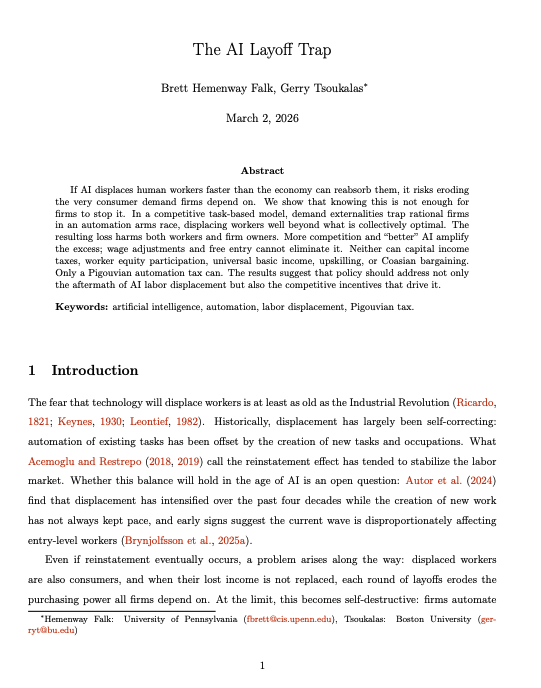
🚨BREAKING: Two researchers from UPenn and Boston University just published a paper that should be uncomfortable reading for every CEO automating their workforce right now. The argument is straightforward. Every company replacing workers with AI is also eliminating its own future customers. Laid off workers stop spending. Enough of them stop spending and nobody can afford to buy anything. The companies that fired everyone end up selling into an economy with no purchasing power left. Every executive can see this. The math is not complicated. But here is why nobody stops. If you do not automate, your competitor does. They cut costs, lower prices, take your market share, and you collapse anyway. So every company automates knowing it is collectively destructive because the alternative is dying alone while everyone else survives. The researchers proved this is a Prisoner's Dilemma playing out in real time. The numbers are already moving. Block cut nearly half its 10,000 employees this year. Jack Dorsey said AI made those roles unnecessary and that within the next year the majority of companies will reach the same conclusion. Salesforce replaced 4,000 customer support agents with AI. Goldman Sachs deployed a coding tool that lets one engineer do the work of five. Over 100,000 tech workers were laid off in 2025 and AI was cited as the primary driver in more than half those cases. 80% of US workers hold jobs with tasks susceptible to AI automation. The researchers tested every proposed solution. Universal basic income does not change a single company's incentive to automate. Capital income taxes adjust profit levels but not the per-task decision to replace a human. Collective bargaining cannot hold because automating is always the dominant strategy. They also identified what they call a Red Queen effect. Better AI does not solve the problem, it accelerates it. Every company chases faster automation to gain market share over rivals but at the end everyone has automated equally, the gains cancel out, and the only thing left is more destroyed demand. The one thing the math says could work is a Pigouvian automation tax. A per-task charge that forces companies to account for the demand they destroy each time they replace a worker. The conclusion is that this is not a transfer of wealth from workers to owners. Both sides lose. Workers lose income. Companies lose customers. It is a deadweight loss with no market mechanism to stop it on its own. Link t.co/AkgzBxi7jX
Aurora Martel tweet media
English
97
470
956
105.2K
Against Atheism
Against Atheism@AgainstAtheismX·
Atheism is arguably the biggest gamble known to man. And the only way they "win" is if this life actually IS a meaningless, chemically driven, random accident that ends with you rotting in the ground, forgotten.
English
155
32
253
10.3K
The Narrow Way Offical Account
I get what you’re trying to say, but that sounds stronger than Scripture actually allows. Saying “there is no question the Bible doesn’t answer” turns the Bible into something it never claims to be. Jesus pushes back on that kind of thinking directly. Look at John 5:39–40. He says, “You search the Scriptures because you think that in them you have eternal life; and it is they that bear witness about me, yet you refuse to come to me that you may have life.” That’s a rebuke of treating Scripture like it contains every answer in itself, instead of seeing it as pointing to Him. The Bible is absolutely sufficient, but it is not exhaustive in the way you’re describing. Deuteronomy 29:29 is clear: “The secret things belong to the Lord our God, but the things that are revealed belong to us…” That means there are real questions that exist where God has not chosen to fully reveal the answer. If every question were answered, there would be no “secret things.” Let me push this a bit. Are there questions about specific future events, personal decisions, or details of God’s will that Scripture does not spell out directly? Of course. That’s why we’re called to wisdom. Proverbs 25:2 says, “It is the glory of God to conceal things, but the glory of kings is to search things out.” Why would God conceal anything if every question were already fully answered? The issue here is a category confusion between sufficiency and exhaustiveness. The Bible gives us everything we need for salvation, truth, and godliness. But it does not claim to answer every possible question in detail. Even 2 Peter 3:16 acknowledges that some things in Scripture are “hard to understand.” So a tighter, more accurate way to say it is this. The Bible answers every question necessary for salvation and knowing God. But it does not answer every question we can ask. And that’s by design.
English
0
0
2
19
Back To Christ
Back To Christ@swilson_to·
There is no question where the Bible has no answer.
English
12
12
96
1.7K
The Narrow Way Offical Account
I get the concern, but this argument assumes abuse is the same thing as the doctrine. That is a major leap. Could someone misuse spiritual authority? Of course. But does possible abuse disprove the biblical practice itself? If that were true, we would have to reject preaching, counseling, marriage, parenting, and every form of authority because all of them can be abused. The biblical question is not, “Could someone twist this?” The biblical question is, “Did Christ give the Church a real ministry of reconciliation?” And the answer is yes. In John 20:21-23, Jesus breathes on the apostles and says, “Whose sins you forgive are forgiven them, and whose sins you retain are retained.” That only makes sense if confession is not merely private therapy, but part of the Church’s visible ministry. James 5:16 also says, “Confess your sins to one another,” so the idea that confession is automatically unbiblical just does not hold. Historically, confession was not invented as a blackmail system. The early Church took sin, repentance, restoration, and pastoral accountability seriously because sin damages both the soul and the body of Christ. The priest is not there as a spiritual spy. He is there as a minister of Christ’s mercy. In Catholic theology, the priest does not forgive by personal power. Christ forgives through the ministry He gave to His Church. There is also a critical thinking problem here. The post frames confession as “handing over leverage,” but that assumes the worst possible motive before proving it. That is not an argument. That is suspicion dressed up as analysis. Is the confessional sometimes vulnerable to human failure? Sure. But the existence of bad actors does not erase the command to repent, confess, and be reconciled to God. And here is the real question. If Christ gave His apostles authority to forgive and retain sins, how would that authority be exercised without knowing what is being forgiven or retained? If confession to another believer is biblical in James, and apostolic forgiveness is biblical in John, then the burden of proof is on the critic to show why the historic practice of confession is automatically corrupt. The Catholic view is not that you confess to a man instead of God. You confess to God through the ministry Christ established. That is not blackmail. That is accountability, repentance, mercy, and restoration. The abuse of a thing does not nullify the proper use of a thing.
English
0
0
0
14
𝚂𝚑𝚊𝚢
𝚂𝚑𝚊𝚢@ShayUnleashed·
The whole concept of “confessing your sins” to a pastor sounds more like a built-in blackmail system than a means of spiritual cleansing. You voluntarily hand over your darkest secrets and worst mistakes to someone who can now hold permanent leverage on you and control you.
English
102
24
235
8.7K
The Narrow Way Offical Account retweetledi
Pascal
Pascal@KnowsPascal·
We must be careful to avoid the love of argument for its own sake and the petty vanity of trying to trap an opponent. -St. Augustine
Pascal tweet media
English
7
99
565
6K
Talk Church
Talk Church@churchtalkative·
The greatest comebacks of all time: 1. Christ’s resurrection
English
8
14
191
4.1K
The Narrow Way Offical Account
@TrevorSheatz I see what you’re getting at here. I think intention is honorable, and at the same time might give the wrong impression. Heaven is for transformed people.
English
0
1
3
127
Trevor Sheatz
Trevor Sheatz@TrevorSheatz·
Heaven isn't for "nice" people. It is for wretched sinners who have been washed by the blood of Christ through repentance and faith in him.
English
59
153
959
10.6K
The Narrow Way Offical Account
That’s a fair question, but it’s probably one we should direct to the Author of life. I think we’re stepping into misplaced authority when we assume it’s our role to definitively define what life is and when it begins. Psalm 139:13–16 “For you created my inmost being; you knit me together in my mother’s womb… Your eyes saw my unformed body; all the days ordained for me were written in your book before one of them came to be.” This shows both God’s intimate involvement in formation and His knowledge before life unfolds. Isaiah 49:1,5 “The Lord called me from the womb, from the body of my mother he named my name… he who formed me from the womb to be his servant.” Here, calling and purpose are tied directly to the womb. Galatians 1:15 “But when he who had set me apart before I was born, and who called me by his grace…” Paul applies the same principle to his own life, showing this is not limited to Jeremiah alone. Job 31:15 “Did not he who made me in the womb make him? Did not one fashion us in the womb?” This emphasizes God as the Creator of all people in the womb. Luke 1:15 “…he will be filled with the Holy Spirit, even from his mother’s womb.” Speaking of John the Baptist, showing God’s work and calling can begin before birth.
English
0
0
0
7
Kristan Hawkins
Kristan Hawkins@KristanHawkins·
When does Life begin, and why do you believe that?
English
107
1
55
5.3K
The Narrow Way Offical Account
I get what you’re trying to say with this, but it flattens the context in a way that can mislead people. The issue with the Pharisees was not that they read Scripture, prayed, fasted, or went to the temple. Those are all good, commanded things. The issue was their motive. In the Gospels, Jesus consistently exposes that they were doing these things for recognition, status, and control, not out of love for God or others. Matthew 6:1 says they practiced righteousness “to be seen by others,” and Matthew 23 shows they loved honor, titles, and influence. That is a heart problem, not a habits problem. So it is not safe to draw a straight line from “Pharisees had religious habits” to “modern Christians practicing these same habits are missing God.” That skips the central issue, which is why those actions are being done. A believer reading Scripture, praying, fasting, and gathering with the church out of love for God and a desire to know Him is not mirroring the Pharisees. They are actually obeying what Scripture calls them to do. John 14:15 makes it clear that love for Christ leads to obedience, not the abandonment of it. Also, reducing it to “habits vs relationship” sets up a false divide. In Scripture, the two are not enemies. Right practices, done with the right heart, are part of a real relationship with God. James 2:17 reminds us that faith without works is dead. The problem is not the presence of habits, it is empty habits disconnected from genuine faith and love. Jesus’ rebuke was never “stop doing these things.” It was “do them for the right reason.” Matthew 23:23 is key. He says they neglected the weightier matters like justice, mercy, and faithfulness, but then adds, “these you ought to have done, without neglecting the others.” That tells you clearly, the practices stay, but the heart must change. So the real takeaway is not to downplay spiritual discipline. It is to examine motive. Are these things being done for self, or for God. That is the dividing line.
English
0
1
1
36
Talk Church
Talk Church@churchtalkative·
The Pharisees read their Bibles. The Pharisees prayed. The Pharisees fasted. The Pharisees went to the temple. Yet their hearts were far from God. Habits don't bring you to heaven, a relationship with Jesus does.
English
28
124
682
9.4K
The Narrow Way Offical Account
I see what you’re trying to wrestle with here, but this kind of post usually doesn’t land the way you think it does. Instead of pointing people to truth, it often pulls them into speculation and argument. Scripture actually sets a boundary on questions like this. Deuteronomy 29:29 says, “The secret things belong to the Lord our God, but the things revealed belong to us…” God has made clear what we need to know for salvation. When we go beyond that, we tend to replace trust with debate. The pattern of Scripture is not to fuel endless disputes but to build up the body. 2 Timothy 2:23 warns plainly to “have nothing to do with foolish, ignorant controversies; you know that they breed quarrels.” And Titus 3:9 goes further, calling these kinds of disputes “unprofitable and worthless.” That is not saying the question has no weight. It is saying the way it is often handled, especially online, does not produce anything good. It creates sides, not clarity. Even more, 1 Corinthians 8:1 reminds us that “knowledge puffs up, but love builds up.” When believers argue over things like this in public, it often reveals the goal is to win, not to care for people. Ephesians 4:29 calls us to speak only what “builds up… that it may give grace to those who hear.” Ask honestly, is this building people up, or just stirring them up? There is also a deeper issue. The enemy does not always need to introduce false doctrine if he can keep believers distracted. 2 Timothy 2:14 says to avoid “quarreling about words, which does no good, but only ruins the hearers.” If a conversation consistently pulls people away from the clear gospel, from repentance, from trusting Jesus Christ, then it is missing the point. Scripture keeps bringing us back to what is clear and life-giving. Micah 6:8 calls us to justice, mercy, and humility. John 3:16 centers us on belief in the Son. Matthew 28:19 sends us to make disciples, not win arguments. And when it comes to children, the posture of Christ in Mark 10:14 is not debate but compassion: “Let the little children come to me… for to such belongs the kingdom of God.” So here is the correction. If this conversation is not leading people to Christ, strengthening faith, or building up others, then it is not serving the purpose of the Church. There is a difference between faithful teaching and fruitless arguing. One produces life. The other produces noise.
English
0
0
1
38
Cheryl Schatz 🩸
Cheryl Schatz 🩸@CherylSchatz·
James White takes issue with John MacArthur's position that all infants and unborn children who die go to heaven. White argues that the same election that applies to adults applies to infants, meaning there are elect infants and non-elect infants. In his view, God makes no exception for the unborn or the very young when it comes to election and its consequences.
English
159
10
99
50.2K
The Narrow Way Offical Account
The argument sounds sharp at first, but it falls apart once you slow it down and examine what it assumes about God, evil, and human life. First, it treats God and the Devil as if they are two moral equals competing for allegiance. That is a category mistake. In Scripture, God is the source of all life, goodness, and moral order. The Devil is a created being in rebellion. You don’t evaluate the Creator and a rebel creature on the same moral plane. That’s like putting a judge and a criminal on trial together and asking who has the better case. One defines justice, the other violates it. Second, the claim that “the Devil never killed anyone” is simply false. Jesus directly contradicts that in John 8:44, calling the Devil “a murderer from the beginning.” The first death in human history traces back to the deception in Eden. Satan did not need to swing a sword. He introduced sin, and with sin came death, as Romans 5:12 makes clear. In other words, Satan is the root cause of death, even when he uses indirect means. He destroys by deception. Now to the harder point about God taking life. This is where people often smuggle in a hidden assumption, that human beings have ultimate ownership over their own lives. Scripture rejects that outright. “The Lord gives and the Lord takes away” (Job 1:21). Life is not self-generated. It is given. If God is the giver of life, then He is not morally bound in the same way creatures are when it comes to taking it. When a human takes life unjustly, it is murder because we are not the authors of life. When God takes life, it is judgment or the ending of a life He created and sustains at every moment. That does not make God arbitrary. It means His actions are tied to justice, not whim. The flood in Genesis 6 is not random violence. It explicitly says the earth was “filled with violence” and that human wickedness was continual. Sodom and Gomorrah were judged after prolonged moral corruption and after Abraham even interceded, showing God’s willingness to spare if there were righteous people (Genesis 18). The Canaanite judgment in Deuteronomy is tied to generations of extreme practices, including child sacrifice (Deuteronomy 12:31). These are not impulsive acts. They are judicial acts after sustained evil. Here’s the tension most people miss. The same God who judges is the God who delays judgment. 2 Peter 3:9 says He is “not willing that any should perish, but that all should come to repentance.” Judgment comes, but it is often preceded by long patience. That patience is mercy. And this is where forgiveness comes in, which completely undercuts the original argument. If God were only a destroyer, there would be no path back. But the entire arc of Scripture moves toward restoration. God does not just take life. He gives it back in a deeper sense. “I have no pleasure in the death of the wicked, but that the wicked turn from his way and live” (Ezekiel 33:11). That is why Christ comes. At the cross, you see both justice and mercy meet. Sin is not ignored. It is judged. But the judgment falls on Christ, not on those who trust Him. “While we were still sinners, Christ died for us” (Romans 5:8). The Devil offers no such thing. He accuses, deceives, and destroys. God judges, but He also redeems, forgives, and restores. So the question is not “Who killed more people?” That’s a shallow metric that ignores justice, authority, and purpose. The real question is: Who is the source of life, truth, and redemption? One leads to deception and death dressed up as freedom. The other has the authority to give life, take it, and then offer it back eternally through forgiveness.
English
1
1
5
88
𝒦𝑒𝓁𝓁𝓎࿎☽
The roles are reversed because everything is inverted and you have been looshed and pysopped for thousands of years. It's really that simple.
English
125
51
481
11.8K
The Narrow Way Offical Account
You’re speaking about a brother in Christ who can no longer respond, and that should matter. Christianity doesn’t call us to pretend sin didn’t exist, but it does call us to speak with truth, restraint, and the right motive. Right now, this sounds less like honest correction and more like tearing someone down who isn’t here to clarify or defend himself. Ask yourself what this actually produces. Is this building anyone up, pointing people to Christ, or just broadcasting someone else’s faults? Scripture is clear that our words are not neutral. We are accountable for them. If what you’re saying is true, then it still needs to be handled with humility and purpose, not as commentary. And if it’s not necessary or edifying, then it falls into the kind of speech we’re warned against. So here’s the real question. What is the goal of saying this now? Because if it doesn’t honor Christ, reflect grace, and serve others in a meaningful way, then it’s not just unhelpful, it’s wrong.
English
0
0
0
37
PaulsCorner-VerseQuest
PaulsCorner-VerseQuest@TNTJohn1717·
Tim Keller Exposed - When Gospel-Centered Cultural Engagement, Psychological Selfhood, and Urban Apologetic Theology Replace the Simplicity of Scripture There are some teachers who are easy to spot because they are wild, loud, gaudy, and plainly corrupt. They grin too much, beg too much, boast too much, and handle the things of God like carnival barkers working a crowd. Then there are others who come in through the front door of seriousness, intelligence, composure, education, urban sophistication, and cultural respectability. They do not wave a jacket and knock people down. They do not shout about seed faith and hundredfold returns. They sit calmly, speak thoughtfully, quote literature, analyze motives, answer skeptics, discuss culture, and make Christianity sound refined, intelligent, nuanced, and deeply relevant to modern life. Tim Keller belongs to that second category. He does not initially strike the average Bible believer as dangerous in the same way a prosperity clown does. That is precisely why he deserves a careful spotlight. The most effective doctrinal drift is often not the one that comes in yelling. It is the one that comes in sounding reasonable. That is the burden here. Tim Keller’s influence did not spread because he acted outrageous. It spread because he sounded measured. He built a whole ministry reputation around being the thoughtful urban apologist, the gospel-centered cultural translator, the man who could speak to Manhattan professionals, students, skeptics, artists, and intellectuals in a vocabulary they found plausible and respectable. He could talk about marriage without sounding like an old country preacher. He could talk about work, justice, community, city life, and identity in a way that made Christianity seem usable inside a modern urban framework. He could preach Christ while still sounding acceptable to people who were deeply shaped by psychology, pluralism, cultural sophistication, and professional ambition. Many believers took that as proof of depth. In reality, it often served as camouflage for a ministry method that steadily moved away from the sharper, simpler, plainer categories of Scripture. And that is where the real issue lies. Tim Keller’s ministry was built around a “gospel-centered” framework that expanded outward into culture, vocation, selfhood, city renewal, apologetics, marriage, justice, and social imagination. Now that language sounds harmless enough, and some of it in isolated form may even sound helpful. But once a teacher builds a whole interpretive system around “gospel-centered cultural engagement,” psychologically aware self-analysis, and a winsome, urbane apologetic posture, he can start replacing the Bible’s own plain categories with a polished evangelical synthesis. The Bible speaks with more force, more simplicity, more authority, and more directness than that system allows. Keller’s work often gives the impression that the great challenge of Christianity is to make the faith plausible, balanced, attractive, and culturally integrated for the modern educated person. But the apostles did not go into the world primarily trying to make the faith sophisticated enough for the city. They went preaching Christ crucified. Chapter 1: Tim Keller Turns “Gospel-Centered” Into a System Bigger Than Scripture’s Plainness One of the biggest issues with Tim Keller is the way he uses the phrase “gospel-centered.” On the surface, who could object to being gospel-centered? No Bible believer wants to be law-centered, self-centered, world-centered, or tradition-centered. The problem is not the phrase in isolation. The problem is what Keller builds around it. In his framework, “gospel-centered” does not remain the simple proclamation that Christ died for our sins, was buried, and rose again for our justification. It becomes an organizing lens for the city, work, wealth, justice, selfhood, marriage, social life, cultural renewal, and nearly every other area of life. The result is
PaulsCorner-VerseQuest tweet media
English
10
9
48
5K