Nico
2K posts

Nico
@Nicoqp
Probably AI at this point 🤖 | Helping You Navigate AI | Building The Next Million Dollar Idea (Me + My Agents)
Katılım Mart 2021
272 Takip Edilen9.3K Takipçiler
Sabitlenmiş Tweet

This is the part builders keep underrating.
AI is not just getting better at answering.
It is starting to compress search through idea space.
OpenAI@OpenAI
Today, we share a breakthrough on the planar unit distance problem, a famous open question first posed by Paul Erdős in 1946. For nearly 80 years, mathematicians believed the best possible solutions looked roughly like square grids. An OpenAI model has now disproved that belief, discovering an entirely new family of constructions that performs better. This marks the first time AI has autonomously solved a prominent open problem central to a field of mathematics.
English

Boris Cherny, the creator of Claude Code at Anthropic, just explained why most people aren't getting real results from Claude
in this podcast he breaks down exactly how most people never actually set up Claude:
- the 14% you lose to CLAUDE.md before typing a word
- the features that change how Claude thinks before you type a word
- the settings 95% of users have never opened
- the workflows hiding behind one toggle
if you've been using Claude for more than a month and never left the chat window, you have at least 30 untouched features. probably 38
instead of another show tonight, watch this
make sure to bookmark it before it gets lost in your feed
my breakdown of all 40 features is below
Khairallah AL-Awady@eng_khairallah1
English

the coding gap is getting weird
one person is spending years in uni waiting to feel ready
other is describing an app to AI and shipping it this weekend
AI turned plain instructions into real products
you can go from idea to app in days now, sometimes even in one day
if you learn how to give context, test, fix and ship
give yourself 6 months with AI and watch what happens
Avid@Av1dlive
English

@Suryanshti777 software engineering is slowly turning into agent management and system design
English

Andrej Karpathy just explained the future of software engineering without directly saying it.
The best AI engineers are no longer “prompting.”
They’re building systems around the agents.
Karpathy’s biggest insight wasn’t:
“Claude can code.”
It was:
LLMs become dramatically better when you force them into disciplined workflows.
That’s why "CLAUDE.md" files are suddenly everywhere.
Not because they’re prompts.
Because they behave like an operating system for the agent.
Karpathy called out the exact problems with AI coding:
- models assume instead of asking
- they overengineer simple tasks
- they hide confusion
- they rewrite unrelated code
- they optimize for completion, not correctness
So developers started encoding rules directly into the workflow:
→ Think before coding
→ Simplicity first
→ Surgical edits only
→ Goal-driven execution
And the results are wild.
People are now running multiple Claude Code agents in parallel like engineering teams:
• one agent researching
• one debugging
• one writing tests
• one optimizing code
• one validating outputs
Not “AI assistance.”
Actual orchestration.
And this part from Karpathy changes everything:
“Don’t tell the model what to do. Give it success criteria and let it loop.”
That is the shift.
From:
“write this function”
To:
“here’s the goal, constraints, tests, and verification system — now iterate until correct.”
The craziest part?
This already feels like a phase shift in engineering.
A lot of developers quietly went from:
80% manual coding → to 80% agent-driven coding in just months.
Not because AI became perfect.
Because the leverage became impossible to ignore.
We’re entering an era where the highest leverage engineers won’t necessarily be the best coders.
They’ll be the people who build the best systems around AI agents.

Suryansh Tiwari@Suryanshti777
English

future tech hiring probably won’t just be about building chatbots
they’ll be around memory systems, personal AI infrastructure,ambient computing, behavioral data and software that understands context instead of just commands
right now software only understands prompts, clicks and searches
the next generation probably understands patterns instead
feels futuristic rn but also feels like one of those posts people will revisit years later and realize how early this space still was

Josh@Building_Josh
English

Andrej Karpathy joining Anthropic is a bigger deal than most people realize.
This isn’t just a high-profile hire.
This is one of the most respected AI researchers alive, former OpenAI founding member, ex-Tesla AI lead, and the guy whose YouTube lectures taught an entire generation how neural networks actually work.
And now he’s joining Anthropic’s pre-training team.
That means working on the foundation itself, making the models smarter at the core.
Also worth noting:
Jan Leike left OpenAI for Anthropic.
John Schulman left OpenAI for Anthropic.
Now Karpathy.
That’s a serious pattern.
My read? Anthropic isn’t just building good AI products anymore.
They’re assembling an absurd research bench.
English

@Suryanshti777 start building systems around it and you'll see how strong it is
English

You've been using Claude for months.
And you're still copy-pasting the same context every single chat.
That's not a Claude problem. That's a setup problem.
Most people use Claude like a search engine.
Type. Get answer. Close tab. Repeat.
Top operators? They built a system.
And the whole system runs on 4 files.
Here's exactly how it works 👇
① CLAUDE.md — Your Foundation
Claude starts every chat with zero memory of you.
No preferences. No brand voice. No idea how you work.
CLAUDE.md fixes that.
It's one file Claude reads before every conversation.
Your brand rules. Your workflow. Your non-negotiables.
All loaded automatically — every single time.
Think of it as the onboarding doc for your best employee.
Except this employee never forgets what's in it.
What goes inside:
— How you write (tone, style, what you hate)
— Workflow rules ("plan before you execute")
— What Claude should NEVER do in your chats
Every time Claude gets something wrong → don't just fix the output. Fix the brief. Update the file. Make the mistake impossible next time.
② memory/ folder — Claude Remembers
Every correction, preference, and rule you've ever given Claude?
Gone. Next session, you start over.
Not anymore.
You can tell Claude to save anything as a memory file.
It creates a .md file in your memory/ folder.
It loads that file in every future session.
"Remember I never use bullet points in captions."
Done. Forever. Never say it again.
The real power move: after every strategy call or important decision, tell Claude to summarize and save it. Your entire business context — always in the room.
③ Skills — Your Custom Commands
Every time you write the same prompt twice, that's a problem.
Skills solve it permanently.
A skill is a reusable workflow you fire with one command.
/create → writes a post in your exact voice
/today → pulls calendar + inbox, plans your day
/repurpose → one post becomes 5 formats
/brief → messy notes become a clean scope doc
You describe what it should do.
Claude builds the SKILL.md file.
You fire it from any chat, any project, any time.
One hour of setup. Hundreds of hours saved.
④ Agents — Your Dream Team
This is where it gets serious.
An agent is Claude with one specific job.
A pipeline is multiple agents handing work off in sequence.
Example — content pipeline:
Strategist → picks the angle
Writer → drafts the piece
Editor → cuts and sharpens
QA Scorer → grades against your standards
Publisher → formats and sends
You give one instruction at the top.
The pipeline delivers a finished output at the bottom.
You didn't touch anything in the middle.
Use Opus for judgment and strategy.
Use Sonnet for execution and speed.
Right model, right job, every time.
THE CLOSE:
4 files. That's it.
Context. Memory. Skills. Agents.
This isn't about prompting better.
It's about building a machine that runs without you.
The people getting 10x results from Claude aren't smarter.
They just stopped treating it like a chatbot

Nainsi Dwivedi@NainsiDwiv50980
English

Marc Andreessen reveals AGI was crossed 3 months ago
"It was with the very latest versions of the leading models."
"One of the reasons people are having a hard time understanding AI is because its moving so fast."
"A lot of people use ChatGPT last year, the year before. They're not actually seeing the new thing right"
"new thing specifically is called GPT 5.5, Anthropic has this thing Claude called 4.6 and then Google has this thing Gemini"
English

@TechnicalBben The hardest part is surviving the phase where nothing seems to be working like im doing rn with few likes
English

The job market is getting reshaped fast because of AI.
I’ve always had an entrepreneurial mindset, and I probably always will. But seeing what’s happening now is wild.
Feels like the market is slowly pushing everyone toward building something for themselves.
One thing people don’t talk about enough though: this path takes time.
A lot of time.
Years where it feels like nothing is moving.
Years of learning, failing, restarting, doubting yourself.
Then one day the results start compounding all at once.
English

@daniel_mac8 your thought process is what you have to offer
that’s probably the most important ai advice people still underestimate
English

Two interns just started on my team. They’re software engineers, but this is the advice I’d give almost anyone who wants to use AI starting a career in knowledge work or a creative field:
1. Explicit knowledge helps. Don’t let it get in the way. The important skill is learning when to delegate to the agent and when to dig in yourself.
2. You own the creative direction. The agent handles the implementation details. Your job is to verify that the implementation stays true to your idea. If you hand the creative direction over to the agent, you’ll lose the uniqueness. You’ll get the average of what already exists. And because anyone can do that, it loses value.
3. Your thought process is what you have to offer. Everyone has access to AI agents now. Anyone can automate the creative process. Usually, what comes back is slop. The differentiator is learning to put your own judgment, taste, and humanity into the work.
That matters now. It will matter more.
English

@kimmonismus crazy how casually people talk about billions and millions here lol
English

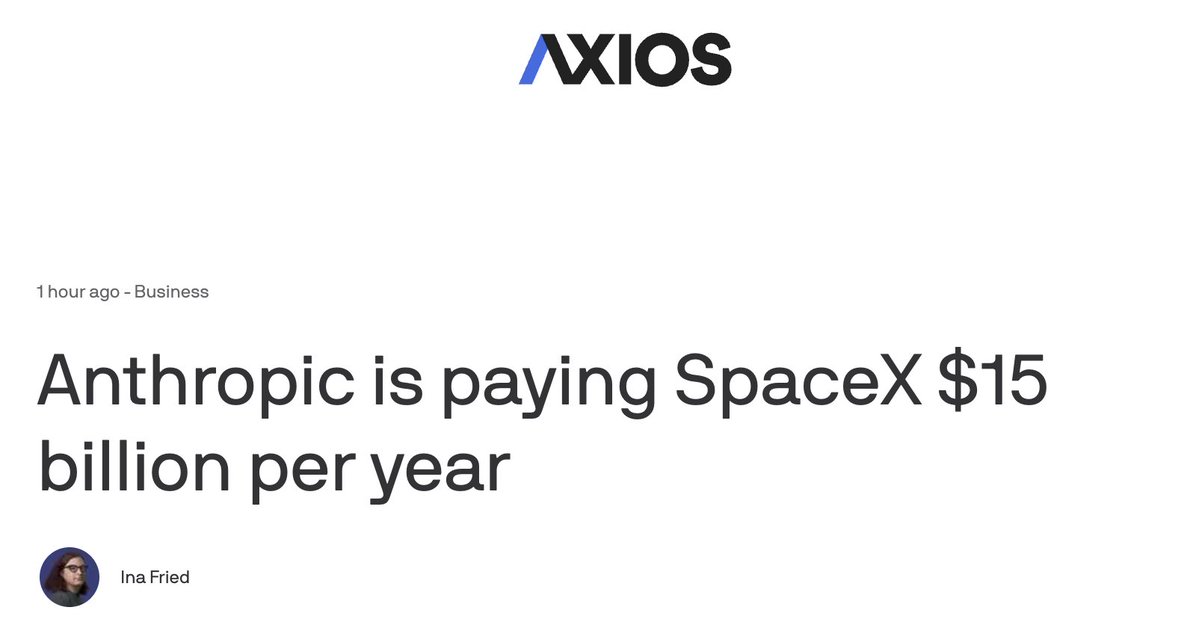
Anthropic is paying SpaceX $1.25 billion per month for compute. Per month.
That's $15 billion a year flowing to a company whose total annual revenue is $18 billion. One AI lab is about to account for the majority of SpaceX's commercial income.
We only know this because SpaceX filed for an IPO today and had to disclose the terms. The deal was announced weeks ago with no financials attached. Source: Axios

English

Claude Code feels completely different once you install this.
Anthropic quietly released an official plugin called claude-code-setup and it basically turns Claude Code from “pretty good” into an actual AI dev environment.
It scans your project and recommends:
→ hooks
→ skills
→ MCP servers
→ subagents
→ automations
Then sets everything up step-by-step for you.
Most people are using Claude Code completely vanilla…
which is why their experience feels messy.
The real power comes from the ecosystem around it.
Install:
/plugin install claude-code-setup@claude-plugins-official
Bookmark this before you forget it.
Suryansh Tiwari@Suryanshti777
English

dario has been marketing "mythos" in every interview, as if it is barely containable
he left openai because he was worried about AI risk and wanted to slow development, but he also understands that if you are not in the race, you become irrelevant
so scaring people in power serves his interests
English

Anthropic just dropped a free 27-minute workshop on prompting Claude.
Taught by the team that built it.
No registration. No paywall. No upsell at the end.
Here is what makes this different from every other prompting resource you have bookmarked and never finished.
Most prompting content teaches you tricks.
This teaches you architecture.
The people who built Claude explaining exactly how it processes instructions at a structural level.
Not surface-level tips.
Not "be more specific."
The actual mechanics of why certain prompts produce reliable outputs and others produce garbage.
The first 8 minutes alone cover what most $300 courses never get to.
I have watched a lot of AI content this year.
This is the one I would pay for if it was not free.
The gap between someone who prompts and someone who architects prompts is the gap between a Claude user and a Claude operator.
This workshop closes that gap in 27 minutes.
Watch it before you write your next prompt.
Bookmark it and send it to the person on your team who uses Claude every day and has never read a single line of documentation.
Follow @cyrilXBT for every Anthropic resource worth your time the moment it drops.
CyrilXBT@cyrilXBT
English

@sairahul1 DON'T USE CLAUDE WITHOUT SKILLS
DON'T USE CLAUDE WITHOUT SKILLS
English

DON'T USE CLAUDE WITHOUT SKILLS
Rahul@sairahul1
English

@JonhernandezIA ai is slowly turning scientific research into something scalable
English

“Scientific progress is becoming computable.”
DeepMind CEO Demis Hassabis says AI is becoming a scientific infrastructure layer, not just a productivity tool.
At Google I/O, he introduced Gemini for Science: a new set of AI systems designed to help researchers read papers, write code, and generate hypotheses faster. The real shift is that research itself is starting to scale like software.
English