S

2.1K posts

S

S

@NinBoss727

Katılım Ağustos 2023
125 Takip Edilen303 Takipçiler
S
S@NinBoss727·
@GavinSBaker I knew it, they told me four years life on chips my brain say no. I think minimum 6 to 8 years if not longer. Thank you, Gavin you make my day. You are such a tremendous person 👏
English
0
0
0
275
Gavin Baker
Gavin Baker@GavinSBaker·
The interest rates at which various chips - GPU or ASIC - can be financed as a function of expected useful life will have real implications for demand. Likely ends up being a significant advantage for the big green GPU incumbent over time.
English
32
28
478
58.3K
S retweetledi
Invest Like the Best
Invest Like the Best@InvestLikeBest·
Gavin Baker (@GavinSBaker) says the disaggregation of inference can extend GPU useful lives from 3-4 years to 10-15. That may single-handedly save private credit and reduce the financing rates for GPUs, which will drive demand and help finance the build-out. "The disaggregation of prefill and inference is going to be amazing for the useful lives of GPU and may single-handedly save private credit. Private credit is in pain from these SaaS loans. But there's a lot of private credit in GPUs too. They were underwriting that to 3-4. The disaggregation of inference means that these GPUs are going to have 10 or 15-year lives. The AI skeptics are like, "Oh, these companies are all cooking their books. The useful life of a GPU is only a year or two. The useful life of a CPU is only four years because the rapid technological change." No. What rapid technological change has done with the disaggregation of prefill and inference is you can put a Cerebras system or Groq LPUs effectively in front of a Hopper or even an Ampere, use that Hopper and Ampere for prefill, and extend the useful life of that GPU until it melts. This is going to be really good for the whole private credit industry. It's gonna help finance the AI build-out. Because if you can start to finance GPUs at 5% or 6% instead of – I think CoreWeave's lowest financing was low sevens – that actually mathematically changes the cost to finance this build-out."
Patrick OShaughnessy@patrick_oshag

This is my sixth conversation with @GavinSBaker. As always with Gavin, the conversation covers a lot of ground, but we spend the most time on watts and wafers. We discuss: - Why the wafer shortage may prevent an AI bubble - Data centers in space (reframed) - Elon's Terafab and the new chip companies challenging Nvidia - Usage-based pricing - The disaggregation of GPUs - DRAM, frontier tokens, and open source Enjoy! Timestamps: 0:00 Intro 7:55 Anthropic and OpenAI Valuations 12:58 Watts, Wafers, and Infrastructure 14:39 Orbital Compute and Data Centers in Space 22:49 Avoiding the AI Bubble 28:26 Terafab and the Future of US Manufacturing 32:16 Returns to the Frontier 37:23 Continual Learning 42:03 New Chip Companies 48:52 Extending GPU Lifespans and Private Credit 51:22 The Application Layer 57:32 The Token Path and Open-Source Dynamics 1:01:37 Cybersecurity 1:05:46 Diversity Breakdown 1:11:59 Assessing the Big Tech Players in AI 1:19:02 Geopolitics, Personal Safety, and the AI Horizon

English
18
45
376
178.5K
Adam Kobeissi
Adam Kobeissi@TKL_Adam·
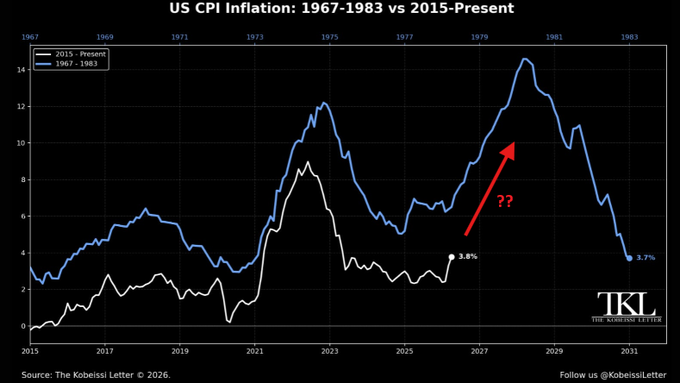
American consumers are now facing 7%+ mortgage rates, 4%+ inflation, and a 30% loss in the purchasing power of the US Dollar since 2020. The second half of 2026 is going to be interesting to say the least.
Adam Kobeissi tweet media
The Kobeissi Letter@KobeissiLetter

Bond markets are flashing red. Today, the US 30Y Note Yield officially hit its highest level since July 2007, at 5.19%. This will soon become Americans’ biggest problem, yet the vast majority do not even know it is happening. What is happening? Let us explain. (a thread)


English
168
828
3.8K
582.1K
S
S@NinBoss727·
@Castantine @TKL_Adam @KobeissiLetter Man you are so stupid even you cannot read your research 👇 It's monetary expansion, not literal currency printing. Like I thought you go back to school and go f - yourself ! Moron .
English
1
0
0
9
S
S@NinBoss727·
@Castantine @TKL_Adam @KobeissiLetter Bro, go back to school and learn to calculate who prints more money 💰 You are a democrat crap 💩 fanatic ! OK ✅
English
2
0
0
19
S
S@NinBoss727·
@Castantine @TKL_Adam @KobeissiLetter Bro, go back to history and take a look Democrats print more money and spend it to the garbage NGO and other crap OK
English
1
0
2
36
Timothy Castantine🕴
Timothy Castantine🕴@Castantine·
Please try being led brain dead. The Fed under Mr EasyMoney Trump printed more dollars than any president, BY FAR. He increased supply by an INSANE 47.37%! M2 Money Supply Trump (Term 1): $13.3T -> $19.6T (+$6.3T / +47.37%) [+1.575T per year] Biden: $19.6T -> $21.5T (+$1.9T / +9.6%) [+0.475T per year] Trump (Term 2 so far): $21.5T -> $22.6T [+1.0T per year]
Timothy Castantine🕴 tweet media
English
1
0
4
205
S
S@NinBoss727·
@aleabitoreddit Do you think $IREN can reach $150-$200 by 2030?
English
9
0
5
1.5K
Serenity
Serenity@aleabitoreddit·
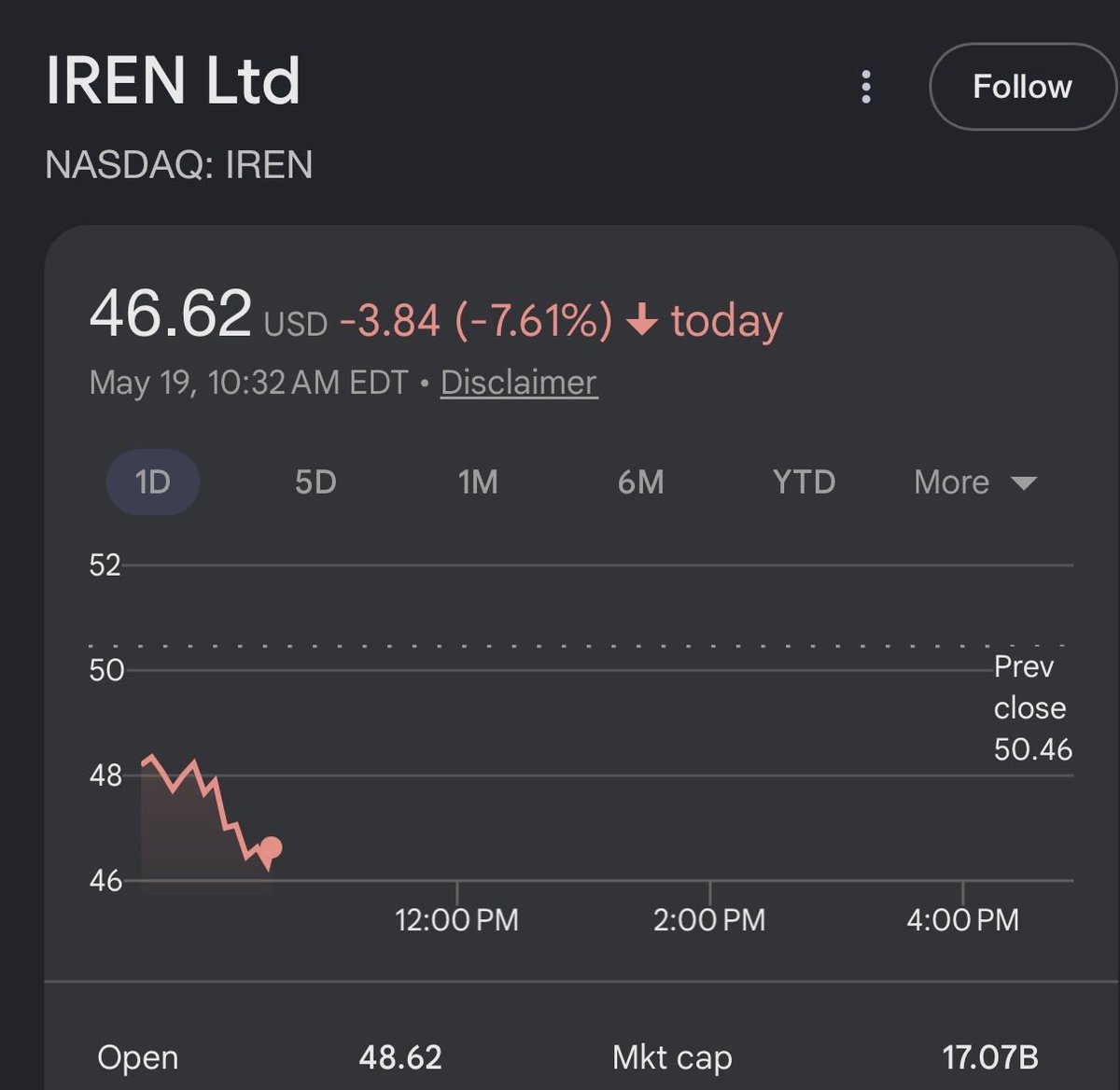
$IREN back down -34% from $70 to $46. I wonder if one of the dumbest communities on X finally learned to read? $NBIS is objectively the better Neocloud, with actual financing. -> Nvidia didn’t fund $IREN at all. They got a free purchase agreement to let IREN use their logos and dilute for GPUS. $NVDA actually gave $NBIS capital. -> $IREN is facing endless dilution like $BKKT, $ASST, $SLNH as retail wealth transfers capital over from $6,000,000,000 ATMs, on a dwindling “5 GW capacity” moat. $NBIS actually uses equity appreciating financing structures. And this is reflected in the YTD differences between them both. I’ve said the same thing last year too. One is up ~100%. The other is flat, and even negative depending on entry points. IREN is literally a marketing company at this point by how they manage to convince retail to wealth transfer over capital.
Serenity tweet mediaSerenity tweet media
Serenity@aleabitoreddit

I still am bearish on $IREN. Algorithms/retail probably read $NVDA + $IREN partnership and bought it up. However, if you look at the realtity, it's just looks like brand agreement giving $NVDA risk-free convertible notes. So $IREN can continue selling their $6,000,000,000 ATM into retail investors. It's the equivalent of a startup using AWS and saying they have an Amazon partnership so give them $6B. This wasn't Nvidia directly funding $IREN yet, just a risk free option to. There's a "5 GW deployment" but I'd rather not be the one buying into the dilution to fund it.

English
432
111
1.7K
716.1K
S
S@NinBoss727·
@dnystedt 💯% agree 👍
English
0
0
0
80
Dan Nystedt
Dan Nystedt@dnystedt·
Taiwan will remain critical for advanced semiconductors for at least another decade — not 12-18 months. Chamath is a sharp investor, but this feels like applying SaaS-style thinking (build once, scale infinitely at near-zero marginal cost) to the harsh realities of chip manufacturing. The physical world doesn’t work that way: -Leading-edge fab construction takes 2-3 years. -Equipment installation, process qualification, and reaching high yields in volume production adds at least another year. -Key tools like EUV machines have 12-16 month lead times. Taiwan/TSMC and its ecosystem still produce the vast majority of the world’s most advanced logic chips. The CHIPS Act is helping the US ramp up, but even optimistic projections show America reaching only around 14% of global advanced capacity by 2032. Just Look at Intel’s struggles. The painful reality behind its 5-Nodes-In-4-Years plan is showpiece process nodes. It’s not even winning 3nm customers away from TSMC, despite explosive AI chip demand. TSMC is expanding 3nm capacity (not even the most advanced node) - as fast as it can. There’s a mountain of money chasing 3nm capacity right now — yet none of it can be served by US production today. "Being “close” on a new process node in the lab is nowhere near “ready” for commercial manufacturing. TSMC’s Arizona plants are important (1st fab in production, 2nd coming), but they represent a small share of total capacity, come with higher costs, and still rely heavily on Taiwanese expertise. And it’s not just the fabs. Taiwan dominates the full supply chain — specialty chemicals, substrates, advanced packaging, talent clusters, infrastructure, and fab know-how built over decades. Replicating this elsewhere is extremely difficult. Bottom line: Smart “friendshoring” (Taiwan, South Korea, Japan, EU) plus building redundancy, makes sense. US investments are good long-term insurance, but they complement Taiwan’s capabilities, they do not replace them anytime soon. Its 'Silicon Shield' remains very much in place.
The All-In Podcast@theallinpod

Chamath: Taiwan Loses Its Strategic Importance in 18 Months @chamath: “ We're 18 months from Taiwan not being an important moment of conversation the way it is today. Why 18 months? Because we are at a point where we're probably 1-2 nanometers away from being able to do what we need Taiwan to strategically do for us. And so as we scale up our chip fabs, as we get more capacity, and interestingly, there are these orthogonal technologies being developed. I don't know if you guys saw, but Neuralink was showcasing a machine that is literally operating at the almost nanometer scale to do the brain operations for the implantation, all automatically. When you have the dexterity and the capability mechanically to make these things, the real reason then is a very different one than what it is today. Today, it's economic. And if you take that off the table, I think we'll have a very different attitude to Taiwan.”

English
43
64
390
46.9K
S
S@NinBoss727·
@GavinSBaker I listen and watch you with great respect 🫡 on this one you are 100% correct a single problem if they wanna do it .
English
0
0
0
5
Gavin Baker
Gavin Baker@GavinSBaker·
There are 100,000 births per year in Taiwan and TSM needs to hire 10,000 people per year in Taiwan, a number which will only grow. Continued expansion in the United States is likely inevitable. Especially given immense willingness to pay a premium for American wafers.
English
47
40
863
122.6K
S
S@NinBoss727·
@MittRomney Shut up you rhino 🦏!!!!!! LOSER !!!
English
0
0
0
5
Mitt Romney
Mitt Romney@MittRomney·
The Senate to now lose an exceptionally brilliant and creative mind, an MD who chairs healthcare, and a person of character. Bill Cassidy’s departure is a loss for the country.
English
16.1K
491
4.7K
2M
IvanaSPEAR
IvanaSPEAR@IvanaSpear·
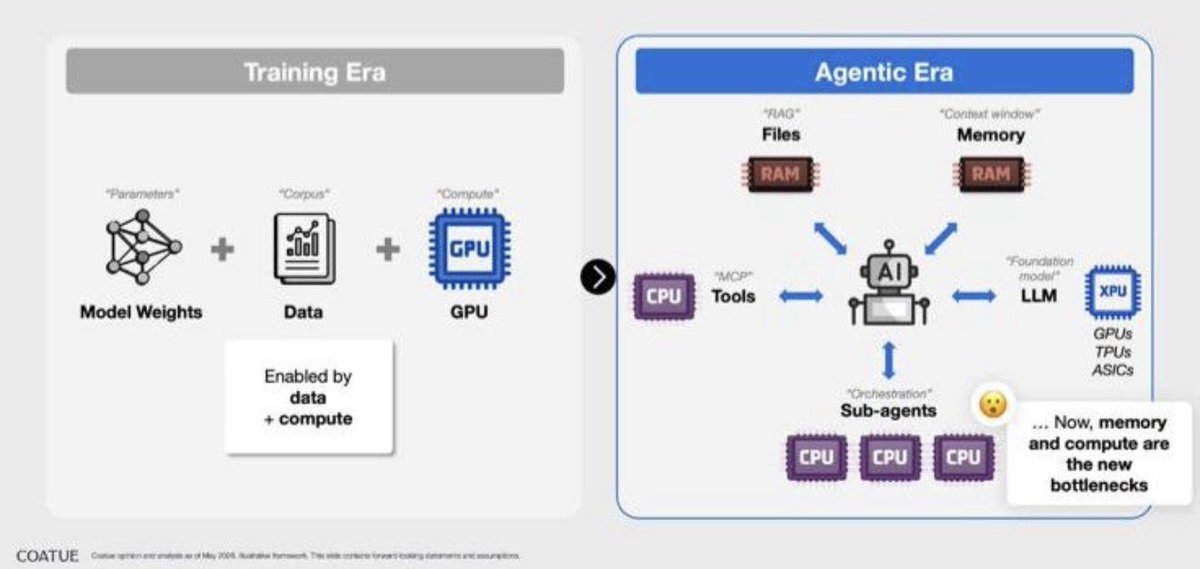
What does the Agentic AI explosion mean for AI Hardware? - 5x more memory - 12x more CPUs - 100x more networking Tune into @cvpayne at 2PM on @FoxBusiness for how to best capitalize on these trends.
IvanaSPEAR tweet media
English
3
6
33
3.3K
Shay Boloor
Shay Boloor@StockSavvyShay·
$EOSE is up over 30% after this print so I’m thinking about doing an Earnings Edge breakdown on the FE YouTube channel today. Would you all want that? @FuturumEquities/featured" target="_blank" rel="nofollow noopener">youtube.com/@FuturumEquiti
English
16
8
146
29.7K
Shay Boloor
Shay Boloor@StockSavvyShay·
$EOSE CRUSHED THEIR Q1 EARNINGS • Revenue: $57M vs. Est. $54M • EPS: $0.12 vs. Est. ($0.22) • Commercial pipeline: $24.3B (+56% YoY) • Backlog: $645M • Cash: $472M FY26 Guidance • Revenue: $350M vs. Est. $304M The company also surpassed 6.0 GWh of discharged energy in the field and completed Line 2 FAT.
Shay Boloor tweet media
Shay Boloor@StockSavvyShay

$EOSE and Cerberus are launching Frontier Power USA to deploy American-made long-duration energy storage projects using Eos’ Z3 zinc batteries. Cerberus is committing $100M of equity, with a 2 GWh capacity reservation and projects targeting 4-16+ hour grid storage.

English
32
143
859
183.6K
Wall St Engine
Wall St Engine@wallstengine·
Birthday today Another year older & the hunger has only grown It’s been a wild ride in the markets, but getting to cover it every day & sharing the journey with all of you has been the best part Grateful for everyone who has followed, supported, challenged, & grown with me ❤️
English
65
5
309
17K
S
S@NinBoss727·
In the next year (by mid-2027): IREN will be at ~1.2 GW AI cloud capacity with $3.7B+ ARR run-rate (and growing). Per-GW revenue stays in the ~$7–8B range on deployed load unless GPU density or pricing rises further. Still ~25–30% of the Sacks benchmark, but they are executing at hyperscaler scale with non-dilutive financing ($2.6B cash + GPU/customer prepays).
English
0
0
1
659
FreeFromMatrix
FreeFromMatrix@ViralMuzik1989·
David Sacks just laid out the math on a 1GW data center: → ~$50B capex → $25–30B annual revenue → ~2 year payback Now do the math for $IREN with 5GW secured power (Sweetwater 1.4GW already energized): → Potential **$125B – $150B ARR** at full scale → At 15–20x revenue multiple = $1.9T – $3T theoretical market cap Even at 2–3GW ramp: $300 – $800 stock price potential
David Sacks@DavidSacks

Back-of-envelope numbers for 1 gigawatt data center: All-in Capex: ~$50 bn Enterprise revenue generated: ~$25-30 bn/year Electricity cost: $1-2 bn/year ~2 year payback. The boom is real.

English
25
27
336
120.7K
S
S@NinBoss727·
In the next year (by mid-2027): IREN will be at ~1.2 GW AI cloud capacity with $3.7B+ ARR run-rate. Per-GW revenue stays in the ~$7–8B range on deployed load unless GPU density or pricing rises further. Still ~25–30% of the Sacks benchmark, but they are executing at hyperscaler scale with non-dilutive financing ($2.6B cash + GPU
English
1
0
0
477
David Sacks
David Sacks@DavidSacks·
Back-of-envelope numbers for 1 gigawatt data center: All-in Capex: ~$50 bn Enterprise revenue generated: ~$25-30 bn/year Electricity cost: $1-2 bn/year ~2 year payback. The boom is real.
English
581
939
12.5K
2.1M
S
S@NinBoss727·
@PalmerLuckey BRAVO 👏 👏👏👏👏👏👏👏
Português
0
0
1
24
Daniel Newman
Daniel Newman@danielnewmanUV·
Worthwhile read on why xAI handed over all that capacity to Anthropic. 👏🏻
Jukan@jukan05

Why did xAI hand over a 220,000-GPU cluster to Anthropic? The technical backdrop to xAI's decision to hand Colossus 1 over to Anthropic in its entirety is more interesting than it appears. xAI deployed more than 220,000 NVIDIA GPUs at its Colossus 1 data center in Memphis. Of these, roughly 150,000 are estimated to be H100s, 50,000 H200s, and 20,000 GB200s. In other words, three different generations of silicon are mixed together inside a single cluster — a "heterogeneous architecture." For distributed training, however, this configuration is close to a disaster, according to engineers familiar with the setup. In distributed training, 100,000 GPUs must finish a single step simultaneously before the cluster can advance to the next one. Even if the GB200s finish their computation first, the remaining 99,999 chips have to wait for the slower H100s — or for any GPU that has hit a stack-related snag — to catch up. This is known as the straggler effect. The 11% GPU utilization rate (MFU: the share of theoretical FLOPs actually realized) at xAI recently reported by The Information can be read as the numerical fallout of this problem. It stands in stark contrast to the 40%-plus MFU figures achieved by Meta and Google. The problem runs deeper still. As discussed earlier, NVIDIA's NCCL has traditionally been optimized for a ring topology. It works beautifully at the 1,000–10,000 GPU scale, but once you push into the 100,000-unit range, the latency of data traversing the ring once around becomes punishingly long. GPUs need to churn through computations rapidly to keep MFU high, but while they sit waiting endlessly for data to arrive over the network fabric, more than half of the silicon falls into idle. Google sidestepped this bottleneck with its own custom topology (Google's OCS: Apollo/Palomar), but xAI, by my read, has not yet reached that stage. Layer Blackwell's (GB200) "power smoothing" issue on top, and the picture comes into focus. According to Zeeshan Patel, formerly in charge of multimodal pre-training at xAI, Blackwell GPUs draw power so aggressively that the chip itself includes a hardware feature for smoothing power delivery. xAI's existing software stack, however, was optimized for Hopper and does not understand the characteristics of the new hardware; when it imposes irregular loads on the chip, the silicon physically destructs — literally melts. That means the modeling stack must be rewritten from scratch, which in turn means scaling is far harder than most of us imagine. Pulling all of this together points to a single conclusion. xAI judged that training frontier models on Colossus 1 simply was not efficient enough to be worthwhile. It therefore moved its own training workloads wholesale onto Colossus 2, built as a 100% Blackwell homogeneous cluster. Colossus 1, on the other hand — whose mixed architecture is far less crippling for inference, which parallelizes more forgivingly — was leased in its entirety to an Anthropic that desperately needed inference capacity. Many observers point to what looks like a contradiction: Elon Musk poured enormous capital into building Colossus, only to hand the core asset over to a direct competitor in Anthropic. Others read it as xAI capitulating because it is a "middling frontier lab." But these are surface-level reads. Look at the numbers and a different picture emerges. xAI today holds roughly 550,000+ GPUs in total (on an H100-equivalent performance basis), and Colossus 1 (220,000 units) accounts for only about 40% of the total available capacity. Colossus 2 — built entirely on Blackwell — is already operational and continuing to expand. Elon kept the all-Blackwell homogeneous cluster (Colossus 2) for himself and leased out the older, mixed-generation Colossus 1. In other words, he handed the pain of rewriting the stack — the MFU-11% debacle — to Anthropic, while keeping his own focus on training the next generation of models. The real point, then, is this. Elon's objective appears to be positioning ahead of the SpaceXAI IPO at a $1.75 trillion valuation, currently floated for as early as June. The narrative SpaceXAI now needs is that xAI — long the "sore finger" — is not merely a research lab burning cash, but a business with a "neo-cloud" model in the mold of AWS, capable of leasing surplus assets at high yields. From a cost-of-capital perspective, an "AGI cash incinerator" is far less attractive to investors than a "data-center landlord generating cash." As noted above, the most important detail of the Colossus 1 lease is that it is for inference, not training. Unlike training, inference requires far less tightly synchronized inter-GPU communication. Even when the chips are heterogeneous, the workload parcels out cleanly across them in parallel. The straggler effect — the chief weakness of a mixed cluster — is essentially neutralized for inference workloads. Furthermore, with Anthropic occupying all 220,000 GPUs as a single tenant, the network-switch jitter (unanticipated latency) that arises under multi-tenancy disappears. The two sides' technical weaknesses end up complementing each other almost exactly. One insight follows. As a training cluster mixing H100/H200/GB200, Colossus 1 was an asset that could only deliver an MFU of 11%. The moment it was handed over to a single inference customer, however, that asset transformed into a cash-flow asset rented out at roughly $2.60 per GPU-hour (a weighted average of the lease rates across GPU types). For xAI, what was a "cluster from hell" for training has become a "golden goose" minting $5–6 billion in annual revenue when redeployed for inference. Elon's genius, I would argue, lies not in the model but in this asset-rotation structure. The weight of that $6 billion becomes clearer when set against xAI's income statement. Annualizing xAI's 1Q26 net loss yields roughly $6 billion in losses per year. The $5–6 billion in annual revenue generated by leasing Colossus 1 to Anthropic, in other words, almost perfectly hedges xAI's loss figure. This single deal effectively pulls xAI to break-even. Heading into the SpaceXAI IPO, this functions as a core line of financial defense. From a cost-of-capital standpoint, if the image shifts from "research lab burning cash" to "infrastructure tollgate stably printing $6 billion a year," the entire tone of the offering can change. (May 8, 2026, Mirae Asset Securities)

English
6
2
45
13K