Andrew Simpson

291 posts

Andrew Simpson banner
Andrew Simpson

Andrew Simpson

@NorthBCPastor

Pastor of Heritage Free Presbyterian Church, Prince George,BC. Married 9 years to Naomi. 🇬🇧 living in 🇨🇦

Prince George, British Columbi Katılım Mart 2024
95 Takip Edilen32 Takipçiler
Josh Barzon
Josh Barzon@JoshuaBarzon·
What are your thoughts about the KJV? (King James Version Bible)
English
374
5
96
28.8K
Andrew Simpson retweetledi
CorkCity1185
CorkCity1185@1185City·
Real Ulster views on people down south in the Irish Republic in 1965 RTE Television Ireland
English
0
9
75
7.1K
Pope Leo XIV
Pope Leo XIV@Pontifex·
The Catholic Church has consistently taught that each human life, from the moment of conception until natural death, is sacred and deserves to be protected. Indeed, the right to life is the very foundation of every other human right. For this reason, only when a society safeguards the sanctity of human life will it flourish and prosper.
English
2K
5.2K
36.2K
921.2K
Jared Sparks
Jared Sparks@jaredksparks·
Paul was not an Elder: 1 Tim. 3 and Titus 1 require an Elder to be married with children: 1. Husband of one wife. 2. Leading his own household well. 3. Keeping his children in submission/Believing Children Objection “But Paul was single with no children so single men with no children can be elders.” Answer Paul was not an elder. He never calls himself one. He was an Apostle not an elder. If you think it's okay for a single man to be an elder, don't appeal to Paul.
English
22
1
39
7.3K
Andrew Simpson
Andrew Simpson@NorthBCPastor·
@rickbrennanjr @HoldenCCole I look forward to listening. Keep on reaching the mission field of Catholicism. I grew up in N.Ireland and saw first hand the superstition and darkness imposed by Rome.
English
0
0
1
17
Pastor Rick Brennan
Pastor Rick Brennan@rickbrennanjr·
@NorthBCPastor @HoldenCCole Not yet. I’m going to be starting a YouTube channel, God willing, this summer. I’ll post on X when we get up and running. Thanks for the encouragement.
English
1
0
3
47
Holden Cole
Holden Cole@HoldenCCole·
Weak Catholics become Protestants. Strong Protestants become Catholic.
Pastor Rick Brennan@rickbrennanjr

I was raised Roman Catholic for the first nineteen years of my life, and I have lived as a Protestant for the past fifty-three. Over that time, I have served as a layman, as a deacon, and now as a pastor within Baptist churches shaped by Evangelical Reformed theology. For that reason, the version of Protestantism described by many Catholics on X does not correspond to anything I have known in doctrine or in practice. Protestants do not approach baptism casually, as if it were something to be repeated at will. Scripture speaks clearly of “one Lord, one faith, one baptism” (Eph 4:5). Baptism marks entry into the covenant community as a public profession of faith, grounded in union with Christ in his death and resurrection (Rom 6:3–4). It is not a ritual to be multiplied, but a once-for-all sign of that union. In the same way, Protestants take marriage with full seriousness as a covenant before God. From the beginning, “a man shall leave his father and his mother and hold fast to his wife, and they shall become one flesh” (Gen 2:24; cf. Matt 19:4–6). What God has joined together is not to be treated lightly or dissolved according to preference. Our teaching and pastoral practice aim to uphold that lifelong covenant, even as we carefully work through the difficult pastoral cases addressed in passages such as Matt 19 and 1 Cor 7. Protestants also do not understand the church as a building. Scripture consistently speaks of the church as the gathered people of God: “you yourselves like living stones are being built up as a spiritual house” (1 Pet 2:5). The church is the assembly (ekklēsia) of those called out and joined together in Christ (Heb 10:24–25), who meet regularly for worship, for the preaching of the Word (2 Tim 4:2), for prayer, and for mutual encouragement as we persevere in faith. With respect to the Lord’s Supper, Protestants do not treat it as a mere symbol devoid of spiritual reality. It is an ordinance instituted by Christ—“Do this in remembrance of me” (Luke 22:19; 1 Cor 11:24–25)—in which we proclaim his death until he comes (1 Cor 11:26). In that act, we look back to the cross, we examine ourselves in the present (1 Cor 11:28), and we look forward to the marriage supper of the Lamb (Rev 19:9). And while we deny any change in the elements themselves, we affirm that believers truly commune with Christ by the Spirit. As Paul writes, “The cup of blessing that we bless, is it not a participation in the blood of Christ?” (1 Cor 10:16). The presence we experience is not physical, but it is real—mediated by the Holy Spirit and received by faith. I could continue, but the point is straightforward. The Protestantism I see described by Catholics is not one I recognize from Scripture, from church history, or from a lifetime within Evangelical Reformed Baptist life. It bears little resemblance to the convictions that have shaped my faith, my ministry, and the churches I have served.

English
56
13
197
8.3K
Pastor Rick Brennan
Pastor Rick Brennan@rickbrennanjr·
I understand that there is common Catholic trope that says: Weak Catholics become Protestants. Strong Protestants become Catholic. Why did I leave? I was not casually exposed to Roman Catholicism as a child; I was thoroughly formed by it. I was catechized for eight years by the Sisters of Charity, trained to know and recite the Baltimore Catechism, served as an altar boy, and then studied theology for four years in a Jesuit high school. Alongside that formal instruction, I pursued additional study on my own because I was seriously considering the priesthood. By any objective standard, that represents a high level of theological formation for a Roman Catholic teenager. By the time I was eighteen, I did not merely identify as Catholic; I understood the system, its categories, and its claims. Yet beneath that formation, there was a persistent uneasiness I could not resolve. At the center of that uneasiness was the question of assurance. The sacramental system promised grace, but I never felt secure in my standing before God. I knew that if I were to die having committed a mortal sin—even something like intentionally missing Mass—I stood in danger of eternal judgment. That awareness shaped how I thought about God. I was taught that God is loving and that Christ died for us, but functionally I lived as though acceptance depended on my ability to remain in a state of grace. My understanding of purgatory intensified this struggle. In reading Catholic devotional literature, I encountered descriptions of purgatory as a place of intense suffering, sometimes described as more severe than any earthly fire. The implication was clear: even if I died within the Church, I would still need to undergo prolonged purification before I could be fit for the presence of God. That left me with a troubling conclusion: Christ’s work, while necessary, did not seem sufficient to bring me fully into peace with God. While I understood the theology said Christ’s work was finished, I never experienced the peace that should follow from that truth, because there always remained the expectation of further purification before I could stand fully accepted before God. At the same time, I began reading Scripture more seriously, often in informal Bible studies. What struck me was not what I found, but what I did not find. I did not see a clear biblical foundation for purgatory or for the idea that my sins must be further purged through post-mortem suffering. Instead, I encountered repeated emphasis on grace, on the sufficiency of Christ, and on the possibility of real peace with God in the present (Rom 5:1). Yet my lived experience told a different story. The only moments of relief I knew came immediately after confession and penance, and even that peace was temporary. The cycle would begin again: examining my conscience, trying to recall every sin, striving to avoid even inward thoughts I knew were wrong. Outwardly, I was what most would call a “good kid,” but inwardly I was caught in a cycle I could not break. Compounding this was the exclusivity of the system itself. I was taught that salvation was found only within the Roman Catholic Church, and that even attending a Protestant service or Bible study could place my soul in jeopardy. As I studied Scripture, those claims of institutional exclusivity became increasingly difficult to reconcile with what I was reading. The turning point came through something deeply personal. After more than twenty years of marriage and five children, my father obtained an annulment—over the objections of my mother, who had been a faithful wife. I struggled to understand how a sacramental marriage could be declared null after two decades. The explanation was technical and grounded in canon law, but the practical reality was hard to ignore. My father had the knowledge, the connections, and the standing within the Church to make his case successfully. That moment forced me to ask a hard question: if a sacramental marriage could be declared never to have existed after twenty years, what did that say about the system itself and its claims to authority? Taken together, these experiences—my struggle for assurance, my growing conviction about the sufficiency of Christ in Scripture, my questions about purgatory and authority, and the personal crisis within my own family—pushed me to reconsider everything. Over time, I came to rest not in a system, but in Christ himself, trusting that his righteousness is sufficient, and that peace with God is grounded in his finished work rather than my ability to maintain it. But the real question for my Catholic friends on X is not what I understood at eighteen. The real question is this: after four years of formal seminary training—devoted to studying Scripture, theology, and church history at the graduate level—why do I remain Protestant? That question deserves an answer every bit as serious as the stories of those who have gone the other direction after their Protestant seminary experience.
English
11
4
50
676
Trad West
Trad West@trad_west_·
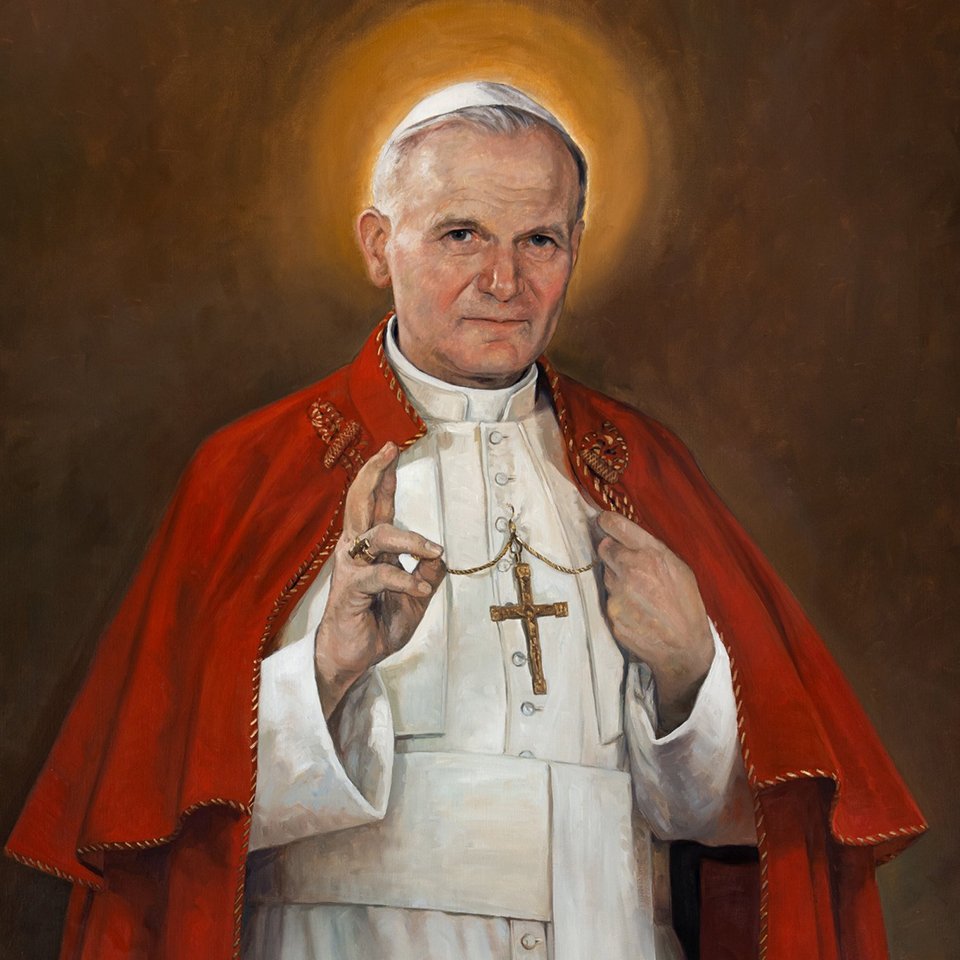
>Pope Saint John Paul II >Survived Communist occupation of Poland >Told millions living under Soviet rule: "Be not afraid" >Called out communism >Helped collapse the Soviet Union >Called out unbridled capitalism and consumerism >Called out declining birth rates >Calls out the modern "culture of death" >Called out the Iraq war >Took a bullet from an assassin and survived >Forgave his own attacker face-to-face >Fiercely defended the traditional family >Spoke 12 languages >Declared a Saint by the Church Pope Saint John Paul II was amazing.
Trad West tweet mediaTrad West tweet media
English
156
785
5.4K
102.5K
Andrew Simpson
Andrew Simpson@NorthBCPastor·
@PaulGolding Respectfully you're wrong Paul. Protestantism built Great Britain and if Britain is to be great again she needs to return to the Bible, not the superstitions of Rome or the East.
English
1
0
1
56
Paul Golding
Paul Golding@PaulGolding·
I'm a Protestant and agree 100%. If Catholics, Orthodox and Protestants ended the infighting, then the Lord will smile down on us. It has to be done to save Christendom. We unite and survive, or we fall separately.
Templarpilled@Templarpilled

I make fun of Protestants sometimes, but that's what you do with your friends and family. There's absolutely no scenario in which I'm going to support a "Catholic-Muslim alliance" against them. Given how many bigger issues there are, Catholic-Protestant infighting is dated and pointless.

English
51
17
162
8.9K
Benjamin Glaser
Benjamin Glaser@WVPitt·
@NorthBCPastor The very brief version is that the Lord used his sermon "Sixty Minutes to Go" to awaken my soul in the Fall of 2002 while filing financial aid paperwork at Shawnee State University in Portsmouth, OH.
English
1
0
3
273
Andrew Simpson
Andrew Simpson@NorthBCPastor·
@grailspear @mrs_k_r_ I perhaps misunderstood you. Were you not implying that Ian Paisleys FP Church acted as independent Presbyerians?
English
0
0
0
44
Mrs. K 🌼
Mrs. K 🌼@mrs_k_r_·
I’m new to Presbyterianism so can someone explain to me how you can have an *independant* *presbyterian* church? Isn’t a key feature of being Presbyterian that you have the presbytery? Without that isn’t it just reformed Congregationalism?
English
65
2
193
28.4K
Donald John MacLean
Donald John MacLean@djmaclean1·
Enjoyed finishing teaching the history of English Presbyterianism @WSeminaryUK this week. Last of three lectures…. origins, decline (x2) and current recovery. Lots of lessons to learn from the past… and lots of hope for the present!
English
3
1
28
939