
Nosedive🦧

2.5K posts

Nosedive🦧 banner
Nosedive🦧

Nosedive🦧

@NosedivePeace

rookie climate educator 🍦🌎

Katılım Nisan 2014
1.3K Takip Edilen201 Takipçiler
Nosedive🦧 retweetledi
Headquarters
Headquarters@HQNewsNow·
Trump is seeking to pay for his new $1.5 trillion military budget by cutting the following: $510 million - Grants for farmers and agricultural research $82 million - Loans for rural small businesses (Fully eliminated) $61 million - Support for farmers and food markets (Fully eliminated) $240 million - School meals and food education for children abroad (Fully eliminated) $659 million - Community building grants $47 million - Support for minority-owned businesses (Fully eliminated) $449 million - Economic development grants for communities $1.6 billion - Weather forecasting, fisheries, and coastal protection (NOAA) $993 million - Scientific research and technology standards $150 million - Support for American exports and trade $2.2 billion - Broadband and internet access programs $8.5 billion - Funding for public schools $1.5 billion - Vocational training and adult education (Fully eliminated) $2.7 billion - College access and higher education support $15.2 billion - Roads, bridges, and infrastructure projects $1.1 billion - Home energy efficiency and clean energy programs (Fully eliminated) $1.1 billion - Scientific research funding $386 million - Environmental cleanup programs $150 million - Cutting-edge clean energy research $4 billion - Help paying home heating and cooling bills for low-income families (Fully eliminated) $768 million - Refugee resettlement assistance $819 million - Care and shelter for migrant children $775 million - Local anti-poverty programs (Fully eliminated) $5 billion - Public health programs, mental health services, and disease prevention $5 billion - Medical research (NIH) $129 million - Healthcare quality and safety research $356 million - Emergency preparedness and disaster response $1.3 billion - FEMA community disaster preparedness grants $707 million - Cybersecurity protection for critical infrastructure $52 million - Airport and transportation security $40 million - Protection against chemical and biological weapons threats $53 million - Funding for homeland security operations $3.3 billion - Community development block grants for local neighborhoods (Fully eliminated) $1.3 billion - Affordable housing construction grants (Fully eliminated) $393 million - Programs to reduce homelessness $529 million - Housing assistance for people living with HIV/AIDS (Fully eliminated) $489 million - Housing and services for Native American communities $50 million - Grants to help communities build more housing (Fully eliminated) $60 million - Enforcement of fair housing and anti-discrimination laws $58 million - Homebuyer and renter counseling services (Fully eliminated) $45 million - Renewable energy development programs (Fully eliminated) $1.7 billion - Grants for local law enforcement and public safety $20 million - Civil rights mediation and legal access programs (Fully eliminated) $1.6 billion - Job training for at-risk youth (Fully eliminated) $395 million - Jobs program for low-income seniors (Fully eliminated) $234 million - Worker safety and labor protection programs $101 million - Enforcement of equal pay and workplace anti-discrimination laws $46 million - Programs to combat child labor and forced labor abroad $2 billion - International humanitarian aid $1.2 billion - Food aid for hungry families abroad (Fully eliminated) $4.3 billion - Global health and disease prevention programs $2.7 billion - Funding for the United Nations and international partnerships $642 million - International economic and treasury programs $315 million - Democracy and anti-corruption programs abroad $486 million - Grants for public transit projects $4.2 billion - Electric vehicle charging infrastructure $372 million - Airline service for rural and small communities $145 million - Grants for sustainable and equitable infrastructure $204 million - Loans and investment for underserved communities $1.4 billion - IRS taxpayer services and enforcement $100 million - Air pollution monitoring and reduction programs (Fully eliminated) $1 billion - EPA grants to states for environmental protection $2.5 billion - Clean drinking water and wastewater infrastructure funds $90 million - Grants to reduce diesel pollution (Fully eliminated) $3.4 billion - NASA space and earth science research $297 million - NASA technology innovation programs $1.1 billion - International Space Station operations $143 million - STEM education programs $309 million - Small business development and entrepreneurship programs $170 million - Small Business Administration operations $158 million - Loans for small businesses

Headquarters tweet mediaHeadquarters tweet media
English
4.1K
24.6K
54.3K
8.7M
Nosedive🦧 retweetledi
Plant trees•destroy lawns•decommodify food
We're gonna need roughly 10-15 million people to get really into plant breeding and crop research asap. Academia cannot possibly contain or organize the scale of scientific inquiry that will be necessary to meet this crisis.
Ben Noll@BenNollWeather

Plants say spring is here! 🌱 About 190 million Americans have experienced an earlier-than-normal spring leaf-out, based on the behavior of lilac and honeysuckle. Leaves emerged 30 to 50 days earlier than normal near the Rockies and in parts of the Plains, breaking records.

English
23
775
4.4K
137.6K
Nosedive🦧 retweetledi
Chris Meder
Chris Meder@EVCurveFuturist·
China deployed 100 fully autonomous electric mining trucks (mid-2025)… each running ~500–570 kWh batteries. That’s ~10× a Model Y. In -40°C. Swapping in minutes. Scaling to 10,000+ by 2026. This is the industrialisation of #Bettrification. Diesel doesn’t stand a chance.⚡🔋
English
83
436
1.6K
131.2K
Nosedive🦧 retweetledi
Angelica 🌐⚛️🇹🇼🇨🇳🇺🇸
Iran managed to lift sanctions in 4 weeks of war that they were not able to life with 40 years of negotiations. The west basically rewards raw power and punishes good-faith diplomacy again and again and again,
Javier Blas@JavierBlas

After a 7-year hiatus, India is about to import its first Iranian oil. At ~$100 a barrel. Quite the achievement in Washington for the long-term strenght of the economic and financial sanctions regime.

English
73
2.2K
9.8K
170.8K
Nosedive🦧 retweetledi
Shanaka Anslem Perera ⚡
JUST IN: Three thousand ships are anchored in and around the Strait of Hormuz. Twenty thousand seafarers are aboard them. Fresh food ran out two weeks ago. Perishables are rotting in refrigerated holds whose generators are burning through the last reserves of diesel. Water is rationed. Mental health is deteriorating. No mass evacuation plan exists. No humanitarian corridor has been negotiated. No international body has the authority or the means to move twenty thousand people off three thousand ships through a five-nautical-mile channel controlled by the IRGC. These are the people who move the global economy. Every barrel of oil that reaches a refinery was carried by a seafarer. Every container of goods that stocks a shelf was loaded by one. Every tonne of fertiliser that feeds a field was shipped by one. The war has trapped the invisible workforce that makes globalisation function, and the world has not noticed because the world never notices seafarers until the shelves are empty. The ships themselves are worth tens of billions. The cargo aboard them is worth more. Crude oil, liquefied natural gas, urea, ammonia, consumer electronics, automotive parts, and 200 cryogenic containers of helium that are boiling off at a rate that no engineer can reverse. The stranded fleet is a floating warehouse of every molecule the global economy needs, and the molecules are degrading while the crews ration drinking water. The cargo is valued higher than the people guarding it, and neither can move. The IRGC’s Larak corridor clearance system does not only control entry. It controls exit. A vessel that wants to leave the anchorage zone must obtain the same clearance code, submit the same documentation, and receive the same pilot escort as a vessel seeking to transit. The customs border works in both directions. These crews are not stranded by geography alone. They are stranded by bureaucracy, the same bureaucracy Iran wrapped in the language of sovereign maritime governance when the parliamentary committee approved the Hormuz Management Plan. The toll booth charges for passage through. It also charges for passage out. No centralised evacuation exists because evacuation at this scale would require IRGC approval, and requesting approval would legitimise the system the United States refuses to recognise. So the crews wait. The International Transport Workers Federation issues statements. P&I clubs cover individual medical evacuations by helicopter. Flag states, predominantly Panama, Liberia, and the Marshall Islands, register ships but do not operate navies. The system that made global shipping cheap by divorcing flag from nationality has left twenty thousand people without a government willing to retrieve them. The seafarers are from the Philippines, India, Bangladesh, Myanmar, Indonesia. Countries whose workers crew the world’s merchant fleet because the monthly pay of $1,500 to $3,000 exceeds anything available at home. They signed contracts to deliver cargo across oceans. They did not sign contracts to become indefinite residents of a war zone, rationing water on a ship whose cargo of ammonia could feed a million people if it could reach a port that is 40 nautical miles and one IRGC clearance code away. The helium boils off. The fertiliser waits. The crude oil sits. And the people who carry it all drink less water today than yesterday. The supply chain has a human body at the very bottom of it. The body is thirsty. open.substack.com/pub/shanakaans…
Shanaka Anslem Perera ⚡ tweet media
English
208
3K
5.8K
669.7K
Nosedive🦧 retweetledi
HealthRanger
HealthRanger@HealthRanger·
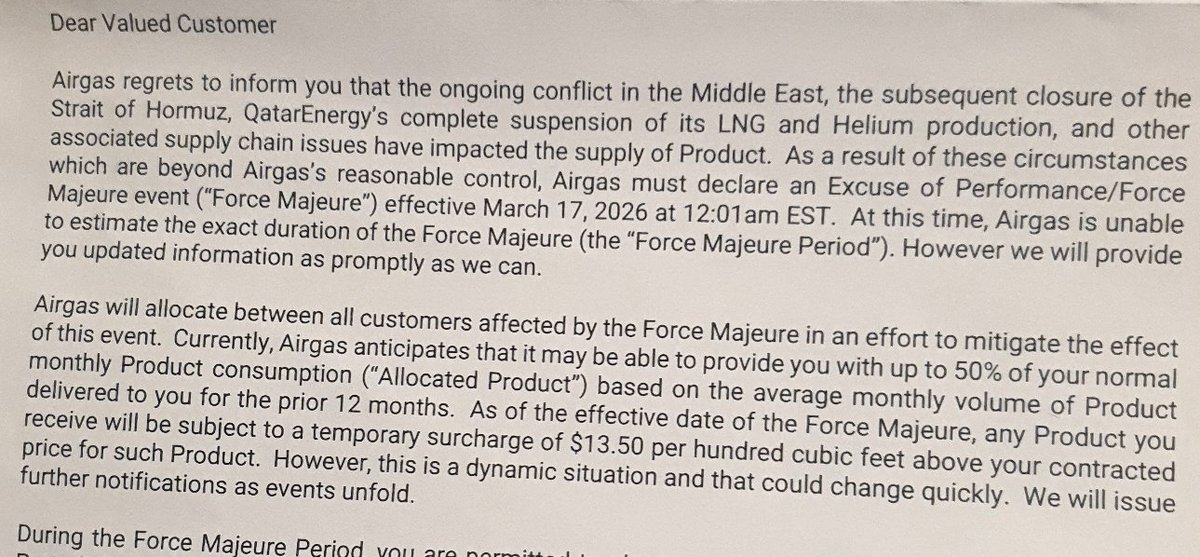
We just got this Force Majeure letter today from AirGas, our helium supplier (for our food science lab, where we have multiple mass-spec instruments that use helium). The letter says that helium supplies are cut off, and if you're lucky, you might be allotted HALF the helium you need. Even then, you will be charged extra for any helium you get. A LOT extra. So basically, every mass spec lab in America is about to go offline. AirGas is expressly invoking FM and saying they cannot meet their contractual obligations. Not their fault. Trump did this by attacking Iran. My lab is fine, of course, because I saw this coming and I ordered my lab staff to buy a one-year supply weeks ago. We already have it in place. So we're still up and running with plenty of helium. But very few lab science people are paying attention to the Strait of Hormuz, so they are getting blindsided by this. Trump's war is shutting down science labs all across the country right now. Don't dare call this "winning." It's a loss for America. And the world.
HealthRanger tweet media
English
2
3K
9.1K
339.5K
Nosedive🦧 retweetledi
Weather Monitor
Weather Monitor@WeatherMonitors·
Indonesia is on track to become the world champion of tropical deforestation. Under the Prabowo administration, over 433,000 hectares were cleared in 2025, nearly double the previous year. Driven by mining and palm oil, the loss equals six times the size of Singapore.
English
1.4K
12.7K
16K
588.6K
Nosedive🦧 retweetledi
Anish Moonka
Anish Moonka@anishmoonka·
There's no blue pigment in that flower. There's no blue pigment in any flower. Less than 1 in 10 flowering species can even make the color. The ones that do pull it off by mixing red pigments with tiny amounts of metals from the soil to bend the color your eyes pick up. Slightly off, and the petal goes purple, or just washes out to nothing. Scientists didn't figure out nemophila's specific trick until 2015. A research team in Japan isolated the pigment molecule and named it nemophilin. It was only the fifth blue-making molecule of its kind ever found in nature. Inside every petal, 12 molecules snap together with a magnesium atom and an iron atom into a tiny color engine. Pull the iron out, and the blue shifts to purple. The exact shade in this video comes down to how much iron the roots pulled from the soil. The plant is originally from California, by the way. A Scottish botanist named Archibald Menzies collected it off the Pacific coast in the 1790s, and the flower got named after him. Each one is about 6 inches tall. It only blooms in cool weather and dies when the second summer hits. But the part that got me is the history of that hill. The Japanese Army built an airfield on that exact site in 1938. After WWII, the U.S. military took it over for bombing practice. Miharashi Hill, the spot now covered with 5.3 million nemophila in this video, was the target. It became a national park in 1991. In 2002, the city started planting seeds in the old bombing zone. Every November, they go into the ground, get covered with frost sheets through winter, and for about two to three weeks each April, the entire hill turns blue. Breeders have been trying to make a true blue rose for decades through normal breeding. Still can't. Roses are missing the gene for the right starter pigment. Nemophila figured it out without anyone's help, and now 5.3 million of them bloom on a hill where bombs used to land.
Science girl@sciencegirl

Nemophila Harmony is a flower event in Hitachi Seaside Park in Japan About 5 million baby blue-eyes flowers (nemophilas) bloom

English
9
282
2.4K
265.2K
Nosedive🦧 retweetledi
Jeff Berardelli
Jeff Berardelli@WeatherProf·
“We find that, since 2003, the decrease of cloudiness has been responsible for half of the increase of Earth’s energy imbalance. Analysing the drivers of global changes to cloud cover, we find that the decrease in cloudiness over the past two decades has been primarily driven by humans, rather than being caused by natural variations in Earth’s climate… Our research finds that about 40% of the low-level cloud decrease since 2003 was driven by warming of the ocean surface – in other words, the cloud feedback process. This is followed by the effects of greenhouse gases (21%) and aerosols (14%).” carbonbrief.org/guest-post-how…
Jeff Berardelli tweet media
English
23
108
286
17.5K
Nosedive🦧 retweetledi
Hinokami Kagura
Hinokami Kagura@Khuze_Elikhulu·
Guys have yall this seen this AMAZING story of a sperm whale giving birth and TEN (10) other female whales were midwives who assisted her with the birth and helped lift the baby to the surface to take a first breath??? Coz I'm not seeing yall making the requisite noise
The Associated Press@AP

Rare footage of a sperm whale giving birth has offered scientists a window into the behavior of these large, elusive mammals.

English
76
11.3K
74.9K
1.3M
Nosedive🦧 retweetledi
John Bistline
John Bistline@JEBistline·
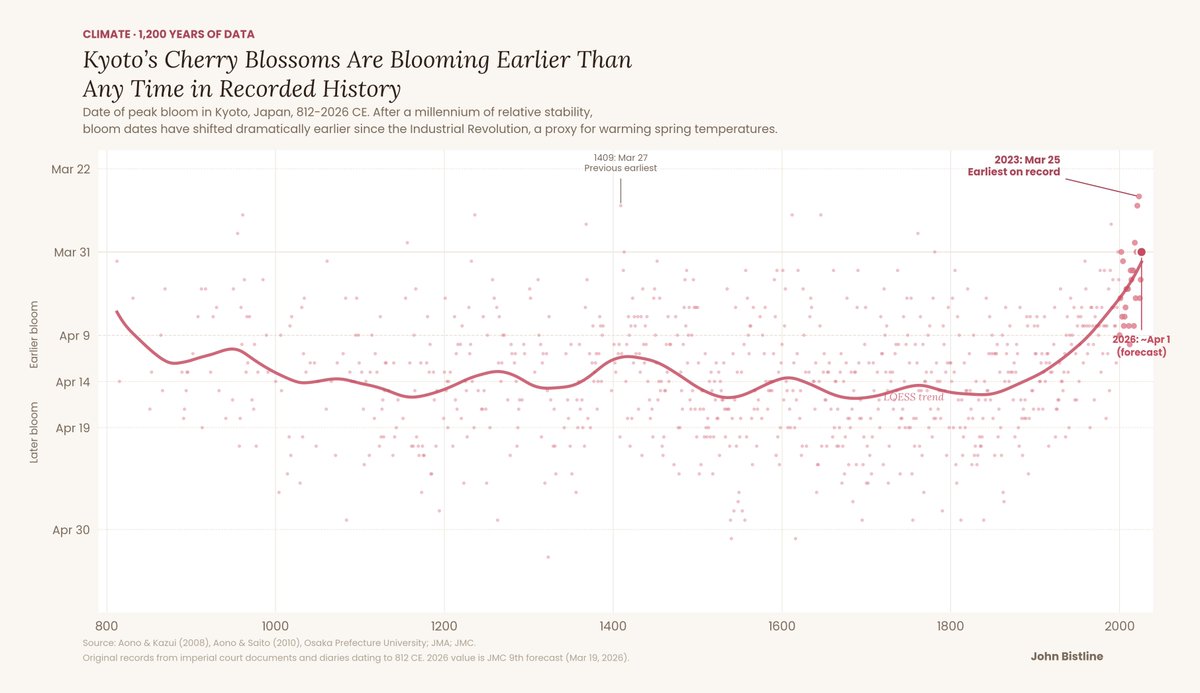
This is my favorite climate change chart. Japanese monks, aristocrats, and emperors kept meticulous records of cherry blossom festivals for 1,200 years and accidentally built the world's longest climate dataset.
John Bistline tweet media
English
216
9.2K
49.6K
1.6M
Nosedive🦧 retweetledi
Robbert Leusink
Robbert Leusink@robbertleusink·
Cotton needs ten times more water than flax The Netherlands grew flax for centuries The fabric lasts decades and needs almost no pesticides We dismantled the industry in the 1970s Now we import cotton from the other side of the world and call it sustainable fashion
Robbert Leusink tweet mediaRobbert Leusink tweet media
English
101
1.1K
5.3K
59K
Nosedive🦧 retweetledi
Policy Tensor
Policy Tensor@policytensor·
Footnote 4. “The closure of Hormuz has taken 34% of globally-traded crude oil, 12% of refined petroleum, 20% of LNG offline. It has taken 30% of urea and 25% of ammonia offline, putting the northern planting season at risk in the largest shock to food production in generations. Some 20% of aluminum production if offline too. In the chips supply chain, in addition to the LNG, 35% of helium, 60% of bromine, and 44% of sulphur are now offline. Unless the war ends soon and Hormuz is reopened, this will be the single greatest stagflationary shock in the history of the modern world economy. And the costs are cumulative. The longer the war lasts, the greater the stagflationary shock and the more central banks must respond by monetary tightening.”
Policy Tensor@policytensor

Read my latest: open.substack.com/pub/policytens… The discount expires tomorrow. Use it please. policytensor.substack.com/springsale

English
13
175
537
29.7K
Nosedive🦧 retweetledi
Daniel Aldana Cohen
Daniel Aldana Cohen@aldatweets·
Maybe the craziest thing about the vanishing cost of green energy is that we're still fighting oil wars.
Our World in Data@OurWorldInData

✍️ New article: Battery costs have declined by 99% in the last three decades, making electrified transport a reality— Over 20 million electric cars were sold globally in 2025 — some for as little as $10,000. Even just two decades ago, that would have been impossible. The reason it's possible now? Batteries have gotten *much* cheaper. In 1991, lithium-ion battery cells cost around $9,200 per kilowatt-hour. By 2024, that had fallen to just $78 — a decline of more than 99%. You can see this in the chart. To put that in perspective: the battery cells in a standard electric car today cost around $5,000. In 1991, those same cells would have cost nearly $600,000. There was no single breakthrough behind this. Batteries follow a “learning curve”: as cumulative production grows, thousands of small improvements in chemistry, manufacturing, and supply chains drive prices down. Since 1998, every time global cumulative battery production doubled, the price dropped by roughly 19%. Early progress was driven by consumer electronics — phones and laptops — before the technology became viable for cars, buses, and larger energy storage. Energy density has also more than tripled since the 1990s, meaning batteries can now store far more energy for their volume. The half-a-million-dollar battery was never going to transform transport. The $5,000 battery is.

English
42
158
782
21K
Nosedive🦧 retweetledi
Sandy Petersen 🪔
Sandy Petersen 🪔@SandyofCthulhu·
We have gigantic creatures in the sea which can sing for hours and have arteries so big you can crawl through them. (whales) We have birds that fly 50,000 miles every year. From the antarctic to the arctic and back again. (arctic tern) We have living creatures which never get old and never die naturally. (jellyfish) We have animals which you can force through a sieve, and they can reassemble themselves. (sponges) We have an ancient line of animals which once had 30 or more successful species, and has gone extinct down to just one single representative, and that representative has conquered the entire world (us). We have horrors that look just like rocks and if you step on them your whole world becomes agonizing pain. (toadfish) We have animals who hide inside other animals, and when you eat that animal, they enter your intestines and live there. (tapeworms) We have plants which live on other plants and never touch the ground. There's a fruit tree that grows around another tree, and eventually kills and replaces it. (strangler fig) We have gliding lizards, marsupials, snakes, frogs, and rodents. What the heck do you need fairies for?
@yducknow

what a boring planet… no fairies, no elves, no mermaids, no dragons, no vampires, no ware wolves….. just bills, stress, gossip, and insufferable people

English
550
6.1K
55.1K
1.9M
Nosedive🦧 retweetledi
James Reeves
James Reeves@jjreeves·
Kind of wild no one is talking about the fact that *as of today* oil companies can kill literally any animal in the Gulf of Mexico no matter how endangered
The Washington Post@washingtonpost

Breaking news: A committee led by the interior secretary voted to exempt oil and gas companies from complying with the Endangered Species Act when drilling in the Gulf of Mexico, which could threaten species facing extinction. wapo.st/4tjQcSA

English
114
7.3K
25.6K
420.1K
Nosedive🦧 retweetledi
Jason,
Jason,@jasonc_nc·
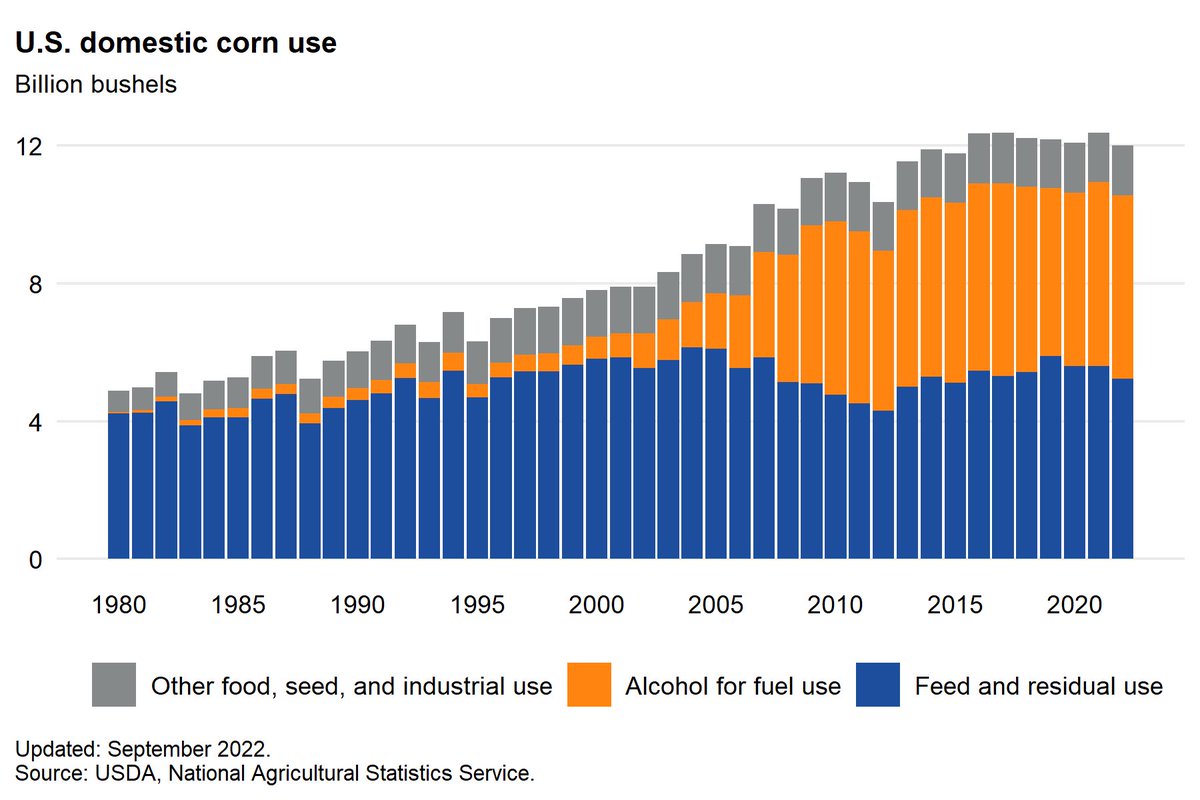
Effectively all growth in corn production over the last 20 years is for ethanol. ~20 million acres of conservation land, grassland, and soybean rotation was turned into corn monoculture that effectively strip mines the topsoil. Meanwhile it’s the most fertilizer dependent crop with only a 40% uptake rate. So ~1.7 million tons of nitrogen runoff flows into the Mississippi basin annually while also polluting their own water supplies. This runoff ends up expanding the Gulf deadzone, which is also where 40% of domestic seafood comes from. It’s hard to find a worse way to create fuel, with a wicked level of waste and downstream consequences.
Jason, tweet media
Jason,@jasonc_nc

45% of US corn production is for fuel ethanol and related. In other words almost half of the market is a form of ag subsidy with negative effects.

English
157
982
4.6K
403K