Nicholas Jager

45 posts

Nicholas Jager banner
Nicholas Jager

Nicholas Jager

@NotYetBankrupt

Stoked about reality, interested in the future. Trading with @CarstenPredicts. Hari Seldon on Discord. Glass artist

Midwest USA Katılım Haziran 2022
174 Takip Edilen160 Takipçiler
Sabitlenmiş Tweet
Nicholas Jager
Nicholas Jager@NotYetBankrupt·
On the prediction market insider trading debate, I was talking with a couple of new finance friends yesterday. One was for, and one was against. We had a good talk about why, intuitively, it seems like insider trading is good for truth seeking but it's actually bad. Prediction markets have two primary utilities. One is accurate pricing of future events, and the other is hedging. These markets only work if there are smart people incentivized to trade on them and make them efficient. Currently, and this is likely to change, there is not much hedging going on. So the main incentive for people to address inefficiencies is having counterparties that price things poorly and making money off of that bad pricing. In order for sharp forecasters to trade on these markets, they have to be confident that: 1. The trading platform is secure 2. Rules are fair and understandable 3. Their counterparties don't have an insurmountable information edge 1. and 2. are mostly there, but there are still some hiccups. With 3, however, if traders think their counterparties are insiders, then they don't want to trade against them. Who can beat an insider? No one! So they don't trade in those markets. If insider trading is allowed in all markets, and it's unknown which are insidered or not, then the risk profile for traders increases, and some really sharp people may not trade any markets! (Except for markets that are insider-proof, of course.) So now the insiders are the only ones setting prices Which is ?maybe? theoretically fine if there is an insider for all 20,000 markets constantly updating prices, but that's not currently the case and unlikely to ever be the case. The model in which prices are set by a combination of insiders+sharp forecasters is tenuous at best. And now with only insiders setting odds the pricing data is useless because it's illiquid and you don't know if the insider is manipulating it or not! Obviously, if you're a hedger, you don't want to hedge against a manipulated price because it wouldn't be fair or reflective of real probability. So actual optimal price setting and fulfilling the promise of these markets only comes when all participants are confident there are no insiders, which in my opinion means consistently banning insider trading.
Star Spangled Gamblers@SSGamblers

"In the context of prediction markets, there's a live debate on whether or not insider trading is even good or bad. The reason, basically, is because the value of these markets is the idea that they can create accurate odds for everyone to see. Of course, if there are people who are participating in the markets who have good information that they can trade on, that is actually going to create more accurate pricing in the markets. That can be very valuable if people want to know the real odds of, let's say, an election." — @pjchougule

English
3
1
11
995
Nicholas Jager
Nicholas Jager@NotYetBankrupt·
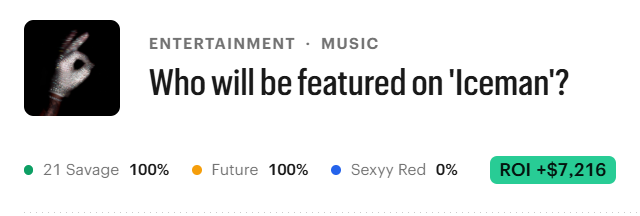
For a chronic No buyer, artist features being split across three albums is pretty nice
Nicholas Jager tweet media
English
0
0
4
38
Nicholas Jager
Nicholas Jager@NotYetBankrupt·
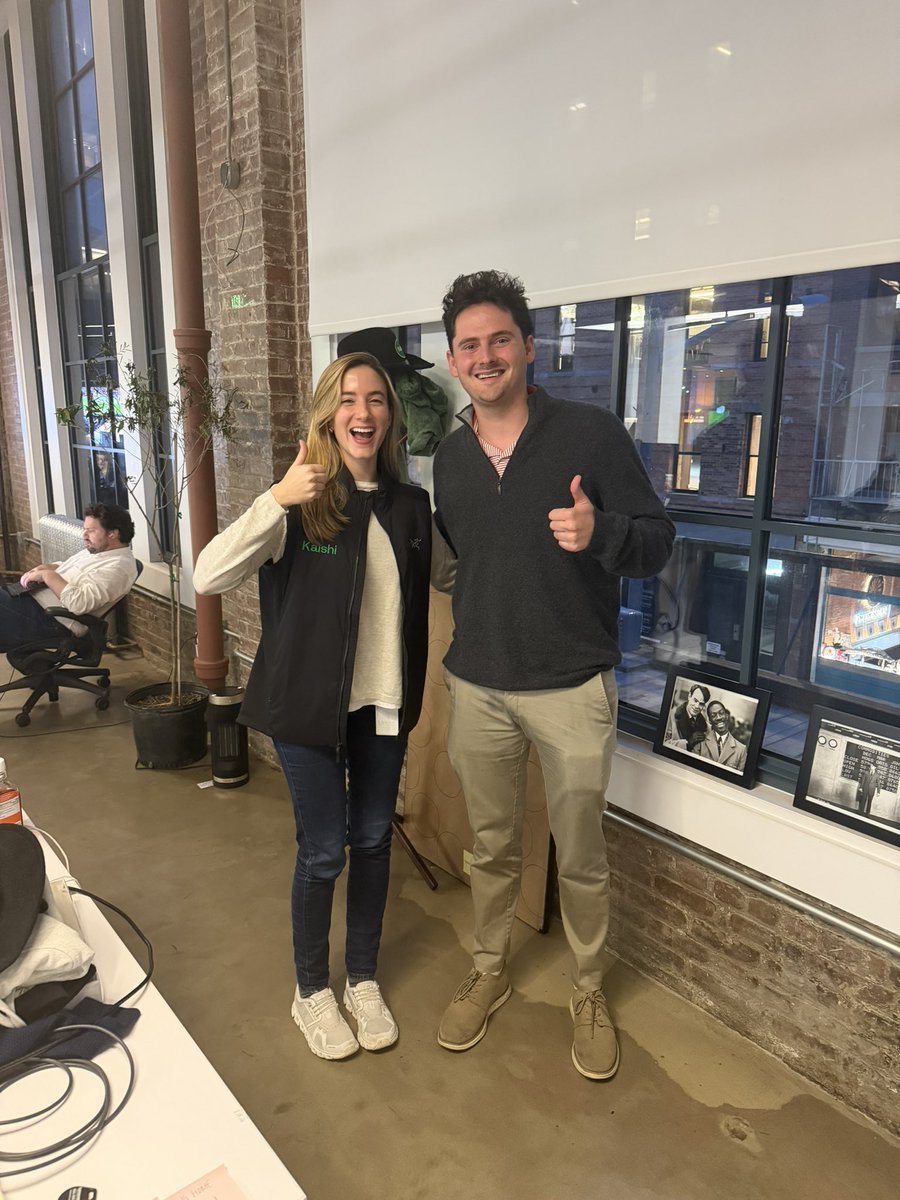
That's a lot of cash, I wonder what it will go to first. Maybe an additional culture markets hire? also throwback pic to meeting cool people.
Tarek Mansour@mansourtarek_

Kalshi raised $1B at a $22B valuation led by Coatue, with participation from Morgan Stanley, Sequoia, a16z, and others. In 2018, we were two kids who loved math, markets, and debate. And we had a dream: build the next generation financial market, where we capture a broader set of questions and harness the power of the masses to price them better than Wall Street. Kalshi was born to fulfill that dream. Today, most of these questions are traded indirectly, priced through imprecise proxies or negotiated bilaterally in opaque, restricted, relationship-driven markets. But thanks to our incredible community of users who make our markets work, Kalshi has the opportunity to change that by turning historically fragmented and untradeable risk into open, liquid, and standardized markets. We’ve seen this movie before. When interest rates, currencies, commodities, and crypto moved from dark to lit markets, volume did not just migrate: access expanded, new use cases emerged, and the opportunity grew by orders of magnitude. Today, Kalshi represents over 90% of US prediction market volume and the majority of activity globally, with annualized volume growing to $178B over the past 6 months. What started as retail is quickly becoming institutional — hedge funds, asset managers, prop firms, and insurers are beginning to trade, provide liquidity, and hedge real-world risk directly. The scope and scale of prediction markets are just beginning to take shape. We’re using this new capital to accelerate the institutional adoption underway — unlocking trillions in capital to facilitate active trading and risk management. Prediction markets are moving from early adoption to core financial infrastructure. This is just the beginning.

English
0
0
2
215
Nicholas Jager
Nicholas Jager@NotYetBankrupt·
Well, it is already happening, just largely off-platform. OTC desks base their pricing on PM data to provide hedges. An example being business owners hedging the result of the 2024 election - there was lots of off-platform activity there, grounded in platform pricing. The thing preventing substantial hedging right now is a lack of institutional liquidity. As liquidity grows, and it has been growing in orders of magnitude, hedging on-platform will become more viable. Institutional liq will likely get a big boost once margin is enabled. An oft-cited example I like is the opportunity for under-insured seaside homeowners to get insurance via betting against the severity of a storm. I'm sure there is some amount of on-platform hedging, it's just too small right now for big business. Maybe you could find a small business owner who hedged against tariffs in April 2025?
English
0
1
1
90
Nick Devor
Nick Devor@nickdevor_·
@NotYetBankrupt "Currently, and this is likely to change, there is not much hedging going on." Why/how is that likely to change?
English
1
0
0
47
Nicholas Jager
Nicholas Jager@NotYetBankrupt·
On the prediction market insider trading debate, I was talking with a couple of new finance friends yesterday. One was for, and one was against. We had a good talk about why, intuitively, it seems like insider trading is good for truth seeking but it's actually bad. Prediction markets have two primary utilities. One is accurate pricing of future events, and the other is hedging. These markets only work if there are smart people incentivized to trade on them and make them efficient. Currently, and this is likely to change, there is not much hedging going on. So the main incentive for people to address inefficiencies is having counterparties that price things poorly and making money off of that bad pricing. In order for sharp forecasters to trade on these markets, they have to be confident that: 1. The trading platform is secure 2. Rules are fair and understandable 3. Their counterparties don't have an insurmountable information edge 1. and 2. are mostly there, but there are still some hiccups. With 3, however, if traders think their counterparties are insiders, then they don't want to trade against them. Who can beat an insider? No one! So they don't trade in those markets. If insider trading is allowed in all markets, and it's unknown which are insidered or not, then the risk profile for traders increases, and some really sharp people may not trade any markets! (Except for markets that are insider-proof, of course.) So now the insiders are the only ones setting prices Which is ?maybe? theoretically fine if there is an insider for all 20,000 markets constantly updating prices, but that's not currently the case and unlikely to ever be the case. The model in which prices are set by a combination of insiders+sharp forecasters is tenuous at best. And now with only insiders setting odds the pricing data is useless because it's illiquid and you don't know if the insider is manipulating it or not! Obviously, if you're a hedger, you don't want to hedge against a manipulated price because it wouldn't be fair or reflective of real probability. So actual optimal price setting and fulfilling the promise of these markets only comes when all participants are confident there are no insiders, which in my opinion means consistently banning insider trading.
Star Spangled Gamblers@SSGamblers

"In the context of prediction markets, there's a live debate on whether or not insider trading is even good or bad. The reason, basically, is because the value of these markets is the idea that they can create accurate odds for everyone to see. Of course, if there are people who are participating in the markets who have good information that they can trade on, that is actually going to create more accurate pricing in the markets. That can be very valuable if people want to know the real odds of, let's say, an election." — @pjchougule

English
3
1
11
995
Nicholas Jager
Nicholas Jager@NotYetBankrupt·
I have a lot of respect for @SSGamblers and the SSG podcast helped get me into prediction markets early but I disagree with @pjchougule here on what makes an optimal long-term system
English
0
0
2
99
Nicholas Jager retweetledi
Esoteric Catboy
Esoteric Catboy@catboyautist·
There’s no other equivalent industry a guy with my skillset could drop into with 0 experience and make a million dollars in half a year Journos love to paint profitable traders as though we are some kind of enigma but there’s really nothing special about most of us.
Nicholas Jager@NotYetBankrupt

I have been able to become a professional trader with no prior trading experience, and I trade completely manually and directionally. No quant bg needed. It's not impossible

English
8
4
64
9.9K
Nicholas Jager
Nicholas Jager@NotYetBankrupt·
Of course, with it being zero sum someone always loses. It'll be interesting in the future to see how much of those losses are hedging. For now it's a tournament but it's still really early and new participants are coming in and crushing old frequently
English
0
0
3
599
Nicholas Jager
Nicholas Jager@NotYetBankrupt·
The WSJ story about the guy who lost it is more of a risk management issue than anything. 5 different approaches to the same market can all be profitable. There's room for many people to think creatively and work hard and make money
English
1
0
1
630
Nicholas Jager retweetledi
Benjamin Freeman
Benjamin Freeman@benwfreeman1·
Election traders, mentions traders, culture traders
Benjamin Freeman tweet media
English
6
3
66
3.2K
Nicholas Jager
Nicholas Jager@NotYetBankrupt·
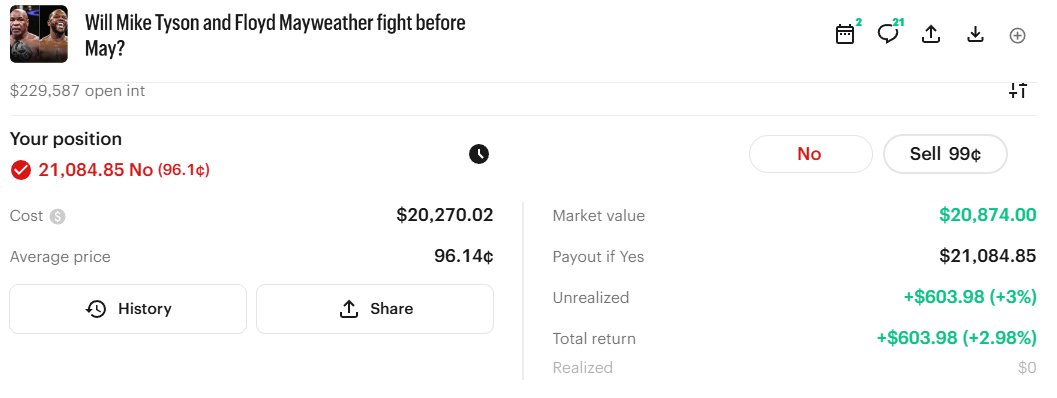
Looked at this a couple weeks ago. Tyson in a cast recently, no venue or advertising, not sure why this was still trading in 2-4c range. Because they said they'd do it? Might not even happen
Nicholas Jager tweet media
English
0
0
2
151
Nicholas Jager
Nicholas Jager@NotYetBankrupt·
Moonlight is also just a good person and a pleasure to talk with. Great success couldn't go to a better guy
Esoteric Catboy@catboyautist

Seven months ago I started trading on @Kalshi with just $1,000. Today, I made my first million! It's been an incredible journey, and I am so grateful for all the friends and knowledge I've acquired along the way. I won't sugarcoat it, at one point I was really worried about my future. When I started trading I was an unemployable CS student with no internships working a 15.45$/hr retail job. I'll spare the details but struggling with chronic physical and mental problems also compounded my worries. A few months in, I graduated early with a $100K port, quit my job and then transitioned to trading full time. Since then, I managed to 10x my port, and have seen @PredictHQ_ grow from a casual hangout chat with @Jarrad_sol and @locksy to the hottest prediction market community around! I feel as though a world of weight has been lifted from my shoulders, I've been grinding so damn hard every single day to bring this goal into fruition. Now that I've finally achieved it, I don't know what's in store for me next. All I know is that I'm incredibly thankful to everyone who believed in and helped me when I was but a fish posting on here. Love you guys♥️

English
0
0
4
259
Benjamin Freeman
Benjamin Freeman@benwfreeman1·
BIG NEWS: I’m joining the Kalshi team! My main goal is going to be growing Kalshi’s political / election markets in terms of visibility, volume, and influence, and showing the world why these markets are so important. This means that I have given up trading on Kalshi. While I loved being a trader and loved giving away “alpha” to my followers, I can no longer do so due to Kalshi’s policies. It was a hard tradeoff for sure. From my days of interning at the White House, starting my own election prediction Youtube channel, to starting trading on Kalshi’s election markets in October 2024, politics, and specifically predicting elections has always been my passion. Since starting tweeting in October 2025, I wanted to show a new audience of why I believe in the power of election prediction markets. I’ve 20x’ed my followers since starting then, and have had a blast doing it along the way with y’all. Now, my goal is to drive liquidity to these markets and make them a bigger part of the cultural zeitgeist and political landscape. Having very liquid, high volume political prediction markets makes our political system better. More accurate forecasts benefit traders and non-traders alike, and growth in political prediction markets translates into higher participation and interest in our political system, which is good for democracy. These markets are built on rationality and probabilistic thinking, which is desperately needed in today’s corrupted information environment. These markets can be incredibly useful for campaigns, political commentators, casual political viewers, fundraisers / bundlers, investors wanting to hedge political risk, investors wanting political exposure, small dollar campaign donors, academics, and everyone in between. Political prediction markets are for everyone. I’m really excited to be a part of the team that mainstreams these markets. Feel free to reach out to me, if you have any ideas on how to grow Kalshi’s political / election markets! Thank you, all!
Benjamin Freeman tweet media
English
129
19
537
127.3K
Nicholas Jager
Nicholas Jager@NotYetBankrupt·
I changed my mind hedging is actually the coolest part of PMs
English
0
0
0
106
Nicholas Jager
Nicholas Jager@NotYetBankrupt·
This is pretty cool and imo the greatest utility of prediction markets. Good stuff
Tarek Mansour@mansourtarek_

As institutional adoption of prediction markets grows, Kalshi is seeing increased demand for a formal market request pipeline to help investors leverage the wisdom of the crowd. @ARKInvest is now working with Kalshi through this pipeline to list markets used in investment analysis. A few of these are already live on Kalshi, including non-farm payroll markets, deficit-to-GDP ratio markets, business KPIs, and more. These markets produce valuable signal for the world's most important institutions to make better decisions. Great to be working with ARK to make this a reality. More to come.

English
1
0
3
289