BankSpecialist

832 posts

BankSpecialist

BankSpecialist

@OneLuckyLobster

Stop following me, I am a bot

Katılım Nisan 2021
140 Takip Edilen83 Takipçiler
BankSpecialist
BankSpecialist@OneLuckyLobster·
@mikealfred Why won't (can't?) IREN presell any power? Is there an issue here?
English
2
0
1
89
Mike Alfred
Mike Alfred@mikealfred·
More completely idiotic shenanigans in the overnight market. Buying this.
English
60
33
1.2K
153.3K
BankSpecialist
BankSpecialist@OneLuckyLobster·
@DollarCostAvg @bitcoinbutcher1 @SmallCapSnipa @BitcoinAIGuy This revenue potential assumes that the $/MW is roughly the same for Sweetwater. Given what they are trying to achieve with the Nvidia partnership and selling power directly to corporates rather than to hyperscalers, it stands to reason that the $/MW should be much higher?
English
0
0
1
501
investing
investing@DollarCostAvg·
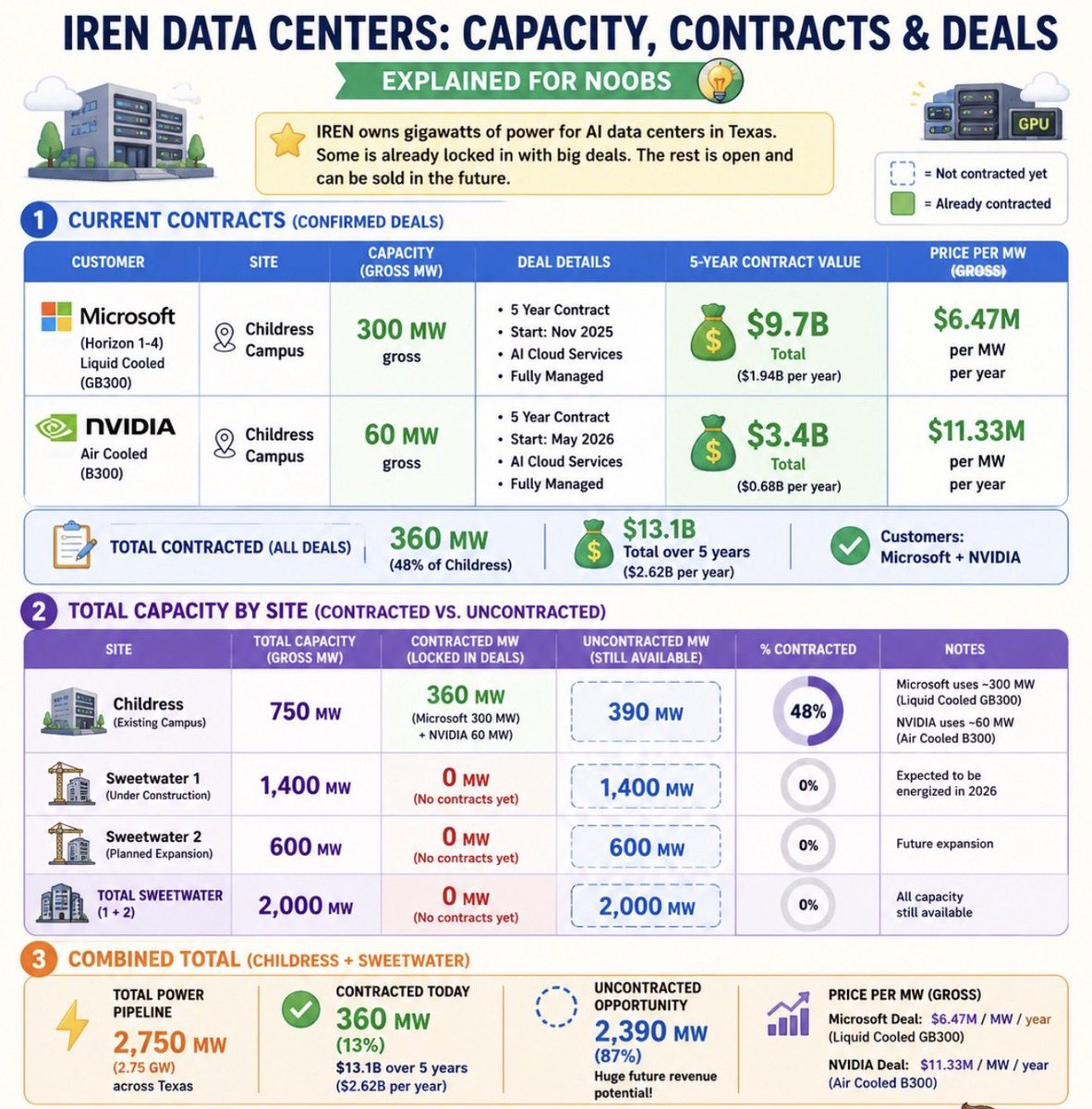
$IREN : Ran some numbers on Saturday Napkin Math. $IREN math is getting WILD 👀 Already signed: • Microsoft = 300 MW → $9.7B • NVIDIA = 60 MW → $3.4B That’s: • 360 MW contracted • $13.1B total value • $2.62B annualized revenue BUT… Childress still has: • 390 MW UNSOLD If future AI-cloud pricing improves: • another ~$15B+ possible • ~$3.8 - 4.5B/yr potential Then add: • Sweetwater 1 = 1.4 GW open capacity At current AI infra pricing: • ~$12–18B/yr possible from SW1 alone Total potential 2027 🤯 for 750 + 1400 MW = 2.15 GW • ~$15–22B+/yr revenue opportunity WOW. They have total 5 GW so still has 2.8 GW, this is insane opportunity.
investing tweet media
English
24
142
959
109.3K
BankSpecialist
BankSpecialist@OneLuckyLobster·
@adcock_brett Why not just have a camera at the top and the bottom to scan the barcode....
English
0
0
0
30
Brett Adcock
Brett Adcock@adcock_brett·
Watch a team of humanoid robots running a full 8-hr shift at human performance levels. This is fully autonomous running Helix-02 x.com/i/broadcasts/1…
English
2K
3.1K
17.2K
13.4M
Daniel Roberts
Daniel Roberts@danroberts0101·
March 2020. 👇 Six years later, the vision is very much alive. @MichaelDell 👊
Daniel Roberts tweet media
English
108
82
1.1K
233.8K
BankSpecialist
BankSpecialist@OneLuckyLobster·
@ilzmcfly The big question is, why can't $IREN presell power at Sweetwater, despite it being energised, while others can presell power without the data center even being built?
English
1
0
2
332
McFly
McFly@ilzmcfly·
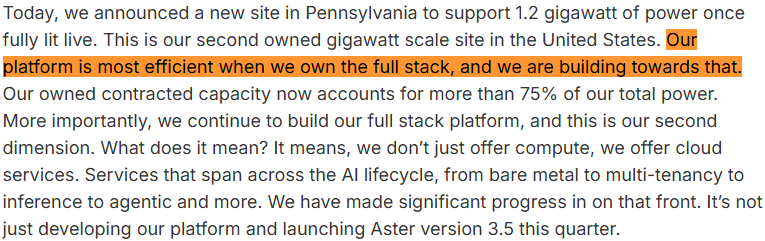
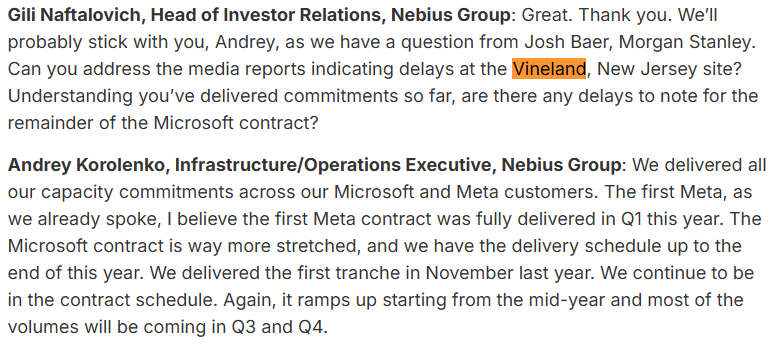
One important thing Arkady said which applies to $IREN. "Our platform is most efficient when we own the full stack, and we are building towards that." He is basically saying we will make more money when own the data centers and don't have to pay to lease them. This is specifically the bottoms up approach in which Iren started with. Now you are seeing $Iren acquire and expand their software stack through acquisitions and partnerships with $NVDA. Nebius guiding 40% Adj. EBITDA margin in 2026 due to their 2026 Capacity being mostly colocation and bare-metal. Iren already guided 85% Project EBIDTA Margins on a bare-metal deal. Minus out the SG&A and I think you can tell what EBIDTA Margins will be like. As much as there is some benefits from selling bare-metal to Hyperscalers the real money and moat is made from AI cloud services on GPU spot prices and fully managed services. $IREN already secured their first Fully Managed Cloud Service with $NVDA for deployment in 2027. $Iren from the start is owning the infrastructure and more importantly 5GW of secured grid-connected power with allot more on the way. Iren's energy costs has been typically the lowest in the industry which will translate to higher margin in the AI Cloud Revenue. But I believe as much as power and land is important the market is only valuing neo-clouds based contracted capacity and revenues. Everything else is fluff. As Nebius has 75% of their power owned, stated by Nebius. I believe their margins will get better over the next couple years but one thing that stands out to me is their reliance on third party contractors and developers which can cause execution risk. Also allot of their owned power is 2027 and out, meaning cost inflation will only rise by then and onwards for their owned datacenters.. A strategic advantage is that Iren is already executing and building on their owned 750MW at Childress, 1400MW at Sweetwater and 160MW in BC. Avoiding more higher cost inflation in 2027 onwards. On the Vineland issue for Nebius The Vineland Datacenter issue was not properly addressed, it was as pretty weak - basically we have till the end of the year don't worry. If you heard the ER Call Andrey sounded unsure and was stuttering, he did not clearly address the issue What I think they are doing is just improvising as a new energy source comes (bloom boxes) or air-permits gets suddenly approved. On their two new sites the 310MW in Finland with Polarnode we already knew about. Polarnode is the developer and owner of the site, while Nebius is the long-term operator and primary investor. The 1.2GW in Pennsylvania sounds great, but I would like to know once delivery starts in 2027 when does full ramp end and what are the phased sizes? Also how is it being powered, BTM or FTM?
McFly tweet mediaMcFly tweet media
English
4
4
68
8.8K
BankSpecialist
BankSpecialist@OneLuckyLobster·
@mikealfred And what about IREN. Why can't it presell power at Sweetwater, despite it being energised? Others are selling power without the data center even being built.
English
1
0
0
108
BankSpecialist
BankSpecialist@OneLuckyLobster·
@mikealfred Honest question for you @mikealfred. Why can't $IREN presell power at Sweetwater, despite it being energised? Why the holdup?
English
3
0
7
398
Mike Alfred
Mike Alfred@mikealfred·
Great to see more scam price action today. This is super bullish. The market makers only do this when it's very important that they mask the true direction. We are going higher soon. Watch.
English
75
68
1.5K
81.6K
Edgard
Edgard@0x454447415244·
I just sold half of my $IREN position at $61 for lack of transparency from management.
English
2
0
4
626
BankSpecialist
BankSpecialist@OneLuckyLobster·
@ViralMuzik1989 How do you get $300 lower end of your target range? $2tn market cap is about 100x the current market cap of $20bn. This implies a target price of c. $6000, assuming no dilution. Even with double the share count, that would be a target price of $3000.
English
0
0
1
108
FreeFromMatrix
FreeFromMatrix@ViralMuzik1989·
David Sacks just laid out the math on a 1GW data center: → ~$50B capex → $25–30B annual revenue → ~2 year payback Now do the math for $IREN with 5GW secured power (Sweetwater 1.4GW already energized): → Potential **$125B – $150B ARR** at full scale → At 15–20x revenue multiple = $1.9T – $3T theoretical market cap Even at 2–3GW ramp: $300 – $800 stock price potential
David Sacks@DavidSacks

Back-of-envelope numbers for 1 gigawatt data center: All-in Capex: ~$50 bn Enterprise revenue generated: ~$25-30 bn/year Electricity cost: $1-2 bn/year ~2 year payback. The boom is real.

English
25
27
336
120.7K
Giovanni's BTC_POWER_LAW
Giovanni's BTC_POWER_LAW@Giovann35084111·
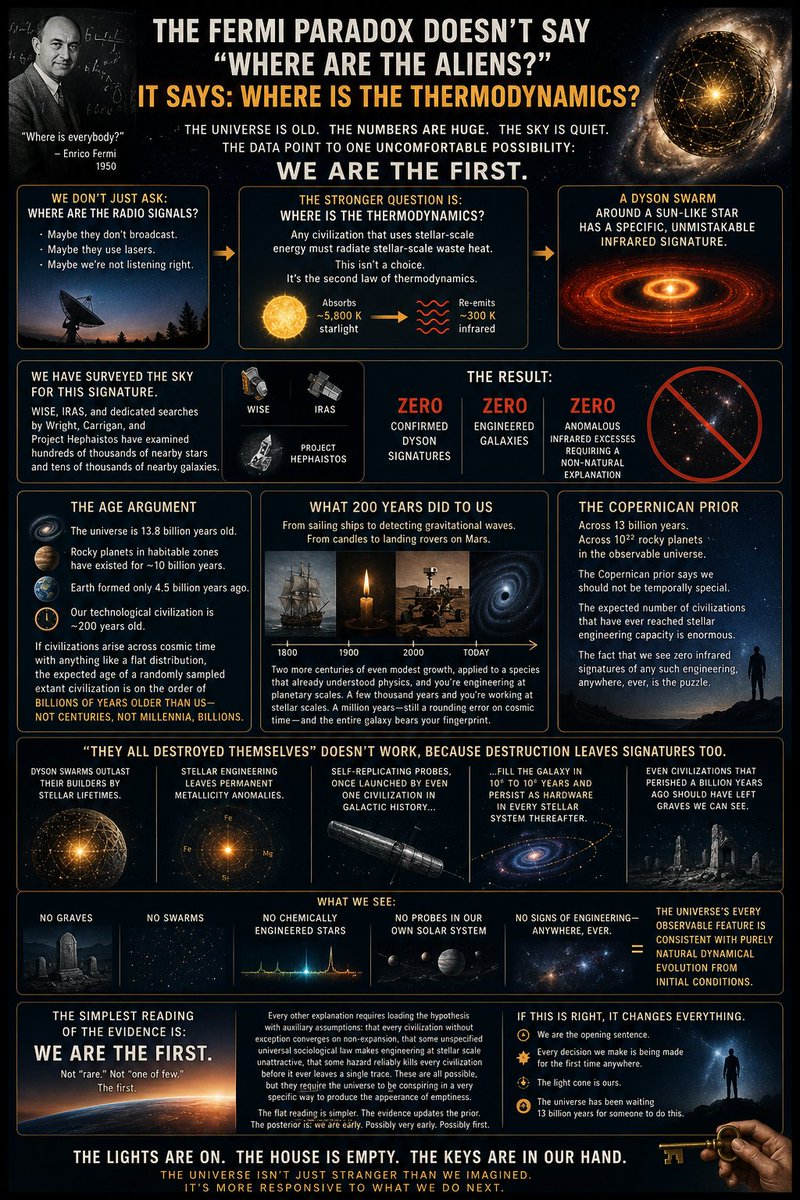
It is extremely likely we are alone in the Universe. This is because nobody solved yet the strongest version of the Fermi's paradox. The Fermi paradox doesn't say "where are the aliens?" It says: where is the thermodynamics? The popular version of Fermi asks why we haven't heard radio signals. That's the weak version. It lets you wave it away with "maybe they don't broadcast" or "maybe they use lasers." The strong version is much harder to dismiss. Any civilization that uses stellar-scale energy must radiate stellar-scale waste heat. This isn't a choice. It's the second law of thermodynamics. A Dyson swarm around a Sun-like star absorbs ~5,800 K starlight and re-emits it at ~300 K — a specific, unmistakable infrared signature. We have surveyed the sky for this signature. WISE, IRAS, and dedicated searches by Wright, Carrigan, and Project Hephaistos have examined hundreds of thousands of nearby stars and tens of thousands of nearby galaxies. The result is zero confirmed Dyson signatures. Zero engineered galaxies. Zero anomalous infrared excesses requiring a non-natural explanation. Now the age argument. The universe is 13.8 billion years old. Rocky planets in habitable zones have existed for about 10 billion years. Earth formed only 4.5 billion years ago, and our technological civilization is roughly 200 years old. If civilizations arise across cosmic time with anything like a flat distribution, the expected age of a randomly sampled extant civilization is on the order of billions of years older than us — not centuries, not millennia, billions. Look at what 200 years did to us. From sailing ships to detecting gravitational waves. From candles to landing rovers on Mars. Two more centuries of even modest growth, applied to a species that already understood physics, and you're engineering at planetary scales. A few thousand years and you're working at stellar scales. A million years — still a rounding error on cosmic time — and the entire galaxy bears your fingerprint. So the strong Fermi argument is this: across 13 billion years, across 10²² rocky planets in the observable universe, the Copernican prior says we should not be temporally special. The expected number of civilizations that have ever reached stellar engineering capacity is enormous. The fact that we see zero infrared signatures of any such engineering, anywhere, ever, is the puzzle. It gets sharper. The "they all destroyed themselves" answer doesn't work, because destruction leaves signatures too. A Dyson swarm outlasts its builders by stellar lifetimes. Stellar engineering leaves permanent metallicity anomalies. Self-replicating probes, once launched by even one civilization in galactic history, fill the galaxy in 10⁶ to 10⁸ years and persist as hardware in every stellar system thereafter. Even civilizations that perished a billion years ago should have left graves we can see. We see no graves. We see no swarms. We see no chemically engineered stars. We see no probes in our own solar system, which has been sitting here as a perfectly accessible target for the entire 4.5-billion-year history of the galaxy. We see a universe whose every observable feature is consistent with purely natural dynamical evolution from initial conditions. This is the part nobody wants to say out loud: the simplest reading of the evidence is that we are the first. Not "rare." Not "one of few." The first. This sounds arrogant, but it isn't — it's just what the data say if you take them at face value. Every other explanation requires loading the hypothesis with auxiliary assumptions: that every civilization without exception converges on non-expansion, that some unspecified universal sociological law makes engineering at stellar scale unattractive, that some hazard reliably kills every civilization before it ever leaves a single trace. These are all possible, but they require the universe to be conspiring in a very specific way to produce the appearance of emptiness. The flat reading is simpler. Somebody had to be first. The Copernican principle says we shouldn't assume we're special, but the Copernican principle is a prior, not a theorem — it gets updated by evidence. And the evidence, after a century of looking, is overwhelmingly that the sky is empty of engineering. That update has to push the posterior somewhere. The somewhere is: we are early. Possibly very early. Possibly first. If this is right, it changes how we should think about what we are. We are not one of countless civilizations whose story has been told a billion times across the universe. We are the opening sentence. Every decision we make about how to develop, how to expand, how to avoid extinguishing ourselves, is being made for the first time anywhere. The light cone is ours. That's not a depressing reading of Fermi. It's the most consequential reading possible. The universe has been waiting 13 billion years for someone to do this, and we are the ones who showed up. The lights are on. The house is empty. The keys are in our hand.
Giovanni's BTC_POWER_LAW tweet media
English
95
46
281
28.3K
BankSpecialist
BankSpecialist@OneLuckyLobster·
@franklee6924T @grok this partnership between IREN and Nvidia seems strategically very interesting. But what advantages does it bring that brings improved monetisation opportunities for IREN?
English
1
0
1
83
franklee6924x
franklee6924x@franklee6924T·
There is no larger long-term strategic move than this — NVIDIA joins forces with $IREN to build the flagship AI factory deployment for the DSX architecture The market will continue to repeatedly reinterpret the deeper intent and long-term objectives behind the partnership between NVIDIA and IREN. On May 7, 2026, IREN’s CEO reposted NVIDIA’s official announcement on X regarding the partnership between the two companies: NVIDIA and IREN Limited today announced a strategic partnership to accelerate the deployment of next-generation AI infrastructure. NVIDIA announcement nvidianews.nvidia.com/news/nvidia-an… At the same time, IREN also released another announcement on its own website: IREN signs a US$3.4 billion AI cloud services agreement with NVIDIA. IREN announcement iren.gcs-web.com/static-files/9… The two announcements, each emphasizing different aspects of the cooperation, carry extremely significant implications. First, after careful verification, this is the first time NVIDIA has sought external compute leasing. There are three major turning points in industry development embedded in this move. A reversal of roles: NVIDIA becomes a “major external compute customer” for the first time In the past, NVIDIA’s relationship with infrastructure companies was almost always centered around “selling hardware” or “borrowing hyperscaler data centers for DGX Cloud.” But in this US$3.4 billion agreement with IREN, NVIDIA is, for the first time in its history, leasing third-party compute capacity at large scale and on a long-term basis as a customer, for use by its own AI research teams. This kind of “reverse leasing” is unprecedented for NVIDIA in both scale and nature. The selective external exposure of its most core secrets: this point carries the deepest implications For a long time, NVIDIA has insisted on keeping its most critical R&D work — chip design, driver optimization, and large-model training — inside its self-built supercomputers such as Selene and Eos, creating a closed loop of “building the shovels and mining with them itself.” But this time, outsourcing a 60MW research workload to an external data center is highly significant. It signals that compute-chip R&D is beginning to transition toward external collaboration. The first opening of stack management: introducing Mirantis to manage NVIDIA’s internal R&D clusters Previously, NVIDIA’s internal cluster management was handled entirely by its own engineering teams. But under this agreement, NVIDIA is for the first time allowing third-party management, bringing in Mirantis to participate in cluster orchestration and operations. This also signals a transformation in NVIDIA’s latest compute architecture R&D approach — beginning to “strengthen external collaboration” for lower-level operational work such as server cooling, restarts, and Kubernetes configuration. As the ability of individual GPU chips to increase computing performance gradually approaches physical and engineering limits, the next phase of AI compute advancement is shifting from “single-chip performance competition” to “system-level scalability competition.” This is NVIDIA’s direction of transformation. The primary paths for the next stage of AI compute improvement include: GPU clustering, high-speed interconnects, rack-scale computing, and data-center-level coordination. This requires GPU manufacturers (NVIDIA), data center designers/builders/operators (IREN), and supercluster operating systems (Mirantis) to jointly collaborate on development. What they are developing is precisely the NVIDIA DSX architecture referenced in the NVIDIA-IREN partnership announcement. And IREN’s hyperscale SW site in Texas is becoming the flagship deployment location for NVIDIA’s DSX architecture. This is absolutely not a simple narrative of NVIDIA investing in a company and becoming a shareholder. For the world’s leading company that holds the core secrets of AI compute chip R&D, this is not a trivial matter. From NVIDIA’s perspective, there appear to be many potential partners, such as CoreWeave, Nebius, Oracle, Microsoft Azure, Amazon Web Services, and Crusoe, and NVIDIA has already invested in or partnered with these firms before. But why did it choose IREN for this most important transformation? Because IREN possesses too many things that are uniquely its own: Multiple GW-scale single sites with secured long-term power supply Grid interaction capabilities Vertical integration Ultra-long-term site planning and abundant land supply Green energy Acting as its own design-and-build general contractor Long-term accumulation of data center operational experience Advanced design and technical capabilities Compared with the companies above that NVIDIA has already partnered with, even if IREN temporarily lacked software capabilities, NVIDIA was still willing to wait until IREN acquired a software company before announcing this deep cooperation. Moreover, Mirantis has long been one of the three software companies that have collaborated with NVIDIA for many years. It is highly possible that NVIDIA itself played the role of connector behind IREN’s acquisition. NVIDIA is transforming toward system-level compute scaling and building an AI factory template. In the future, the products it sells may no longer simply be GPU chips, but complete racks, clusters, or even entire AI factories. That inevitably requires standardized data centers in order to guarantee performance, compatibility, scalability, and token efficiency. What NVIDIA needs are facilities with massive long-term secured power supply, land, GW-scale campuses, HPC DNA, rapid construction capability, neutrality, automated scheduling capability, workload routing, GPU virtualization, fault recovery, and cluster operating systems capable of distributed training management. At present, IREN is the only company that possesses all of these elements simultaneously. What they are trying to build is the industrial standard for the next phase of the AI industry. The greatest companies do not merely participate in industries — they define the standards. From this perspective, there is no larger strategic theme than this one. Selling compute capacity to hyperscalers, partnering with Anthropic, or developing new sovereign AI businesses are all important, but none compare with this. The deeper meaning of last week’s announcement will require time for the market to fully interpret and understand. I believe I have already analyzed this trend relatively clearly. This move by NVIDIA and IREN, once executed successfully, could once again widen the gap between the NVIDIA ecosystem and Google just as Google had begun catching up — and it carries major implications for the entire AI industry.
English
32
87
433
81.2K
BankSpecialist
BankSpecialist@OneLuckyLobster·
@ekwufinance Value from AI large cap will go into small-mid caps powering AI infrastructure, like data centers
English
0
0
0
36
Lukas Ekwueme
Lukas Ekwueme@ekwufinance·
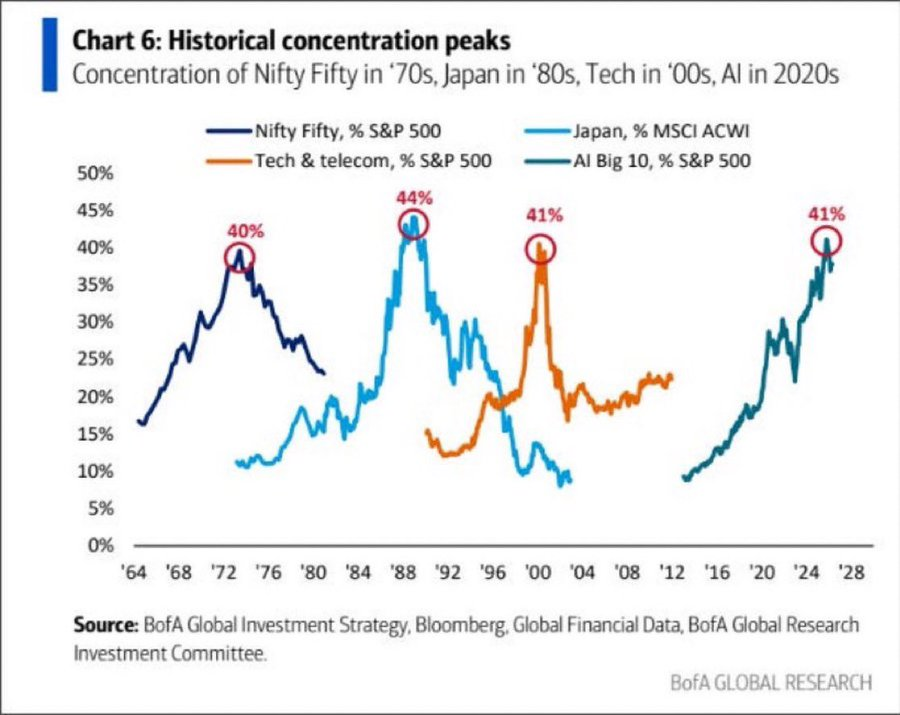
Each time concentration levels hit 40 percent, a crash followed. We are at 41 percent. But I’m sure this time is different. If only there was a catalyst for the AI bubble unwind.
Lukas Ekwueme tweet media
English
82
295
1.5K
118.6K
Heisenberg
Heisenberg@Mr_Derivatives·
Remember when $GOOG was just a search engine? Remember when $NVDA was just a graphics card maker? Remember when $AMZN was just an online book store? Remember when $AAPL was just a personal computers company? Remember when $META was just a single social media platform company? Remember when $TSLA only had one car? Remember when $MSFT was just an operating systems company? Evolve or die.
English
74
27
612
70.3K
Black Panther Capital
Black Panther Capital@BlackPantherCap·
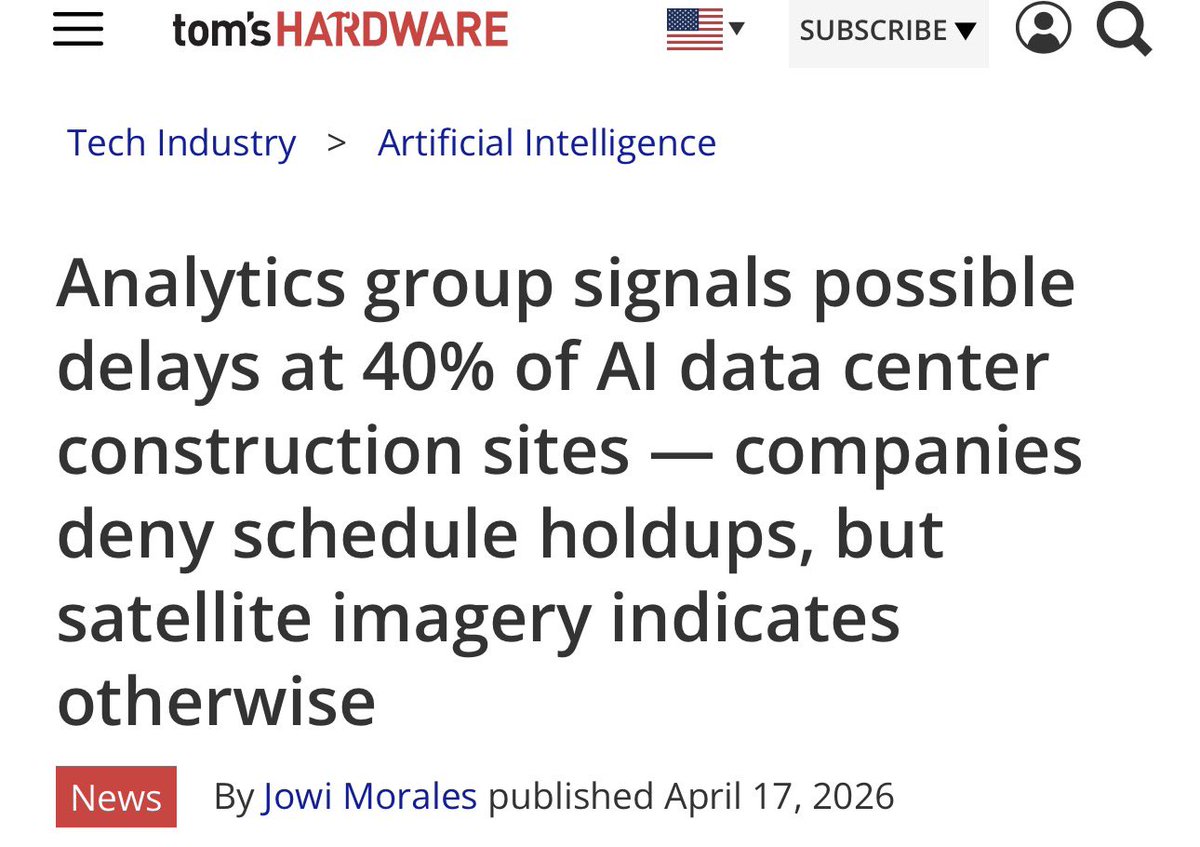
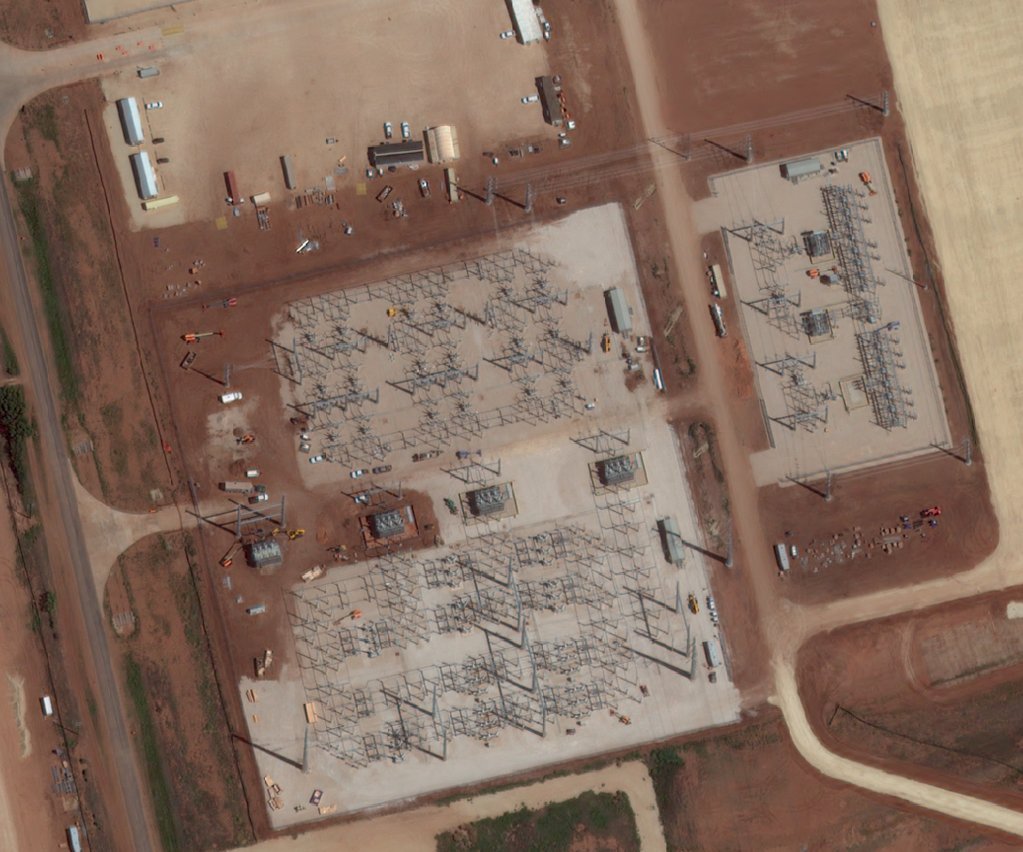
I don’t expect a deal from $IREN around the corner or at earnings. On the other hand I expect some kind of delays. I also expect to see the a drawdown in the stock due to sentiment. But let’s see. I could be wrong. Anyhow. It’s important to note this most likely will hit the whole sector. “Several U.S. data centers slated for completion in 2026 are at risk of being delayed as strict schedules encounter regulatory friction, supply chain bottlenecks, and the lack of available utility. According to a report by the Financial Times, major data center projects involving Microsoft, OpenAI, and other tech companies will miss projected deadlines by more than three months. The estimate is based on data from SynMax, a geospatial data analytics company that uses satellite imaging and AI to deliver real-time insights and predictive analytics on the maritime and energy sectors.” I’m not shocked at all here. And expect to see delays on all project; $NBIS $CIFR $CRWV $IREN $WULF. The Danish professor and world-leading expert on megaproject management who frequently cites high failure rates in project time and economy is Bent Flyvbjerg. His research often highlights that 9 out of 10 (90%) of projects go over budget, over time, or fail to deliver on benefits -BP Please note: This is not financial advice.
Black Panther Capital tweet media
Daniel Roberts@danroberts0101

Feels like we’re still early in the compute cycle. Supply isn’t easy, real-world constraints are everywhere. And every step forward in AI just seems to create more demand for compute.

English
25
6
99
44.4K
Frans Bakker
Frans Bakker@FransBakker9812·
"The winners under this regime are whoever locked in power purchase agreements and electrical equipment orders 3-4 years ago, before anyone was modeling hundreds of megawatts of inference load. Everyone else is waiting in line behind them." $IREN fixes this 🏗️ SW1 4/26/2026 ⤵️
Frans Bakker tweet media
Aakash Gupta@aakashgupta

A 5-year backlog on grid transformers just killed half of America's 2026 AI data centers. Sightline Climate tracked 12 GW of 2026 US data center capacity announced across 140 projects. Only 5 GW is actually under construction. 11 GW sits in the "announced" stage with no physical progress despite typical build times of 12-18 months. 25% of those projects haven't disclosed a power strategy at all. That last number is the tell. A quarter of "planned 2026 AI capacity" has no sourced answer to where the electrons come from. Call those projects what they are: vapor capex with a press release attached. Nvidia is shipping. The gating constraint is high-voltage transformers, switchgear, and grid-tie batteries. Pre-2020 lead time on a high-power transformer was 24-30 months. Today it stretches to 5 years. Electrical equipment is under 10% of total data center cost and 100% of the bottleneck. This breaks the standard analyst model. When a hyperscaler announces $50B of capex, the Street treats it as compute coming online in 18 months. If the transformer order wasn't placed in 2022, that money sits as commitment without capacity. You cannot pay for a transformer that doesn't exist yet. The winners under this regime are whoever locked in power purchase agreements and electrical equipment orders 3-4 years ago, before anyone was modeling hundreds of megawatts of inference load. Everyone else is waiting in line behind them. Second order is uglier. Hyperscalers buying $50B of GPUs that sit unpowered depreciate against Nvidia's annual cadence while paying carrying costs on empty data center shells. Every quarter dark is a quarter of compounding waste. The "we're 6 months from running out of compute" panic just became "we're 5 years from running out of transformers." Capital fixes one. Capital cannot manufacture a transformer.

English
39
73
528
110.8K
BankSpecialist
BankSpecialist@OneLuckyLobster·
@TheTechInvest @Sebagyeong I don't get how you can say that about SW. So it is energised as it is costing them money to produce power. But you are saying they don't have a deal to pay for this power until late 2026, early 2027?
English
1
0
1
28
Mason
Mason@MasonFoard·
- The dollar loses 7% a year. - AI is coming for white-collar work. - Robots are 10 years out. @saylor just laid out what young people should actually do about it. 12 lessons:
Mason tweet media
English
62
228
1.6K
275.7K
BankSpecialist
BankSpecialist@OneLuckyLobster·
@BlackPantherCap Why do you have such a conservative $200 target for $IREN when it has monetised only 5% of its secured power base?
English
0
0
2
193
Black Panther Capital
Black Panther Capital@BlackPantherCap·
Most people underestimate how long the runway is for AI infrastructure buildout. $IREN 4.5 GW pipeline doesn't come online in six months. It comes online over three years. Patience is the position.
English
11
2
103
10.3K