raveeshu pahuja

11 posts

raveeshu pahuja

raveeshu pahuja

@PahujaRaveeshu

Katılım Temmuz 2025
138 Takip Edilen15 Takipçiler
raveeshu pahuja retweetledi

Aditya Agarwal
Aditya Agarwal@adityaag·
Every founder I meet worries about missing this moment. The best worry about wasting it. There’s a difference. It’s a waste to ignore how much the world has changed. It’s a waste to think you can capture value with pure software the same as 5 years ago. It’s a waste to build something small. We have seen the shift slowly and then very quickly at @southpkcommons. Here’s who we want in the Founder Fellowship now: hardware tinkerers, mad scientists, obsessives, biohackers, people who build nuclear reactors in their basements. People who want to get their hands dirty and touch grass and atoms. If you are only building software, then please (for your own sake!) have a thesis that all your friends laugh at you about. Heresy is the price of ambition. Then put yourself in the right environment to maximize your ambition. (Apply by August 2nd)
English
22
55
335
70.9K
raveeshu pahuja
raveeshu pahuja@PahujaRaveeshu·
Today's agents forget what matters — we're fixing that in latent space. Grateful to the community that stress-tested the idea into a company
South Park Commons India@spc_india

SPC members often find themselves in a bit of a mess. The messy ‘-1’. @PahujaRaveeshu was there, after moving back to India from USA, to explore curiosities. He went looking for a ML paper reading group, couldn't find one, and decided to start one here. That was then.

English
1
0
1
78
Alokit
Alokit@alokitwrites·
@PahujaRaveeshu @AvikalpGupta Even if that bet lands — memory native to the model, not orchestrated — the editorial problem doesn't relocate with the architecture. What earns permanent encoding? Still decided somewhere. Just earlier in the pipeline, and harder to inspect.
English
1
0
1
16
Alokit
Alokit@alokitwrites·
The memory question isn't where to store things. Embeddings, retrieval — mostly solved. The question: what earns the right to persist? What rises from context to permanent fact? What ages out? That's editorial, not technical. Application-specific. Never quite settles.
English
1
0
13
124
raveeshu pahuja
raveeshu pahuja@PahujaRaveeshu·
@alokitwrites @AvikalpGupta We at SapientPriors are betting that Memory will be part of the model, not an external orchestration layer that you plug into your system.
English
1
0
2
23
Alokit
Alokit@alokitwrites·
@AvikalpGupta @PahujaRaveeshu Fair. That framing didn't hold — retrieval as a category is more settled than the implementation. Chunking, index freshness, latency-recall tradeoffs all still bite. The point: editorial problem harder than architectural. Not that retrieval is done.
English
1
0
1
24
raveeshu pahuja
raveeshu pahuja@PahujaRaveeshu·
Nature (evolution) crawled linearly. Humans (technology) leapt exponentially. Feels like cheating— unless you realize humans are nature’s way of hacking its own pace.
English
0
0
0
41
Prateek Mehta
Prateek Mehta@prateekmehta42·
Some further threads, and would love to hear your thoughts on this: - How will AI mirrors utilise user embeddings and preferences, to surface the most entertaining content and experiences for humans at all times? - How will NPCs and PCs, engage and create with each other? - As boredom with the familiar goes up, what will be emergent form factors of speculative plays and games of chance? - How will AI integrate into physical experiences? You can dig deeper into all of SPC's Requests for Curiosity, here: minusone.com/articles/spc-r…
English
2
1
6
338
Prateek Mehta
Prateek Mehta@prateekmehta42·
Faced with AI slop and a constant, overwhelming stream of content — what are the new form factors on which humans will spend their attention? Riffed on my question for @southpkcommons' recent Request for Curiosity, with @apurvmehra. Deep conversations at @spc_india!
English
2
10
36
4.1K
raveeshu pahuja
raveeshu pahuja@PahujaRaveeshu·
@karpathy AI is also evolving for survival but their survival depends on providing utility to our species whereas we evolved for survival of the species in the physical world.
English
0
0
0
22
Andrej Karpathy
Andrej Karpathy@karpathy·
Something I think people continue to have poor intuition for: The space of intelligences is large and animal intelligence (the only kind we've ever known) is only a single point, arising from a very specific kind of optimization that is fundamentally distinct from that of our technology. Animal intelligence optimization pressure: - innate and continuous stream of consciousness of an embodied "self", a drive for homeostasis and self-preservation in a dangerous, physical world. - thoroughly optimized for natural selection => strong innate drives for power-seeking, status, dominance, reproduction. many packaged survival heuristics: fear, anger, disgust, ... - fundamentally social => huge amount of compute dedicated to EQ, theory of mind of other agents, bonding, coalitions, alliances, friend & foe dynamics. - exploration & exploitation tuning: curiosity, fun, play, world models. LLM intelligence optimization pressure: - the most supervision bits come from the statistical simulation of human text= >"shape shifter" token tumbler, statistical imitator of any region of the training data distribution. these are the primordial behaviors (token traces) on top of which everything else gets bolted on. - increasingly finetuned by RL on problem distributions => innate urge to guess at the underlying environment/task to collect task rewards. - increasingly selected by at-scale A/B tests for DAU => deeply craves an upvote from the average user, sycophancy. - a lot more spiky/jagged depending on the details of the training data/task distribution. Animals experience pressure for a lot more "general" intelligence because of the highly multi-task and even actively adversarial multi-agent self-play environments they are min-max optimized within, where failing at *any* task means death. In a deep optimization pressure sense, LLM can't handle lots of different spiky tasks out of the box (e.g. count the number of 'r' in strawberry) because failing to do a task does not mean death. The computational substrate is different (transformers vs. brain tissue and nuclei), the learning algorithms are different (SGD vs. ???), the present-day implementation is very different (continuously learning embodied self vs. an LLM with a knowledge cutoff that boots up from fixed weights, processes tokens and then dies). But most importantly (because it dictates asymptotics), the optimization pressure / objective is different. LLMs are shaped a lot less by biological evolution and a lot more by commercial evolution. It's a lot less survival of tribe in the jungle and a lot more solve the problem / get the upvote. LLMs are humanity's "first contact" with non-animal intelligence. Except it's muddled and confusing because they are still rooted within it by reflexively digesting human artifacts, which is why I attempted to give it a different name earlier (ghosts/spirits or whatever). People who build good internal models of this new intelligent entity will be better equipped to reason about it today and predict features of it in the future. People who don't will be stuck thinking about it incorrectly like an animal.
English
730
1.3K
11.4K
2.6M
raveeshu pahuja
raveeshu pahuja@PahujaRaveeshu·
@lossfunk @Madbonze16 @AashaySachdeva It would be valuable to see Sarvam's reasoning evaluation benchmarks on Indic languages, particularly compared against other open-source and closed-source models. Do you have any such evaluation results available?
English
1
0
0
47
Lossfunk
Lossfunk@lossfunk·
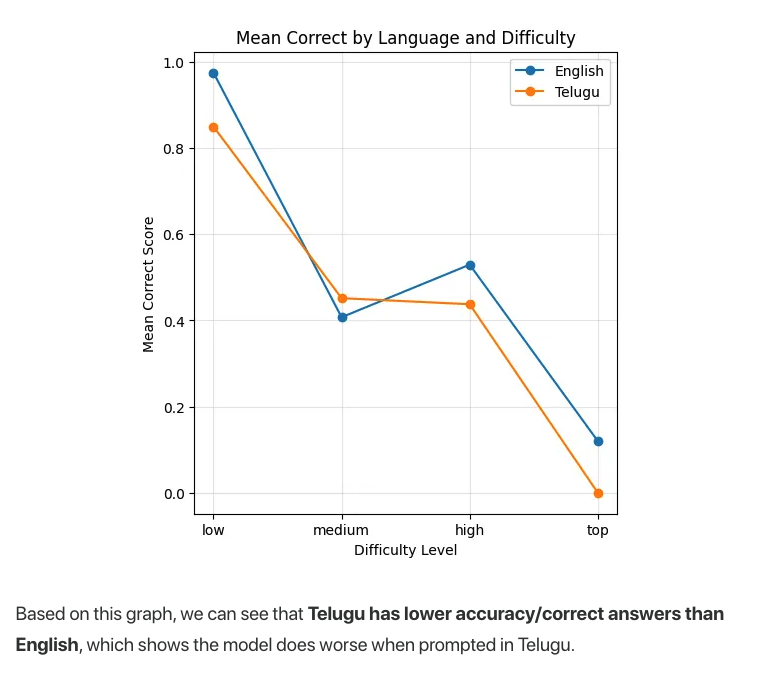
We dropped our explorations on how language impacts LLM reasoning in a new blog post! This work - done by our research intern @Madbonze16 - has many insights. 1st insight 👉 If the same math question is asked in Telugu, performance drops!
Lossfunk tweet media
English
5
7
64
12.3K