Patent Vault

316 posts

Patent Vault banner
Patent Vault

Patent Vault

@PatentVault

Historical archive of vintage U.S. patent illustrations and in-depth explorations of the inventors, innovations, and technological legacies that shaped society

USA Katılım Nisan 2026
68 Takip Edilen145 Takipçiler
Patent Vault
Patent Vault@PatentVault·
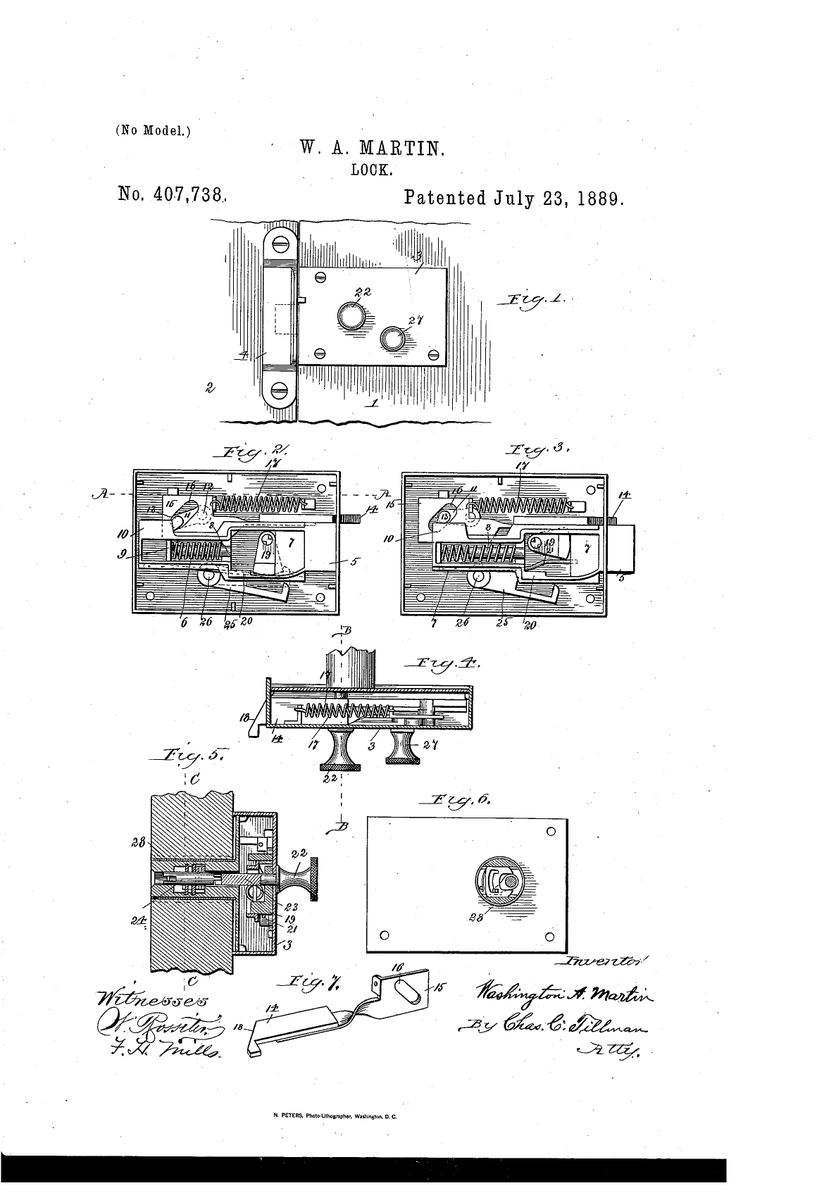
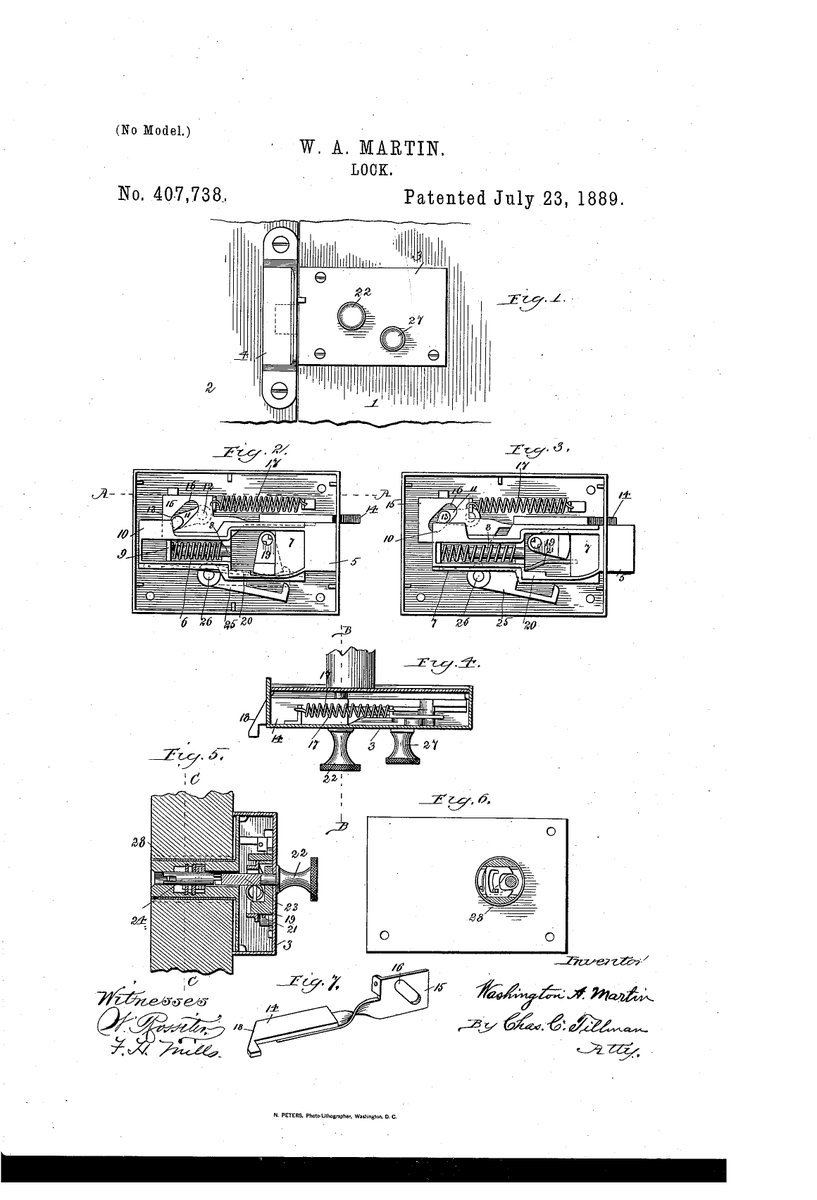
By the closing decades of the 19th century, rapid industrialization had transformed American cities into dense networks of factories, tenements, and emerging middle-class homes. Chicago, in particular, swelled with newcomers drawn by opportunity, yet the same growth brought heightened risks of burglary and opportunistic intrusion. Builders and residents relied on simple spring latches for everyday convenience, their beveled bolts designed to retract automatically upon contact with the strike plate. These offered smooth entry and exit amid the bustle of urban life, but they carried a critical weakness: a thin blade or tool could easily slide between door and jamb, pushing the bolt back and defeating the lock in seconds. Deadbolts, by contrast, demanded deliberate engagement, providing true resistance yet complicating routine use in an era when speed and practicality mattered in crowded households and commercial spaces. The broader technological landscape amplified these pressures. The Industrial Revolution had made affordable hardware widely available, yet lock designs still echoed centuries-old principles that prioritized ease over impregnability. As cities expanded and property values rose, inventors recognized that security could no longer be an afterthought; it had to integrate seamlessly with daily existence without compromising the very safeguards families depended upon. Washington A. Martin of Chicago addressed precisely this tension when he received U.S. Patent 407,738 in 1889. Motivated by the everyday vulnerabilities he observed in standard latches, he engineered a square-faced bolt held retracted by a swinging dog until a trigger mechanism—actuated by the door’s closure—released it to project automatically into the jamb socket. The patent explains how this arrangement overcomes the flaw of prior art: ordinary beveled bolts “can be thrown back and the door unlatched by forcing in a thin knife-blade or other instrument.” Through a cam-and-yoke system operable by knob or key (often paired with a Yale cylinder), Martin’s design delivered latch-like convenience paired with deadbolt-style resistance to tampering. This innovation reminds us that the choice of lock has always been about more than features—it is a reflection of the era’s needs for reliable protection rooted in thoughtful engineering. Full patent text & diagrams: patents.google.com/patent/US40773…
Patent Vault tweet media
English

0
0
1
27
Patent Vault
Patent Vault@PatentVault·
By the closing decades of the 19th century, rapid industrialization had transformed American cities into dense networks of factories, tenements, and emerging middle-class homes. Chicago, in particular, swelled with newcomers drawn by opportunity, yet the same growth brought heightened risks of burglary and opportunistic intrusion. Builders and residents relied on simple spring latches for everyday convenience, their beveled bolts designed to retract automatically upon contact with the strike plate. These offered smooth entry and exit amid the bustle of urban life, but they carried a critical weakness: a thin blade or tool could easily slide between door and jamb, pushing the bolt back and defeating the lock in seconds. Deadbolts, by contrast, demanded deliberate engagement, providing true resistance yet complicating routine use in an era when speed and practicality mattered in crowded households and commercial spaces. The broader technological landscape amplified these pressures. The Industrial Revolution had made affordable hardware widely available, yet lock designs still echoed centuries-old principles that prioritized ease over impregnability. As cities expanded and property values rose, inventors recognized that security could no longer be an afterthought; it had to integrate seamlessly with daily existence without compromising the very safeguards families depended upon. Washington A. Martin of Chicago addressed precisely this tension when he received U.S. Patent 407,738 in 1889. Motivated by the everyday vulnerabilities he observed in standard latches, he engineered a square-faced bolt held retracted by a swinging dog until a trigger mechanism—actuated by the door’s closure—released it to project automatically into the jamb socket. The patent explains how this arrangement overcomes the flaw of prior art: ordinary beveled bolts “can be thrown back and the door unlatched by forcing in a thin knife-blade or other instrument.” Through a cam-and-yoke system operable by knob or key (often paired with a Yale cylinder), Martin’s design delivered latch-like convenience paired with deadbolt-style resistance to tampering. This innovation reminds us that the choice of lock has always been about more than features—it is a reflection of the era’s needs for reliable protection rooted in thoughtful engineering. Full patent text & diagrams: patents.google.com/patent/US40773…
Patent Vault tweet media
English
0
0
0
30
Patent Vault retweetledi
Cyber City Circuits
Cyber City Circuits@MakeAugusta·
@PatentVault The demonstrations were part of the Paris Electrical exposition. The very first of its kind. Everyone was there.
English
1
1
2
146
Patent Vault retweetledi
Cyber City Circuits
Cyber City Circuits@MakeAugusta·
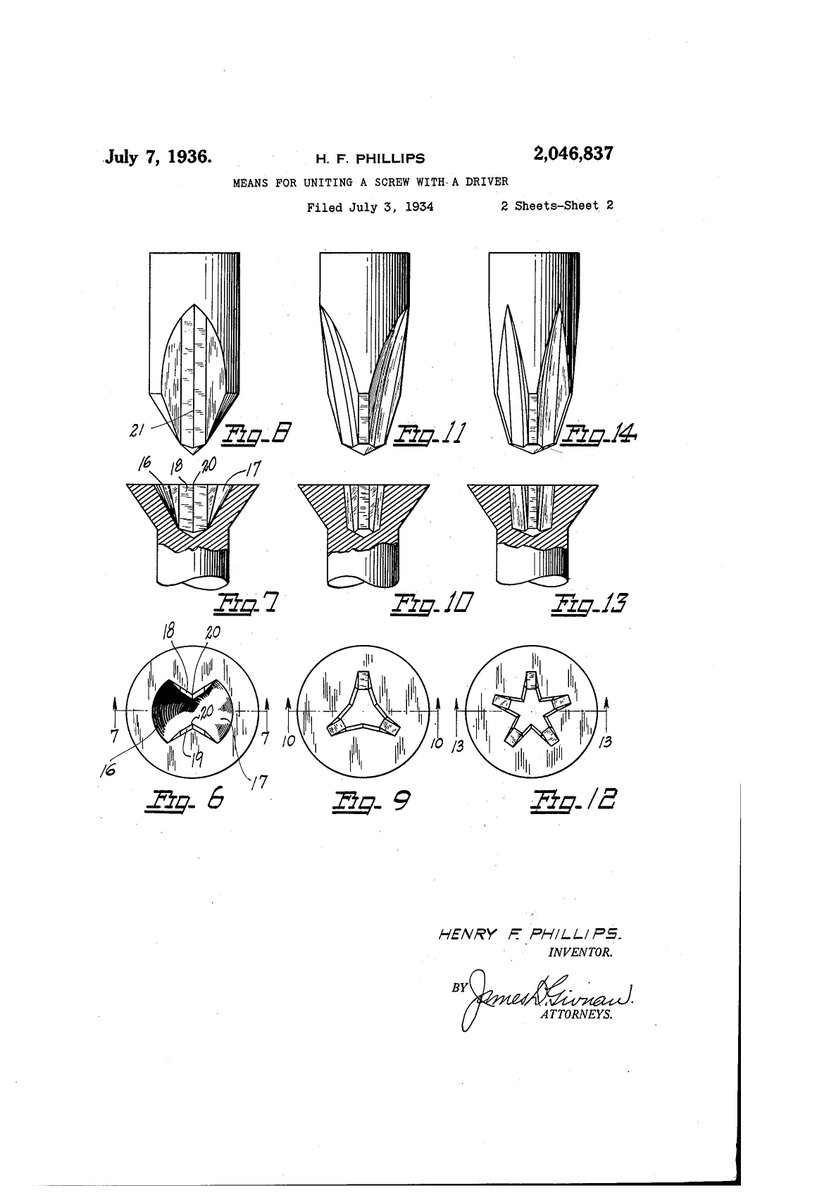
Means for uniting a screw with a driver - Patent US2046837A Inventor Henry F Phillips
Cyber City Circuits tweet mediaCyber City Circuits tweet media
English
4
12
53
4.5K
Patent Vault retweetledi
Sovey
Sovey@SoveyX·
Did you know the classic Chinese takeout box wasn’t made for Chinese food at all? It started as an American oyster pail, patented in the 1890s as a folded paper container for carrying oysters. The design used one piece of paperboard folded into shape, with a wire handle on top. Its construction is often compared to Japanese origami because of the folding technique, but the original purpose had nothing to do with Chinese food. Chinese-American restaurants later adopted it because it was cheap, sturdy, disposable, and ideal for rice and noodles. So one of the most recognizable symbols of Chinese takeout is actually an American oyster container that got repurposed into an icon.
Sovey tweet media
English
102
103
726
10K
Patent Vault
Patent Vault@PatentVault·
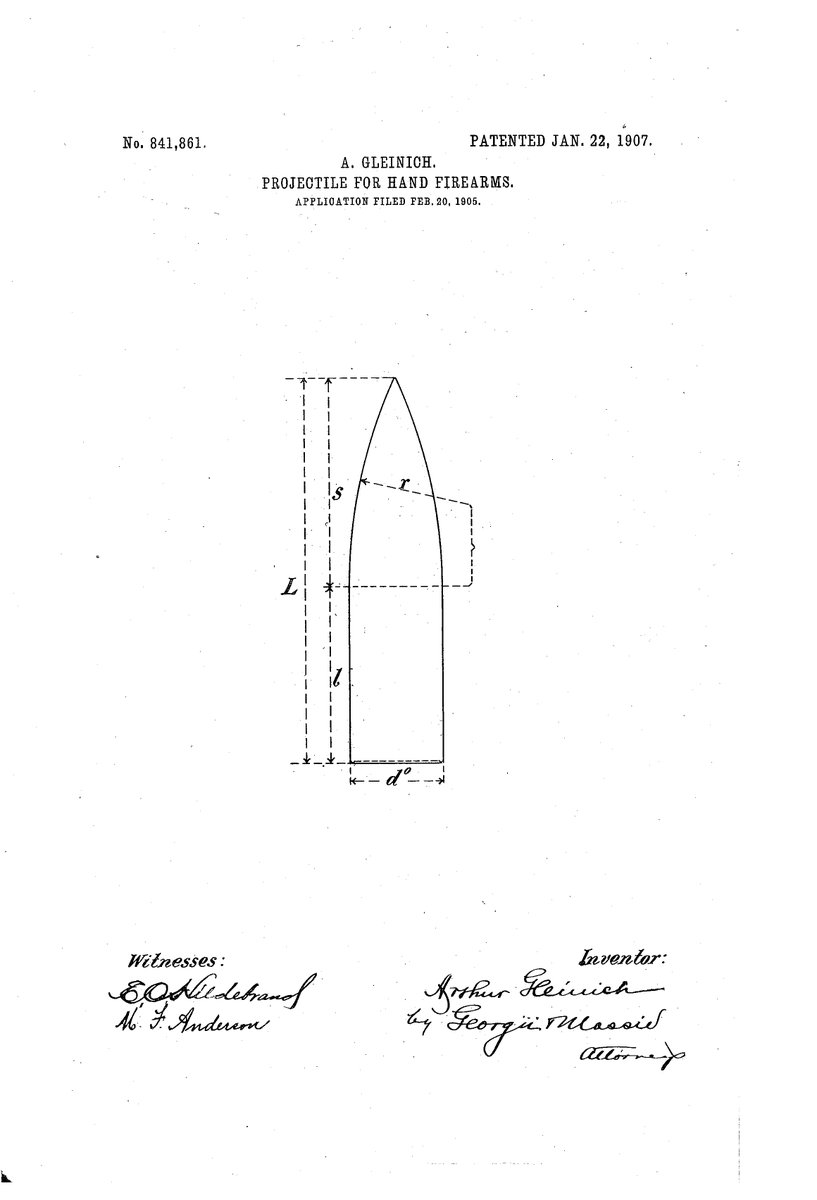
In the stable, high-velocity flight of the military projectile captured on video, we see a vivid demonstration of aerodynamics refined over decades for battlefield dominance. This mastery traces directly to US Patent 841861A, which introduced a precisely contoured pointed projectile engineered to slice through air resistance with unprecedented efficiency. By the early twentieth century, European and American armies faced mounting pressure to modernize their small arms amid rapid industrialization and shifting tactics of warfare. Older round-nosed bullets, once adequate for black-powder rifles, faltered under the higher muzzle velocities demanded by smokeless propellants. Drag from blunt shapes caused rapid deceleration, steep arc trajectories, and limited effective range—shortcomings exposed in colonial conflicts where soldiers needed to engage distant targets accurately while contending with wind, elevation, and the physical stresses of prolonged combat. The push toward lighter, faster ammunition demanded a fundamental redesign of the projectile itself, one that could maintain speed and stability across hundreds of meters without sacrificing penetration or reliability. High-speed photography and wind-tunnel experiments of the era revealed how airflow formed shock waves and suction zones around flying bullets, underscoring the need for streamlined forms. Nations raced to adopt elongated designs that minimized frontal resistance while preserving gyroscopic stability from rifling. These changes transformed infantry firepower, extending lethal reach and flattening trajectories in ways that reshaped defensive and offensive doctrines on the eve of global conflict. Arthur Gleinich, a German engineer working for Deutsche Waffen- und Munitionsfabriken, drew from these ballistic insights to perfect the proportions: a cylindrical guiding body paired with a sharply pointed head whose curves were calculated to specific radii for optimal airflow. The patent itself emphasized that such a form endows the projectile with “a capacity for speed of flight in excess of the ordinary projectile, great penetration, superior stopping effect, flat trajectory, accuracy, and extended range.” This elegant solution to the era’s aerodynamic challenges continues to underpin the precise, unerring flight we witness in modern military testing. Full patent text & diagrams: patents.google.com/patent/US84186…
Patent Vault tweet media
English
1
0
0
124
History Defined
History Defined@historydefined·
The military has truly mastered the art of aerodynamics
English
7
14
268
58.5K
Patent Vault
Patent Vault@PatentVault·
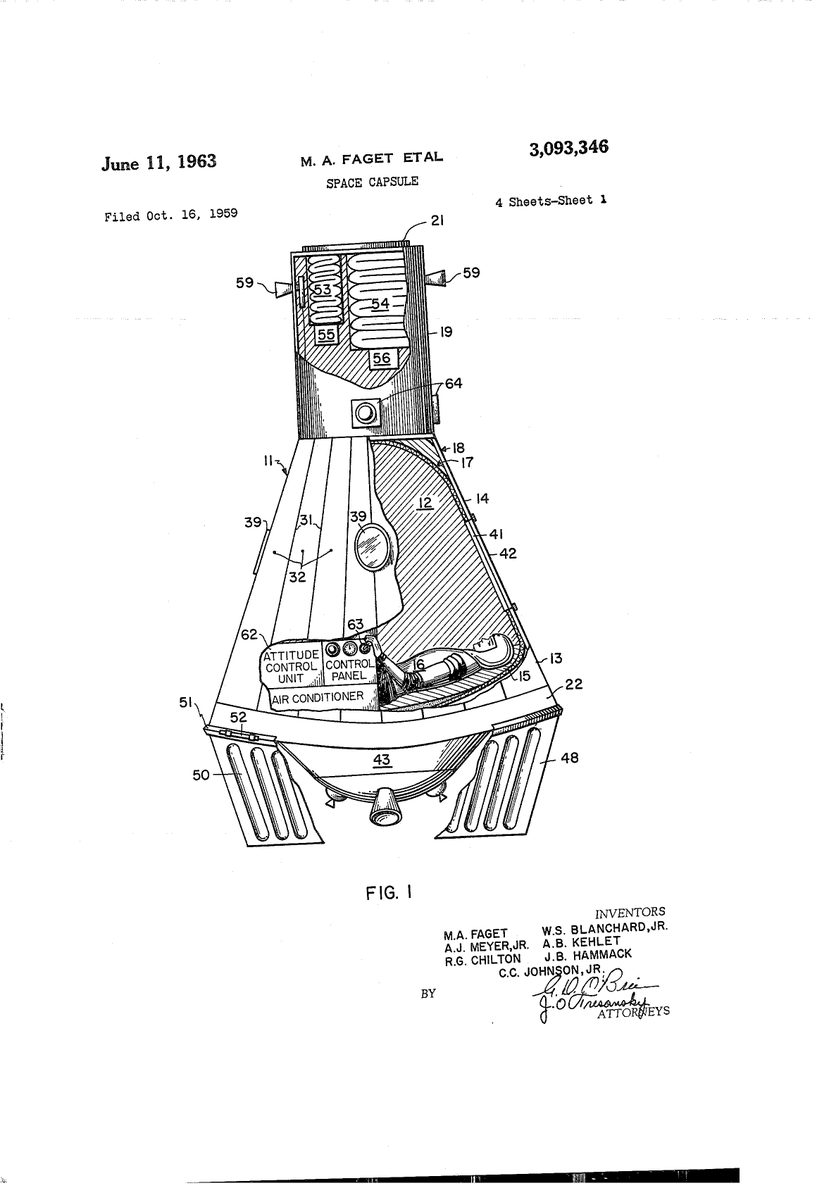
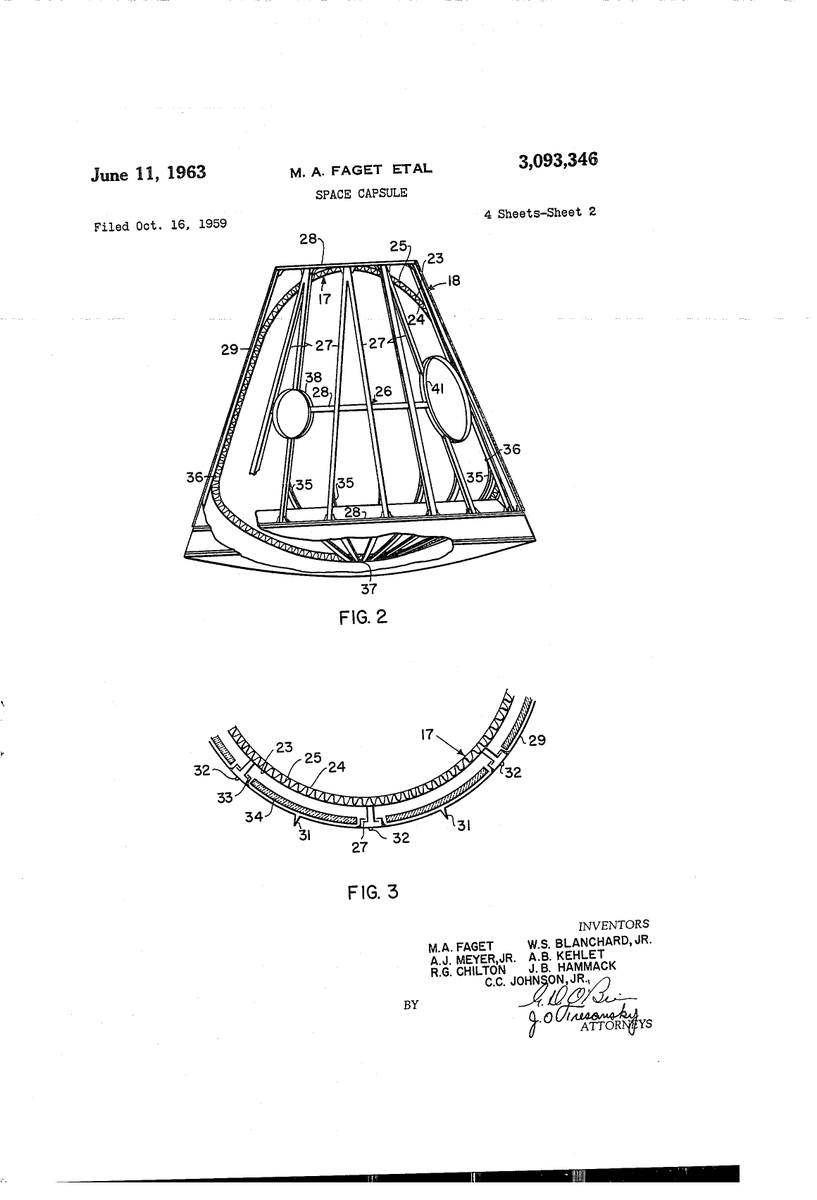
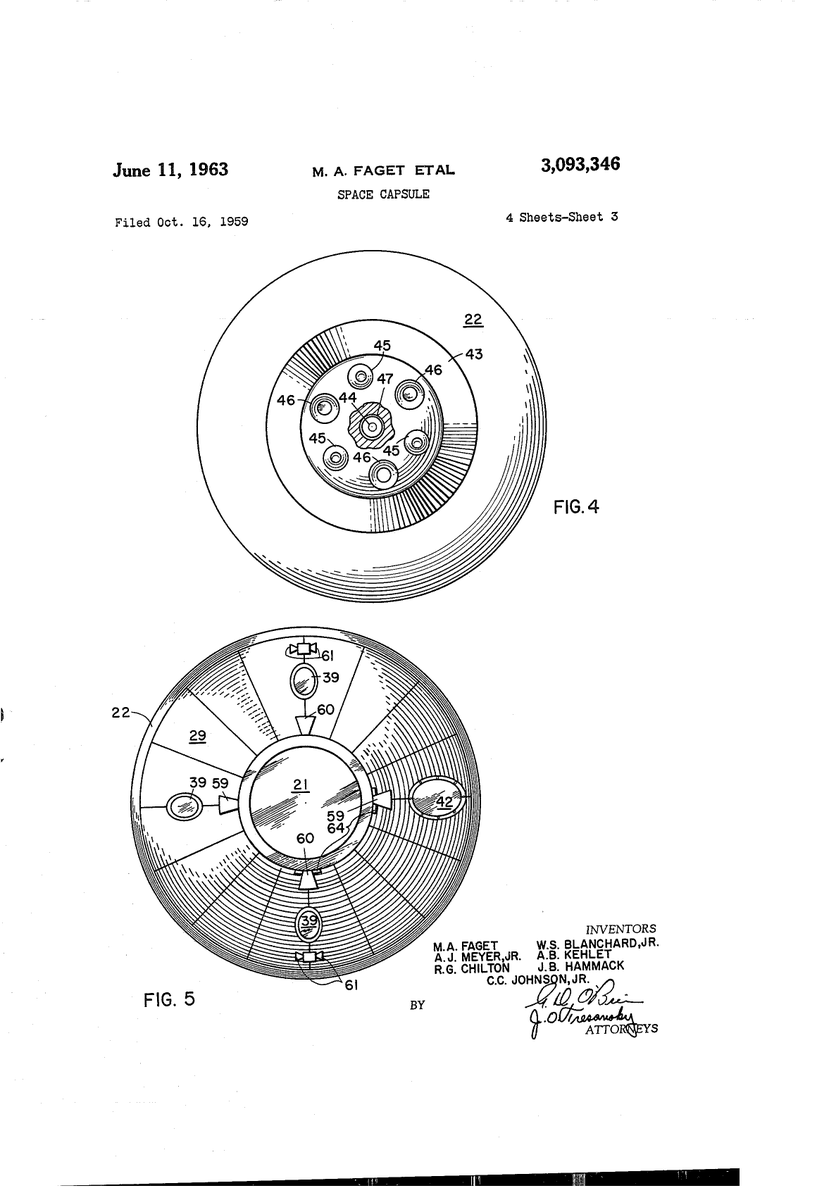
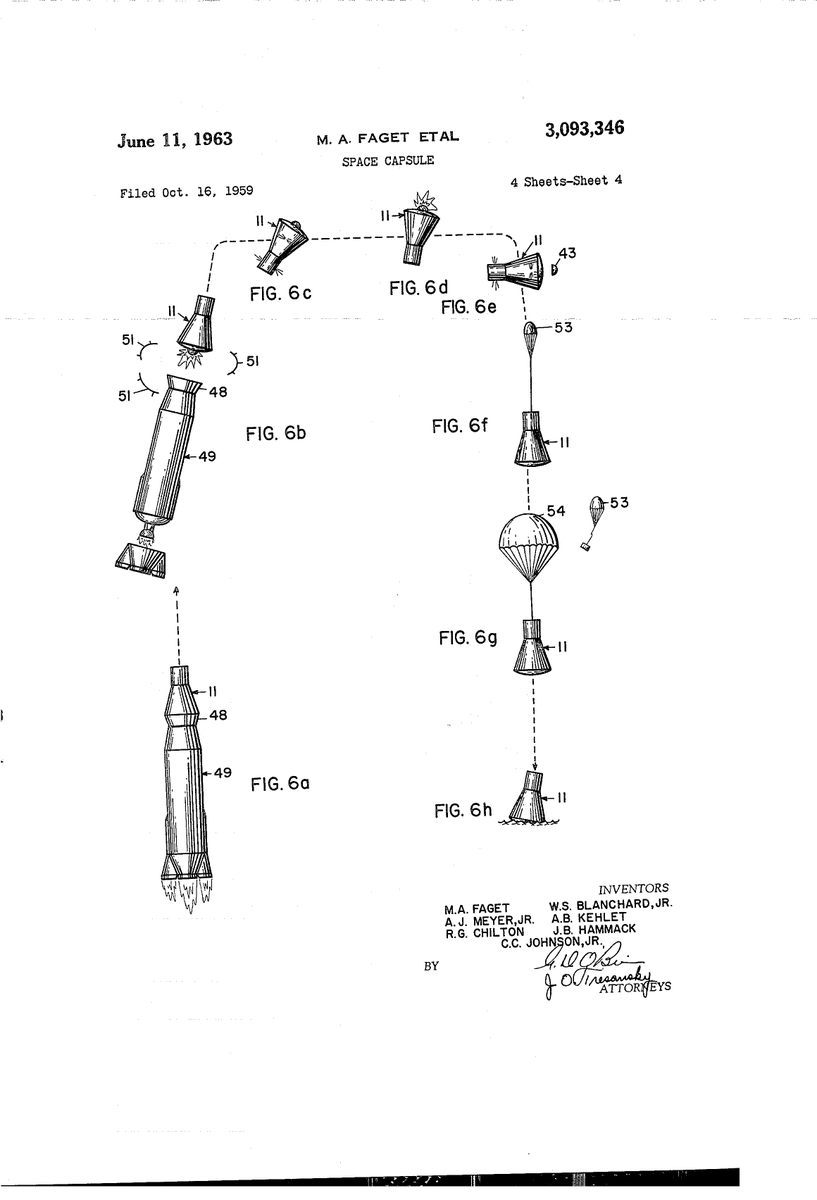
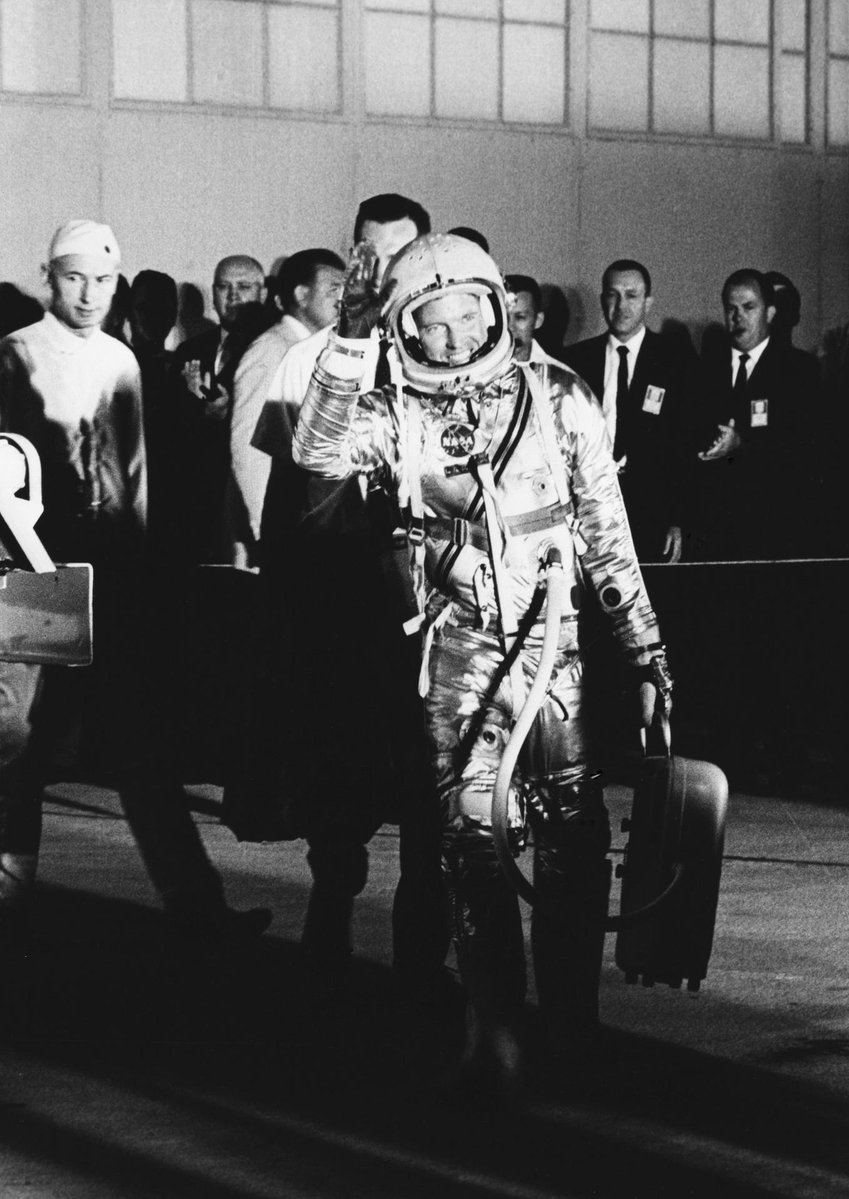
In 1963, as Gordon Cooper embarked on the final crewed flight of Project Mercury aboard Faith 7, he undertook a 34-hour mission that pushed the boundaries of human endurance in the weightlessness of space. The spacecraft that carried him through 22 orbits was built upon a design whose core principles had been captured in a patent for the Mercury space capsule. By the early 1960s, the United States found itself locked in an urgent technological race with the Soviet Union. Following the launch of Sputnik and the first human spaceflights, American engineers confronted the profound challenges of sending a person into orbit and ensuring a safe return through the searing heat of atmospheric reentry. The Mercury program represented the nation's initial commitment to human space exploration, a necessary foundation for the bolder goal President Kennedy had set of reaching the Moon within the decade. In this era of uncertainty about the effects of prolonged weightlessness and the demands of spaceflight on both machine and man, the capsule offered a compact, reliable vessel capable of sustaining life amid extremes of pressure, temperature, and isolation. The design emphasized simplicity and structural integrity, featuring a blunt forebody that generated the necessary drag for a controlled ballistic descent while a dedicated heat shield absorbed the intense thermal loads of reentry. An inner pressure vessel protected the astronaut, while provisions for attitude control and parachute recovery systems ensured the vehicle could be oriented properly and brought to a safe landing in the ocean. These elements addressed the critical needs of the time, transforming theoretical concepts of space travel into a practical engineering reality that allowed astronauts to venture farther from Earth than ever before. Maxime A. Faget and his team of engineers at NASA conceived this configuration and filed the patent in 1959, driven by the imperative to create a stable, protective spacecraft for manned orbital missions. They positioned the occupant's contour couch low within the blunt end to maintain the capsule's center of gravity for superior aerodynamic and hydrodynamic stability during reentry and splashdown. As the patent noted, the outer structure served as both a load-bearing framework and a shield against heat and micrometeorites, safeguarding the inner habitat. This thoughtful engineering directly enabled the success of Cooper’s landmark endurance flight and the broader progress toward lunar exploration that Project Mercury helped make possible. Full patent text & diagrams: patents.google.com/patent/US30933…
Patent Vault tweet mediaPatent Vault tweet mediaPatent Vault tweet mediaPatent Vault tweet media
English
0
0
2
98
NASA History Office
NASA History Office@NASAhistory·
Two years after NASA's first astronaut launched to space, Gordon Cooper launched for the sixth and final crewed mission of Project Mercury OTD in 1963. Cooper's 34-hour mission in the cramped Faith 7 spacecraft was the longest of any NASA astronaut to that point.
NASA History Office tweet mediaNASA History Office tweet media
English
11
73
386
9.3K
Patent Vault
Patent Vault@PatentVault·
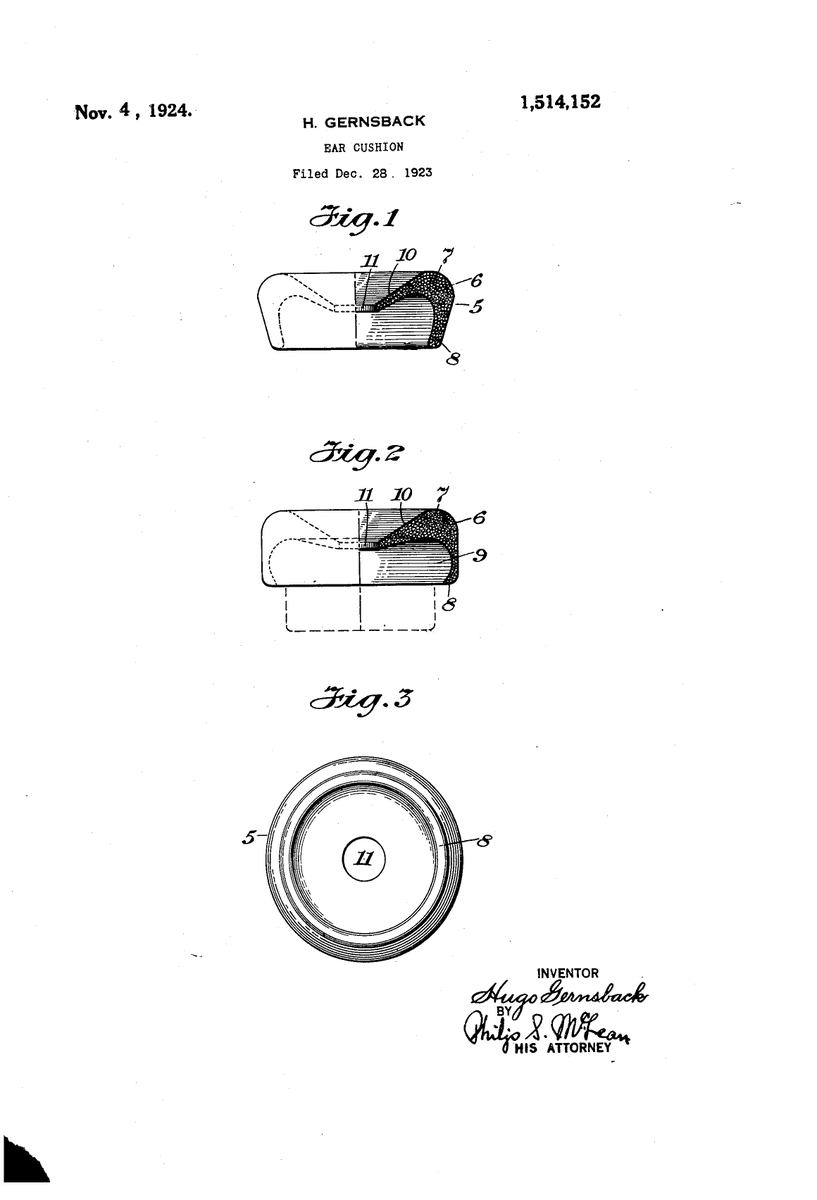
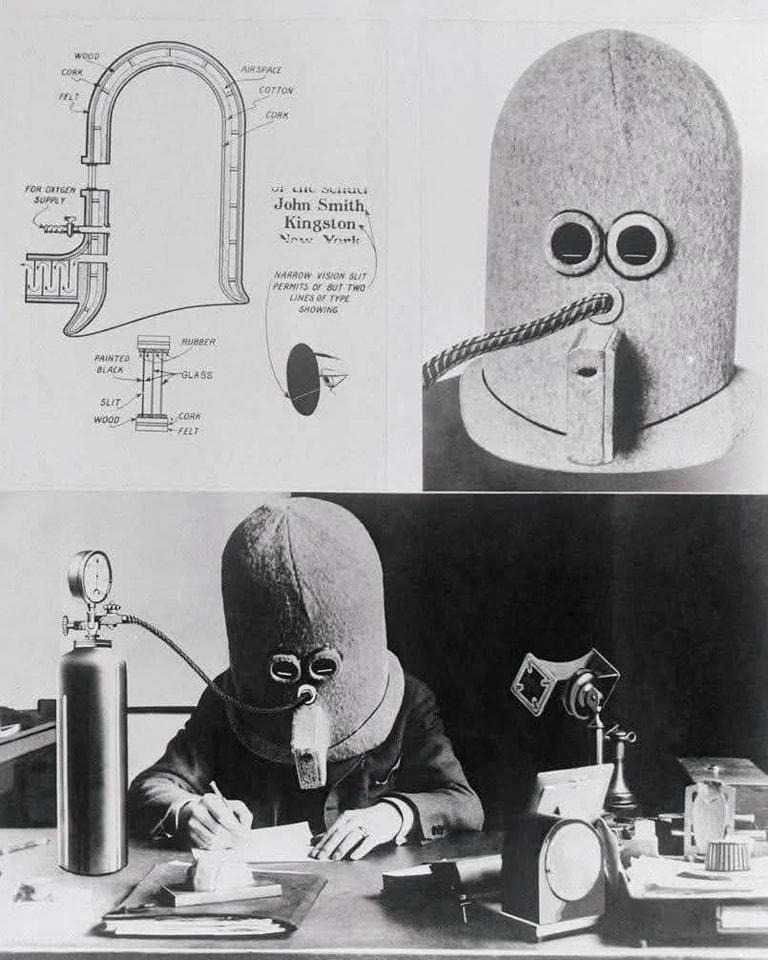
In 1925, as the pace of modern life intensified with telephones ringing in homes and offices across America, the anti-distraction helmet stood as a striking response to the growing need for unbroken concentration, its design echoing an inventive pursuit of sensory isolation that Hugo Gernsback had explored in his work on sound-excluding devices just the year before. The 1920s marked a transformative era when industrialization and urban expansion filled daily existence with unprecedented noise—from clattering machinery in factories to the constant hum of street traffic and the emerging clamor of communication technologies. Writers, engineers, and business professionals found themselves battling interruptions that shattered deep thought, at a time when efficiency and productivity were becoming watchwords of the age. Early efforts in soundproofing reflected broader societal pressures: the shift toward specialized office labor demanded sustained focus, yet the very tools connecting people, like the telephone, often pulled attention away. In this context, personal devices that could create quiet pockets amid the din represented not mere novelty, but a practical answer to the human struggle for clarity in an accelerating world. Technological challenges of the period further amplified the urgency. Telephone receivers, while revolutionary for linking distant voices, struggled with poor seals that allowed ambient sounds to intrude, undermining conversations and work alike. Inventors turned to resilient materials and precise fits to combat this, drawing on the era’s advances in rubber manufacturing born from wartime needs and consumer demand. These developments spoke to a deeper quest for control over one’s environment, where the mind could engage fully without the pull of external chaos. Hugo Gernsback, whose visionary ideas spanned electronics and scientific publishing, was driven by precisely these frustrations in everyday communication. In 1924, he received U.S. Patent 1,514,152 for an ear cushion crafted as a single piece of highly resilient porous sponge rubber, featuring a thickened rim and a tapered flange that stretched securely over the receiver cap to press the material firmly into place. As the patent explained, it was engineered to “fit closely to the ear so as to exclude external sounds,” offering cushioning and isolation without added bulk. This clever design not only enhanced the helmet’s conceptual lineage but underscored the same ingenuity in taming distractions that defined Gernsback’s approach to focus amid the distractions of his time. Full patent text & diagrams: patents.google.com/patent/US15141…
Patent Vault tweet media
English
0
0
1
168
DaVinci
DaVinci@BiancoDavinci·
This crazy anti-distraction helmet from 1925 was designed to eliminate distractions and maximize concentration.
DaVinci tweet media
English
24
69
340
11.3K
Patent Vault retweetledi
Cyber City Circuits
Cyber City Circuits@MakeAugusta·
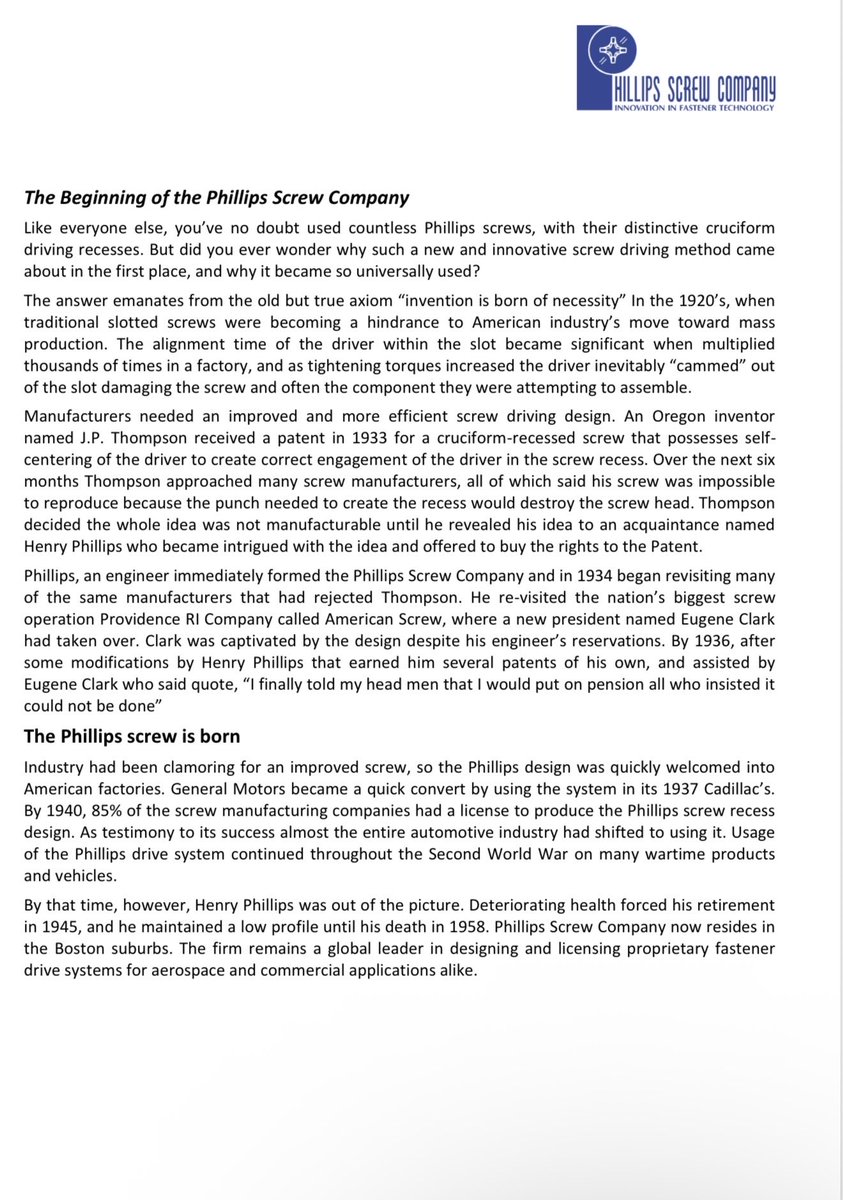
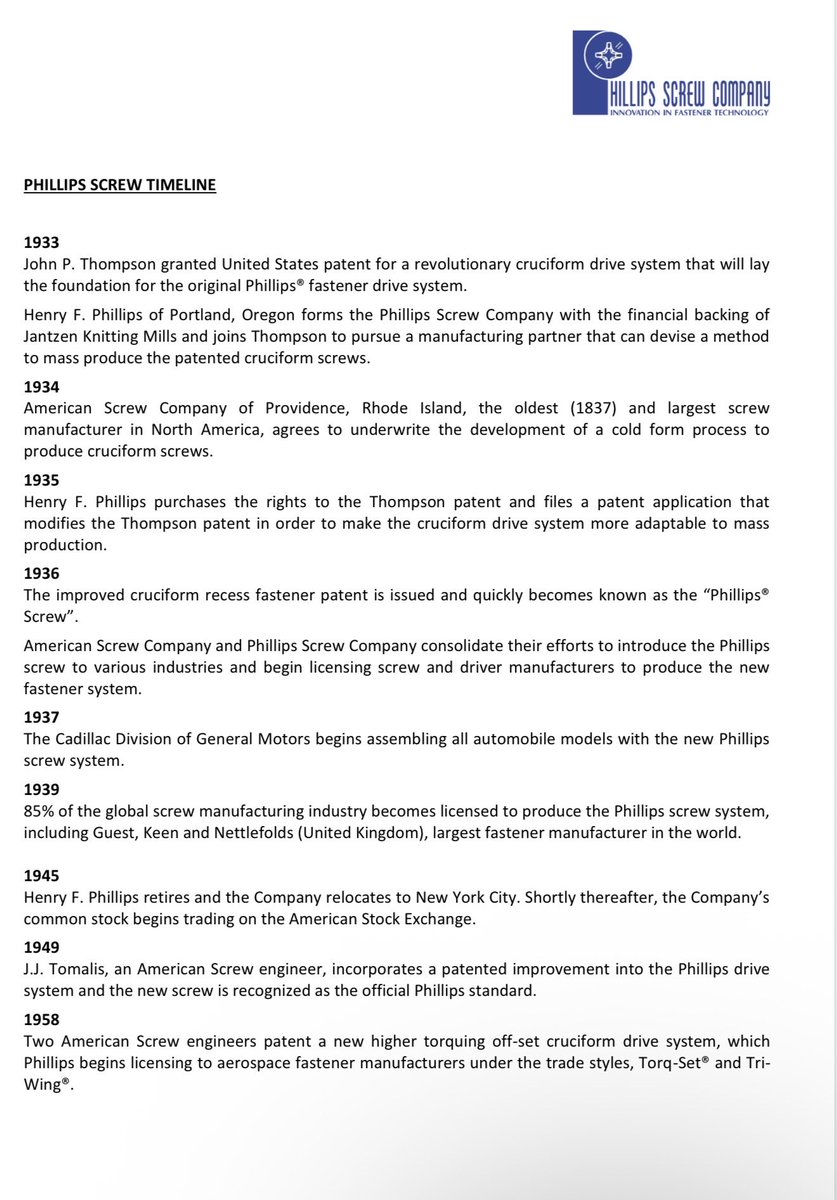
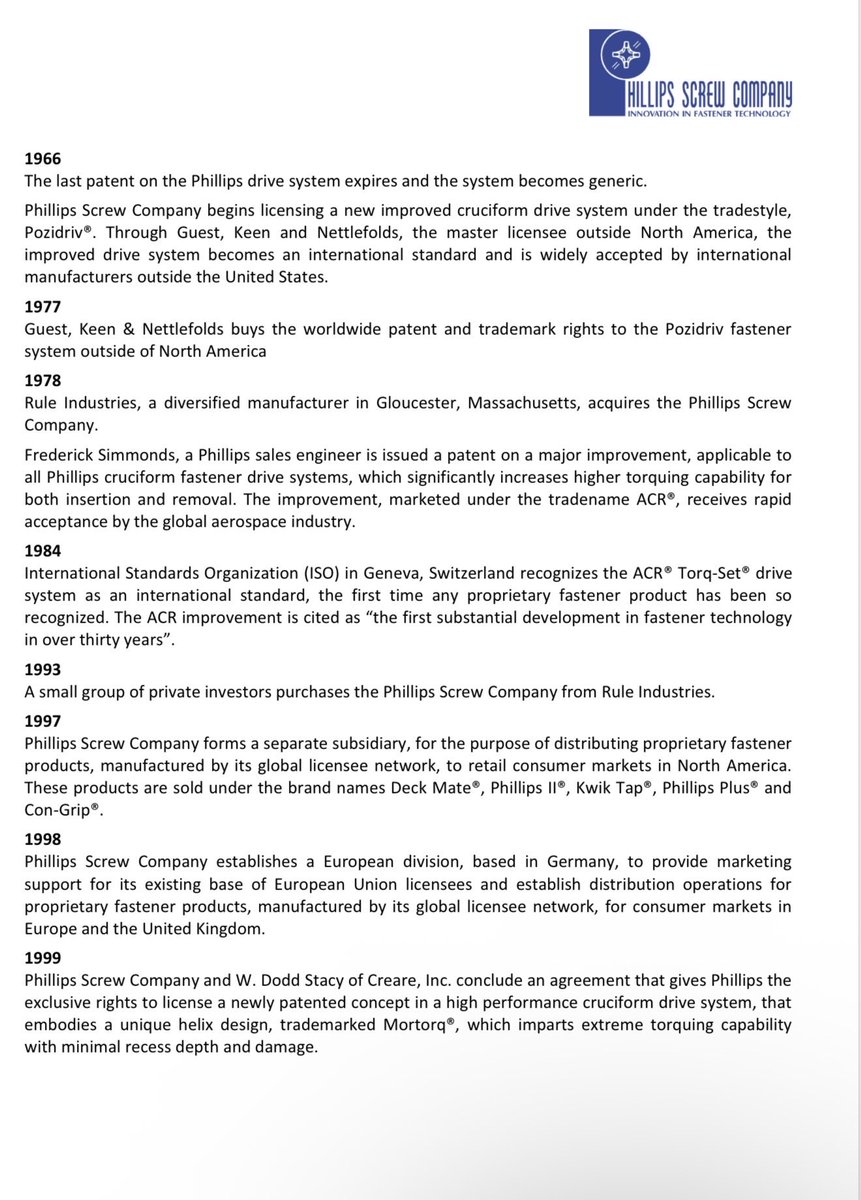
The guy patented as many aspects of the screw head concept. The PhIllips Screw Company didn’t start making screws until relatively recently. Phillips made their money licensing the design to tool makers. The company is still around. I tried it interview someone on the company’s history and they didn’t have much to share other than this handout on the company history. Check it out.
Cyber City Circuits tweet mediaCyber City Circuits tweet mediaCyber City Circuits tweet mediaCyber City Circuits tweet media
Cyber City Circuits@MakeAugusta

Means for uniting a screw with a driver - Patent US2046837A Inventor Henry F Phillips

English
1
2
5
665
Patent Vault
Patent Vault@PatentVault·
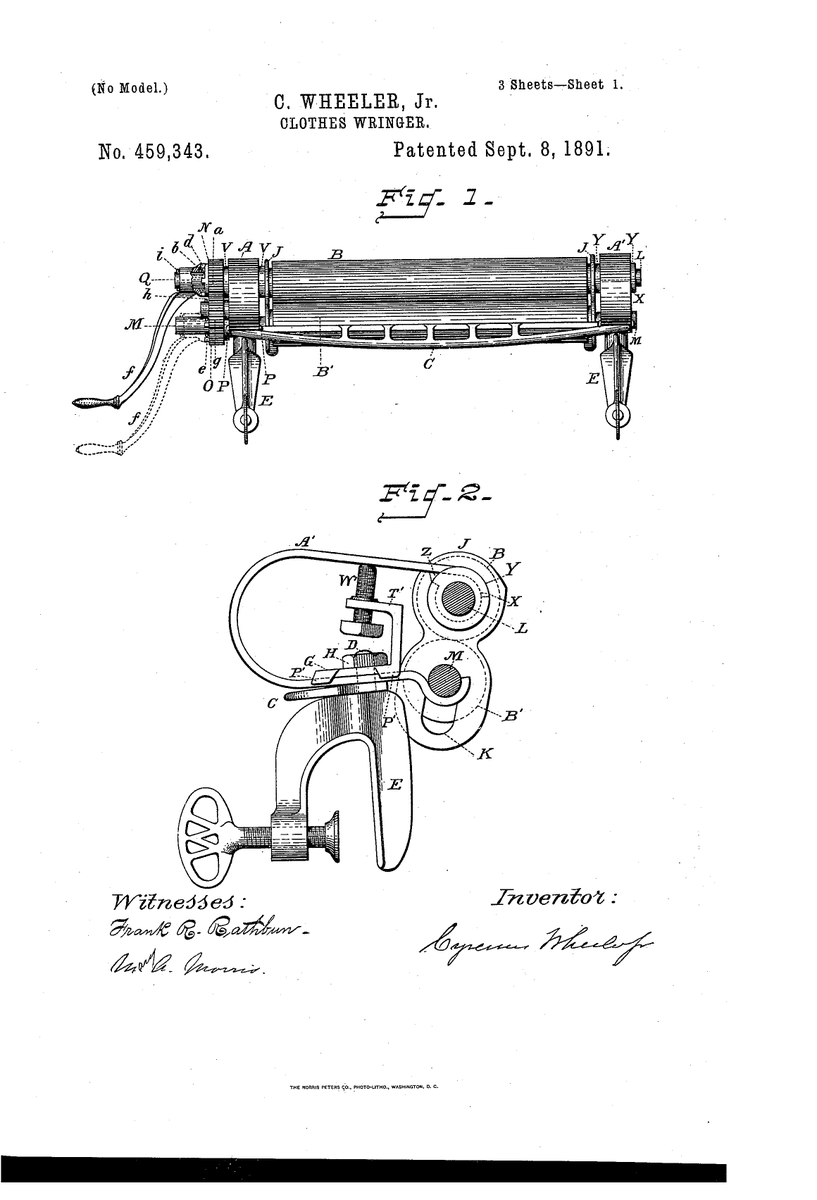
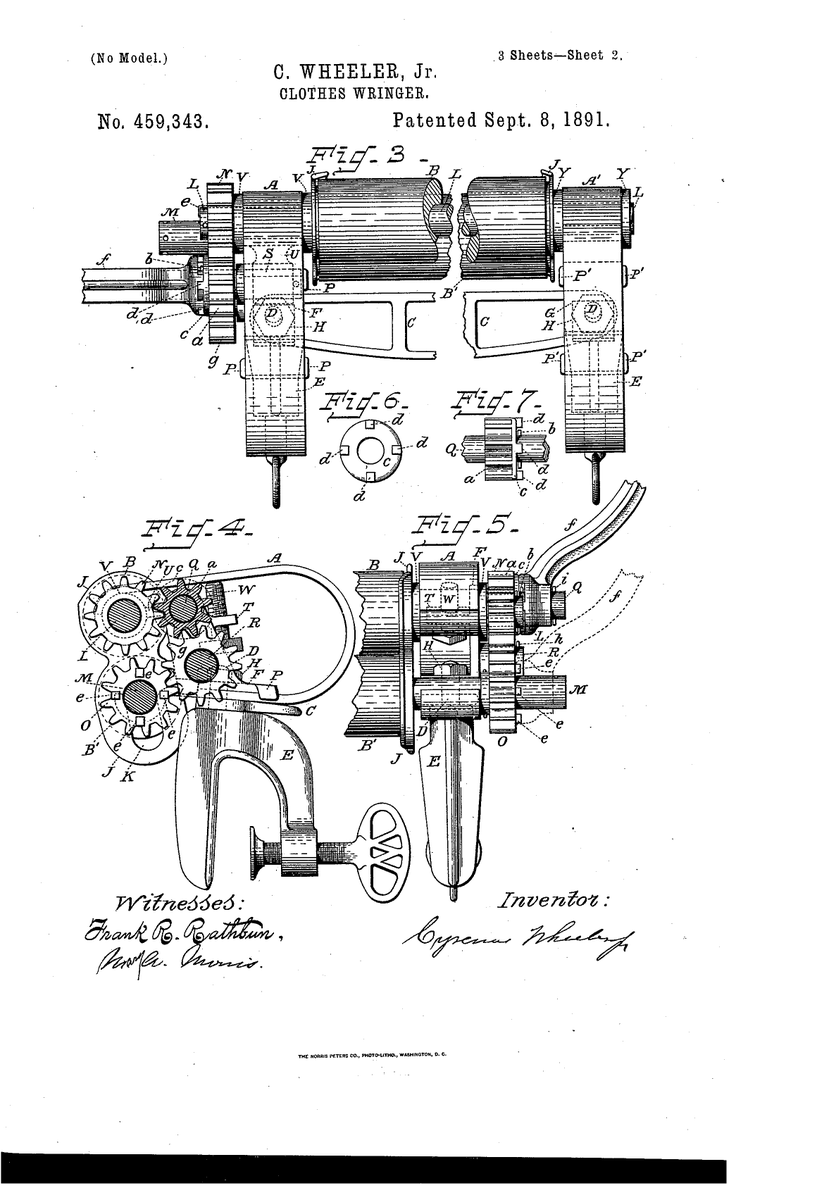
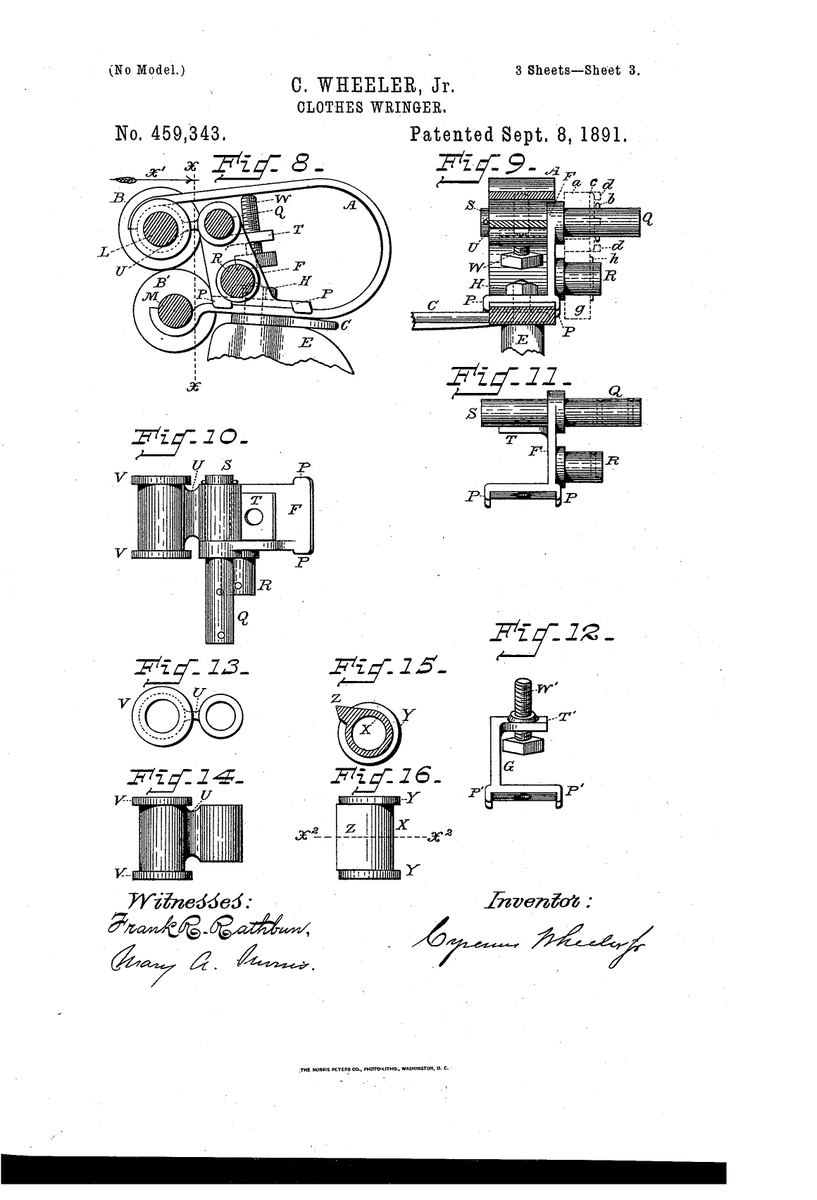
That vintage wringer washer, with its wooden tub and heavy rollers, captures the very essence of what your post describes: a daily ritual that tested patience and physical resolve in ways modern appliances have long since erased. Generations of homemakers knew those machines not as conveniences but as steadfast companions in the unending labor of keeping a household clean. In the late nineteenth and early twentieth centuries, laundry day loomed as one of the most demanding chores in American homes. Families relied on rainwater or hand-pumped wells hauled indoors by the bucketful, heated over wood or coal stoves until steam filled the kitchen. Clothes and linens were scrubbed on washboards, boiled to lift stains, and rinsed through multiple changes of water that grew heavy and gray with use. The final extraction of moisture fell to tired arms and hands—twisting fabrics by hand or feeding them through rudimentary rollers often left garments torn, hands blistered, and floors slick with spilled water. As cities expanded and households grew busier with industrial-era rhythms, the search for any mechanical aid became pressing, yet electricity remained a luxury in many places, leaving families to rely on human effort alone. These early wringer machines emerged at the intersection of necessity and quiet ingenuity, transforming the backbreaking end of the wash into something slightly more manageable. Mounted atop sturdy wooden tubs, the rollers pressed out excess water far more thoroughly than manual methods, allowing clothes to dry faster on outdoor lines or indoor racks and reducing the risk of mildew in damp climates. Still, operating them required steady hands and careful timing, especially when handling heavier items like blankets or work shirts that could jam the mechanism or demand extra strength to turn the crank. Cyrenus Wheeler, Jr., of Auburn, New York, received US Patent 459343 in 1891 for an improved clothes-wringer that addressed these very challenges. His design used U-shaped springs to support the rollers with consistent yet adjustable pressure, paired with a system of spur-gearing that allowed the operator to choose higher or lower speeds depending on the fabric. As the patent explains, the arrangement enabled “a child” to handle large and small items with equal ease and minimal exertion. That thoughtful engineering spoke directly to the era’s realities and echoes in the resilient machines our grandmothers operated, where success was measured not in gleaming results but in clothes that emerged intact after a long, determined day. Full patent text & diagrams: patents.google.com/patent/US45934…
Patent Vault tweet mediaPatent Vault tweet mediaPatent Vault tweet media
English
0
0
1
30
G-MA & G-PA
G-MA & G-PA@GPAIndiana·
This is not a washing machine. This is a full-time life lesson in patience, upper-body strength, and why my Grandma never trusted “newfangled" anything. Back then, if the clothes came out clean, it was considered a miracle. If they came out in one piece, it was a banner day. And if the machine only made one terrible noise instead of three, you probably called that a blessing. 😂
G-MA & G-PA tweet media
English
18
15
59
3.3K
Patent Vault
Patent Vault@PatentVault·
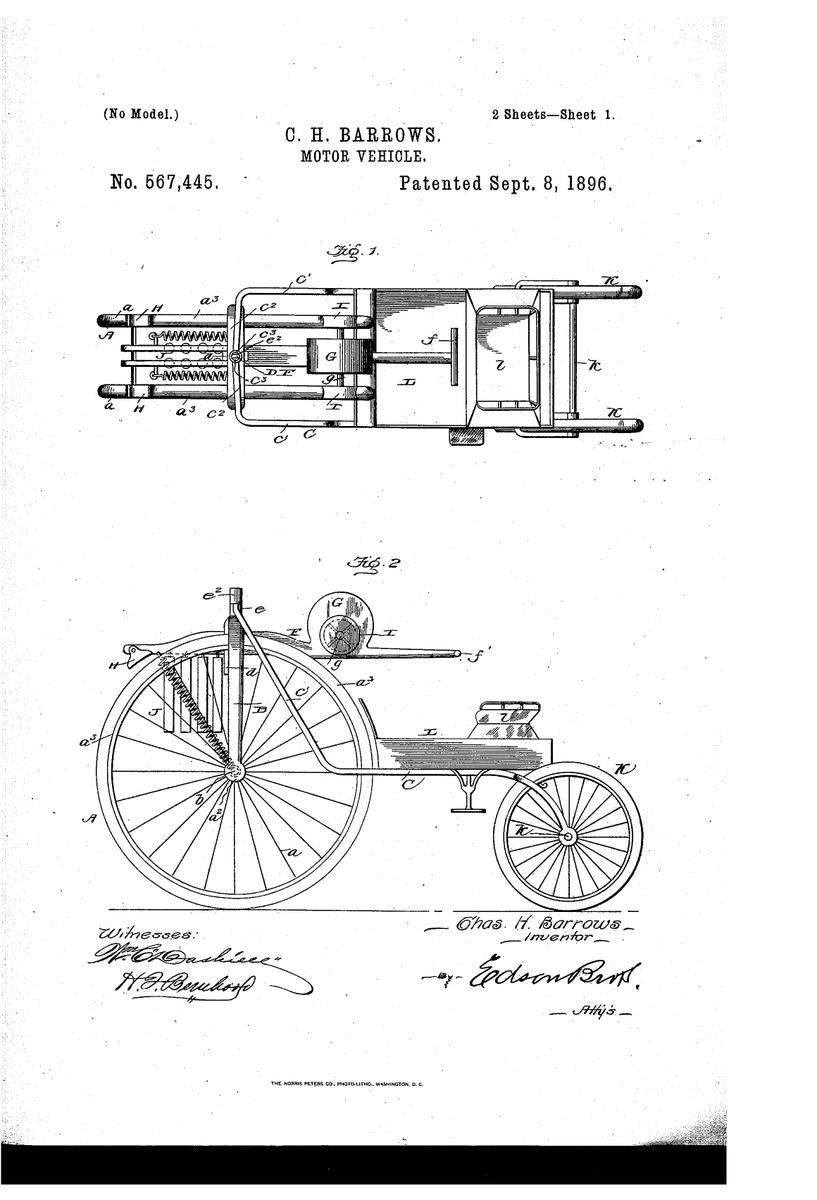
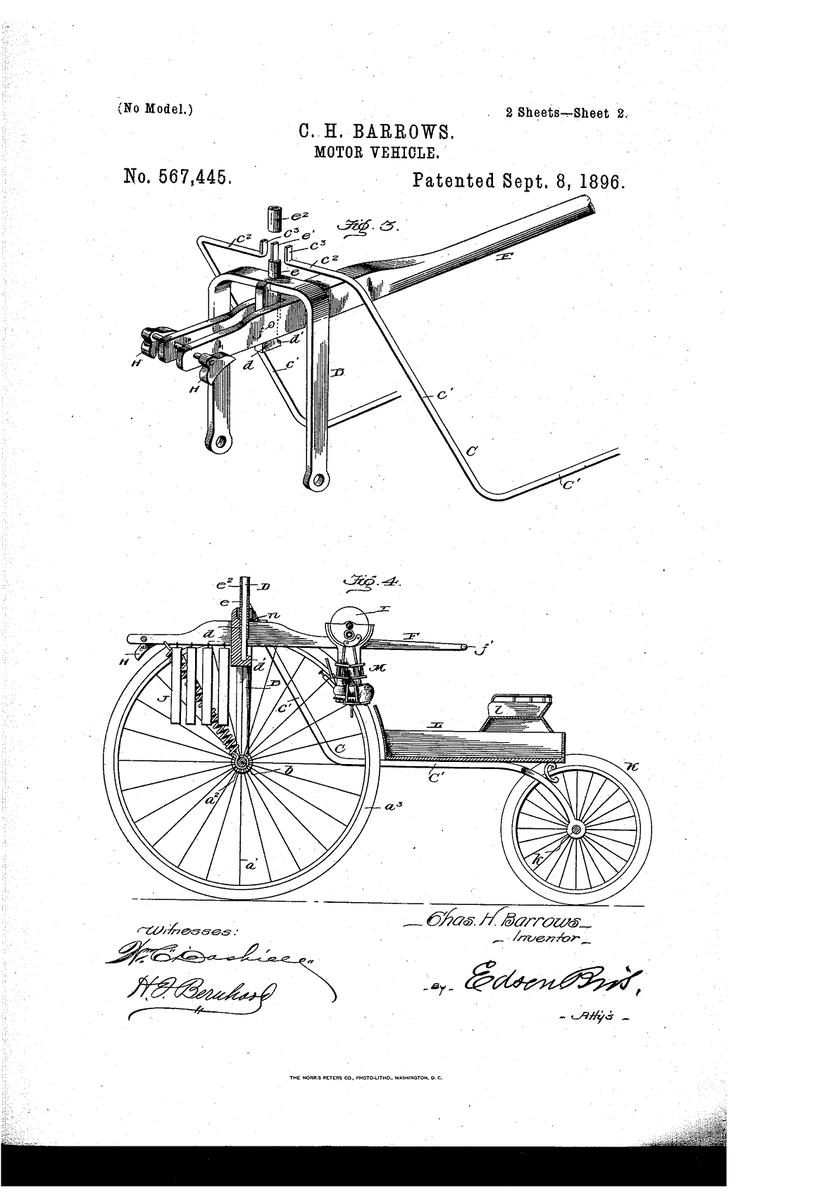
In the streets of Paris in 1881, French inventor Gustave Trouvé mounted an improved Siemens electric motor and rechargeable lead-acid batteries onto a British Starley tricycle, producing what stands as one of the earliest demonstrations of practical electric personal transport. By the closing decades of the nineteenth century, rapid urbanization had strained traditional horse-drawn systems to their limits. Crowded city thoroughfares suffered from congestion, dust, and the constant labor of feeding and stabling animals, while growing factories demanded cleaner sources of motive power. Electricity, newly harnessed through reliable storage batteries and compact motors, offered a promising alternative—one that required no fuel combustion and promised quieter, more controllable movement. Trouvé’s brief but successful trial along the Rue Valois revealed both the potential and the fragility of these early systems: the vehicle performed well enough on level pavement yet highlighted the weight of batteries and the need for refined mechanical integration if electric mobility was to move beyond experiment. Across the Atlantic, American inventors absorbed these European lessons and adapted them to local conditions of road and industry. The 1890s saw a surge of patents seeking to balance battery power, motor placement, and chassis stability in compact vehicles suited for everyday use. Such designs addressed not only propulsion but also the everyday challenges of steering, braking, and energy management in an era when infrastructure for recharging remained rudimentary. Charles H. Barrows of Willimantic, Connecticut, pursued one such refinement in his 1896 motor-vehicle patent. Motivated by the desire for a light, maneuverable conveyance that placed control directly in the operator’s hands, he mounted the electric motor on the steering lever itself so that it could be frictionally engaged or disengaged from the front driving wheel. “The leading feature of my invention consists of a steering handle or lever carrying a motor to be engaged with or disengaged from the driving-wheel of the machine in a manner to avoid interfering with the movement or adjustment of the steering handle,” he wrote. This elegant arrangement allowed simultaneous steering and power delivery while preserving balance and safety—echoing the same spirit of resourceful adaptation that first propelled Trouvé’s tricycle through the avenues of Paris. Full patent text & diagrams: patents.google.com/patent/US56744…
Patent Vault tweet mediaPatent Vault tweet media
Things From the Past@pastarchive

The world’s first electric car? It was built in 1881. French inventor Gustave Trouvé fitted a tricycle with an electric motor and rechargeable batteries, creating what is often cited as the world’s first electric car. Tested on the streets of Paris in 1881, it showed that electric mobility began far earlier than most people think.

English
1
0
7
429
Patent Vault
Patent Vault@PatentVault·
@RealPreCinema Thank you for the original content! I love supplementing the knowledge transfer on stuff like this -- love your page!
English
0
1
1
38
Pre Cinema History 📷🎞️🇨🇦 🏴󠁧󠁢󠁳󠁣󠁴󠁿
Thank you!
Patent Vault@PatentVault

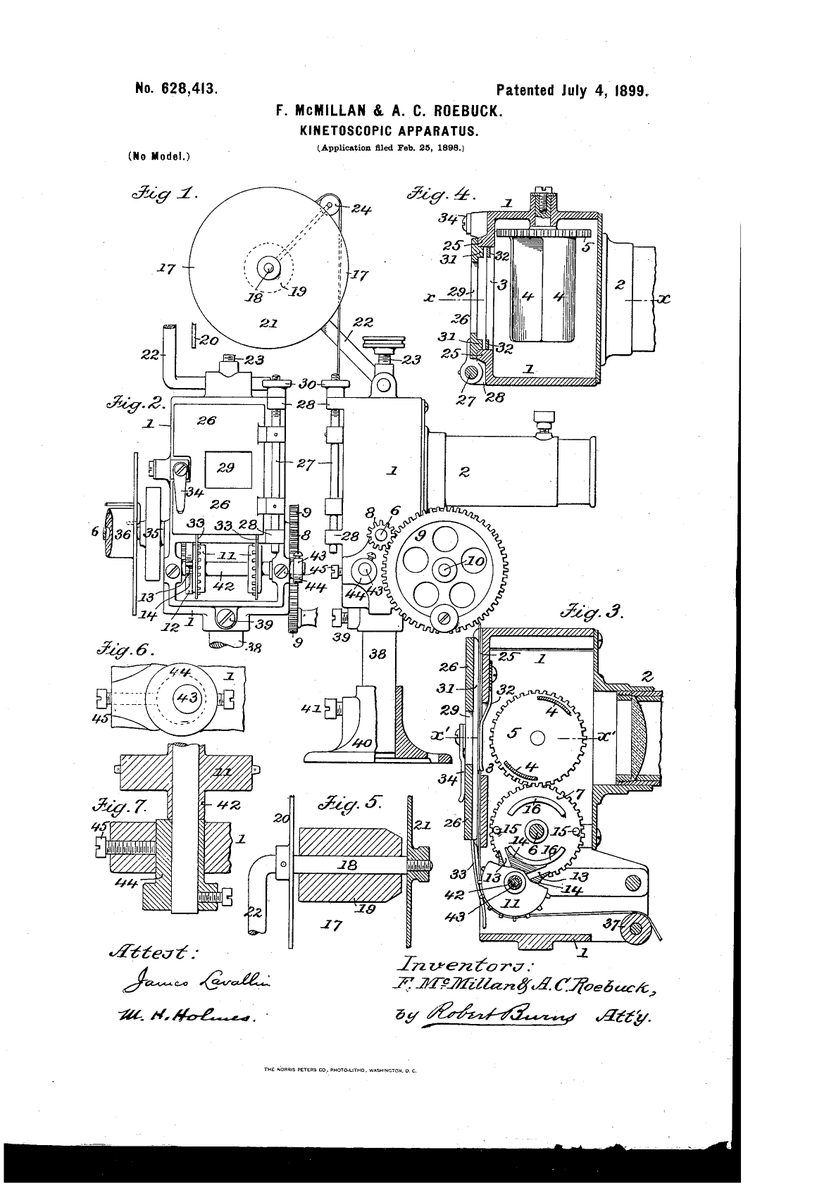
In the late 1890s, the Optigraph projector stood out as a pioneering 35mm motion picture device from Chicago’s Enterprise Optical Company, its practical design for traveling exhibitors captured precisely in U.S. Patent 628,413 for a kinetoscopic apparatus. The closing years of the nineteenth century witnessed a quiet revolution in how Americans encountered the world through light and shadow. Magic lantern projections had long offered still images in lecture halls and church basements, yet the arrival of perforated celluloid film promised something more alive—figures in motion that could transport viewers beyond their daily routines. For itinerant showmen hauling equipment across dusty roads and rail lines, the barriers were immense: projectors were often heavy, temperamental, and expensive, requiring skilled operators and lengthy setups that cut into scarce performance time. In an era when rural communities and smaller towns hungered for shared spectacles amid rapid industrialization, the need grew for machines that could fold into compact cases, adapt to existing lantern systems, and withstand the rigors of constant movement without sacrificing image quality. These pressures reflected deeper societal shifts. As vaudeville theaters and makeshift venues multiplied, the standardization of 35mm film opened possibilities for wider distribution of reels, while mechanical refinements addressed the persistent flicker and film damage that plagued early demonstrations. The Optigraph’s emergence spoke to a broader quest for accessibility, allowing modest operators to compete in a landscape long dominated by a handful of powerful patents and corporate interests. Alvah C. Roebuck, drawing on his background in manufacturing and commerce, collaborated with inventor Frank McMillan to meet these exact demands. Their kinetoscopic apparatus featured a hinged film-confining plate with vertical guides and spring fingers that held the strip securely yet allowed swift loading, paired with an intermittent gearing system that imparted precise rotary motion to the feed roller while the shutter revolved continuously. As the patent explained, the arrangement ensured “a positive intermittent rotary motion is imparted... so that the beams of light will be projected through the pictured film only when the same is in a stationary condition.” This engineering insight not only eased assembly and disassembly for road-weary exhibitors but also realized the very vision of portable, reliable projection described in the original account. Full patent text & diagrams: patents.google.com/patent/US628413

English
1
0
2
143
Patent Vault
Patent Vault@PatentVault·
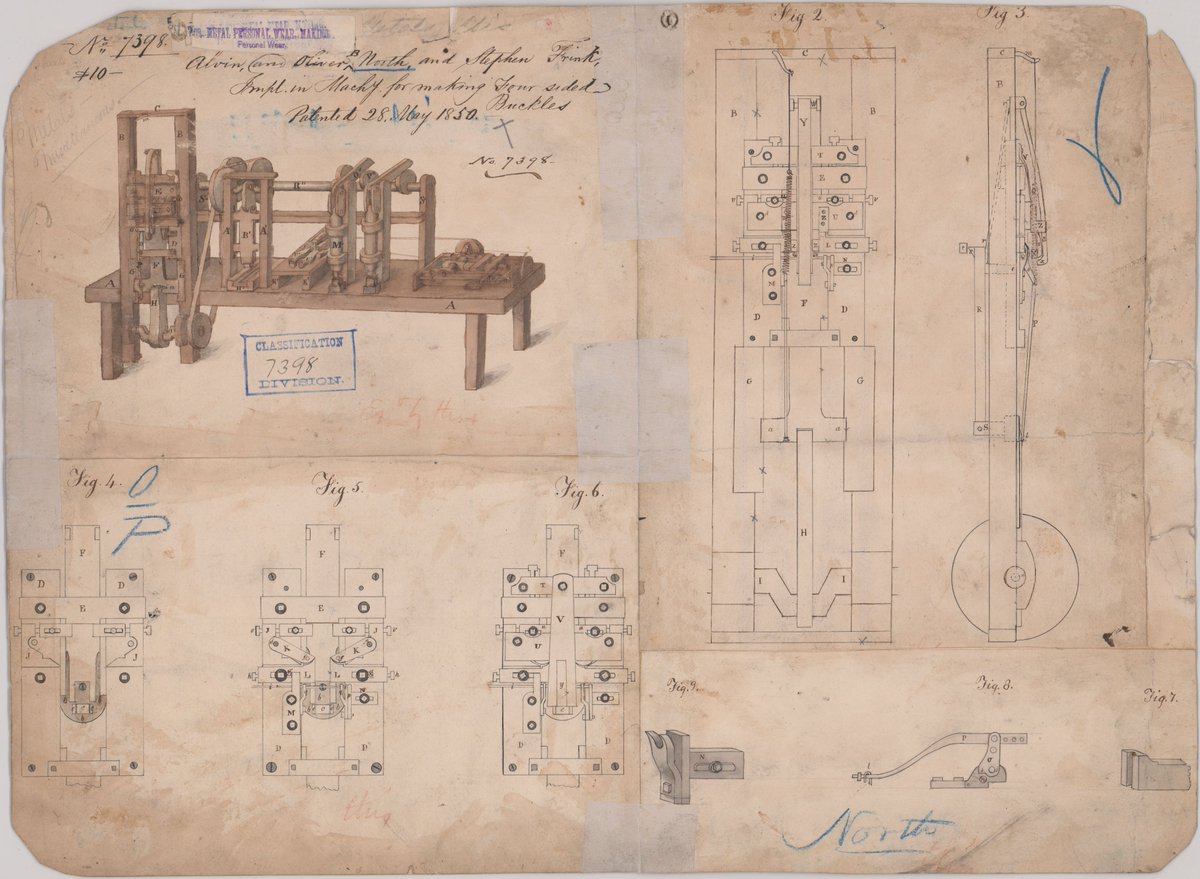
US #Patent 7,398 (1850) – Machinery for Making Four-Sided Buckles On May 28, 1850, Alvin North, Oliver B. North, and Stephen Frink of New Britain, Connecticut, received U.S. Patent 7,398 for their machinery designed to manufacture four-sided buckles used in personal wear and hardware. In the 1850s the United States stood firmly in the midst of the Industrial Revolution, with New England leading the way in mechanized production of everyday goods. New Britain, Connecticut—already on its way to becoming known as the Hardware City of the World—served as a bustling center for small metal manufactures, where local foundries and workshops supplied buckles for clothing, belts, harnesses, and a growing array of consumer items. The expanding apparel industry and the steady rise in ready-to-wear garments created insistent demand for standardized metal fittings that hand labor alone could no longer supply efficiently. Four-sided buckles, with their precise rectangular geometry, presented special challenges in forming and finishing that traditional methods struggled to meet at scale. Inventors responded by developing specialized machines that promised greater speed, uniformity, and output, helping to fuel the commercial growth of hardware firms across the region. Alvin North, Oliver B. North, and Stephen Frink, working from the heart of Connecticut’s hardware district, created a multi-station machine that automated the shaping of four-sided buckles from metal stock. Their apparatus featured coordinated presses, forming dies, levers, and clamping mechanisms arranged on a sturdy wooden frame to bend, press, and assemble the buckle frames with consistent accuracy. The design specifically tackled the difficulties of producing the flat-sided structures required for reliable fastening in garments and accessories, reducing the manual steps that had long limited production. Patent drawings illustrate the intricate layout of stations and tools that allowed operators to turn out uniform pieces far more rapidly than by hand. By integrating these operations into a single workflow, the inventors addressed the practical needs of local manufacturers seeking to meet market demand without sacrificing quality. Their collaborative improvement reflected the inventive spirit that drove New Britain’s rise as a hardware powerhouse, where mechanical ingenuity turned small metal goods into staples of American daily life. For further reading: • Original patent drawing at the National Archives: catalog.archives.gov (search RG-241 for patent 7398 or inventors North and Frink, 1850) • Full patent text & diagrams on Google Patents: patents.google.com/patent/US7398
Patent Vault tweet media
English
0
0
1
86
Patent Vault
Patent Vault@PatentVault·
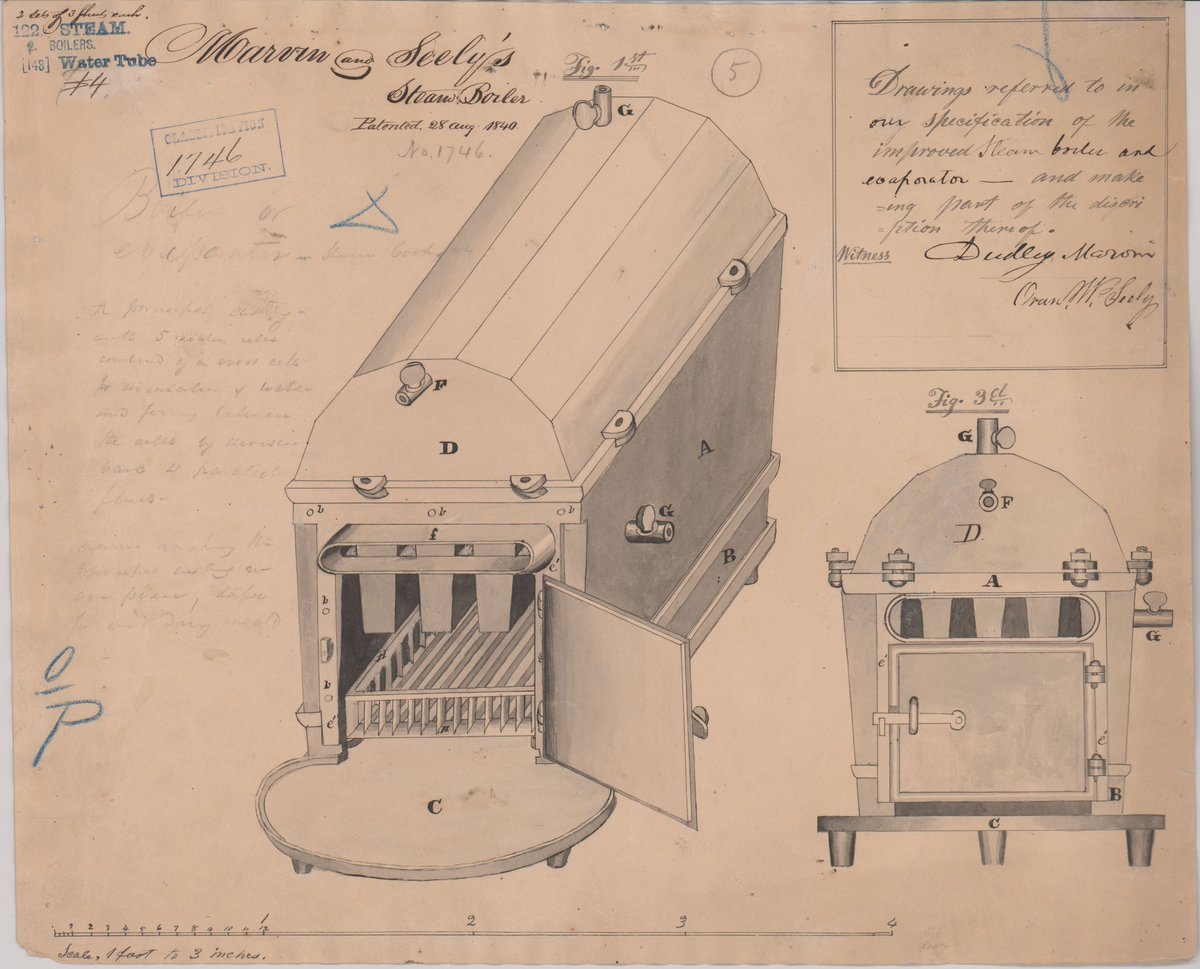
US #Patent 1746 (1840) – Improvement in Steam-Boilers and Evaporators In August of 1840, Dudley Marvin and Oran W. Seely received United States Patent 1746 for their water-tube steam boiler and evaporator, a compact design engineered to generate steam more efficiently for cooking, industrial processes, and other practical applications. By the early 1840s the United States stood at the threshold of full-scale industrialization. Steam engines drove textile mills and ironworks in the Northeast, while steamboats plied the major rivers and the first railroads began linking eastern cities to the expanding interior. The opening of the Erie Canal had already accelerated commerce, creating urgent demand for reliable mechanical power across factories, workshops, and transportation networks. Conventional fire-tube boilers, however, were often slow to raise steam and consumed large quantities of fuel, while the risk of explosion from large volumes of water under pressure remained a constant hazard. Inventors responded by seeking ways to increase heating surface area and improve water circulation without enlarging the boiler’s overall size. Marvin and Seely’s water-tube arrangement addressed these very limitations, offering a timely step toward safer and more economical steam generation. Dudley Marvin of New York City and Oran W. Seely of Sodus, Wayne County, New York, collaborated on this improvement after recognizing the shortcomings of existing boilers in everyday use. Their principal casting featured parallel water-cells that created a large heating surface directly exposed to the fire, with outer cells extending around three sides and down to the bottom for added protection and extended heat transfer. Three central cells were kept shallower to accommodate the furnace space, while the gaps between cells served as reverberating flues that circulated heat more thoroughly before it escaped. A sliding division-piece with bars formed return flues, maintaining draft and combustion even when the furnace door stood open. The entire apparatus was cast in just seven pieces—stool, pedestal with grate, principal casting, steam-chamber cap, division-piece, grate, and door-piece—allowing straightforward molding without cores thanks to the tapering design. As the patentees explained, this construction produced “a more perfect circulation of water” while keeping the heated surfaces properly immersed, making the boiler suitable for steaming vegetables for livestock, distilling, bleaching, dyeing, or refining. Their practical, cast-iron solution reflected the resourceful ingenuity of American inventors who were steadily refining steam technology during the antebellum years. For further reading: • Original patent drawing at the National Archives: catalog.archives.gov/search?q=1746+… • Full patent text & diagrams on Google Patents: patents.google.com/patent/US1746
Patent Vault tweet media
English
0
0
6
108
Patent Vault
Patent Vault@PatentVault·
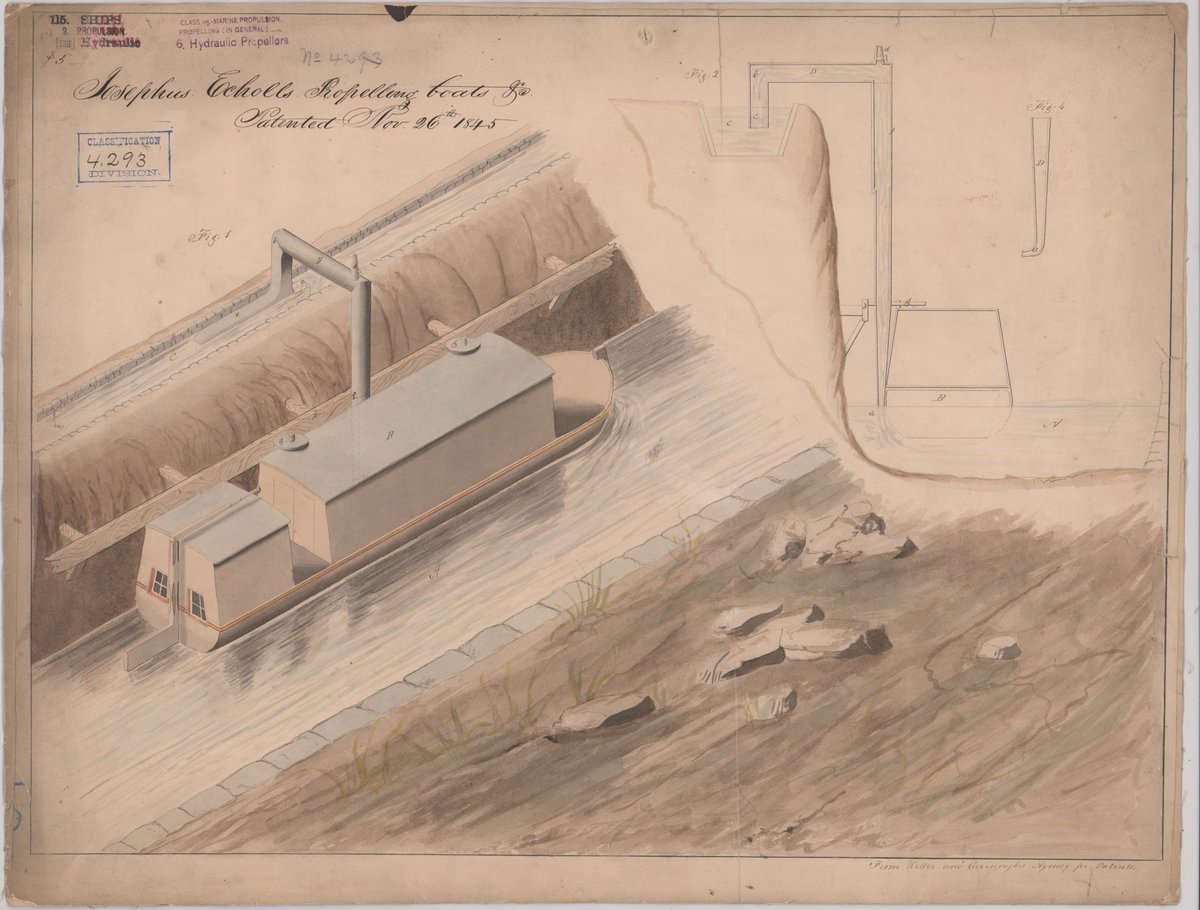
In the bustling canal era of the 1840s, when America’s inland waterways formed the vital arteries of commerce linking eastern ports to western frontiers, Josephus Echols envisioned a quieter, more efficient means of moving boats through narrow channels. His patented system, captured in the detailed drawing shared here, harnessed the simple yet powerful force of falling water to propel vessels forward without paddles, screws, or the churning wake of steam-driven wheels. By the time Echols filed his application in 1845, the great canal boom had already reshaped the young republic. The Erie Canal and its successors had opened vast markets for grain, lumber, and manufactured goods, yet traditional methods of propulsion—teams of mules plodding along towpaths or early steamboats whose sidewheels eroded fragile earthen banks—revealed their limits. Engineers and merchants alike yearned for a solution that conserved water, minimized bank damage, and allowed steady progress even in the confined spaces of artificial waterways. Echols’ approach drew on principles of hydraulic reaction already familiar from water wheels and fountains, but he adapted them ingeniously for mobile use on a boat itself. A parallel upper canal or reservoir supplied a steady column of water that descended through a vertical siphon tube mounted aboard the vessel, then discharged horizontally beneath the surface to drive the craft ahead by the very recoil of the exiting stream. This was an age when inventors across the Atlantic world experimented with reaction propulsion, from Robert Fulton’s early steamboats to European hydraulic turbines. Yet Echols’ design spoke directly to the practical realities of American canals: it required no onboard fuel once the upper water source was in place, produced virtually no turbulence to disturb the channel, and could even be adapted for railroad cars by discharging water into the open air. The system’s elegance lay in its reliance on gravity and the natural topography of canal systems, turning the very infrastructure of transportation into its own source of motive power. Josephus Echols, working from Columbus, Georgia, was driven by the everyday frustrations of canal navigation in the South, where seasonal water levels and the need for reliable freight movement pressed against the limitations of animal and steam power alike. In the patent specification he described his core insight with quiet precision: propelling boats “by means of a column or columns of water discharged from an upper level or reservoir not in or on the boat.” The clever arrangement of the siphon tube, with its adjustable joints and steering aids, reflected a deep understanding of both fluid dynamics and the practical demands of working waterways. In doing so, Echols offered a thoughtful glimpse into the inventive spirit that sought to harmonize human ambition with the steady flow of nature itself—precisely the ingenuity preserved in this remarkable 1845 drawing. Full patent text & diagrams: patents.google.com/patent/US4293
Patent Vault tweet media
English
0
0
3
122
Patent Vault
Patent Vault@PatentVault·
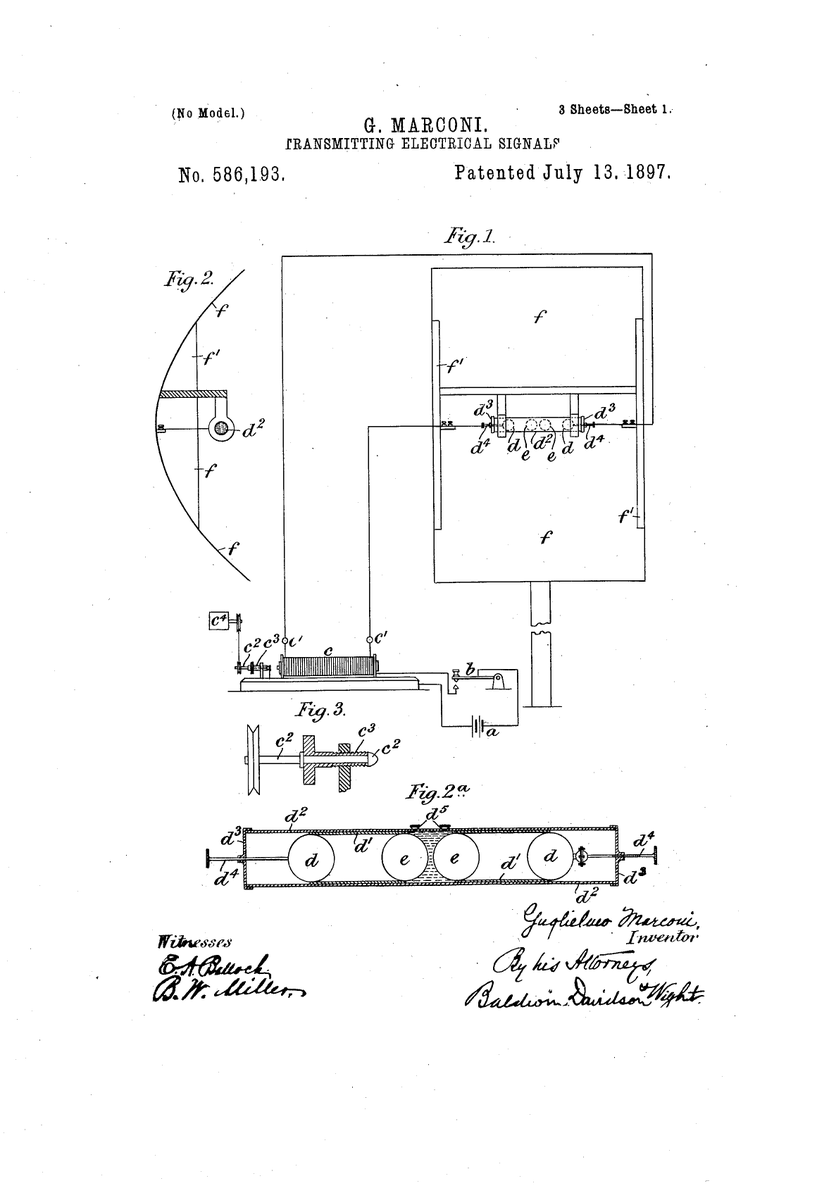
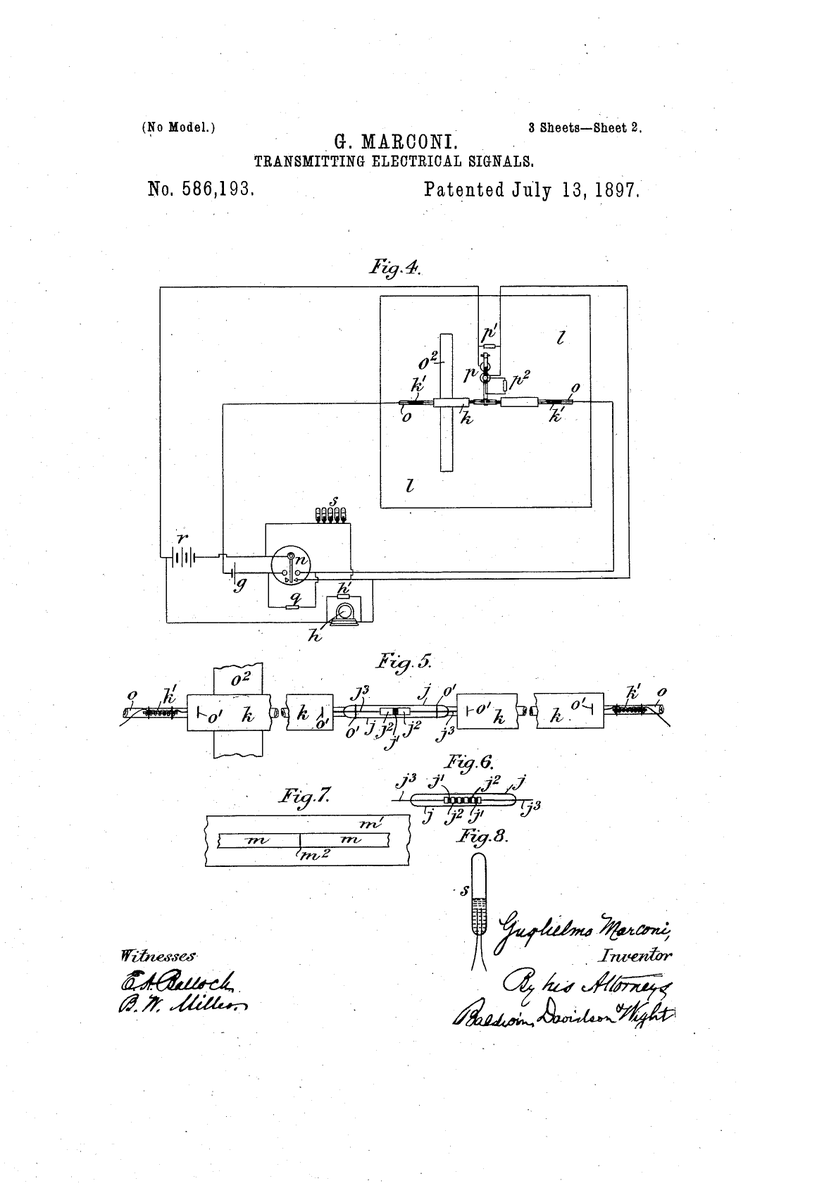
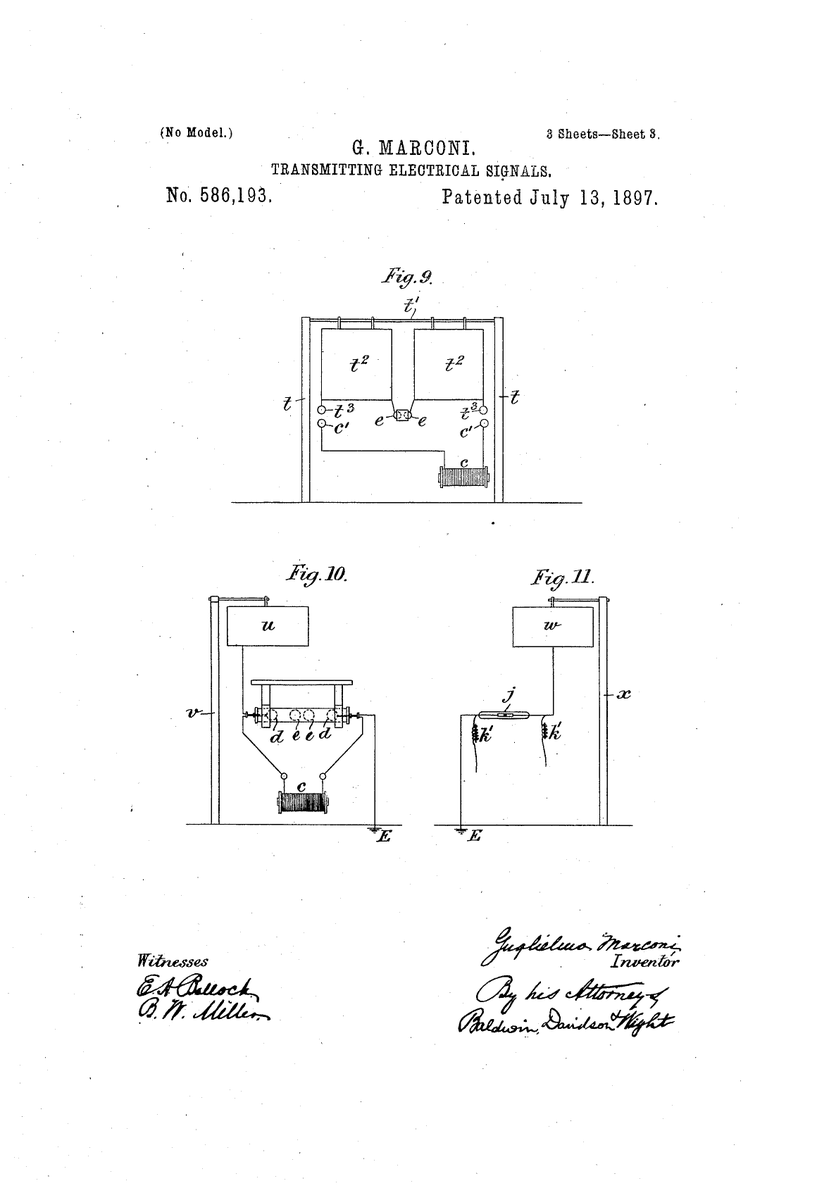
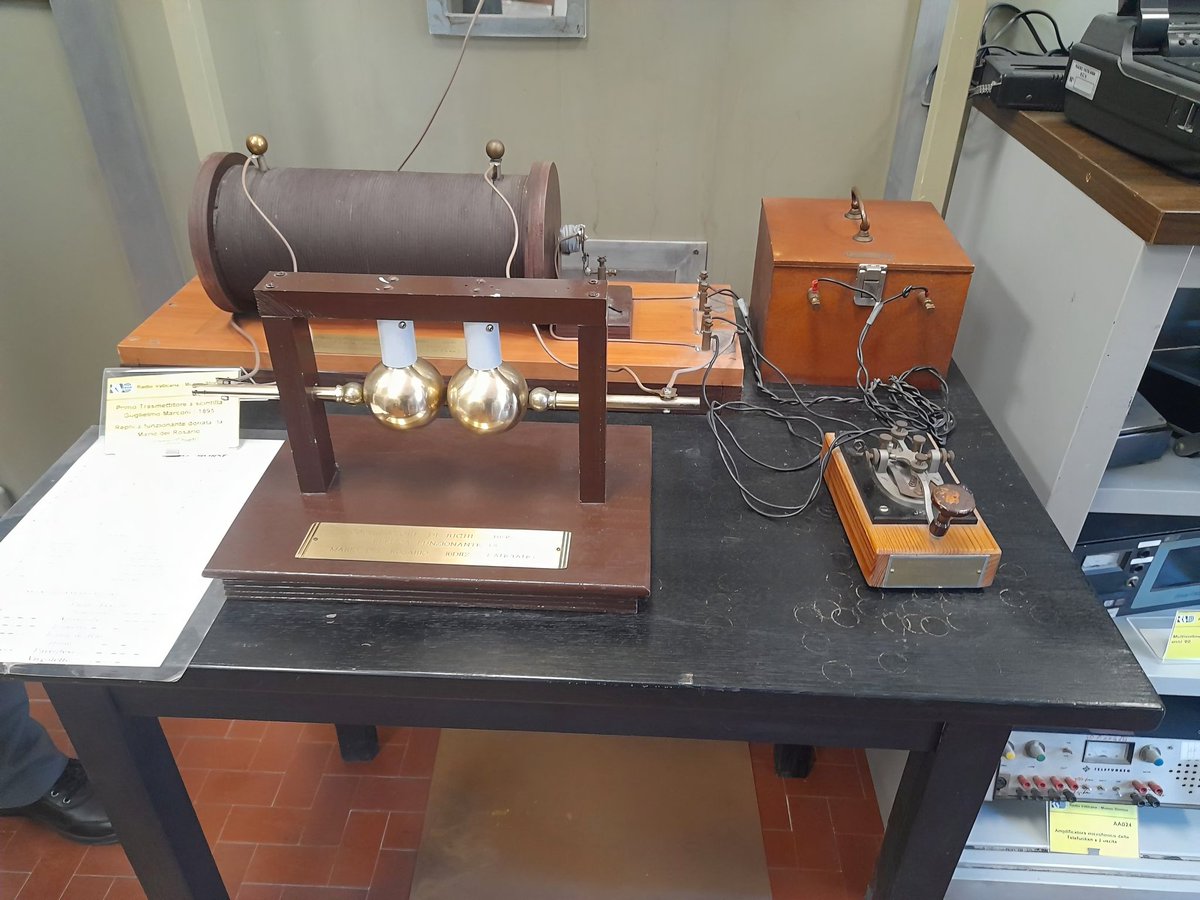
The Righi oscillator’s spark-gap design, featuring four metal spheres arranged as a dipole resonator and antenna system in 1895, provided a foundational element for the development of wireless communication technologies and found direct application in early patented transmitters. In the waning years of the nineteenth century, the rapid expansion of telegraph networks had transformed global communication, yet vast stretches of the world remained unreachable by wire—particularly the open seas, where ships relied on flags and lights for signaling in emergencies. Scientists, building upon James Clerk Maxwell’s theoretical framework of electromagnetic waves and Heinrich Hertz’s experimental confirmation of their existence in the 1880s, turned their attention to generating and propagating these invisible signals over meaningful distances. The era’s technological challenges centered on creating reliable high-frequency oscillations that could carry information without physical conductors, a pursuit driven by both scientific curiosity and the practical needs of navigation, commerce, and safety at sea. Augusto Righi advanced this field through meticulous laboratory work in Bologna, refining the spark-gap apparatus to produce more stable and controllable waves. His four-sphere configuration, with the central pair often immersed in a dielectric medium such as vaseline oil, minimized irregularities in the discharge while enabling shorter wavelengths suitable for precise experimental analysis of wave behavior, including reflection and refraction phenomena that mirrored those of light. Guglielmo Marconi, inspired by these developments as Righi’s former student, recognized the potential for practical wireless telegraphy and incorporated a similar oscillator into his patented system. In United States Patent 586,193, issued in 1897 for “Transmitting Electrical Signals,” Marconi described connecting the terminals of an induction coil to metallic balls fixed within insulating tubes to form the spark gap. The patent highlights how “the distance they should be apart depends on the quantity and electromotive force of the electricity employed,” emphasizing the careful engineering required for effective oscillation. This adaptation of Righi’s innovative design bridged laboratory experimentation with real-world signaling, underscoring the human ingenuity that propelled the replica shown in the post toward the dawn of the wireless era. Full patent text & diagrams: patents.google.com/patent/US586193
Patent Vault tweet mediaPatent Vault tweet mediaPatent Vault tweet media
English
0
0
1
18
Two Communications
Two Communications@2Communications·
“Righi Oscillator” spark-gap oscillator design developed by Italian physicist Augusto Righi in the late 19th century, notable for its use of four metal spheres arranged as a dipole resonator and antenna system. Righi Oscillator 1895 Working replica by Mario Del Rosario I6DRZ
Two Communications tweet media
English
2
10
44
852
Patent Vault
Patent Vault@PatentVault·
In the late 1890s, the Optigraph projector stood out as a pioneering 35mm motion picture device from Chicago’s Enterprise Optical Company, its practical design for traveling exhibitors captured precisely in U.S. Patent 628,413 for a kinetoscopic apparatus. The closing years of the nineteenth century witnessed a quiet revolution in how Americans encountered the world through light and shadow. Magic lantern projections had long offered still images in lecture halls and church basements, yet the arrival of perforated celluloid film promised something more alive—figures in motion that could transport viewers beyond their daily routines. For itinerant showmen hauling equipment across dusty roads and rail lines, the barriers were immense: projectors were often heavy, temperamental, and expensive, requiring skilled operators and lengthy setups that cut into scarce performance time. In an era when rural communities and smaller towns hungered for shared spectacles amid rapid industrialization, the need grew for machines that could fold into compact cases, adapt to existing lantern systems, and withstand the rigors of constant movement without sacrificing image quality. These pressures reflected deeper societal shifts. As vaudeville theaters and makeshift venues multiplied, the standardization of 35mm film opened possibilities for wider distribution of reels, while mechanical refinements addressed the persistent flicker and film damage that plagued early demonstrations. The Optigraph’s emergence spoke to a broader quest for accessibility, allowing modest operators to compete in a landscape long dominated by a handful of powerful patents and corporate interests. Alvah C. Roebuck, drawing on his background in manufacturing and commerce, collaborated with inventor Frank McMillan to meet these exact demands. Their kinetoscopic apparatus featured a hinged film-confining plate with vertical guides and spring fingers that held the strip securely yet allowed swift loading, paired with an intermittent gearing system that imparted precise rotary motion to the feed roller while the shutter revolved continuously. As the patent explained, the arrangement ensured “a positive intermittent rotary motion is imparted... so that the beams of light will be projected through the pictured film only when the same is in a stationary condition.” This engineering insight not only eased assembly and disassembly for road-weary exhibitors but also realized the very vision of portable, reliable projection described in the original account. Full patent text & diagrams: patents.google.com/patent/US628413
Patent Vault tweet media
Pre Cinema History 📷🎞️🇨🇦 🏴󠁧󠁢󠁳󠁣󠁴󠁿@RealPreCinema

1899 THE OPTIGRAPH ENTERPRISE OPTICAL COMPANY The Optigraph was a pioneering 35mm motion picture projector developed in 1899 by the Enterprise Optical Company of Chicago. This company was founded by Alvah Curtis Roebuck (1864-1948), co-founder of Sears, Roebuck & Company, who aimed to challenge Thomas Edison’s dominance in the film equipment market. Roebuck’s vision was to create an affordable, portable projector that could be assembled and disassembled quickly, making it accessible for travelling exhibitors and theatre operators.

English
0
0
1
282