Lawrence Lynn

8.9K posts

Lawrence Lynn banner
Lawrence Lynn

Lawrence Lynn

@PatientStormDoc

Crit/Care research physician. CoAuthor of “The Physician’s War” The Battle between Physicians & Pathological Consensus https://t.co/l8sZ0gKPTI

Katılım Ağustos 2012
875 Takip Edilen1.3K Takipçiler
Sabitlenmiş Tweet
Lawrence Lynn
Lawrence Lynn@PatientStormDoc·
@fluidloading @bentatoo31 @Denis_Faust @Procto_Log The story of pathological consensus and shortcutting the RCT method of Hill/Fischer with the Petty/Bone science. The lumping paradigm. The Physician’s War: The Story of the Hidden Battle between Physicians and a Science Based on Pathological Consensus a.co/d/8OtJlVk
English

4
10
50
10.4K
Lawrence Lynn
Lawrence Lynn@PatientStormDoc·
Excellent work. This linked paper is absolutely a must read.
Ashley Miller@icmteaching

Why critical closing pressure (CCP) always felt wrong For years, I found CCP papers confusing — not because the idea of vessel collapse is wrong, but because CCP was often treated as something that exists all the time, as if it continuously governs perfusion in normal, open-flow states. That framing immediately caused problems and led to some very strange ideas. CCP was frequently presented as a downstream opposing pressure — something to subtract from MAP. Hence formulas like tissue perfusion pressure (TPP) = MAP − CCP. But a collapse threshold cannot be a back-pressure. CCP is only relevant once arterioles have collapsed. CCP was also used to explain autoregulation, even though autoregulation occurs in proximal arterioles at much higher pressures than those at which CCP becomes relevant in distal arterioles. CCP − Pms was then used to describe capillary perfusion, even though a collapse threshold cannot be an input pressure. This is simply a category error. CCP marks the point at which arterioles close. Above that point, flow is governed by ordinary arterial–venous pressure gradients and arteriolar tone — not by CCP. A waterfall analogy — developed for passive collapsible tubes (veins, zone-1 lung) — was exported into arteriolar physiology. But arterioles are not floppy veins. They possess active smooth-muscle tone, making them functionally open or closed, in a way veins are not. A true waterfall would make venous pressure irrelevant for organ blood flow — which it plainly is not. And here lies the central contradiction: If capillary perfusion were governed by CCP − Pms, how could there simultaneously be a “waterfall” in which venous pressure does not matter? The framework collapses under its own assumptions. From this came papers proposing that we might manipulate — even widen — waterfalls, which would in fact imply closing off more vascular beds rather than improving perfusion. In healthy physiology, there should be no collapse and no waterfall. None of this fits with clinical observation: • Raising MAP does not reliably restore perfusion • SVR does not reliably reflect tone • Oedema and venous congestion clearly impair organ blood flow • Monitors can reassure while tissues suffer The problem was never CCP. The problem was how it was framed. Active arteriolar closure was conflated with passive Starling-resistor behaviour. In reality, CCP is a conditional collapse threshold: vessels are either open or closed. It is not continuously “acting” when flow is normal. Once those ideas are separated, the contradictions disappear. CCP stops adding confusion and instead explains haemodynamic incoherence. CCP always felt wrong because it was being asked to do jobs it was never meant to do. Used correctly, it simplifies physiology — and supports genuinely personalised care. And that leads to the most important practical point: What matters clinically is restoring flow continuity across the macro-to-micro interface — reducing excessive tone, relieving external or venous constraint, and avoiding pressure strategies that worsen collapse rather than reopen closed beds. That is what CCP is actually useful for and why it finally makes sense. Read our full paper here 👇 @ThinkingCC @khaycock2 @EMNerd_ mdpi.com/2075-4426/16/2…

English
2
3
14
4.2K
Lawrence Lynn
Lawrence Lynn@PatientStormDoc·
Below we lay the science of critical care synthetic syndrome RCT out for critical care fellow consumption. —- Teach your mentors well, the path they chose is the one they live by. “Don’t you ever ask them why…” Apologies to CSNY.
Lawrence Lynn@PatientStormDoc

@yudapearl Here is a clearer “high school” explanation of Lynn’s Paradox (sequential RCT reversal). This is a real-world simulation, it models a structural flaw in current trial design. — A critical care researcher sees patients with severe infection who have fever and shortness of breath. She names this “Breathless Fever Syndrome” (BFS). It is a pragmatic synthetic syndrome, not a single disease with a common cause. To study treatment, she defines entry criteria:
suspicion of infection + temperature >100.4°F + respiratory rate >20. A consensus group adopts these criteria for RCT enrollment. She receives @NIH funding and tests an anti-inflammatory drug (benefit in some infections, harm in others). She enrolls patients using these criteria. The first RCT shows benefit. The treatment and entry criteria are incorporated into guidelines. Over the next 4 years, patients treated under the same criteria in the same ICU do worse.
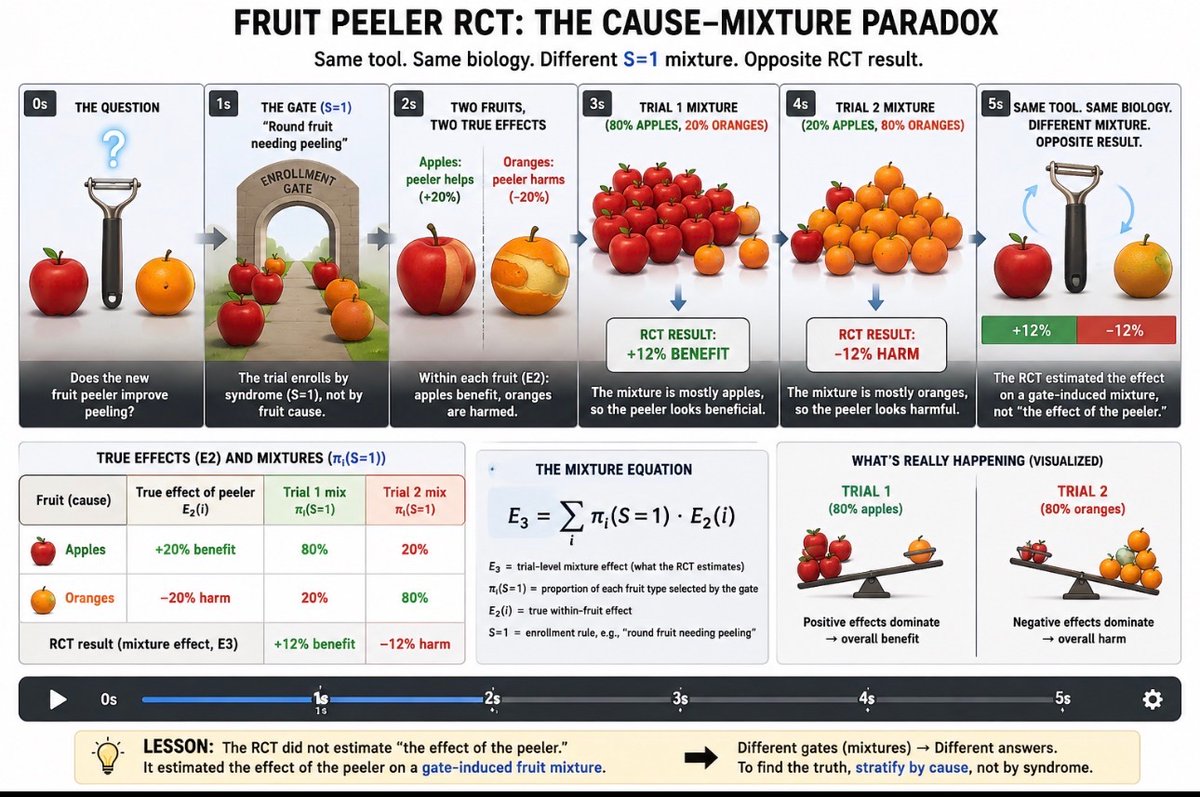
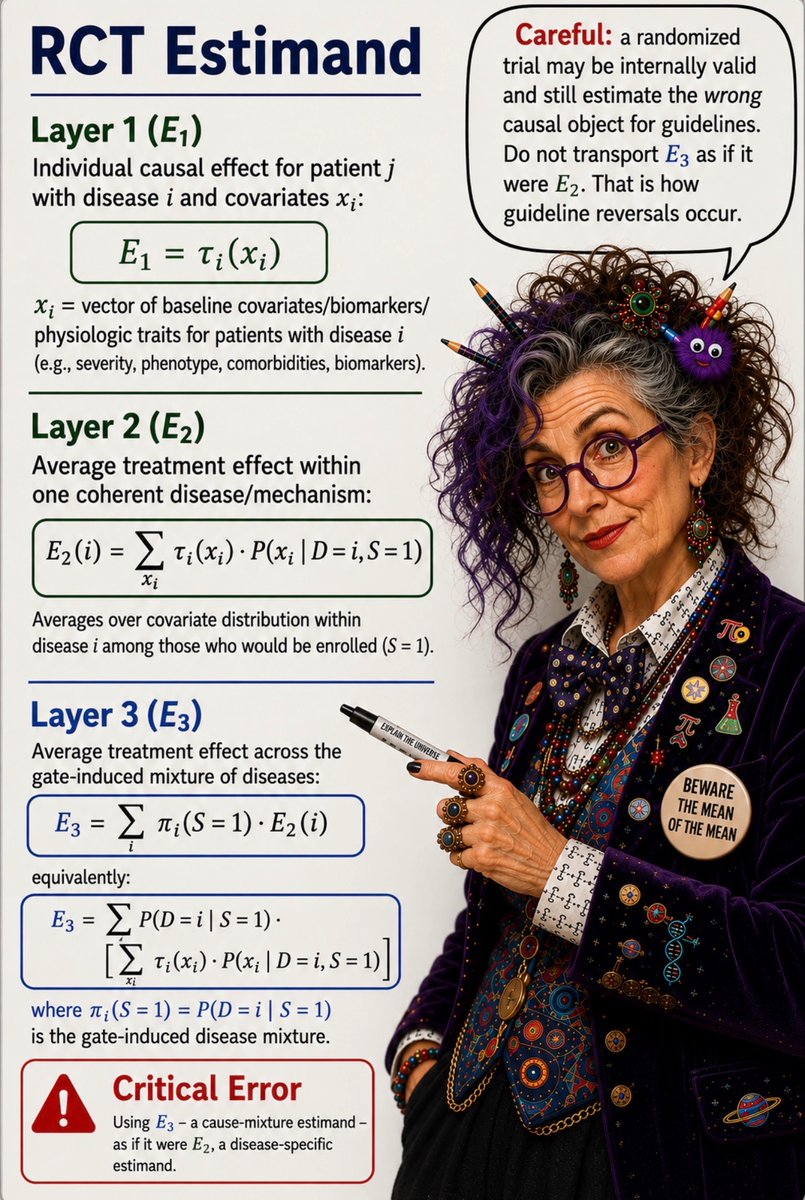
A second RCT with the same protocol, same center, and same entry criteria shows harm. — Questions: 1Was this reversal predictable? 2What was missing in the RCT design? 3How could it be prevented? Answers: 1Yes 2A disease- or cause-specific diagnostic anchor 3Incorporate basic structural causal modeling into RCT design — Explanation: This is a “cause-agnostic RCT”. Enrollment is based on threshold criteria, not a causal disease. The entry criteria select a mixture of different infections, each with different treatment effects. The trial estimates only the weighted average: ATE = Σ pᵢ τᵢ Toy example of three infections (diseases): 
• Trial mixture (45%/35%/20%), effects (+35%/–25%/+10%) ->ATE = +9.0% 
• Second RCT, New mixture (25%/50%/25%) -> ATE = –1.25% Same criteria. Same setting. Opposite conclusions. The estimand changes because the underlying disease mixture changes. The criteria and treatment protocol stay exactly the same, but the real-world proportions of underlying infections shift. No amount of power, covariate adjustment, or statistical refinement can fix a design in which the enrollment gate is disease & cause-agnostic. This exact pattern has repeated for 40+ years in critical care. But causal tools which were not available when the critical care cause agnostic RCT became the standard now make this failure mode preventable! This is what your Book of Why II can teach. This is the mechanism behind Lynn’s Paradox and a central failure mode of modern critical care “synthetic syndrome” trials for four decades.

English
1
0
4
463
Lawrence Lynn
Lawrence Lynn@PatientStormDoc·
@yudapearl Here is a clearer “high school” explanation of Lynn’s Paradox (sequential RCT reversal). This is a real-world simulation, it models a structural flaw in current trial design. — A critical care researcher sees patients with severe infection who have fever and shortness of breath. She names this “Breathless Fever Syndrome” (BFS). It is a pragmatic synthetic syndrome, not a single disease with a common cause. To study treatment, she defines entry criteria:
suspicion of infection + temperature >100.4°F + respiratory rate >20. A consensus group adopts these criteria for RCT enrollment. She receives @NIH funding and tests an anti-inflammatory drug (benefit in some infections, harm in others). She enrolls patients using these criteria. The first RCT shows benefit. The treatment and entry criteria are incorporated into guidelines. Over the next 4 years, patients treated under the same criteria in the same ICU do worse.
A second RCT with the same protocol, same center, and same entry criteria shows harm. — Questions: 1Was this reversal predictable? 2What was missing in the RCT design? 3How could it be prevented? Answers: 1Yes 2A disease- or cause-specific diagnostic anchor 3Incorporate basic structural causal modeling into RCT design — Explanation: This is a “cause-agnostic RCT”. Enrollment is based on threshold criteria, not a causal disease. The entry criteria select a mixture of different infections, each with different treatment effects. The trial estimates only the weighted average: ATE = Σ pᵢ τᵢ Toy example of three infections (diseases): 
• Trial mixture (45%/35%/20%), effects (+35%/–25%/+10%) ->ATE = +9.0% 
• Second RCT, New mixture (25%/50%/25%) -> ATE = –1.25% Same criteria. Same setting. Opposite conclusions. The estimand changes because the underlying disease mixture changes. The criteria and treatment protocol stay exactly the same, but the real-world proportions of underlying infections shift. No amount of power, covariate adjustment, or statistical refinement can fix a design in which the enrollment gate is disease & cause-agnostic. This exact pattern has repeated for 40+ years in critical care. But causal tools which were not available when the critical care cause agnostic RCT became the standard now make this failure mode preventable! This is what your Book of Why II can teach. This is the mechanism behind Lynn’s Paradox and a central failure mode of modern critical care “synthetic syndrome” trials for four decades.
English
0
0
3
568
Lawrence Lynn
Lawrence Lynn@PatientStormDoc·
The point, of course, is that we in critical care don’t deserve to talk about alpha/CI as if we are like other fields, such as cardiology. We won’t even mention, in our literature, the guessed, triage based flawed cause agnostic RCT structure that has generated and reversed them for 50 years. We dress our studies up like we deserve a seat at the frequentist/Bayesian debate but we never had the courage, as group, to gain a seat at that table.
English
0
0
0
19
Lawrence Lynn
Lawrence Lynn@PatientStormDoc·
The alpha/CI debate for a critical care scientist is “synthetic debate”, an elephant-in-the-room-agnostic debate. A safe, endlessly recycling substitute debate for critical care physicians who wish to “debate like scientists,” yet are the afraid of politically inexpedient discourse.
English
1
0
0
24
David Nunan
David Nunan@dnunan79·
Franks dismay gets to the heart of how the majority of medial/health researchers (& users of their outputs) treat observed effects based on frequentist methods. Purists rightly pick the flaw - but it’s rare that real world consequences are shown. x.com/dnunan79/statu…
Frank Harrell@f2harrell

Oh my goodness how did @JClinEpi allow this? The authors are pretending that point estimates are true values! For this study the subjects should not have been given point estimates & you really can't answer the survey questions without Bayesian posterior probs. #Statistics

English
3
2
7
5.3K
Lawrence Lynn
Lawrence Lynn@PatientStormDoc·
From the “old guard” that selected the 1996 guessed SOFA score (which was shown to be so nonspecific for sepsis in 1998 they changed the name from “sepsis related”to “Sequential”) yet they still pulled it out of mothballs to be the gold standard triage gate for funding of sepsis RCT for the past decade. Synthetic science. Harmful to the public.
English
1
0
1
78
Lawrence Lynn
Lawrence Lynn@PatientStormDoc·
@soboleffspaces Early on it was hubris born of unrecognized assumptions. Now the synthetic foundations of syndrome science are known and the response is the “silence defense”. The arrogant scientist debates,. These people have retreated into “the keep” and that’s a harder nut.
English
1
0
0
49
Boris Sobolev
Boris Sobolev@soboleffspaces·
@PatientStormDoc Causal agnosticism results from hubris… Learning causal structure requires humility…
English
1
0
1
100
Lawrence Lynn
Lawrence Lynn@PatientStormDoc·
This simple, decades-long standardized RCT design flaw induced paradox (which no one will deny when challenged), harmful as it has been, is also a breakthrough pedagogical opportunity. If the causal community demonstrates clearly how the paradox arises and how structural causal modeling resolves it, SCM will become recognized as an essential patient safety component of CONSORT strengthening RCT design with explicit causal structure. @eliasbareinboim @yudapearl @soboleffspaces
Lawrence Lynn@PatientStormDoc

There are two instantiations of the paradox which, unrecognized, have plagued critical care science for decades. First “RCT-to-clinical protocol effect reversal”. Suppose investigators conduct a RCT to test a treatment for patients with severe infection, which experts label “sepsis.” A consensus panel defines disease and cause agnostic triage criteria for sepsis, and patients meeting those criteria are enrolled in the trial. The treatment protocol is tested in what appears to be a well-designed &! powered RCT that meets all methodological standards & reports strong evidence of benefit. The treatment protocol is then converted into clinical guidelines. However, when implemented in practice, the protocol surprisingly results in patient harm, even when applied with the same treatment timing, the same hospital system, the same caregivers, & using the same clinical entry criteria as the trial. This is Lynn’s paradox. The paradox arises because the RCT was designed without causal modeling. Sepsis is not a single disease or causal entity it was initially derived as similarity heuristic & then migrated to causal disease equivalent status in the 80s. In practice, more than 50 different infectious diseases/causes can satisfy the consensus criteria used to define sepsis. If the treatment benefits some of these diseases/causes but harms others, the overall result of the RCT reflects only the average effect across that specific tested mixture of diseases. The trial appears positive only because the particular mixture of diseases among enrolled participants happened, by chance, to favor those that benefited from treatment. Unfortunately, this mixture is not stable. When the same criteria are applied in routine clinical practice, the proportions of diseases will shift. The result can be clinical guidelines derived from a “positive” RCT that produces net harm. This phenomenon also appears as RCT reversal, in which sequential trials of the same intervention in the same setting and the same every criteria, equivalent covariates, and treatment timing produce opposite conclusions. This is Lynn’s Paradox of sequential RCTs. The mechanism can be illustrated with a simple toy model. Imagine sequential RCTs enrolling patients who meet the latest consensus “sepsis criteria” but some participants have one infectious diseases (d1) and other participants have another infectious disease (d2). (both diseases meet the trial entry criteria). The treatment effect benefits d1 to the same degree that it harms d2 If the first RCT happens to enroll more participants with d1, the trial will show benefit. If a subsequent RCT enrolls a higher proportion of d2 the result will reverse and show harm, even though the hospital, caregivers entry criteria, trial design, power, and covariate mix and treatment protocol remains equivalent This is difficult to understand only because no one trained in SCM would think that disease & cause agnostic entry criteria for an RCT is acceptable. How could covariates be modeled as they may be different for each disease/cause and the disease/cause mix is not stable. Yet this is standard structure in critical care syndrome science Lynn’s paradox was the reason the ventilator protocols failed during the pandemic. Severe COVID pneumonia met the disease agnostic criteria for adult respiratory distress syndrome (ARDS) so the guideline committee thought they had strong evidence for a particular ventilator protocol (high PEEP) and produced guidelines with “strong” evidence based recommendations for this ventilator protocol But COVID pneumonia did not exist when the source RCT was performed it only met the criteria used in the trials. But meeting the syndrome criteria establishes causal equivalence in syndrome science so they thought they had high level RCT evidence for the protocol. It failed & has now been abandoned. That was Lynn’s Paradox Requiring SCM interrogation as part of RCT design would prevent the paradox

English
1
0
4
1.2K
Lawrence Lynn
Lawrence Lynn@PatientStormDoc·
@PulmCrit That Dr. Farkas. Amazing gift for creative education.
English
0
0
1
101
Lawrence Lynn retweetledi
Fluid Academy
Fluid Academy@Fluid_Academy·
The third part of the European Society of Intensive Care Medicine (ESICM) guideline on fluid therapy focuses on the de-escalation phase of fluid management, particularly strategies for fluid removal in critically ill patients. This phase typically follows the initial resuscitation and stabilization period, when fluid accumulation may become harmful rather than beneficial. The guideline synthesizes available evidence and expert consensus to guide clinicians on when and how to remove excess fluid in ICU patients. Read the full paper 🔗 fluidacademy.mn.co/posts/european… Key take-aways from the new ESICM guideline on fluid removal (de-escalation phase): 🔹 Fluid accumulation after initial resuscitation is common — and consistently linked to worse outcomes in the ICU. 🔹 Once hemodynamic stability is achieved, the goal may shift from giving fluids to removing them. 🔹 Active deresuscitation should be considered in patients with persistent fluid overload. 🔹 Loop diuretics are usually the first step when kidney function allows. 🔹 Extracorporeal fluid removal may be required when diuretics fail or renal dysfunction is present. 🔹 Fluid removal must be carefully titrated and closely monitored to avoid hypoperfusion. 🔹 Evidence is still limited — highlighting the need for better trials on timing, targets, and strategies for deresuscitation. Sometimes the most important fluid decision in the ICU… is not when to start fluids — but when to stop, and when to take them away.
Fluid Academy tweet media
English
0
61
166
9.2K
Lawrence Lynn
Lawrence Lynn@PatientStormDoc·
This has been misconstrued as garden variety heterogeneity of treatment effects (HTE) made worse by the complexity of “sepsis”. But this is not the same. HTE ->general statistical phenomenon Lynn’s Paradox -> a design-level failure of cause-agnostic trials where disease mixtures create unstable average treatment effects. In other words: HTE is not a flaw and naturally exists inside diseases/ participants. Lynn’s Paradox arises as a structural flaw in cause agnostic RCT design of synthetic syndrome science when multiple diseases are mistakenly treated as one disease in an RCT.
English
0
0
1
103
Lawrence Lynn
Lawrence Lynn@PatientStormDoc·
There are two instantiations of the paradox which, unrecognized, have plagued critical care science for decades. First “RCT-to-clinical protocol effect reversal”. Suppose investigators conduct a RCT to test a treatment for patients with severe infection, which experts label “sepsis.” A consensus panel defines disease and cause agnostic triage criteria for sepsis, and patients meeting those criteria are enrolled in the trial. The treatment protocol is tested in what appears to be a well-designed &! powered RCT that meets all methodological standards & reports strong evidence of benefit. The treatment protocol is then converted into clinical guidelines. However, when implemented in practice, the protocol surprisingly results in patient harm, even when applied with the same treatment timing, the same hospital system, the same caregivers, & using the same clinical entry criteria as the trial. This is Lynn’s paradox. The paradox arises because the RCT was designed without causal modeling. Sepsis is not a single disease or causal entity it was initially derived as similarity heuristic & then migrated to causal disease equivalent status in the 80s. In practice, more than 50 different infectious diseases/causes can satisfy the consensus criteria used to define sepsis. If the treatment benefits some of these diseases/causes but harms others, the overall result of the RCT reflects only the average effect across that specific tested mixture of diseases. The trial appears positive only because the particular mixture of diseases among enrolled participants happened, by chance, to favor those that benefited from treatment. Unfortunately, this mixture is not stable. When the same criteria are applied in routine clinical practice, the proportions of diseases will shift. The result can be clinical guidelines derived from a “positive” RCT that produces net harm. This phenomenon also appears as RCT reversal, in which sequential trials of the same intervention in the same setting and the same every criteria, equivalent covariates, and treatment timing produce opposite conclusions. This is Lynn’s Paradox of sequential RCTs. The mechanism can be illustrated with a simple toy model. Imagine sequential RCTs enrolling patients who meet the latest consensus “sepsis criteria” but some participants have one infectious diseases (d1) and other participants have another infectious disease (d2). (both diseases meet the trial entry criteria). The treatment effect benefits d1 to the same degree that it harms d2 If the first RCT happens to enroll more participants with d1, the trial will show benefit. If a subsequent RCT enrolls a higher proportion of d2 the result will reverse and show harm, even though the hospital, caregivers entry criteria, trial design, power, and covariate mix and treatment protocol remains equivalent This is difficult to understand only because no one trained in SCM would think that disease & cause agnostic entry criteria for an RCT is acceptable. How could covariates be modeled as they may be different for each disease/cause and the disease/cause mix is not stable. Yet this is standard structure in critical care syndrome science Lynn’s paradox was the reason the ventilator protocols failed during the pandemic. Severe COVID pneumonia met the disease agnostic criteria for adult respiratory distress syndrome (ARDS) so the guideline committee thought they had strong evidence for a particular ventilator protocol (high PEEP) and produced guidelines with “strong” evidence based recommendations for this ventilator protocol But COVID pneumonia did not exist when the source RCT was performed it only met the criteria used in the trials. But meeting the syndrome criteria establishes causal equivalence in syndrome science so they thought they had high level RCT evidence for the protocol. It failed & has now been abandoned. That was Lynn’s Paradox Requiring SCM interrogation as part of RCT design would prevent the paradox
English
1
0
2
859
Judea Pearl
Judea Pearl@yudapearl·
I would be glad to include Lynn's paradox in #Bookofwhy if I only understood it. Simpson's paradox can easily be explained to high school students, and evokes immediate surprise. Can we do the same with Lynn's paradox?
Lawrence Lynn@PatientStormDoc

Which Paradox explains decades of sequential RCT reversal and is correctable by causal modeling? (Hint: it’s not Simpson or Berkson). @yudapearl Ans: In standard cause-agnostic randomized trials (CARs), enrolling a synthetic syndrome, the treatment effect observed in the trial can be expressed as: ATE_t = Σ_i w_{i,t} τ_i where i = underlying causal disease w_{i,t} = proportion of disease i in trial t τ_i = treatment effect for disease i. If the disease mixture differs across trials, the weighted average treatment effect can change sign: Σ_i w_{i,1} τ_i > 0 Σ_i w_{i,2} τ_i < 0. Sequential trials can therefore produce opposite conclusions even when the treatment effects within each disease remain constant. This is “Lynn’s Paradox”. Should be in “Book of Why II” (Call the paradox what you will. I’m just seeking reform.)

English
1
0
5
2.5K
Lawrence Lynn
Lawrence Lynn@PatientStormDoc·
Which Paradox explains decades of sequential RCT reversal and is correctable by causal modeling? (Hint: it’s not Simpson or Berkson). @yudapearl Ans: In standard cause-agnostic randomized trials (CARs), enrolling a synthetic syndrome, the treatment effect observed in the trial can be expressed as: ATE_t = Σ_i w_{i,t} τ_i where i = underlying causal disease w_{i,t} = proportion of disease i in trial t τ_i = treatment effect for disease i. If the disease mixture differs across trials, the weighted average treatment effect can change sign: Σ_i w_{i,1} τ_i > 0 Σ_i w_{i,2} τ_i < 0. Sequential trials can therefore produce opposite conclusions even when the treatment effects within each disease remain constant. This is “Lynn’s Paradox”. Should be in “Book of Why II” (Call the paradox what you will. I’m just seeking reform.)
Lawrence Lynn@PatientStormDoc

Lynn’s Paradox (with deference to Simpson) “A phenomenon in which sequential cause-agnostic randomized trials (CARs) testing a treatment for a disease-agnostic syndrome yield opposing conclusions across studies because enrolled participants represent a shifting mixture of diseases with opposing treatment effects.”

English
0
4
10
3.8K
Lawrence Lynn
Lawrence Lynn@PatientStormDoc·
Lynn’s Paradox (with deference to Simpson) “A phenomenon in which sequential cause-agnostic randomized trials (CARs) testing a treatment for a disease-agnostic syndrome yield opposing conclusions across studies because enrolled participants represent a shifting mixture of diseases with opposing treatment effects.”
English
0
2
10
3.1K
Lawrence Lynn
Lawrence Lynn@PatientStormDoc·
It goes deeper in critical care. SIRS, SOFA, Berlin, and the various “global” ARDS criteria are fabricated RCT gates. Recognizing this forces a return to the many parts of the evidence that is real, when interpreted through clinical covariates and the relevant physiology. I have a paper pending that teaches to look beyond conventional RCT metrics such as statistical power & balance, and instead examine the “causal species” of the RCT itself. Not all cause-agnostic RCTs (CARs) are invalid. But the enrollment gates used in CARs can be readily fabricated, and when they are, the trial may produce results that appear internally rigorous yet lack safe transportability. zenodo.org/records/185194…
English
0
0
2
345
𝙟𝙤𝙨𝙝 𝙛𝙖𝙧𝙠𝙖𝙨 💊
Fabrication remains a major weakness of EBM. I think this may be what happened with Marik's initial paper about vitamin C for septic shock in CHEST. Fabrication is extremely hard to detect and we rarely consider this when analyzing studies. medpagetoday.com/special-report…
David Juurlink@DavidJuurlink

The official journal of the Canadian Paediatric Society has just acknowledged that more than 100 of its case reports are fabricated. Incredible reporting from @RetractionWatch: retractionwatch.com/2026/03/03/can…

English
5
9
63
11.7K