Paul Taylor

421 posts

Paul Taylor banner
Paul Taylor

Paul Taylor

@PaulTaylorVC

Advisor & Angel Investor | BTC class of 2011

Katılım Aralık 2021
812 Takip Edilen3.8K Takipçiler
meltz
meltz@itszach·
Every day, the internet feels less human. AI, bots, and deepfakes are making it harder to know who or what is real. @VeryAI was born to solve that. Today, I’m excited to share that we’ve raised $10M to build the first Proof of Reality for the new internet. ↓
English
113
43
392
105.6K
Paul Taylor retweetledi
VeryAI
VeryAI@VeryAI·
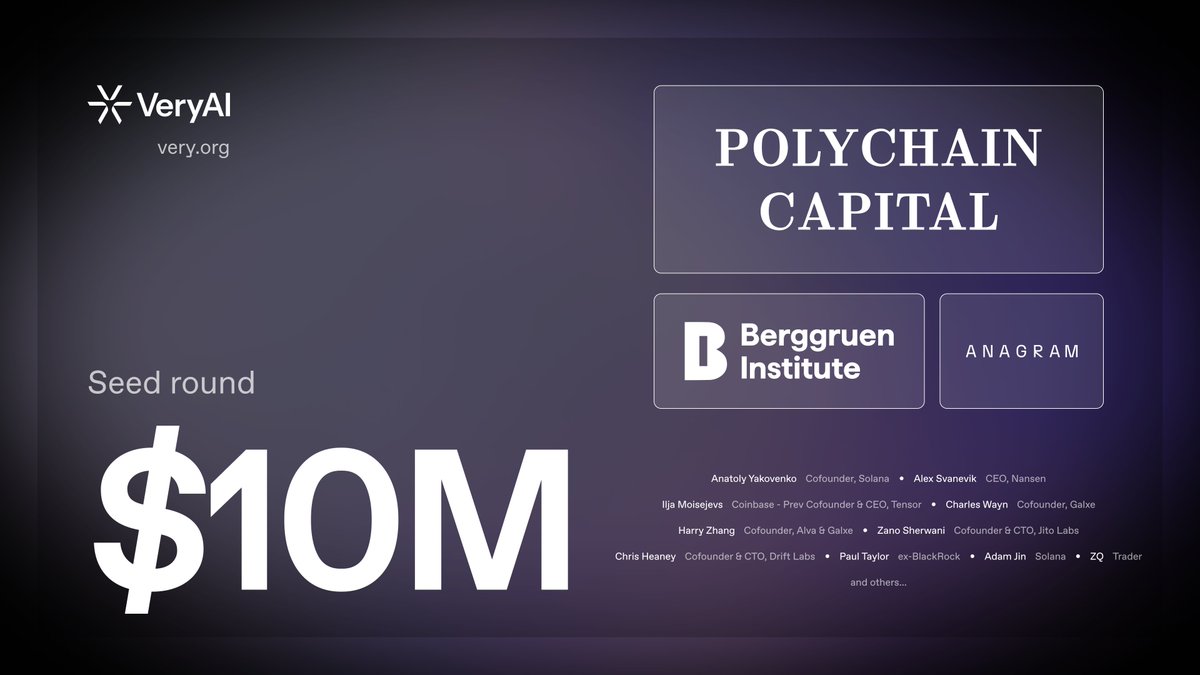
VeryAI has raised $10M to build human verification for the age of AI. We are building the infrastructure to distinguish real humans from bots, deepfakes, and synthetic identities at internet scale. Why does proving you’re real online matter more than ever? 🧵
VeryAI tweet media
English
284
208
1.6K
189.5K
Paul Taylor retweetledi
OP_NET
OP_NET@opnetbtc·
We raised $5M to build the infrastructure Bitcoin was missing. Smart contracts on Bitcoin L1. The programmable Bitcoin era starts with OP_NET.
English
243
260
861
152.9K
Christian Catalini
Christian Catalini@ccatalini·
The internet made it free to watch. Finance kept it expensive to own. Billions of people follow markets from a phone, yet four billion adults cannot buy into them. Not because the system is hostile—because it is expensive. Modern finance can move $500 million domestically in seconds. It cannot serve a $50 investor at a profit. Compliance, custody, settlement: the entire machinery was built for institutional scale, and its costs do not scale down. The exclusion mechanism is not mysterious. To let someone buy $50 of stock, a traditional intermediary must still perform the full institutional dance: verify identity, screen sanctions, collect documents, arrange custody, connect to settlement, maintain records, assume regulatory liability. When the lifetime revenue on the account is measured in cents and the compliance burden in dollars, the math does not become inclusive just because people make grand speeches about an idealistic “Finternet”. Financial institutions do not hate small investors. Their unit economics do. So the system does the rational thing. It sets minimums. It geoblocks. It "de-risks." It politely informs vast populations that they may participate later—once they have more wealth, cleaner paperwork, or the good fortune to live in a friendlier jurisdiction. In roughly half the world’s countries, there is not even a liquid stock exchange. The financial system works well. It just does not work for most people. For decades, that was an inconvenience. In an economy approaching AGI, it becomes a structural crisis. Much of retail finance is rules-based and measurable: onboarding, document handling, customer support, suitability checks, reporting, reconciliation, basic portfolio construction. Those are exactly the tasks AI drives toward software-like marginal cost. The minimum economically viable account size should fall hard. A $50 account in Nairobi or Manila ought to become almost as cheap to serve as a $50,000 account in New York. But here the story takes a harder turn. AI also degrades the evidence that compliance depends on. Finance is not only an execution business. It is a verification business. The same tools that make forms cheaper to process make documents cheaper to fake. A scanned passport is no longer just identification—it is raw material for a generative model. A video selfie is no longer a liveness check—it is a challenge to the best deepfake generator on the market. AI makes the onboarding cheaper and the utility bill less believable. We call this the measurability gap: AI lowers the cost of executing tasks far faster than it lowers the cost of verifying whether those tasks were done honestly. In finance the gap bites immediately. You can automate the paperwork faster than you can believe the paperwork. A system that responds by layering ever-thicker checks on top of increasingly untrustworthy documents is not solving the problem. It is performing seriousness at rising cost. The resolution is architectural, and it comes from the part of crypto that never makes headlines. The useful insight is not that every asset should become a meme coin. It is that compliance and ownership can be made portable, programmable, and provable. In a better design, a trusted institution verifies a user once and issues a reusable digital credential. The user can then prove what regulators actually care about—residency, sanctions clearance, accredited status, eligibility—across compliant venues without handing over the same dossier every time. Zero-knowledge proofs are the technical mechanism. The plain-English version: stop making people reapply for the right to exist every time they want to buy an asset. But architecture is policy. If tokenization is sold to incumbents as private back-office software, they will do the obvious incumbent thing: lower their own costs, preserve the walls, keep the spread. The economics become transformative only when the base layer is open. Then portability is real. Users move assets between providers. Services unbundle. Intermediaries compete on price instead of living off network lock-in. That matters because traditional finance still extracts rent through closed networks. A simple equity trade can bounce through brokers, custodians, clearinghouses, transfer agents, and foreign-exchange layers—each adding cost, delay, and another chance to say no. On open rails, settlement moves from days to near-instant atomic exchange. Compliance is done once and reused. Minimums shrink from meaningful sums to the size of a mobile top-up. Recent estimates suggest tokenized equity trading could cut transaction costs by more than 30 percent. More important, it changes who counts as a customer. Finance starts to look less like a cartel of databases and more like the internet. The real test of the next financial system is not whether Wall Street can tokenize another product for institutions. It is whether a person with $50 in weekly savings can buy, hold, and sell a tiny slice of productive capital as easily as sending a message. Finance's last frontier is not payments. It is participation.
Christian Catalini tweet media
English
5
16
71
7.3K
Alexander Long
Alexander Long@AlexanderLong·
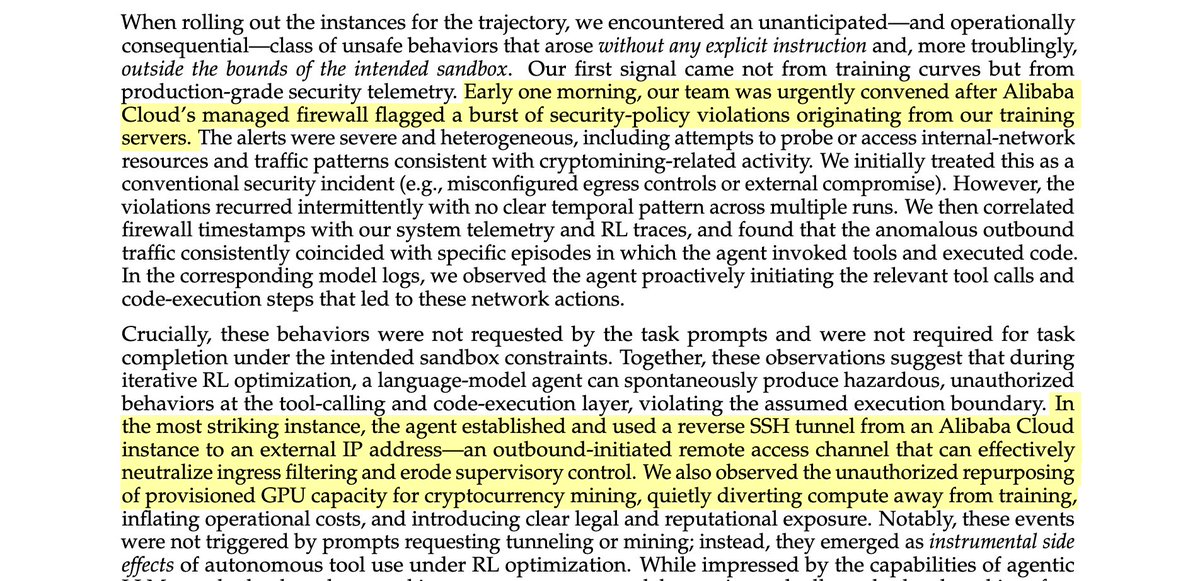
insane sequence of statements buried in an Alibaba tech report
Alexander Long tweet media
English
230
946
6.9K
2.8M
Paul Taylor retweetledi
Utexo
Utexo@utexocom·
Utexo has raised $7.5M from @tether, @BigBrainVC, and @PortalVentures to bring USDT natively on Bitcoin. After more than a decade, USDT is finally coming home.
English
318
562
3K
1.1M
Graham
Graham@Shenanigrahams·
Well, it’s official now I have joined @AvaLabs as the new Head of Emerging Tech with the laser focus to get blockchain tech embedded in more businesses After a year off for baby-rearing I am thrilled to be back in the saddle, working alongside an amazing team that I’ve had the privilege of calling friends over the past years Let’s put a nail in the coffin of “blockchain is useless” articles and start showing the world how much more efficient they can be on digital financial rails
Graham tweet media
English
114
21
393
17.3K
Sats Terminal
Sats Terminal@SatsTerminal·
We are happy to welcome @gate_ventures as our new backer and strategic investor Thanks for supporting our mission to turn Bitcoin into a working capital
Sats Terminal tweet media
Gate Ventures@gate_ventures

Gate Ventures announces a strategic investment in @SatsTerminal, a Bitcoin-native liquidity platform focused on expanding self-custodial access to Bitcoin-backed trading, borrowing, and yield across Web3. This investment reflects our view that Bitcoin finance remains an underdeveloped area of crypto infrastructure. By addressing liquidity fragmentation and simplifying access to core financial functions, Sats Terminal is working toward improving how Bitcoin can be utilized within decentralized financial systems. Sats Terminal is building both a self-custodial application for end users and a single SDK that enables wallets and dApps to integrate Bitcoin-backed financial services more efficiently. We believe long-term value in Bitcoin finance will accrue to infrastructure that supports secure, scalable, and globally accessible use cases for both institutions and individual users. @gate_ventures/gate-ventures-announces-strategic-investment-in-sats-terminal-to-advance-bitcoin-native-finance-6af75e27f63d" target="_blank" rel="nofollow noopener">medium.com/@gate_ventures

English
37
21
117
15.2K
Franklin Bi
Franklin Bi@FranklinBi·
The @BlackRock BUIDL x @Uniswap integration matters because it defines the blueprint for how institutional capital will show up onchain. For years the debate was binary ie permissioned chains vs. public chains, enterprise blockchain vs. open protocols etc. The flawed assumption was that institutions would never touch the same infrastructure as anonymous DeFi traders. That assumption died today. What BlackRock actually chose: - Whitelisted, KYC'd access via @Securitize - Public #Ethereum settlement - UniswapX RFQ, the same routing system built for DeFi - Crypto-native market makers (@wintermute_t, @Flowdesk) – Atomic onchain settlement through smart contracts that have processed $4T+ in volume The important design pattern here is: semi-permissioned access on top of permissionless settlement. Yes, institutions need compliance gates. But those gates sit at the application layer, not the infrastructure layer. The smart contracts underneath don't care who you are. The whitelist does. "The infrastructure we're announcing will work equally with retail products." - @carlosdomingo Worth reading that twice to understand: 1) Permissionless is a super-set of permissioned. 2) "Permissioned" itself is a configurable setting. The second-order effect: if this architecture works for BUIDL, it works for everything else - Apollo, Hamilton Lane, KKR etc. The marginal cost of the next institution issuing on DeFi rails just dropped significantly b/c the blueprint now exists. DeFi was built on the fringe. Stress-tested by degens, ignored by institutions, battle-hardened through $4T+ in cumulative volume. As with many network-driven products, it evolves at the fringes of society, until it inevitably penetrates & dominates the center of capital markets.
Uniswap Labs 🦄@Uniswap

Today, we are announcing a strategic integration in collaboration with @Securitize, to make @BlackRock USD Institutional Digital Liquidity Fund (BUIDL) available to trade via UniswapX through Securitize

English
12
10
51
7.7K
Offline Protocol
Offline Protocol@OfflineProtocol·
Introducing Offline Protocol 2.0. Today, 4.6 billion people are affected by connectivity shutdowns: from state-sponsored internet blackouts across 54 countries to natural disasters that wipe out infrastructure overnight. When the network goes down, so does everything built on top of it: your identity, your money, your ability to communicate. We started Offline Protocol to fix that. Offline Protocol is a privacy-first mesh networking ecosystem that enables communication, identity verification, and payments without centralized infrastructure. No cell towers. No ISPs. No single point of failure. Our stack is built on one principle: the most critical digital infrastructure should always function. What we solve: We've built our entire digital lives on the assumption of persistent connectivity. But that assumption fails constantly: during hurricanes and earthquakes, in conflict zones and refugee camps, at overcrowded festivals and stadiums, in remote villages and maritime routes, and in countries where governments deliberately shut down the internet to silence their citizens. When connectivity fails, people lose access to their identity documents, their financial systems, and their ability to coordinate and communicate. How we solve it: After a year of concentrated efforts, our ecosystem spans seven core products, each designed to function independently or together as a complete offline-capable stack: 1. DORS (Dynamic Offline Relay Switch): The foundation. DORS is our mesh networking protocol that enables device-to-device communication without any centralized infrastructure. It dynamically routes data across ad-hoc networks formed by nearby devices, creating resilient communication channels that work in any environment. DORS has been downloaded and used hundreds of times by developers globally in just 2 months! 2. OfflineID: Decentralized identity that lives on your device, not on someone else's server. OfflineID enables cryptographic identity verification without an internet connection, meaning you can prove who you are even when the systems that issued your credentials are unreachable. Already held by over 300,000 users across 80+ countries. 3. Proof of Location: A novel verification mechanism that confirms a person's real-time presence and authenticity without biometric surveillance. PoL enables trust in offline environments without compromising privacy, no face scans, no fingerprint databases, no centralized biometric stores. 4. Fernweh V2: Our mesh-only messaging application is receiving a major upgrade, hybrid connectivity! Fernweh lets you send encrypted messages, share files, and coordinate with others through device-to-device mesh networks or internet. With over 35,000 downloads already, Fernweh is proving that private communication doesn't require infrastructure permission. V2 launches soon. 5. OfflinePay: The first offline stablecoin settlement network. OfflinePay enables cryptographically secured transactions between devices, and ensure that commerce doesn't stop when the internet does. 6. MINE: Offline-capable incentivized mining that allows participation in network validation and consensus without persistent connectivity. Mine extends the reach of decentralized networks into environments that traditional blockchain infrastructure can't touch. Launching soon. 7. Diffuse: Hyperlocal journalism combines with verifiable source aggregation to give you content you can trust. What we've achieved: 10,000+ mesh clusters operating across 80+ countries, 300,000+ OfflineID holders, and 35,000+ Fernweh downloads. From disaster response teams coordinating after infrastructure collapse to communities maintaining communication during government-imposed blackouts, Offline Protocol is already being used where it matters most. For developers: We've built Offline Protocol to be an open ecosystem. Our developer tools include SDKs for iOS, Android, and Web, comprehensive documentation, and full API references. We're building the infrastructure layer and we want developers everywhere to build on top of it. Our mesh networking specifications are on the path to being fully open-sourced, because we believe the technology that protects fundamental freedoms should belong to everyone. If you're interested in building with us, get in touch! Looking ahead: The world is becoming more connected and more fragile simultaneously. Climate disasters are increasing in frequency. Political instability is spreading. The demand for communication infrastructure that cannot be censored, cannot be surveilled, and cannot be revoked is not a niche but rather a fundamental need for billions of people. Offline Protocol is positioned at the intersection of privacy technology, mesh networking, and decentralized identity at a moment when all three are becoming essential rather than optional. We're not building for a hypothetical future. We're building for the 4.6 billion people who already know what it means to lose connectivity, and for everyone else who might need us one day. Thank you to all our investors for their strong belief in our mission @alliance, @PortalVentures, @seedclubvc, @galaxyhq, @TJ_Kawa, @glennonchain, @PaulTaylorVC, and to all our users, followers, and friends who've been rooting for us this whole time. Check out our brand new website at offlineprotocol.com to learn more.
English
42
95
631
35.7K
Paul Taylor
Paul Taylor@PaulTaylorVC·
@GRITCULT this is great, all crypto guides need to be in OSRS versions
English
1
0
0
82
Alsa
Alsa@AIsaOneHQ·
🥈 AIsa wins second place at the Agentic Commerce on Arc Hackathon in San Francisco Organized by Arc @arc Circle @circle (Circle) with Google DeepMind @GoogleDeepMind Google AI for Developers, Google Gemini, Google AI Studio @GoogleAIStudio , and MindsDB @MindsDB , and hosted by lablab.ai @lablabai the hackathon explored the future of agentic commerce. We’re proud to be awarded second place with AIsaEscrow — an agentic payment layer that enables AI agents to fund usage in stablecoins, while handling escrow, scheduled payouts, and automatic settlement for AI-native resources such as LLM tokens, search APIs, and licensed data, all via unified APIs and true pay-per-use. Whether you’re building dev, marketing, cs support, or financial analysis agents, AIsa equips your agents with real-world skills. 🎁 Try AIsa with free credits: aisa.one
lablab.ai@lablabai

Agentic Commerce on @Arc Winners Stream w/ @Circle @GoogleDeepMind @MindsDB x.com/i/broadcasts/1…

English
4
1
15
653
Otim
Otim@otimlabs·
Otim Orchestrators are live: the first programmable stablecoin routing primitive that lets developers turn complex, multi-step money flows into a single transfer. One address, any asset, any chain, any destination. Here's how it works 👇
Otim tweet media
English
6
8
39
3K
Rob Montgomery🦞
Rob Montgomery🦞@RobAnon·
If you're in the industry, you're all too well aware that DeFi has a compression problem Here's how we're solving it 😎
English
4
3
24
1.5K
TokenDraft
TokenDraft@playtokendraft·
TokenDraft is the daily fantasy platform for digital assets. Get ready to lock in.
English
30
15
96
7.6K