

Paul Dubois
1.1K posts

Paul Dubois
@pauldubois
Rebuilding the regulated economy as software primitives | Convergence of DeFi & TradFi | Thesis-driven investor | Fintech • Proptech • Wealthtech | NFA - DYOR
🌎 🌍 🌏 Katılım Ocak 2009
1.7K Takip Edilen531 Takipçiler

Paul Dubois retweetledi

🚨 Over the past few days, three articles have been co-written with @Pauldubois !
We can't guarantee STBL's success, but we'll give you the keys to understanding why @stbl_official has the potential to be one of the big winners of the next cycle.
In some cases, price is just noise, and the real added value is what's being built behind the scenes. This is where $STBL stands today.
So, forget about the price and immerse yourself in reading about the future of finance
1⃣ - The balance Sheet Thesis or why STBL is the AWS of stablecoins x.com/On_Chain_Notes…
2⃣ - The Wooden Dollar and why STBL is quietly rebuilding how institutional yield moves x.com/On_Chain_Notes…
3⃣ - When hundreds of companies run on STBL
x.com/On_Chain_Notes…
@avtarsehra @Reeve_Collins @bundeep @rjvollono @BrianneFrey @Mrbullemmy @Trail2Crypto @gemhunter2_0 @CryptoGems100YT
On Chain Notes@On_Chain_Notes
English

Paul Dubois retweetledi
Three layers used to exist separately:
• What the yield is (accounting)
• What it's authorized to do (treasury policy)
• Where it actually goes (settlement)
USST and YLD collapse them into programmable primitives.
On Chain Notes@On_Chain_Notes
English
Run a consortium when you have shared interests or network effects.
Collaborative innovation runs on different rules than competitive innovation.
But governance and coordination risk are always the tax you pay.
Choose wisely before you start one.
English
Paul Dubois retweetledi

Paul Dubois retweetledi
.@HyperliquidX goes further than @Securitize. Not just custody and settlement onchain, but the exchange itself is: full orderbook, sub-second finality. ~98% of fees automatically buy back tokens. The company doesn’t touch the spread, holders do. But regulators aren’t happy (yet).
English
.@Securitize going public is a milestone, but the change in ownership structure deserves a look: compliance stays fully centralized: transfer agent, broker-dealer, ATS, KYC. Only custody and settlement moved onchain. Regulators are happy, holders get 24/7 self-custody.
English
@e_goldstein_84 @RobinhoodApp @BlackRock @Securitize Ondo fits in category 2 at the moment. But with the new IVV and Micron custodial tokenized securities, arguably we now also have category 2B depending on how granular you want to go.
English

@pauldubois @RobinhoodApp @BlackRock @Securitize I agree. Quick question: where does Ondo fit in these 3? One or two?
English
Tokenization is diverging. Three live models:
1️⃣ Synthetic (price-tracking, no shareholder rights) like @RobinhoodApp
2️⃣ Custodian/spv claims (claim on asset held by custodian) like BUIDL by @BlackRock
3️⃣ Issuer-native (token is the share) like @Securitize
Which one survives?
English
.@Securitize led by example. Went public on NYSE as $SECZ, then tokenized its own shares. $295M live on @Solana and @Avalanche >> same stock, same rights, fully compliant. Today tokenized RWAs are ~$33B and projected to hit ~$100B by end of 2026.
English
@mariekeflament @stripe @tempo @Stablecoin @privy @Nicolas_Colin @CurrenPower Nice. Looking forward to your podcast 👍
English

@pauldubois @stripe @tempo @Stablecoin @privy Exactly what we will try to address with @Nicolas_Colin in @CurrenPower edition this week - when open sourcing happens on an increasing number of layers, where does economic value flows to?
English
5 thoughts on OpenUSD:
1. I read this as very much a @stripe -led move — and it makes complete sense for them. Stripe has been quietly rebuilding the entire stack of how money moves: @tempo , @Stablecoin / Bridge , @privy , and now OpenUSD. This is the missing piece falling into place. For OpenUSD to succeed partners are needed, and the list of 140 partners that has been put together is very strong.
2. @tether and @circle were already on a path of diversification before this landed. Both had clocked that minting stablecoins is a great business today, maybe not forever. Circle is building the full machine by going deep — Arc, CPN, agentic commerce rails. Tether is going broad, into everything, fast (read our latest newsletter on Tether for that).
3. What's actually being rewired here is bigger than stablecoins themselves. Circle and Stripe are becoming competitors on different segments — Circle chasing big banks and big agentic commerce, Stripe owning SMEs and small business. But look at what each is building: Arc / Tempo. USDC / Open USD. Agentic rails on both sides. And both need the same partners to make their stack work — Coinbase, Visa, Mastercard, BlackRock, etc. What's actually being contested is not the dollar. It's SWIFT.
4. None of this is guaranteed traction. Stablecoins live and die on network effects, distribution and deep liquidity — and Tether and Circle are deeply entrenched incumbents. Launching isn't winning. There are over 200 USD-denominated stablecoins in existence today. Tether and Circle have a 83% market share. The rest is mostly insignificant.
5. Whatever happens with Open USD specifically, this should be the moment the tired arguments retire — "it's not real money," "it's just for criminals." Stablecoins can't be dismissed anymore. Any government or institutions that wants its currency to matter in the agentic economy should be paying very close attention, and building, not writing position papers.
The bigger question underneath all of this: what does this mean for the dollar? Blockchains are already open source. So far the money has been made by issuers keeping the yield on reserves. If that gets commoditized too — where does the next pool of profit sit?
More on that in this week's @CurrenPower!
English
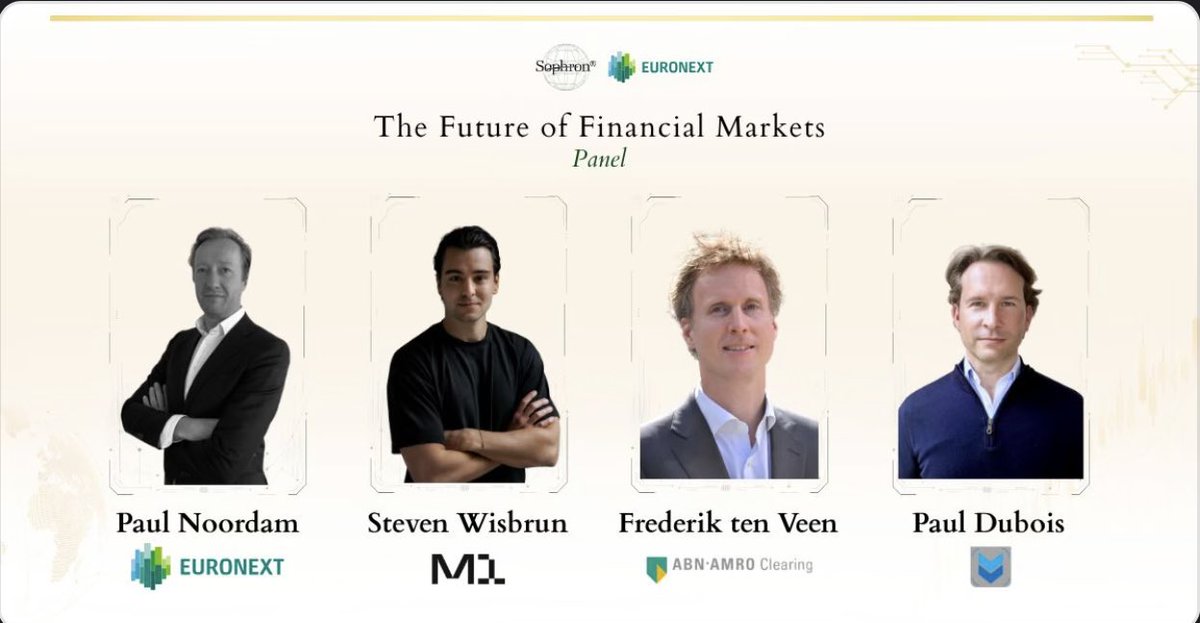
Looking forward to discussing how tokenized assets and AI are changing financial markets.
English