Paul
100 posts


@CatholicArena Absolutely—wild. Other than a Catholic, every single one of the people there is an Evangelical dispensationalist Zionist. The woman LARPing as a pastor is Paula White, Trump’s “pastor,” a hard‑core Pentecostal Zionist heretic.
English

Maybe, just maybe, we could also start giving a caring about the Christians in the Middle East. Since 1948, the Christian population in the Holy Land has collapsed, and it wasn’t merely Islam that did that. Those Christians survived Romans, Byzantines, Mamluks, and Ottomans. What they didn’t survive (barely hanging on) was the modern geopolitical “miracle” that turned their homeland into a pressure cooker. Israel created a dynamic of hostility with its neighbors that has repeatedly put Christians in the crossfire.
The biggest threat to the United States.
1. Evangelical dispensationalists (heresy), Zionists, AIPC, and other related lobbyists such as the heretical Christians United for Israel (CUFI), together with progressives, combined with out‑of‑control immigration and the growing national debt.
500. Iran
English

@ohhitssami @DumisaniTemsgen She, along with other anti-zionists, has thus smug look on her face. Arrogance. Like what’s Romans 11 talks about
English

Apply to be a White House Intern:
The White House Internship Program is a public service leadership program that provides an opportunity to gain professional experience and build leadership skills.
The deadline to apply for the fall is April 6th!
🇺🇸
whitehouse.gov/internships/
English

First of all, there’s no such thing as “replacement theology.” That’s a pejorative term invented by dispensationalist. If anything, it’s addition theology. Dispensationalism is an eschatological heresy. The only groups that teach this nonsense are Baptists and evangelicals.
Second, dispensationalism is an eschatological heresy. The only groups that hold to dispensationalism are evangelicals and Baptists, and it is not even a historic Baptist teaching. It has never been taught anywhere in the history of the Church. It was not taught by the early Fathers, by any medieval theologian, by the magisterial Reformers, or in sacred Scripture. It is a 19th century innovation. It arose in the same era that produced other novel theological systems and sectarian movements such as Mormonism, the Jehovah’s Witnesses, and Seventh‑day Adventism. Each of these movements reflects the same nineteenth‑century impulse toward religious innovation.
Third, Paul clearly states that there is one olive tree rooted in the promises given to the patriarchs. In this one tree, which is the one people of God, there are both believing Jews and believing Gentiles. Together they constitute the one people of God, the true Israel, which is the Church.
Fourth, Ignatius of Antioch was a disciple of the Apostle John. Polycarp of Smyrna was also a disciple of John, and Clement of Rome sat under Peter and Paul. These men taught sacramental theology and affirmed the continuity of God’s people. They held that the Church is the true Israel. They did not teach dispensational eschatology in any form. This is significant because they received their instruction from the apostles themselves. Scripture is also clear that there is one people of God. It does not present a hard distinction between Old Testament Israel and a separate purpose for the Church.
Fifth, Dispensationalism presents a false sense of history. It makes the physical nation of modern Israel, created seventy‑seven years ago, rather than the Church, the center of history. Yet all blessings come through Christ and His Church, which is made up of both believing Jews and Gentiles.
Finally, Evangelicals, sever Scripture from everything that gives it context and coherence. These include the Fathers, the ecumenical creeds, the liturgical sacramental life of the Church, and catechetical tradition, and the interpretive continuity of the first 1500 years. The Evangelical slogan is not the historical church doctrine. Lutherans confess sola Scriptura, which means that Scripture is the only infallible norm. They do not confess nuda Scriptura, the notion that Scripture is the only authority and that the Church’s entire historic witness is disposable. Evangelicalism has no patience for this distinction. It wants the Reformation’s vocabulary without its theology. It wants its slogans without their theology and its heroes without their commitments. In the end, Evangelicalism is Restorationism. It is loud, confident, and historically illiterate. It insists that it is the true heir of the Reformation while rejecting everything the Reformers themselves actually believed.
English

Former IDF spokesperson Jonathan Conricus told NEWSMAX that the Israel-Iran conflict "won’t end" until Tehran’s nuclear material is fully secured. bit.ly/4dbK9L7
English

While the Roman Catholic Church is growing worldwide, this growth is driven almost entirely by Africa and parts of Asia. It is certainly not occurring in Europe or North America. In both regions, Catholic populations are aging, and fertility rates track with the broader demographic decline, typically below replacement level.
English

Catholics want you to believe there is a sort of revival happening in the Catholic Church with an abnormally large amount of conversions happening!
What they fail to tell you is:
“Catholicism has one of the largest net losses of any religion in the U.S.
13% of all U.S. adults are former Catholics
Catholics have experienced the greatest net losses due to switching. About three-in-ten U.S. adults (30.2%) say they were raised Catholic. But 43% of the people raised Catholic no longer identify as Catholic, meaning that 12.8% of all U.S. adults are former Catholics.
Meanwhile, on the other side of the ledger, 1.5% of U.S. adults have become Catholics after being raised another way. Overall, 18.9% of U.S. adults currently identify as Catholics, according to the new RLS.
For Catholics, retention rates tend to be significantly lower than for other faiths,
reasons given by former Catholics for walking away were clergy and religious leader scandals (39%) and dissatisfaction with church teachings on social and political issues (37%).
Another 35% of former Catholics pointed to a gradual drifting away from their religion -- slightly less than the report's overall share of 38%.
Equal shares of former Catholics said that their religion "just wasn't important" in their lives (36%) or that their spiritual needs were not being met (36%).”
***Data is quoted from the Pew Research Center & from the DetroitCatholic.com referencing the new study from Pew Research Center released Dec. 15, 2025
What’s really happening is that Roman Catholicism has a superficial lure promising structure and nostalgia, but once the short-lived experiences fade away these young converts seek truth and fulfillment elsewhere.
Catholic Arena@CatholicArena
BREAKING 🌎 The Catholic Church has passed 1.422 billion members for the first time The 2026 Pontifical Yearbook (Annuario Pontificio) reports the latest numbers, with the strongest increases in Africa (+2.6%) and Asia (+3.3%).
English

Fun fact: Early Jewish immigrants were not universally allowed to vote. That blow your narrative out of the water. For example: Pennsylvania: required voters to affirm belief in Jesus as Savior, which excluded Jews from voting.
I’m suspicious of anything popularized by evangelicals, especially when it conveniently aligns with the eschatological heresy of dispensationalism. The entire framework is inherently political, tied to the modern geopolitical state of Israel. It also blurs the distinction between rabbinic Judaism and Old Testament Judaism, as though they were the same thing. The Fathers, Reformers or scripture never used the term. It’s mostly used politically and ultimately unhelpful.
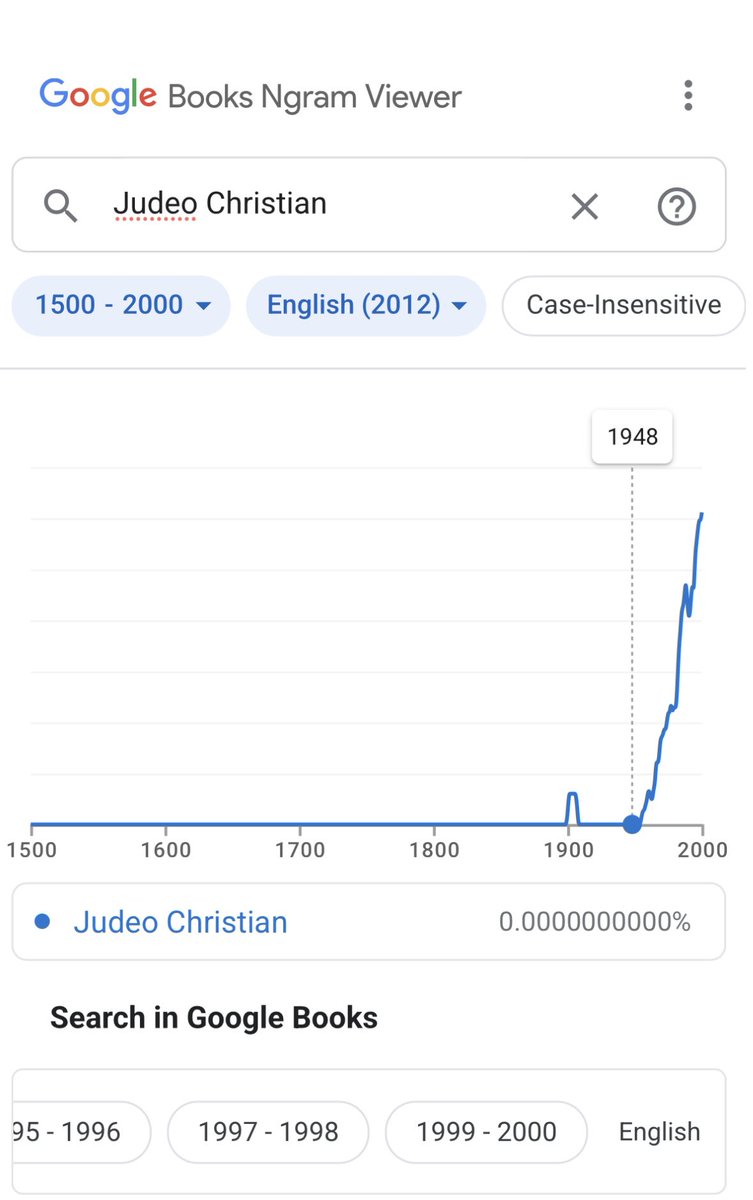
If you look at the etymology and the Google Ngram graph, it shows precisely when this word entered popular usage. Its rise conveniently coincides with 1948, and the small bump before that aligns with the year the Balfour Declaration was issued. The graph exposes the modern, political origin of the term. We should use the language of Scripture and the Creed: “I believe in the Holy Spirit, the holy catholic (Christian) Church.” We do not say, “I believe in the Holy Spirit, the holy Judeo‑Christian Church.” Scripture uses the word Christian without a modifier in Acts 11:26, Acts 26:28, and 1 Peter 4:16. Since that is the language of Scripture, the Confessions, and the Creeds, I think one should simply stay with it.
I think whenever you put a modifier in front of a term that is already inherently good, you risk distorting it. In this case, the modifier ends up sidelining or obscuring the fulfillment in Christ.

English

The USA was founded on shared religious, moral, and cultural traditions that come from both Judaism and Christianity.
SHARED
Fr Calvin Robinson ©️®️@calvinrobinson
There are Christian values - following Christ. And there are Jewish values - rejecting Christ. There are no Judeo-Christian values. Before you pretend Judeo-Christian means Old and New Testament, we have a word for that already: The Bible.
English

Nice try. Your entire argument assumes the very Christology the Fathers would have laughed out of the room. If the Word truly became flesh, then His flesh truly gives life. The Reformed dodge that by shrinking Christ’s humanity to fit their metaphysics. The Fathers didn’t.
In short, you’re reading the Fathers like a Zwinglian snapping pictures of the word “symbol” while missing the entire landscape of sacramental realism they actually lived in. Baptists end up with a Christology so thin it drifts dangerously close to Nestorian territory.
English

Clement of Alexandria wrote: “Elsewhere the Lord, in the Gospel according to John, brought this out by symbols, when He said: ‘Eat ye my flesh, and drink my blood;’ describing distinctly by metaphor the drinkable properties of faith and the promise.”
Clement also stated: “Thus in many ways the Word is figuratively described, as meat, and flesh, and food, and bread, and blood, and milk. The Lord is all these, to give enjoyment to us who have believed on Him. Let no one then think it strange, when we say that the Lord’s blood is figuratively represented as milk.”
Clement further explained: “the mixture of both–of the water and of the Word–is called eucharist… they who by faith partake of it are sanctified both in body and soul.”
Origen distinguished: “these things indeed are said of the typical and symbolical body. But many things might be said about the Word Himself who became flesh, and true meat of which he that eateth shall assuredly live for ever.”
Origen added: “It is the spirit that quickens; and then added, The flesh profits nothing… We ought therefore to desire Him in order that we may have life, and to devour Him with the ear, and to ruminate on Him with the understanding, and to digest Him by faith.”
Tertullian equated: “Having taken bread… He made it His own Body by saying, ‘This is My Body’ — that is, the ‘figure of My Body.’ A figure, however, there could not have been, unless there was in truth a body.”
The Didache calls the Eucharist “spiritual food and drink” in thanksgiving prayers focused on knowledge, faith, and holiness, with no mention of literal transformation of the elements.
Justin and Irenaeus use stronger realistic language for anti-Gnostic purposes, but even their statements tie the benefits to prayer, remembrance, and participation by faith rather than automatic corporeal presence.
Reformed theology affirms Chalcedonian Christology and the Apostles’ Creed. It teaches spiritual real presence received by faith through the Holy Spirit, without requiring the ascended human body of Christ to be locally present or multiplied in every Eucharist.
English

@travelingflying Historically, in the United States, criminals were dealt with far more swiftly and harshly than they are today. Now, in many cases, they worry more about the victimizer than the victims.
English

If your argument rests on pretending the U.S.A. gives Israel nothing, then your argument rests on fiction. And if you invoke God to prop up that fiction, you have confused divine providence with your own talking points. God does not need your exaggerations. The First Commandment forbids using His name to purposely sanctify half‑truths.
Long‑term military aid: The U.S. and Israel signed a 10‑year Memorandum of Understanding (FY2019–FY2028) committing $38 billion in military assistance. $33B in Foreign Military Financing (FMF) $5B for missile defense programs. Israel is the largest cumulative recipient of U.S. foreign assistance since WWII, receiving over $300 billion in economic and military aid. This does not even include the trillions we’ve spent fighting wars fought on their behalf.
Next. Israel can’t invoke October 7th ad nauseam as some kind of license to unleash a level of hell, far beyond anything that could be called self‑defense.
Additionally, the Church is biblical Israel, not the geopolitical state of modern Israel. The real issue is not malice toward Jews but a theological system that redefines Israel, relocates the center of God’s saving work away from Christ and His Church, and treats a modern nation‑state as if it were a sacramental object. Then they make up names like ‘Judeo-Christian’ to promote their political agenda. It’s Christian not ‘Judeo-Christian.’
Lastly, imagine having the audacity to suggest that American foreign policy should not be written by Jewish pundits like Ben Shapiro, the Scofield footnotes,’ and AIPAC.
English

The Fathers didn’t reject the Real Presence; they simply didn’t use medieval philosophical vocabulary. Their “symbolic” language is sacramental, not Zwinglian, and their literal language is unmistakable. The Didache’s “spiritual food” is biblical, not symbolic. The early Church believed the Eucharist is truly Christ’s body and blood long before anyone debated how it becomes so. The same is true of baptismal regeneration, which is undeniable among the Church Fathers and not a matter of debate.
I’m assuming you’re some type of Reformed Baptist. You have to recognize that where your tradition goes off the rails is in Christology and in how the Reformed interpret the Apostles’ Creed. Groups such as the Baptists reject the real corporal presence because their position is rooted in their Christology.
English

They rejected transubstantiation because it relies on later Aristotelian philosophy not found in Scripture or the earliest fathers, and it risks leading people to adore the elements rather than the Christ they point to. Instead, the Lord’s Supper is a means of grace where the risen Christ meets His people, just as He promised.
Clement calling wine the symbol of the sacred blood, Origen speaking of the bread as a symbol of gratitude, and Cyprian insisting wine must be used because it represents Christ’s blood, all of this shows the fathers comfortably mixing realistic and representational language. They weren’t locked into one rigid system. The Didache’s simple description of “spiritual food and drink” with prayers of thanksgiving and no hint of substantial change and the focus is on grateful remembrance, unity in Christ, and spiritual nourishment through faith.
English

@RepMarkHarrisNC How about we slap some sanctions on Finland and start pressuring them to do the right thing?
English

Quoting scripture is a crime?
Finnish Parliament member Päivi Räsänen and Lutheran Bishop Juhana Pohjola were convicted of “hate speech” just because they said the TRUTH: that marriage is between a man and a woman.
The state that can criminalize the Bible can criminalize anything — and eventually will.
@FRCdc

English

@proper2332 @TaylorRMarshall Yeah, these citations don’t work. The Fathers used the Eucharist to refute docetism, not to teach memorialism. Their Christology required a substantial Real Presence. On this point, Catholics aren’t wrong, for perspective I’m a confessional Lutheran.
English

Tertullian wrote:
“Having taken the bread and given it to His disciples, Jesus made it His own body, by saying, ‘This is My body,’ that is, the symbol of My body. There could not have been a symbol, however, unless there was first a true body. An empty thing or phantom is incapable of a symbol. He likewise, when mentioning the cup and making the new covenant to be sealed ‘in His blood,’ affirms the reality of His body. For no blood can belong to a body that is not a body of flesh” (Against Marcion, 4.40).
We ought to interpret the church fathers' statements within their historical context.
Such is especially true with regard to the quotes cited above from Ignatius and Irenaeus. During their ministries, both men found themselves contending against the theological error of docetism (a component of Gnostic teaching), which taught that all matter was evil. Consequently, docetism denied that Jesus possessed a real physical body. It was against this false teaching that the apostle John declared, "For many deceivers have gone out into the world, those who do not acknowledge Jesus Christ as coming in the flesh. This is the deceiver and the antichrist" (2 John 7).
In order to combat the false notions of docetism, Ignatius and Irenaeus echoed the language Christ used at the Last Supper (paraphrasing His words, “This is My body” and "This is My blood"). Such provided a highly effective argument against docetic heresies, since our Lord's words underscore the fact that He possessed a real, physical body.
The Didache, written in the late-first or early-second century, referred to the elements of the Lord’s table as “spiritual food and drink” (The Didache, 9). The long passage detailing the Lord's Table in this early Christian document gives no hint of transubstantiation whatsoever.
Justin Martyr (110–165) spoke of “the bread which our Christ gave us to offer in remembrance of the Body which He assumed for the sake of those who believe in Him, for whom He also suffered, and also to the cup which He taught us to offer in the Eucharist, in commemoration of His blood"(Dialogue with Trypho, 70).
Clement of Alexandria explained that, “The Scripture, accordingly, has named wine the symbol of the sacred blood” (The Instructor, 2.2).
Origen similarly noted, “We have a symbol of gratitude to God in the bread which we call the Eucharist” (Against Celsus, 8.57).
Cyprian (200–258), who sometimes described the eucharist using very literal language, spoke against any who might use mere water for their celebration of the Lord’s Table. In condemning such practices, he explained that the cup of the Lord is a representation of the blood of Christ: “I marvel much whence this practice has arisen, that in some places, contrary to Evangelical and Apostolic discipline, water is offered in the Cup of the Lord, which alone cannot represent the Blood of Christ” (Epistle 63.7).
English


Why not Islam-Christian? Ironically, Islam retains more elements recognizably adjacent to Christianity than those found in post‑biblical rabbinic Judaism.
I’m suspicious of anything popularized by evangelicals, especially when it conveniently aligns with the eschatological heresy of dispensationalism. The entire framework is inherently political, tied to the modern geopolitical state of Israel. It also blurs the distinction between rabbinic Judaism and Old Testament Judaism, as though they were the same thing. It’s mostly used politically and ultimately unhelpful.
If you look at the etymology and the Google Ngram graph, it shows precisely when this word entered popular usage. Its rise conveniently coincides with 1948, and the small bump before that aligns with the year the Balfour Declaration was issued. The graph exposes the modern, political origin of the term. Christians should use the language of Scripture and the Creed: “I believe in the Holy Spirit, the holy catholic (Christian) Church.” We do not say, “I believe in the Holy Spirit, the holy Judeo‑Christian Church.” Scripture uses the word Christian without a modifier in Acts 11:26, Acts 26:28, and 1 Peter 4:16. Since that is the language of Scripture, the Confessions, and the Creeds, I think one should simply stay with it.
When you look at the term “Judeo‑Christian,” it fits evangelicals who follow dispensationalism eschatological heresy perfectly. Because their whole system runs on a Plan A for the Jews and a Plan B for the Church.
Whenever you put a modifier in front of a term that is already inherently good, you risk distorting it. In this case, the modifier ends up sidelining or obscuring the fulfillment in Christ. It’s a political term. It only makes sense for those who followed the dispensationalism heresy.
Lastly, the church is biblical Israel.

English

@senatorbabet Jesus was a Jew, from the line of Judah. Hence we say Judeo-Christian, to confirm✝️is a branch off✡️. ✝️has not replaced✡️. We are the ppl who believe Jesus Christ was the Messiah & our Lord and Saviour.
Then you have other✡️who are still waiting for the Messiah.
English

Wrong. The United States was founded on Christian values. The phrase “Judeo Christian” is a 20th century invention, it didn’t gain traction until the 1930s as a political slogan to advocate for the Jewish cause. For most of history, Judaism and Christianity were not presented as a single tradition. They are theologically distinct, and in many ways fundamentally opposed.
Disclose.tv@disclosetv
NOW - White House's Leavitt: "Our nation was a nation founded, 250 years ago almost, on Judeo-Christian values."
English

I’m certainly not ‘pro‑Iran’ or ‘pro‑Islam’ by any stretch of the imagination. I’m all for the re‑immigration of Islam out of Europe and North America.
Christians have been steadily pushed out of these regions for decades. Israeli treatment of Christians is not morally superior to Muslim treatment. Christians are caught in the middle, and they are the ones who suffer the most and lose the most. And if you want to support Israel, support the Church, because the Church is biblical Israel.
Christian’s do not deny the image of God to any human being, not to Muslims, not to Jews, not to anyone. That is the doctrine of creation from Genesis onward. Naming the dangers of a religion is not the same thing as denying the humanity of its adherents. Only bad theology confuses the two.
Quoting a survivor’s horror doesn’t rescue your argument. Every Christian condemns the evil of grooming gangs and grieves for the victims. Dragging their trauma into this discussion just to dodge your own twisted logic isn’t righteous. You don’t get to use someone else’s suffering as a shield for bad reasoning.
English

@TradingEthix @DVATW Haha. The impulse to ‘re‑brand’ the world through clever linguistic inversions is the hallmark of the Gnostic mind.
English