
The Lewis Lab

400 posts

The Lewis Lab banner
The Lewis Lab

The Lewis Lab

@PeterLewisLab

Chromatin biochemistry and genomics in development and cancer. @UWMadison @UWSMPH @BMC_UW

Wisconsin, USA Katılım Mart 2019
639 Takip Edilen1.3K Takipçiler
Sabitlenmiş Tweet
The Lewis Lab
The Lewis Lab@PeterLewisLab·
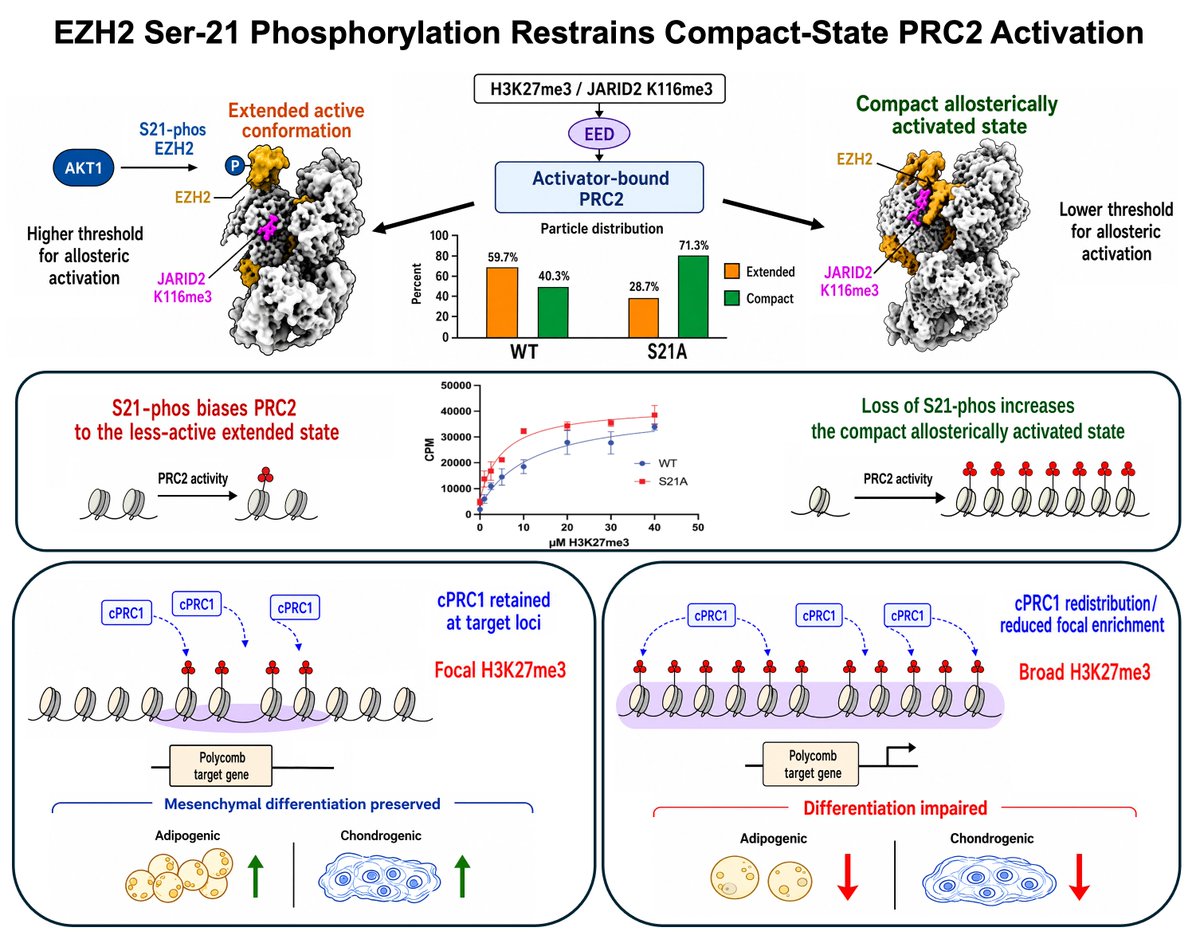
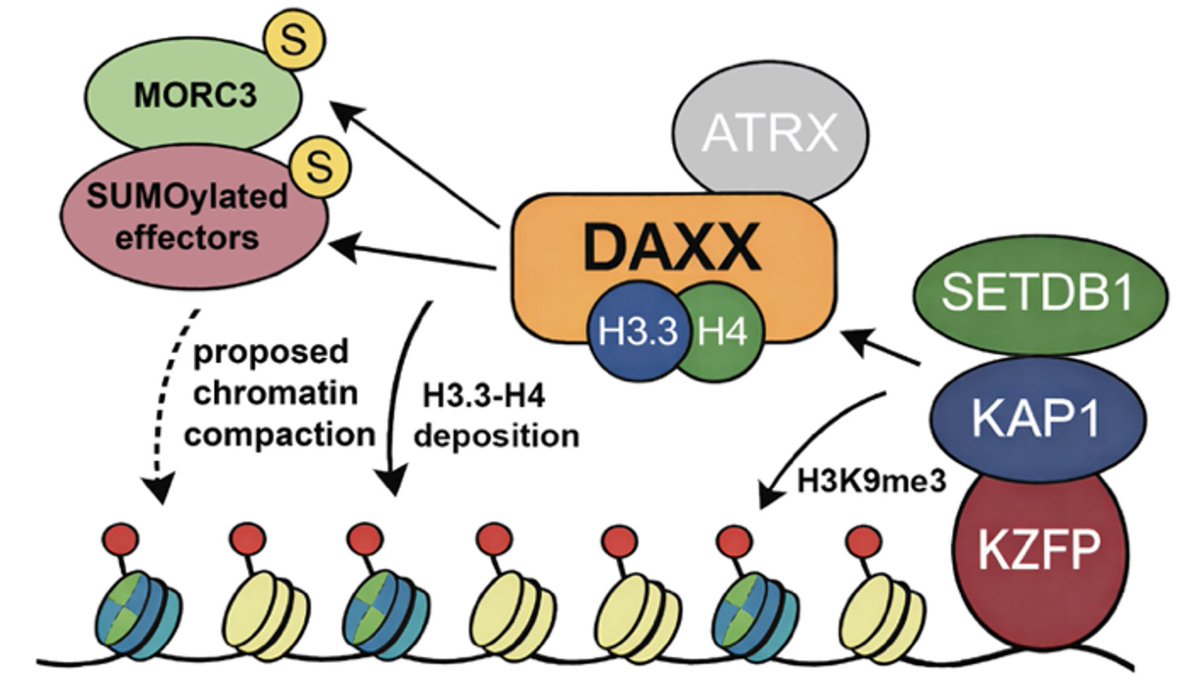
New preprint from our lab! An H3.3 knockout does two things at once: it removes H3.3 from chromatin and destabilizes DAXX. We disentangle those functions and find that DAXX-mediated H3.3 deposition can be uncoupled from ERV silencing. biorxiv.org/content/10.648…
The Lewis Lab tweet media
English
3
10
65
4.6K
The Lewis Lab
The Lewis Lab@PeterLewisLab·
In a genome not so far away, the most elegant design in the galaxy was already wrapped into ~147 base pairs. #HappyNucleosomeDay, May-The-Fourth Be With You.
The Lewis Lab tweet media
English
1
20
82
3.3K
The Lewis Lab retweetledi
Hironori Funabiki
Hironori Funabiki@HironoriFunabi1·
Excited to share our structural insights into how microtubules differentially guide phosphorylation of kinetochore-microtubule regulators, Ndc80 and MCAK, for chromosome segregation. Heroic efforts by Yiming Niu with a fun collaboration with DeLuca lab! science.org/doi/10.1126/sc…
Rockefeller University@RockefellerUniv

Microtubules have been viewed as passive structural supports, but a study from @HironoriFunabi1 in @ScienceAdvances redefines microtubules as active regulators, helping to prevent abnormalities in the number of chromosomes, a hallmark of cancer. 🔗: bit.ly/4v8miCC

English
1
7
25
3.9K
The Lewis Lab retweetledi
Keiichi Ito
Keiichi Ito@itok10918·
A single-nucleotide enhancer mutation overrides chromosomal sex to drive XX male development | Nature Communications nature.com/articles/s4146…
English
0
3
10
833
The Lewis Lab
The Lewis Lab@PeterLewisLab·
These separation-of-function mutants show that H3.3 deposition can be uncoupled from ERV silencing. This supports our finding that H3.3 deposition at ERVs is dispensable for repression. Instead, repression depends on the C-terminal SIM and interaction with SUMOylated effectors.
The Lewis Lab tweet media
English
0
0
0
104
The Lewis Lab
The Lewis Lab@PeterLewisLab·
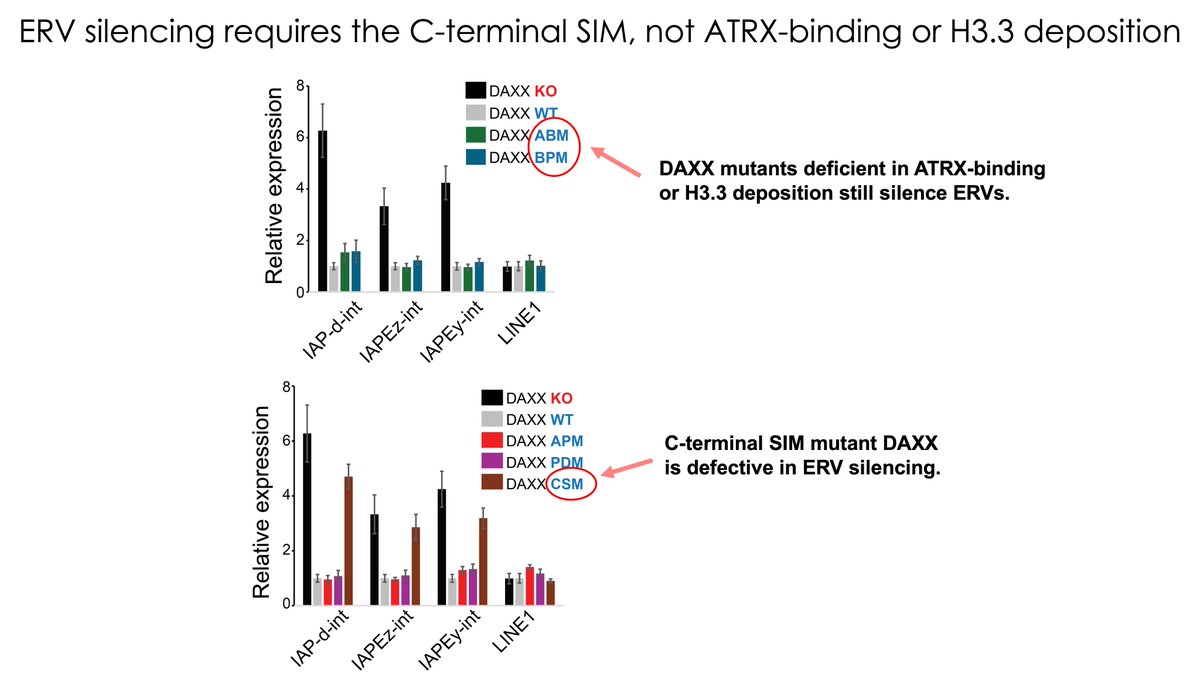
Which DAXX functions are required for ERV silencing? Mutants defective in ATRX binding or H3.3 deposition restore ERV repression. By contrast, deletion of the SIM abolishes silencing. Thus, ERV repression requires the C-terminal SIM, but not ATRX binding or H3.3 deposition.
The Lewis Lab tweet media
English
1
0
0
137
The Lewis Lab
The Lewis Lab@PeterLewisLab·
New preprint from our lab! An H3.3 knockout does two things at once: it removes H3.3 from chromatin and destabilizes DAXX. We disentangle those functions and find that DAXX-mediated H3.3 deposition can be uncoupled from ERV silencing. biorxiv.org/content/10.648…
The Lewis Lab tweet media
English
3
10
65
4.6K
The Lewis Lab
The Lewis Lab@PeterLewisLab·
Model: Gcn5-containing HAT complexes are targeted to active genes by the transcription machinery, providing a direct link between histone acetylation and gene activation. A fitting paper to revisit 30 years later, on what would have been Dave Allis's 75th birthday, March 22.
The Lewis Lab tweet media
English
1
3
27
1.2K
The Lewis Lab
The Lewis Lab@PeterLewisLab·
And then decisive experiment. Recombinant Gcn5p expressed in E. coli had HAT activity in the in-gel assay, whereas controls lacked activity. With that, Gcn5p was assigned a direct biochemical activity, linking histone acetylation more directly to transcriptional activation.
The Lewis Lab tweet media
English
1
0
3
230
The Lewis Lab
The Lewis Lab@PeterLewisLab·
Happy 30th birthday to this paper published March 22, 1996, one of the foundational studies in chromatin biology. Brownell et al. linked a transcription-associated Tetrahymena HAT to yeast Gcn5p, providing a biochemical link for chromatin modification to gene activation.
The Lewis Lab tweet media
English
2
13
46
4.4K