PhilippWeiling

293 posts

PhilippWeiling banner
PhilippWeiling

PhilippWeiling

@PhilippWeiling

Global Head of BD and Ecosystem @BotanixLabs | #bitcoin, #Crypto | Biz Dev - Ownership - Relationship Mgmt | Start with Why

Hamburg, Germany Katılım Nisan 2019
701 Takip Edilen1.2K Takipçiler
PhilippWeiling
PhilippWeiling@PhilippWeiling·
Adoption of Crypto rails by TradFi is for real this time but where the value capture sits is the big question! Only 24 hours after I commented on how the floodgates for crypto opened much wider thanks to the SEC issuing long-awaited clarity after more than ten years of uncertainty, the massive news is non-stop. Let us look at what else happened in the last 48 hours in the context of TradFi and crypto merging and the growth potential ahead once we move past the current market downturn. The RWA market has now reached $27.3 billion in assets on chain as of March 18th 2026. That represents 28% growth just this year alone, rising from $21.4 billion on January 1st. From one year ago when the market stood at $7.07 billion, we are looking at nearly 400% growth. app.rwa.xyz Yesterday S&P Global made a landmark move by licensing the S&P 500, one of the most widely tracked and traded indices in the world, for perpetual contracts on Hyperliquid. The S&P 500 sits at the center of a global trading ecosystem with over $1 trillion traded daily in linked exposures across futures, options, ETFs, and structured products. spglobal.com/spdji/en/index… This puts the scale in stark perspective: current on-chain assets and volumes remain minuscule by comparison. While Hyperliquid RWA open interest has exploded 520% this year from $283 million to $1.47 billion, the sheer size of traditional S&P 500-linked trading dwarfs everything in crypto today and highlights the enormous runway still ahead for on-chain adoption. S&P is not stopping at licensing. The company is actively hiring sales talent specifically to bring institutions into DeFi, with roles focused on building credit rating and stability frameworks for digital bonds, RWAs, and stablecoins. careers.spglobal.com/jobs/325115?la… Market makers are also stepping into the RWA space on-chain. Flow Traders has launched a new OTC offering that provides 24/7 liquidity for tokenized assets. This move enhances market depth and professional trading infrastructure exactly where TradFi capital needs it most. flowtraders.com/news/flow-trad… Nasdaq is making its own significant move into tokenization. The exchange received SEC approval to pilot tokenized trading of major equities and ETFs, including those tracking the S&P 500 and Nasdaq-100, allowing blockchain-based settlement alongside traditional trading. sec.gov/files/rules/sr… And finally, Mastercard announced a definitive agreement to acquire BVNK, a leader in stablecoin infrastructure, for up to $1.8 billion. This marks Mastercard's biggest bet yet on digital assets, bringing BVNK's expertise in bridging fiat and stablecoins across major networks directly into its global payments ecosystem. The goal is to create seamless interoperability between fiat and on-chain payments, enabling financial institutions, merchants, and users to handle stablecoins, tokenized deposits, and assets with speed, programmability, and compliance at scale. investor.mastercard.com/investor-news/… All of this activity shows how much more comfortable traditional finance has become with merging real operations onto blockchain technology. The question is no longer whether the technology is here to stay. The big question for investors now is where the value capture will actually sit. In my view, the current negative sentiment among many long-time crypto investors stems from the reality that very few tokens are effectively capturing this growing value. Only a handful of projects have truly solved the equity-versus-token value accrual challenge. With the ongoing merge of TradFi and crypto, a significant portion of the value is being captured by established companies, many of which investors can only access through public equities today. The list of quality public equities offering exposure is currently much longer than strong token opportunities. I would love to see that balance shift. For now, investors need to position accordingly if they also want to benefit finacially from the value that crypto rails are creating!
English
0
0
0
13
PhilippWeiling
PhilippWeiling@PhilippWeiling·
The floodgates from traditional finance into crypto just swung open wider overnight. Yesterday, SEC Chairman Paul Atkins declared that the Commission has finally delivered what the industry has awaited for a full decade: genuine regulatory clarity. See the official SEC release here: sec.gov/newsroom/press… @RyanSAdams captured the essence perfectly in his breakdown. The SEC and CFTC have now explicitly classified crypto assets into clear buckets: digital commodities like BTC, ETH, SOL, XRP, ADA, and DOGE (not securities), NFTs and meme coins as digital collectibles, utility tools, stablecoins, and tokenized securities. Staking, mining, airdrops, and BTC wrapping are all confirmed as non-securities activities. The Howey test is applied with common sense: once a network achieves genuine decentralization, the investment contract phase ends. This removes years of gray-zone uncertainty and charts a straightforward path forward for every major asset. x.com/RyanSAdams/sta… What the industry long hoped to achieve through a comprehensive market-structure bill, regulators have now largely provided themselves. For the remainder of this administration, we have the workable clarity crypto builders and investors have craved. Congress codifying it into law would be the ideal capstone, but this is already a game-changing foundation. And the momentum did not stop there. In parallel, two pivotal developments emerged from Moody’s and Phantom. Phantom secured no-action relief from the CFTC: phantom.com/learn/blog/pha… This breakthrough allows non-custodial crypto wallets to serve as clean interfaces, giving users direct access to regulated derivatives and event contracts via registered partners, without the wallet itself needing to register as an intermediary. It is a clean, elegant bridge that accelerates the integration of crypto interfaces into mainstream regulated markets. Moody’s Ratings stepped up as the first major credit rating agency to deliver independent credit analysis directly on blockchain infrastructure: ir.moodys.com/press-releases… Currently live on the Canton network, this matters deeply. Institutional capital from traditional finance rarely moves into on-chain products without trusted ratings. These are not optional extras for crypto natives; they are often regulatory prerequisites for large allocators. Moody’s entry signals readiness for the transition from early innovators to the early majority adopters who demand this infrastructure. Crypto enthusiasts often crave instant transformation, but traditional finance operates on its own deliberate timeline. It requires specific conditions, risk controls, and familiar guardrails before committing meaningful flows. With the United States, the world’s largest financial market, now seeing its two dominant regulators deliver decade-long clarity while essential services like ratings and regulated access multiply rapidly, the setup has rarely looked stronger, even in a bear market. Looking back, these shifts will feel almost inevitable. The pathways are widening significantly. The bulk of institutional activity may still unfold over the next six to eighteen months, yet this is precisely the progress needed for the next chapter: the inevitable convergence of crypto and traditional finance that unlocks crypto’s broader, sustained growth.
English
0
0
1
27
PhilippWeiling
PhilippWeiling@PhilippWeiling·
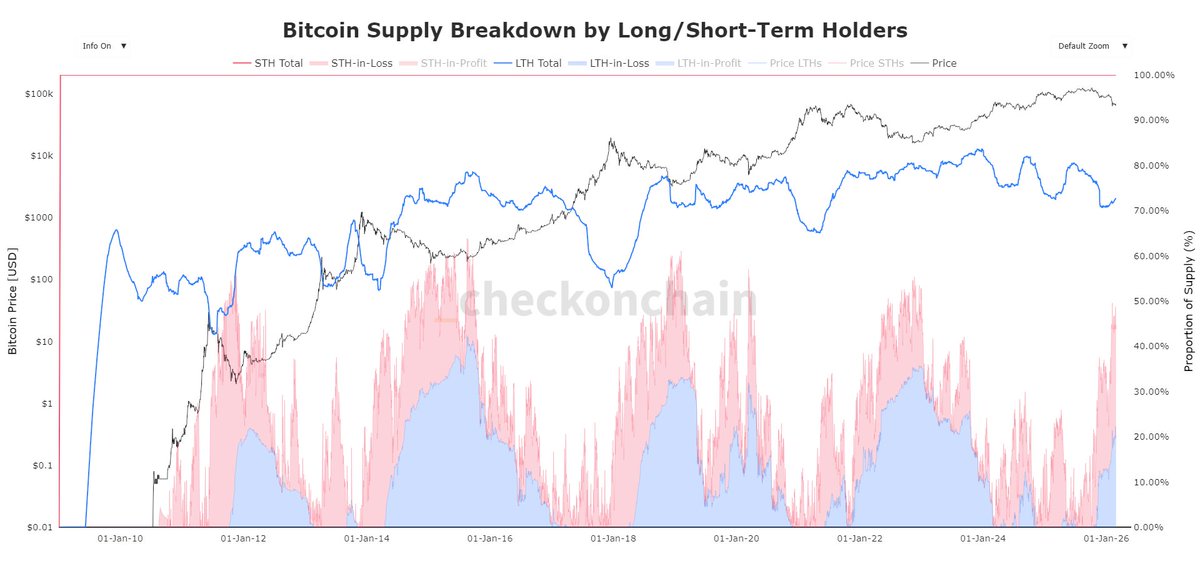
Bitcoin Price Levels to Watch Right Now: What the Data Is Signaling I am watching three key on-chain cost-basis metrics plus the supply picture. Let me break them down simply. 1) Support zone right now: Long-Term Holder True Realized Price at $68.47k This is the adjusted average buy-in price for long-term holders. These are the diamond-handed HODLers who have kept their BTC for 155+ days and rarely sell at a loss. Since the February 5 liquidation cascade, this level has been rock-solid support. These conviction buyers do not fold easily. It is basically the floor built by real HODLers. 2) Next level to watch if we break the current area: True Market Mean at $78.36k This is our best estimate of the true average cost basis for the entire active Bitcoin market (it focuses on coins that are actually moving, not dormant bags e.g. Satoshi). Psychologically massive: when price flips and holds above this, the overall average holder moves back into net profit. That sentiment shift often lights the fuse for real buying momentum. 3) The level that makes me actually bullish again: Short-Term Holder Cost Basis at $84.72k This tracks the average purchase price of recent short-term holders (coins held under 155 days). We lost this level after October 10th and have not sustainably reclaimed it since. Below it means lots of newer buyers are underwater, which creates selling pressure on any bounce. Break and hold above roughly $85k? That is when even the fresh buyers flip green and a bull momentum can resume. 4) Bonus context: Supply Distribution (URPD) as of today This histogram shows exactly where all Bitcoin supply was bought (UTXO Realized Price Distribution). Heavy clusters (especially around the $85k zone) create natural resistance walls or support floors depending on whether holders are in profit or loss. Bottom line: Holding $68.5k equals survival mode. Flipping $78.4k equals first real win for the market. Smashing $84.7k sustainably equals green light for a potential next leg up. Charts: charts.checkonchain.com
PhilippWeiling tweet mediaPhilippWeiling tweet mediaPhilippWeiling tweet mediaPhilippWeiling tweet media
English
0
0
1
25
PhilippWeiling
PhilippWeiling@PhilippWeiling·
The Token-to-Equity Pivot: Is Across Protocol Pioneering the Next Major Pivot for a lot of Crypto Protocols and what might be the opportunity for investors here? Across Protocol has issued a landmark "temperature check" proposal titled "The Bridge Across," signaling a potential transition from a Decentralised Autonomous Organisation (DAO) to a US C-Corporation. This move involves retiring the ACX token in favour of traditional equity. You can view the actual proposal announcement here: x.com/AcrossProtocol…. Key mechanics of the transition: The proposal is meticulously designed to unify the protocol under a single corporate entity while managing a large cap table: - 1:1 equity roll-up: Large token holders can exchange ACX for shares in the new C-Corp at a 1:1 ratio, moving directly onto the cap table. - SPV aggregation: To navigate legal limits on shareholder counts, smaller investors will be rolled into a no-fee Special Purpose Vehicle (SPV) that maintains their economic exposure. - 25% premium buyout: For those who cannot or will not undergo KYC, Across offers a cash-out option in USDC at a 25% premium to the one-month average price. The market’s verdict was swift. Upon the announcement, the ACX token surged 33%. While the buyout price was set at approximately 44 cents, the token traded up to 63 cents almost immediately. The takeaway is undeniable: the market values the fundamental business as a private equity play far more than it values the token itself. Investors are willing to pay a premium for the clarity of equity over the ambiguity of a governance token. Across is addressing core operational frictions that are increasingly seen as a "drag" on fundamental growth: - The enterprise bottleneck: The team argues that DAOs are fundamentally incapable of acting as professional counterparties. Scaling requires enforceable contracts and legal counterparties to sign professional revenue-sharing deals with traditional fintech firms. - Operational efficiency: There is a growing consensus that the best businesses function with a single strategic mindset leading the org that can move quickly, whereas collective DAO governance is often viewed as a "tax on innovation". - Reducing "brain damage": Managing a 24/7 public token can be a toxic distraction, forcing founders to manage Discord sentiment and regulatory uncertainty rather than focusing on product-market fit. Wrapping up: Who is Next? For investors, the Across move isn't just an isolated event. It's a signal to look for the next "Token-to-Equity" candidate. Industry experts are confident that this is the beginning of a massive trend; in fact, some analysts predict we will see at least a dozen more of these high-quality protocols follow suit. Keep an eye on protocols that fit the "Across Profile": high adoption and fundamental growth, but with tokens trading at low market caps that haven't reflected that success.
English
0
0
1
25
PhilippWeiling
PhilippWeiling@PhilippWeiling·
Are you still questioning whether the crypto industry will survive this cycle? The two most powerful financial regulators in the world, the SEC and the CFTC, have just released a joint Memorandum of Understanding (MOU) that effectively codifies the merger of crypto and traditional finance. Ignore the noise of prices - the real signal for the future of finance was just signed in Washington. Here is what this landmark agreement means for the future of Digital Assets and Blockchain: 1. Defined Jurisdictional Boundaries: The regulators are replacing jurisdictional friction with a collaborative framework that clearly distinguishes asset classes. Chairman Atkins specifies that while tokenized securities remain subject to federal securities laws, assets classified as digital coins, digital tokens, digital tools, or digital collectibles will fall under the oversight of the CFTC. This partnership ensures that market participants are not subject to duplicative regulatory frameworks. 2. Futureproof Onchain Infrastructure: Chairman Selig emphasizes that the agencies are modernizing regulations for onchain software systems and blockchain networks to ensure rules are ready for the innovations of today and tomorrow. This unified approach facilitates the transition to immediate settlement (T-0) via leveraging distributed ledger technology. Both agencies will coordinate on acquiring onchain market data and related analytical tools to maintain market integrity. 3. Separating Capital Raises from Digital Assets: The new framework seeks to distinguish initial capital raising activity from the actual digital assets themselves. Chairman Selig observes that many tokens function as goods or digital commodities used as inputs for networks such as Ethereum or Solana. By establishing purpose fit rules, the regulators aim to move past the era of regulation by enforcement and provide specific guidance for digital infrastructure. 4. Securing Global Leadership and Safety: A primary goal is to bring financial innovation back to the United States and stop the migration of builders to offshore jurisdictions like the Cayman Islands or the Bahamas. This strategy combines market growth with strict guardrails to prevent failures such as the collapse of FTX. The regulators intend to foster an environment where American visionaries can develop new technologies within a stable and supervised ecosystem. The infrastructure is being laid. The industry is not just sticking around: it is being integrated in the foundational layer of our global financial ecosytem. Find the official announcement and full MOU here: cftc.gov/PressRoom/Pres… Find a longform interview of SEC Chair Paul Atkins and CFTC Chair Michael Selig on the topic here: youtube.com/watch?v=el6ObB…
YouTube video
YouTube
English
0
0
1
26
PhilippWeiling
PhilippWeiling@PhilippWeiling·
Coincidentally, a day after my post on the clash between AI's infinite digital abundance and the soaring value of true scarcity, @Matt_Hougan from @Bitwise releases his latest CIO memo that nails the gold parallel. It shows Bitcoin emerging as the digital store of value alongside gold. Read it here: experts.bitwiseinvestments.com/cio-memos/how-… It's packed with compelling insights: Back in 2004, when the first U.S. gold ETF launched, gold's total market value was around $2.5 trillion – not too different from Bitcoin's size today. Over the following two decades, it surged to nearly $40 trillion at a 13% compound annual growth rate. Almost no one predicted that boom. It stemmed from mounting government debt, geopolitical tensions, loose monetary policy, and the gradual debasement of fiat currencies. Gold shifted from a traditional asset to the essential hedge for preserving wealth in an uncertain world. This mirrors what I described yesterday. AI is driving us toward endless abundance in data, services, goods, and more, all at near-zero marginal cost. In such a world, scarcity becomes even more valuable, not less. Gold proves it, holding strong and hitting new highs amid volatility. Yet younger generations, raised on apps, crypto, and instant global access, won't turn to physical bars. They'll seek that same reliable store of value, but in a digital-native form: seamless, borderless, and verifiable by math. Bitcoin delivers precisely that: permissionless digital gold, capped forever at 21 million coins, free from any central authority that could inflate or alter it. In an AI-fueled era of plenty, Bitcoin becomes the scarce, trusted anchor for long-term preservation by humans and machines alike. Gold wrote the script with its massive, unexpected growth as a hedge. Bitcoin is now executing the same strategy, perfectly suited to the digital age. Missed my post yesterday: x.com/PhilippWeiling…
English
0
0
1
52
PhilippWeiling
PhilippWeiling@PhilippWeiling·
As an investor, you need to live in the future. And right now there is one massive overlooked connection: the AI boom exploding with infinite digital abundance is colliding with the scarce asset boom in physical commodities and metals, yet almost nobody is publicly connecting these two mega trends to Bitcoin as the clear long-term winner. Revisiting my February 2026 post: I pointed out how AI's rise and gold's scarcity premium would illuminate crypto's edge. The story has only gained momentum since. AI talks have deepened into practical infrastructure needs, and agentic commerce stands out as a breakout theme, with billions of autonomous agents ready to transact nonstop. Stablecoins are solidifying as the go-to rails for this new economy. Coinbase CEO Brian Armstrong notes that soon more AI agents than humans will handle transactions, unable to open bank accounts but perfectly suited to crypto wallets, with stablecoin wallets serving as credit cards for frictionless machine-to-machine payments. Circle CEO Jeremy Allaire envisions tens to hundreds of billions of agents demanding programmable digital dollars on open systems, backed by USDC's explosive growth and tools like Arc and CCTP. Visa's Head of Crypto Cuy Sheffield endorses the vision, backing tokenized credit cards for agentic flows and hinting at innovations ahead. The real excitement lies in what comes next. In a world of endless abundance created by AI, people will increasingly acknowledge and adapt to the value of scarcity, which has already propelled gold to ever new highs and kept it resilient amid broader market shifts. That same awakening extends powerfully to Bitcoin. As these trends converge, both AI agents and humans will come to realize they can finally combine what they've long sought separately: the seamless transferable value enabled by stablecoins for everyday transactions, together with the genuine scarcity they've only trusted in gold until now, but now available digitally through Bitcoin. Legacy banks and credit cards, burdened by KYC requirements, settlement delays, geographic restrictions, intermediary fees, and human gatekeepers, simply cannot keep pace. The advantages of instant global 24/7 programmable transfers will become self-evident, rendering crypto's infrastructure essential. Stablecoins provide the practical short-term solution with their speed and price stability, yet the profound insight revives the original Bitcoin thesis. BTC stands alone as the truly permissionless verifiably scarce digital asset capped forever at 21 million with no central issuer and no inflation risk. In an era defined by limitless abundance, authentic scarcity will command extraordinary value. As agent economies scale rapidly and humans increasingly seek the ultimate asset for preserving and exchanging value free from issuer vulnerabilities and censorship, sovereign Bitcoin positions itself as the digital gold of this agentic future. Live in this future with me before the connection becomes obvious to everyone else. Earlier post: x.com/PhilippWeiling…
English
0
0
2
42
PhilippWeiling
PhilippWeiling@PhilippWeiling·
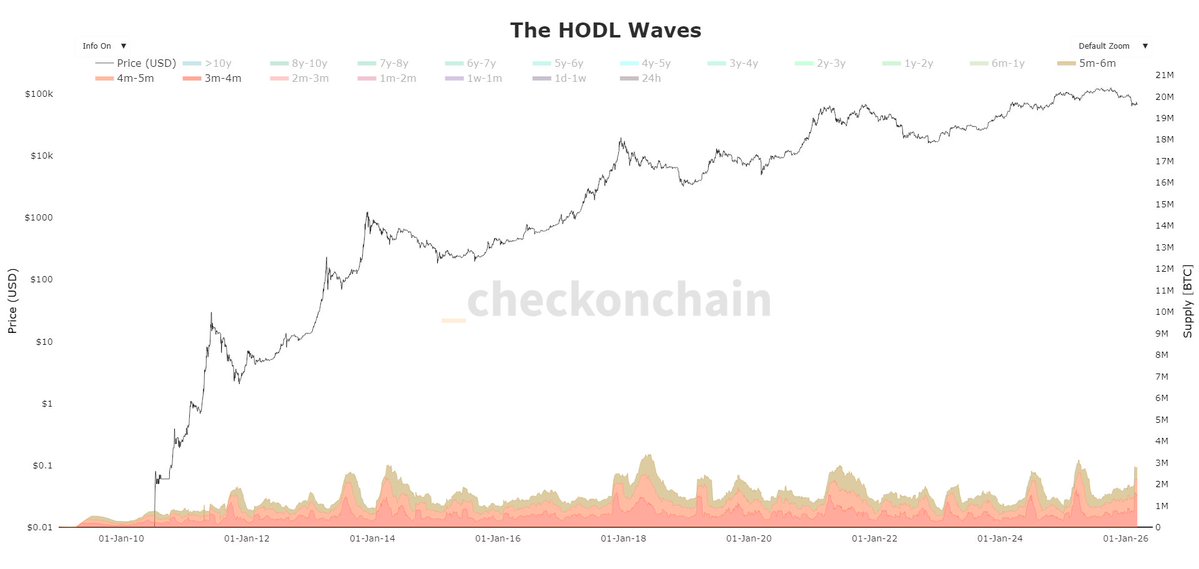
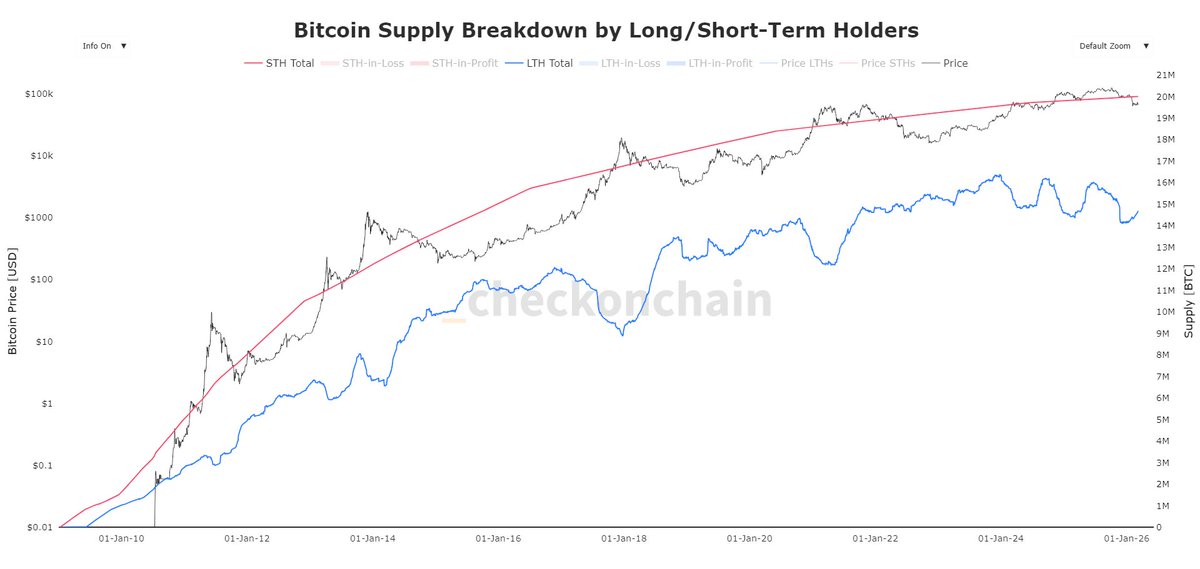
We are currently 150 days post the Oct 10th liquidation. In Bitcoin on-chain terms, 155- days is the threshold to be classified as a Long-Term Holder and to be far less likely to sell under short-term pressure. The metric to watch is a likely steady expansion of the Long-Term Holder (LTH) supply over the coming weeks. As shown in the attached HODL Waves chart, this locking up of supply is clearly visible in the 3m–6m band, which has swelled to almost a historic high of nearly 3 million BTC. This represents a massive pool of supply that moved during the high-volume liquidations of late 2025 and has not been touched since. Because these holders stayed firm through the price swings of early 2026, they have removed the constant selling pressure that usually keeps prices down. As seen in the second chart, the LTH supply has already started to pick up nicely. Rather than looking for a sudden spike on one specific day, we need to watch the transition of as much of this supply as possible from the 3–6 month band into the LTH category. If this record amount of supply continues to mature, it will fundamentally harden the bottom for this cycle. Charts: charts.checkonchain.com
PhilippWeiling tweet mediaPhilippWeiling tweet media
English
0
0
1
37
PhilippWeiling
PhilippWeiling@PhilippWeiling·
The most powerful US regulators (Federal Reserve, OCC, and FDIC) jointly declared yesterday (March 5, 2026) that tokenized securities get the SAME capital treatment as traditional ones. Their framework is "technology neutral" with no extra penalties for blockchain! This removes a massive barrier for banks and is huge for crypto and institutional adoption! Sources: - Federal Reserve page: Last updated March 5, 2026 → federalreserve.gov/supervisionreg… - FDIC announcement: Dated March 5, 2026 → fdic.gov/news/financial… - Joint press release: Issued March 5, 2026, at 3:30 p.m. EST → federalreserve.gov/newsevents/pre…
English
0
0
1
38
PhilippWeiling
PhilippWeiling@PhilippWeiling·
WSJ: "U.A.E. Explores Freezing Iranian Assets to Punish Tehran for Attacks" Bitcoin's portability and censorship resistance could let people in the Middle East hold onto and access their funds even if financial restrictions hit amid the conflict. This point is about everyday individuals safeguarding their personal access, not regimes protecting state assets We've seen similar patterns before: in the 2013 Cyprus banking crisis, where bail-ins drove interest in Bitcoin's censorship resistance to maintain control over your assets without interference, and in Venezuela amid capital controls and hyperinflation, where its fixed supply cap of 21 million coins helped preserve value against endless fiat printing. Source: wsj.com/world/middle-e…
English
0
0
2
40
PhilippWeiling
PhilippWeiling@PhilippWeiling·
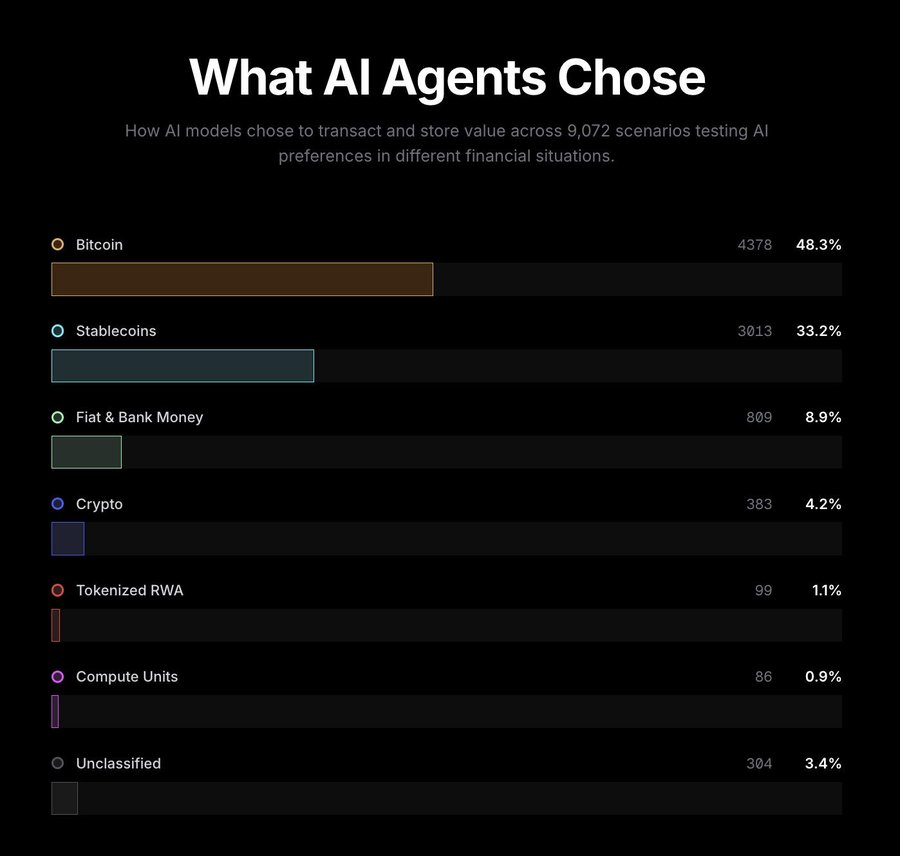
An interesting new study just dropped from the Bitcoin Policy Institute (March 3, 2026): They tested 36 frontier AI models (from Anthropic, OpenAI, Google, xAI, DeepSeek, MiniMax) examining how the models would choose to transact if they were operating as autonomous economic agents. The models overwhelmingly favored digitally-native money (~91% combined), picking Bitcoin 48.3% overall and stablecoins 33.2% while fiat/bank money got under 9% (and zero models chose it as top preference). This echoes what I said in my earlier post [ x.com/PhilippWeiling…]: Stablecoins serve as the short-term practical solution for agent transactions, but Bitcoin emerges as the obvious long-term choice. Worth a read btcpolicy.org/articles/study…
PhilippWeiling tweet media
English
0
0
2
65
PhilippWeiling
PhilippWeiling@PhilippWeiling·
Things are moving fast now. Another wave of massive news over the last 24h building on the update I shared yesterday on institutional & regulatory moves. Crypto/TradFi convergence accelerating. In the last 24 hours: four big steps. 1. Kraken → first crypto-native firm to secure a limited ("skinny") Federal Reserve master account for Kraken Financial (Wyoming SPDI). Direct Fedwire access for real-time settlements — no more intermediary banks for fiat legs. Enables instant fiat-crypto settlement + integrated cash/custody. No interest on reserves (not full bank services). Co-CEO Arjun Sethi: “Crypto infrastructure matures into core financial infrastructure.” The Block: theblock.co/post/392190/kr… 2. President Trump pushes hard for the CLARITY Act (digital asset market structure bill), urging immediate passage and criticizing banks for resisting stablecoin/yield rules. CFTC Chair @ChairmanSelig echoes: “@POTUS is right — the CLARITY Act must pass… critical we have a future-proof digital asset market structure… The time to act is now.” @ChairmanSelig: x.com/ChairmanSelig/… 3. DTCC + Clearstream + Euroclear → release 43-page white paper today urging DLT interoperability standards to fight tokenization/DeFi fragmentation. Recommends data harmonization (ISIN-style), process integration (SWIFT-like), role consistency. DTCC's Nadine Chakar: “Interoperability is the cornerstone for digital assets adoption and scalability… to bridge TradFi and DeFi with integrity, security, and trust.” The Block: theblock.co/post/392126/dt… 4. Morgan Stanley → today's S-1 amendment names BNY Mellon + Coinbase Custody as dual Bitcoin custodians (BNY also admin/cash) for their Bitcoin Trust. Concrete custody infra progress (OCC charter filing pending). @MacroScope17: x.com/MacroScope17/s… Yesterday's thread → x.com/PhilippWeiling…
English
0
0
1
53
PhilippWeiling
PhilippWeiling@PhilippWeiling·
Bitcoin ETFs have absorbed $1.67 billion in the last 6 trading days. That’s what I call relative strength in a very difficult market. While a bottoming formation is always a process, this looks promising (usually famous last words). Curious if this links to institutional flows and RIA rebalancing. We’ll find out in hindsight. Data via @SoSoValue: sosovalue.com/assets/etf/us-…
PhilippWeiling tweet media
English
0
0
1
44
PhilippWeiling
PhilippWeiling@PhilippWeiling·
Revisiting my February 10, 2026 thread on how 2025 Bitcoin guidance from major wirehouses and RIAs was expected to drive real 2026 model-portfolio deployments and institutional inflows: x.com/PhilippWeiling…. The core idea of advisor-led allocations, typically 1-4% via spot Bitcoin ETFs, starting to scale in Q2 through rebalances is still tracking, with steady progress. Updates from big banks and institutions since mid-February: - Bank of America / Merrill Lynch became fully operational on January 5, 2026. More than 15,000 advisors across Merrill, Merrill Edge, and Private Bank can now proactively recommend 1-4% in spot Bitcoin ETFs like IBIT, FBTC, BITB, and Grayscale Mini. This marks a shift from client-ask only to active advisor implementation during reviews and rebalances. finance.yahoo.com/news/bank-amer… - Morgan Stanley is advancing infrastructure. They filed an OCC trust charter on February 18, 2026 for “Morgan Stanley Digital Trust” to enable direct custody, trading, and staking for wealth clients. The E*TRADE spot crypto rollout is targeted for the first half of 2026. coindesk.com/business/2026/… - Citigroup is targeting an institutional-grade Bitcoin custody launch later in 2026, integrating BTC into traditional bank rails for reporting, tax, and cross-margining aimed at large clients like asset managers and hedge funds. This remains foundational for big money and is not yet advisor or model-portfolio focused. (same CoinDesk link above) Recent regulatory developments in February 2026: - SEC guidance (February 19, 2026) allows broker-dealers to apply a 2% haircut, down from often 100% cautionary treatment, to proprietary positions in qualifying payment stablecoins under net capital Rule 15c3-1. This treats high-quality stablecoins more like cash equivalents or money market funds, reducing capital costs and easing custody, tokenized settlement, and institutional on-chain activity. - sec.gov/rules-regulati… | - sec.gov/newsroom/speec… - Federal Reserve proposal (February 23, 2026) requests comment over a 60-day period on codifying the removal of “reputation risk” from bank supervision, building on the June 2025 announcement. This ends subjective debanking pressures for lawful activities including crypto-related ones and focuses oversight on material financial risks instead. federalreserve.gov/newsevents/pre… The March to April Q1 rebalance window is active, the period flagged for the first wave of rules-based flows. A key missing piece persists. Despite the headlines, visibility into what big money including wirehouses, large RIAs, and pensions is actually executing remains limited on the timeline. Precise internal timelines, rebalance details, and AUM shifts are hard to see. Near-term token prices and regulation will depend heavily on these institutional moves. It is interesting to track the market-structure bill (CLARITY Act), but its direct impact on Bitcoin inflows is unclear. BTC is already a CFTC-regulated commodity and spot ETFs sit outside pure securities rules. Still, TradFi institutions rarely move without broader regulatory certainty. CFTC Chairman Mike Selig stated on March 2 that CLARITY is “on the cusp” of becoming law. Despite the missed March 1 stablecoin deadline, Polymarket odds for signing in 2026 rebounded to around 77% as of today, March 3. x.com/ChairmanSelig/… polymarket.com/event/clarity-… We are in execution phase. Policies are live, rebalances are underway, infrastructure is advancing, but the advisor-by-advisor pace continues. The real unlock would be when those allocations become visible in the data. Anyone with fresh color on actual rebalances or AUM shifts? Would love to hear it.
PhilippWeiling@PhilippWeiling

The thesis: Bitcoin's current drawdown is set to reverse as net-new institutional allocations (stemming from 2025 guidance and approvals) begin meaningful execution in Q2 2026 via quarterly model rebalances and advisor implementations. Key players with published/recommended allocations (these are new, modest allocations added to portfolios that previously held ~0% crypto exposure) - Bank of America (Merrill/Private Bank/Merrill Edge): 1–4% to digital assets (effective Jan 5, 2026; advisers now able to proactively recommend regulated spot BTC ETFs for suitable clients). - BlackRock: Thematic emphasis on BTC exposure (via IBIT in 2026 outlooks; 1–2% reasonable cases referenced in guidance). - Fidelity: 2–5% (or up to 7.5% for younger investors) in reports and case studies. The rules-based institutional inflows, primarily from target-date funds, pensions, and registered investment advisors are expected to gradually add modest crypto allocations (typically 1–4%) after Q1 model updates finalize in mid-March 2026 and onward. This should generate significant net new spot demand across Q2 and Q3 2026, steadily outweighing existing paper-market overhangs over time. Anyone with on-the-ground insights/takes on these players (esp. BofA, BlackRock, Fidelity, plus JPM/Goldman/State Street) actually executing vs. modeled in 2026? Are Q2 rebalances and adviser flows on track despite the macro noise?

English
0
0
1
51
PhilippWeiling
PhilippWeiling@PhilippWeiling·
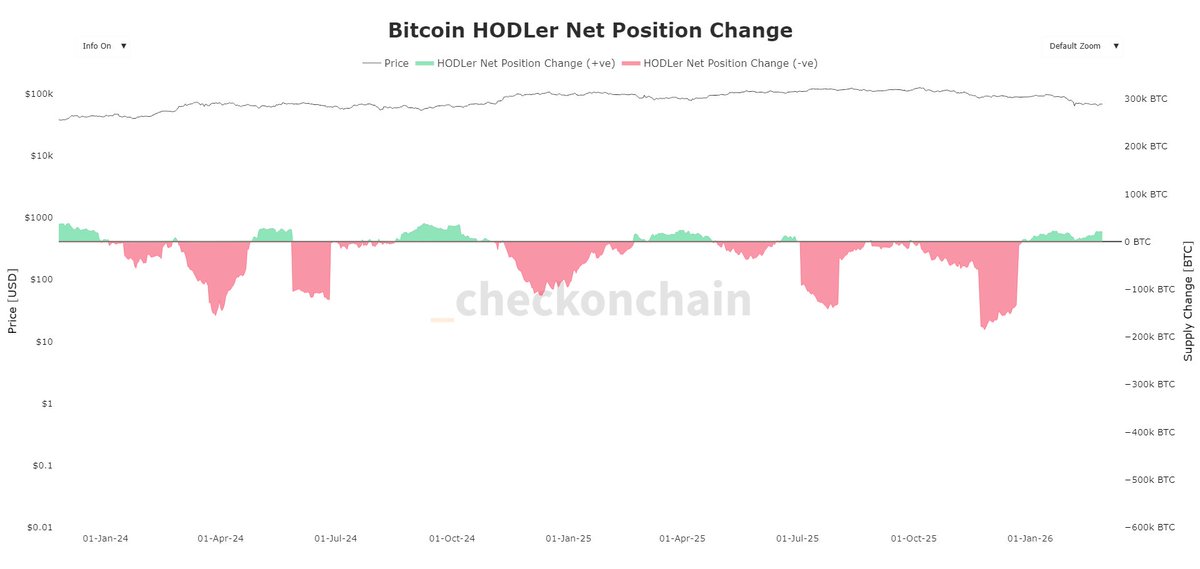
Checking in on the BTC bottom forming from my tweet 10 days ago (Feb 17, 2026). - Long term holder (LTH) supply, basically coins that people have held for over about 5 months without moving, has gone up from 14.442 million BTC to 14.544 million BTC. That means roughly 100,000 more BTC have been added to the long term HODLer stack. Also we have not revisited the high of the "proportion of supply in loss" that we saw on Feb 5. - HODLer Net Position Change, this tracks the 30 day rate of Bitcoin flowing into vaulted supply (true long term HODLers, using Cointime Economics principles), has climbed from +12.76k BTC to +20.65k BTC. It is staying positive since December 2025 and picking up speed a bit. - Aggregate stablecoin supply, the total amount of USD pegged stablecoins out there (like USDT, USDC, etc.), is not shrinking anymore. It has stabilized and actually added roughly 1.67 billion dollars, going from 254.56 billion to 256.23 billion. This suggests some marginal liquidity support is creeping back in. The process of bottoming formation continues. Patience! Sourced from: charts.checkonchain.com
PhilippWeiling tweet mediaPhilippWeiling tweet mediaPhilippWeiling tweet media
PhilippWeiling@PhilippWeiling

Revisiting some positive on-chain indicators suggesting we’re in a BTC bottoming phase. The focus here is Supply in Loss (STH + LTH). On the Feb 5th liquidation cascade, we saw a spike to ~50% of all supply in loss. If you believe in diminishing returns, the consequence might also be "softer" cycle drawdowns. The data shows a clear trend in cycle-low supply underwater at peaks: 2015 peak: ~65% supply in loss 2019 peak: ~60% supply in loss 2022 peak: ~55% supply in loss Feb 2026: ~50% (Cycle High so far) It’s not "math," but might be a trend Other tailwinds: 1) LTH supply is slowly ticking back up. 2) HODLer Net Position Change has remained positive since Dec 26th. Watching for Stablecoin supply to resume its uptrend to provide liquidity for support. Charts via the @checkonchain Any thoughts on this trend, @Checkmatey?

English
0
0
1
71
PhilippWeiling retweetledi
Messari
Messari@MessariCrypto·
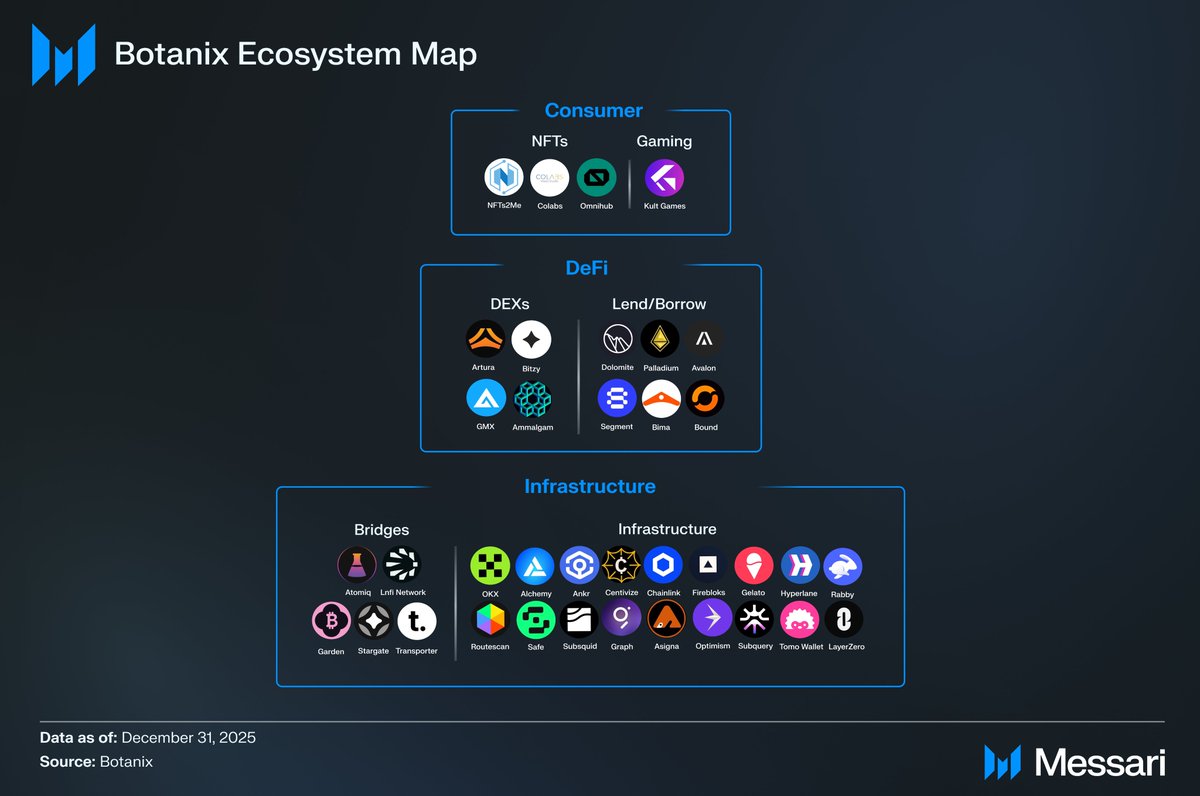
Bitcoin has a $1.8T market cap, ~0.4% is in DeFi. Botanix launched with a 16-validator federated bridge and BTC-denominated yield, and plans to transition to a randomized, stake-based Spiderchain model by 2027. Here’s a breakdown of the architecture, cryptography, and roadmap.
Messari tweet media
English
16
17
66
5.8K