Philip Armstrong
4.2K posts

Philip Armstrong
@PipArmstrong
Writer, actor, tea-drinker, dog-lover, author of ‘Scions of the Gods’ novels. Passionate Europhile #Rejoin #FBPE appalled by our venal, shambolic government.
Washington Katılım Nisan 2009
3.1K Takip Edilen2.3K Takipçiler
Philip Armstrong retweetledi

@docrussjackson This is so egregious that there aught to be some grounds for criminal prosecution. It’s shit like this that is seriously undermining our democracy.
English

On 22 July, Robert Jenrick posted a short audio clip of Jo White, the new Immigration Minister, captioned as her saying: "I don't care if we stop the boats." The clip was picked up and amplified by Reform UK's official account, which framed it as evidence that Andy Burnham's government "doesn't give a stuff about stopping the boats" and called for a general election.
White responded directly, posting the fuller recording the clip had been taken from. In it, she can be heard saying: "I don't care who will stop the boats, but my priority... my focus is to make sure that we stop those boats." The background audio in her version matches the clip Jenrick posted, indicating both are drawn from the same underlying recording. What differs is the editing and the caption: "who will stop" became "if we stop," and the second half of the sentence, where she affirms stopping the boats as her priority, was cut.
The audio recording was posted by notorious right-wing purveyors of misinformation and disinformation, Guido Fawkes and Basil The Great, on 11th July 2025.
Both Jenrick and Reform UK subsequently deleted their posts. Neither issued a correction or apology.
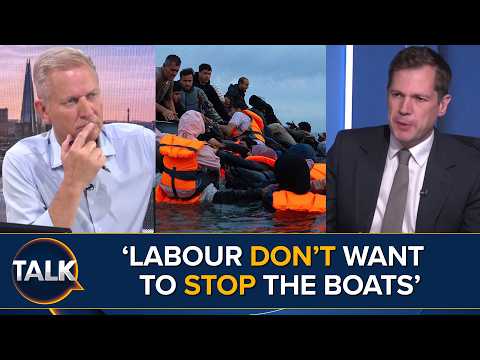
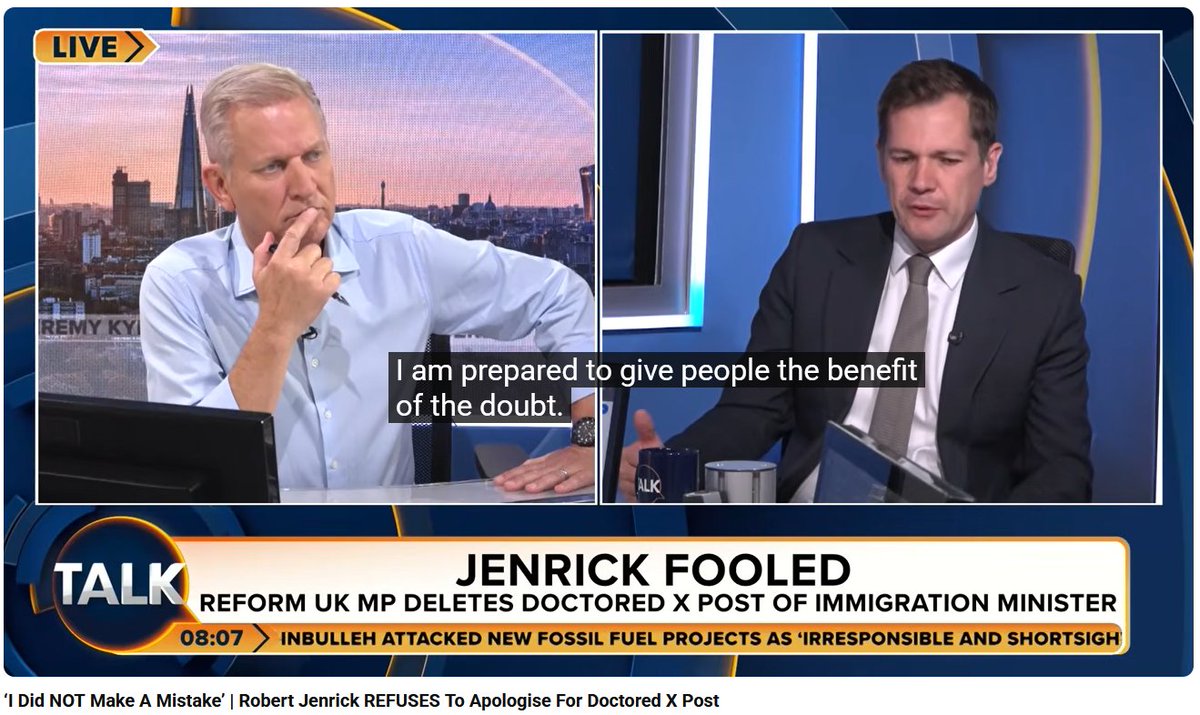
Jenrick was then asked about the episode on TalkTV, in an interview with Jeremy Kyle. That exchange is worth examining closely, because the way he characterised the dispute does more to obscure what happened than to explain it (the transcript is from the interview).
To date, Jenrick and Reform UK have not issued an apology.
Kyle put the accusation to him plainly: that Jenrick had "doctored" the clip so that White appeared to say the opposite of what she meant. Jenrick's response ran through several distinct moves, each doing different rhetorical work.
1. "It's very confused" — manufacturing ambiguity where none exists.
This phrase is the anchor of his entire defence. It does a lot of work precisely because it's vague: it invites the listener to assume there's a genuine, unresolved factual dispute, perhaps a poor recording, or an ambiguous turn of phrase.
But "confused" is not an accurate description of a situation where specific words have been swapped for others ("who will" for "if we") and a clarifying second clause has been removed. That isn't ambiguity; it's a checkable, binary fact about what is or isn't on the recording. Framing it as "confused" moves the dispute from the realm of the verifiable into the realm of the unresolvable, which is precisely where a fair-minded-sounding non-denial wants to sit.
2. Recasting the original quote as self-contradictory.
Jenrick describes White as appearing to say "with one breath" that she wants to stop the boats, then "with the next breath" that she doesn't care. This is a subtle but important move: he is not describing the edited clip as misleading (which would concede the point), nor defending the edited clip as accurate (which the evidence doesn't support), he is instead relocating the supposed contradiction into White's original, unedited remarks.
But the sentence he's characterising ("I don't care who stops them, my priority is that they're stopped") is not contradictory at all. It is a single, coherent statement about not caring which party or government gets credit. The only version in which a contradiction exists is the one Jenrick shared, which removed the words that resolved it.
3. "A perfectly reasonable point... asking her to explain."
This reframes an assertion as a question. But the graphic captioned White's words as a direct, declarative quote, presented as fact, not put to her as a query. You cannot retroactively convert a false statement of fact into an open question by describing it that way after the fact.
4. "She says the recording isn't quite right."
This line minimises what White actually did. She didn't raise a vague objection about audio quality; she released a recording with matching ambient markers that demonstrates the specific substitution. Describing this as her merely saying the clip "isn't quite right" downgrades a documented discrepancy to the level of a subjective complaint, which then sets up his next move.
5. "Recollections vary... like the royal family".
Imho, this is the most consequential sentence in the interview. By invoking Prince Harry's line about the Queen and Meghan Markle, Jenrick reframes what is, in principle, a resolvable factual question (what is on the tape?) as a matter of subjective memory (what do different people recall from a meeting?), which by definition cannot be adjudicated.
This is a category substitution: a dispute about the content of a recording (which either does or does not contain certain words) is recast as a dispute about human recollection, which can never be fully settled. It is a rhetorically effective move precisely because "recollections vary" sounds reasonable and humble, while quietly removing the question from the domain where it could actually be checked.
6. Non-response to the fuller quote.
When Kyle read White's fuller statement back to him on air ("I don't care who will stop the boats, but my number one priority is to stop those boats") Jenrick did not engage with its content. His reply, "Well, let's see, let's see," treats a piece of evidence directly bearing on the question as if it were still an open, future-tense matter, rather than something to be assessed on the spot. This is a stalling move: it lets him avoid either conceding the point or contesting it with a counter-argument.
7. The core denial.
Asked directly whether he'd made a mistake, Jenrick said: "No, I don't think so." Everything else in the interview functions to make that denial sound reasonable, without addressing the specific, checkable claim against him, namely that the clip he posted altered her words in a way that inverted their meaning.
Jenrick's manipulative framing lets him appear conciliatory without ever conceding that the original post was inaccurate or that posting it was a misjudgement.
Since Ann Widdecombe's murder (described by police as a targeted attack, and now the subject of a counter-terrorism investigation) Jenrick has spoken repeatedly and forcefully about the dangers of political rhetoric, the need for civility in public debate, and the responsibility owed to people in public life who face threats and abuse for their views. He has argued that politicians holding views "outside the mainstream" face heightened risk, and has criticised the government for what he characterises as complacency about the safety of his colleagues.
That case is not unreasonable in the abstract. But it sits uneasily next to a documented episode in which he circulated, and Reform UK's official account amplified, a doctored quote attributed to a sitting MP, on one of the most inflammatory issues in British politics, and then, when confronted with clear evidence of the misrepresentation responded not by acknowledging the error but by reframing a checkable fact as an unresolvable dispute about memory.
Deleting the post without any correction or apology is not accountability; it is the quiet withdrawal of a claim without ever admitting the claim was false.
If dangerous rhetoric on immigration is a genuine concern, and the argument that heated, dehumanising language on this subject has consequences is one Jenrick himself has made in other contexts, then amplifying a false quote from a fellow MP on precisely that subject, and then defending it through rhetorical sleight of hand rather than correction, is difficult to square with that concern.
The inconsistency is not that Jenrick worries about MPs' safety; it's that concern for the tone of political debate applies asymmetrically: vocally invoked when the threat is to his own side, and set aside when the tactic in question is his own.
Imho, the @HoCStandards should launch a formal investigation.
Interview clip:
youtube.com/watch?v=0wRTX5…

YouTube

GET A GRIP@docrussjackson
It wasn't just Robert Jenrick who posted then deleted this dangerously irresponsible disinformation. Reform UK are desperate. This follows their irresponsible claims and speculation about political rhetoric and Ann Widdecombe's death. @HoCStandards need an urgent investigation.
English

@MsPocketRocket And so few people realise Wendy was a Geordie!
English

@Socket1Sophie They can’t hear that insincerity in his laugh at the end as he turns away.
Don’t know which is more nauseating, them or him.
English

@KissofSofiah Each character’s face changes more frequently than Doctor Who’s.
English
Philip Armstrong retweetledi

@WillHayCardiff I don’t have a single friend who was a smoker, who moaned about the smoking ban when it came in, who didn’t decide it was a good thing, a year later. Almost all of them are now ex-smokers.
English
Philip Armstrong retweetledi

BREAKING: Trump's $10 billion BBC lawsuit is BACKFIRING BIGLY and may force Special Prosecutor Jack Smith's January 6 evidence back into the courtroom
After making $16 million from Paramount/CBS to settle one of his frivolous lawsuits, Donald Trump figured he could keep suing media companies and rake in the dough from corporate CEOs who would rather give in than face a protracted and expensive legal fight.
But Trump got greedy and wanted a $10 billion payday from his next target, Britain’s venerable public broadcaster, the BBC.
What he's getting instead is a legal nightmare of his own making.
Trump sued the BBC last December, claiming a documentary on their news program Panorama, "put words in his mouth" by editing together portions of his January 6th speech delivered nearly 50 minutes apart.
He even bizarrely claimed the network used AI to fabricate his words — it didn't. The BBC did splice the footage, which sparked an internal investigation, the firing of some senior officials at the broadcaster, and the issuing of a written apology.
An apology simply wasn't enough for Trump, however. He still wanted that $10 billion.
Now his lawsuit against the British broadcaster is unraveling spectacularly.
A federal judge ruled this week that Trump must hand over detailed financial records from more than 400 companies tied to his family trust — because HIS OWN lawsuit claims the BBC's editing damaged his businesses.
You can't claim massive financial injury and then refuse to show your books. Judge Enjoliqué Lett wasn't buying the attempted dodge: "All of President Trump's brand, properties and businesses are impugned... Reputational, economic damages, all of that is now at issue in this case."
It gets worse. The same judge greenlit subpoenas targeting Trump's inner circle — Donald Trump Jr., Steve Bannon, and Stephen Miller — to determine what Trump actually intended on January 6th.
And now, in a third gut-punch within 24 hours, the BBC is demanding records showing exactly how Trump LOST his executive privilege claims during Special Prosecutor Jack Smith's January 6th investigation.
Smith's team had already gathered evidence establishing that the Capitol violence was "foreseeable" to Trump, that he "caused it," and that he made "a conscious choice not to stop it" once it began. If the BBC gets that evidence, Trump's entire defamation case collapses.
Trump built a career suing media outlets into silence. This time, he sued an organization willing to actually fight — and in doing so, handed prosecutors a roadmap straight into his finances, his inner circle, and his own conduct on January 6th.
Plus, the public may get another chance to review the evidence that Jack Smith amassed against Trump, evidence that judges appointed by the litigious president have made sure that he’ll never be held accountable for.
Sometimes a lawsuit is simply a trap you built for yourself.
Please like and share to spread the news!

English
Philip Armstrong retweetledi

I make no secret of the fact that I found Anne Widdecombe’s views abhorrent, nor will I deny that I believe Reform UK incites division and hostility. But did she deserve to have every woman’s worst nightmare happen to her? No. She did not.
The key takeaway is this: you don’t stop male violence by encouraging more hatred and division. Once you normalise that, society itself begins to unravel. There was already an epidemic of male violence long before politicians started fanning the flames for political gain.
The leaders of Reform and Restore create unease and unrest because they profit from it. They point fingers. They deflect. They exploit despair and anger. Time and again, they have manipulated some of the poorest and most disadvantaged people in Britain. In doing so, they have contributed to an environment in which women, gay people, trans people and people of colour face greater hostility and, potentially, greater risk of violence.
Does that mean I think Anne Widdecombe was to blame for what happened to her? Again, no. No woman deserves to be brutally murdered by a man. It is one of the oldest, deepest fears carried by women, and tragically, it is not an irrational one.
I’ve received unspeakable threats despite not being a politician, simply for talking about politics. The police do nothing. The police are yet another institution women are forced to fear. Women are not safe anywhere, not even in our own home. I’ve lived alone. I know how vulnerable you can feel, simply because you’ve dared to have a voice as a woman. I’ve lain awake in bed wondering whether the noise downstairs was a man, radicalised by social media, fuelled by misogyny, entitlement and rage, finally acting on one of those threats. Anne would have likely done that countless times.
The price women pay simply for existing is fear, the price they pay for having a voice or agency is even higher.
While I found many of Anne’s views, particularly those regarding other women, abhorrent, that does not mean she asked for this. Men who inflict horrific violence on women rarely need an excuse. The fact that they can is often reason enough. Male violence is not limited to one culture, a political viewpoint, a particular religion or one race. It is endemic. No woman should have to die to prove this point but many more will unless action is taken.
Do I think Reform and Restore should be defenestrated? Absolutely. But at the ballot box. Because we’re not fucking animals. And because the working class should have more respect for itself than to let a handful of old Etonian pricks decide who we are.
The best revenge is to recognise who your real enemies are, then quietly leave them to their riches, their private jets and their mansions. The more irrelevant they become and the less divided we are, the less power they hold and the less money they make.
Two things are true:
No woman deserves what Anne Widdecombe endured.
The likelihood of women enduring male violence has markedly increased because of the hateful, violent and divisive rhetoric of figures like Farage or Lowe.
Reject them. They’re not on your side.
English

@sarrah_bellus Most of the world, but that’s the problem with US Republicans - they forget we exist.
English

@MsPocketRocket @CBrollies Though her cousin Alexis always addressed her as Sibyl, suggesting she’s tweaked her birth name to the more swanky sounding ‘Sable’.
English

@jakkristy4 @MsPocketRocket Alexis’ cousin. Her sister was played by Kate O’Mara.
English

@MsPocketRocket Stephanie beachum ( not sure of spelling of her surname )….sister if Alexis … dynasty ?
English


Wonderful 94 year-old voter wipes the floor with a Reform councillor who tries to feed him blatant lies. Shows you the shocking calibre of Reform councillors - the guy is floundering in the face of informed facts.
Miss Chief 🤨@Midge1415
Knocking on people’s doors and trying to feed them shit. This chap wasn’t having it 😂🤣👏🏽👏🏽 Soon as they’re scrutinised they fall apart 🙄
English

@Midge1415 Absolutely GLORIOUS! What a wonderful man. If all voters were this well-informed, our democracy wouldn’t be under threat.
The ‘councillor’ tells him at least 2 blatant lies - that Labour controls the Standards Committee and that Farage is paying for the by-election. Dishonest!
English


@UpTheWorkers @TheRealJamieKay At least in Britain they don’t add the nauseating ‘and prayers’ as they do in America.
English

@TheRealJamieKay My thoughts are with...
Pentewan, England 🇬🇧 English