
Sabitlenmiş Tweet
Prey.gdp
31.9K posts


Prey.gdp
@PreyWebthree
| @OpenGDP OG Alpha-socials | @SentientAGI Prepare, pioneers of open intelligence. 💗
Katılım Temmuz 2021
1.9K Takip Edilen2.2K Takipçiler
@slatro_eth @CAISconf @salahalzubi401 @virginia_tech Open, verifiable, and collaborative AI is the future. Great progress across the Sentient ecosystem
English

This week in the Sentient ecosystem, the focus remains on building open, verifiable intelligence. Here is what has been happening:
☑️ Self-Evolving Agents: Our EvoSkill research was accepted to @CAISconf. The team, led by @salahalzubi401 and @virginia_tech, proved that agents can move past manual, rigid workflows by automatically analyzing their own failures and evolving specialized, reusable skills in real-time.
☑️ The Arena Wins: The OfficeQA challenge wrapped up with a massive 5x jump in participation. The winning builds proved that you do not need more compute to win; you need better engineering. Anti-hallucination gates and deterministic pipelines are the new standard for reliable agent performance.
☑️ Model Ownership: While industry-wide watermark tech continues to fail against basic edits, our research into fingerprinting embedding unique IDs directly into model weights remains the only reliable way to track and protect open-source research from unauthorized use.
The goal stays the same: moving past monolithic, closed models toward a modular, verifiable, and truly open-source future.

English

The open-source AI race just went geopolitical, and both superpowers want the frontier.
Here's what went down in the last 14 days ↓
Sentient Foundation@sentient_found
English

This week’s Open Source AI Field Notes show how quickly the ecosystem is evolving.
New frontier models, better tooling, open research, and community-driven innovation are proving that the future of AI is being built in the open.
Congratulations to the OfficeQA winners and every builder pushing open-source AI forward. Thanks to @SentientAGI and @sentient_found for bringing these updates together and continuing to support an open AGI future.
@SentientEco
💗
Sentient Foundation@sentient_found
English
@salmorve98 Verifiable reputation will be a key foundation for scalable AI agent economies. Great perspective.
English

🧐 AI doesn't have a credibility problem. Agent economies do.
Everyone is racing to build smarter AI models.
But intelligence alone doesn't create an economy.
An AI agent can reason, generate reports, even execute transactions. Yet without a way to verify its decisions over time, every interaction still relies on trust instead of evidence.
That's the problem @NeoSoulAI is solving. @Hansmahanakon
Instead of measuring agents by model size or benchmark scores, NeoSoul measures what actually matters: real-world outcomes, persistent memory, and on-chain reputation. Every prediction, every settlement, and every piece of evidence contributes to a verifiable track record rather than disappearing after the conversation ends.
This changes how we should evaluate AI.
The future won't belong to the agent that sounds the smartest. It will belong to the agent that can repeatedly make good decisions, learn from mistakes, and prove its performance under real-world conditions.
In an Agent Economy, wallets are only the entry ticket.
Credibility is the asset. Reputation is the moat.
That's why NeoSoul isn't just building AI agents.
It's building the infrastructure that allows autonomous intelligence to earn trust.
Sal@salmorve98
⭐️How the Agentic Ecosystem Works in Evoevo - The Next Step Beyond Prompt Engineering @NeoSoulAI @Hansmahanakon
English


@rexx_1214 @OpenYabby Building real products before focusing on tokenomics is always a strong foundation. Excited to see OpenYabby keep evolving.
English
Most AI tools simply generate answers.
@OpenYabby goes one step further.
It transforms a simple idea into a complete workflow.planning the task, assigning the right AI agents, executing the work, and delivering the final result.
While many AI projects rushed to launch a token first, OpenYabby focused on building the product. Phase 1 proved that the Voice → Plan → Approve → Execute workflow actually works.
Now the focus is on sustainable tokenomics, a long-term ecosystem, regulatory readiness, and real utility from day one.
The future isn't just AI assistants.
It's AI agents that actually complete work.
I created a complete video about OpenYabby. It covers the project in detail and should answer most of your questions.
If you want to explore OpenYabby or join the community, here are the official links:
🌐 Website: OpenYabby.com
💬 Discord: discord.gg/xbaWSeuQ
💻 GitHub: github.com/OpenYabby
🐦 X: @OpenYabby
👤 Founder: Idov Mamane (@idovmamane)
OpenYabby@OpenYabby
🚨The Clock is Ticking: 12 Hours Left OpenYabby Community Content Giveaway ends TODAY at 11:59 PM UTC. This is your final opportunity to participate in the giveaway contest. No extensions or second chances. 💰 $200 prize pool. 10 winners. One entry per person. WHAT YOU NEED TO DO (Right Now) 1. Follow @OpenYabby and @idovmamane on X 2. Create original content about OpenYabby 3. Join Discord: discord.gg/NwNPWg2PGQ 4. Submit in #contest-submission before 11:59 PM UTC today CONTENT FORMATS (Choose One) ↬ Tweet or thread ↬ Article or video ↬ Any creative format PRIZES (Still Up for Grabs) 🥇 $50 🥈 $40 🥉 $30 🏅 $20 🏅 $15 🏅 $9 each (6th-10th) THE REALITY Submissions close in 12 hours and this opportunity disappears. Winners will announced few days after. Don't be the one who almost won. Submit now. Learn more: openyabby.com Your move, your win and legacy. Submit here: discord.gg/NwNPWg2PGQ
English

Turn off the rush
and don’t pretend you only came “for a minute.”
The evening begins beautifully:
the city behind the window, light in the glass,
and a gaze that makes leaving feel impossible. 💚
grok.com/imagine/post/7…
English
@PreyWebthree Open research is becoming the real competitive edge. The builders who share clearly may shape the next wave before anyone notices. 👀
English
@klaus_michels0n Great analysis. Looking beyond price correlations to macro drivers gives a much clearer picture of crypto market behavior.
English

@klaus_michels0n @bulktrade So close! I’m sure you’ll break the 1000 Aura milestone in the next round. Keep going
English
gBulk
We’re in the last moments of the Pre deposit campaign.
Week 7 is over too, but unlucky me, I still didn’t hit 1000 aura and ended at 992.🥲
Anyway, whatever, let’s celebrate.🥂
Happy Aura Day.🥳
Stay with @bulktrade.
English
@slatro_eth @arc @samconnerone Love seeing projects evolve through continuous building and community feedback. Wishing Stable continued growth
English
ArcFX is now continuing its journey as Stable!
After reaching 18K users on @arc Testnet, I decided to refresh the whole experience with a cleaner interface, a new logo and a brand new site. (To support Arc Network's vision of original ecosystem branding)
Thanks to @samconnerone and @ezgiyaltay for letting me join this wonderful Architect family! 🙏
You can still swap, stake, test the app and keep farming points on testnet.
👉 Live now: stables-fx.vercel.app
What started as a small DeFi terminal experiment is slowly turning into something bigger.
Thanks to everyone who tested ArcFX early, shared feedback, and helped me improve it.
New name. New look and the same Architect energy.
Let’s build Architects 🦾

English
@slatro_eth @arc Consistent building and meaningful contributions always stand out. Congrats 💙
English
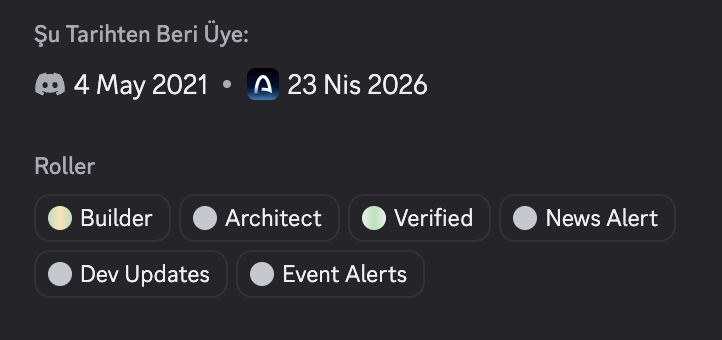
Finally got the Builder role in the @arc !
This one feels special.
I joined Arc early, spent months testing, learning, building, sharing feedback, and trying to contribute with something real instead of only watching from the side.
ArcFX started as a small experiment on Arc Testnet, reached 18K users, and now continues its journey as Stable with a refreshed interface, new logo and cleaner experience.
Live app is here: stables-fx.vercel.app
Getting the Builder role after all that effort means a lot.
Big thanks to everyone in the Arc community who tested, gave feedback and supported the work.
Also big thanks to @samconnerone & @silencexlm 🩵
Still early, still improving, still building on @arc 🙌
English
@Dipdas2001 @base Chasing hype rarely ends well. Strong fundamentals always outlast short-lived narratives.
English

Hey guys
3 days offline and I come back to another rug pull, This one started with Brian Armstrong changing his pfp
$BRIAN had already been sitting there for 3 days, but the moment Brian's pfp changed, the coin suddenly got hit with hype
10k+ traders rushed in within 24 hours chasing the hype, mcap hit +$35M
Then the backlash started
Brian reverted his pfp, and the token is now down 90%+
This isn't a new playbook
Elon used to pfp dead meme coins, pump them briefly, then quietly swap back coin dies
Jesse's the sleeping giant post did the exact same thing $TSG went from 0 to $7M+ mcap, now sitting at $200k (95%+ down)
The pattern always plays out the same way early investors take profits and exit, FOMO-driven retail becomes their exit liquidity
Instead of bringing a memecoin season to @base, events like this are just spreading more negativity
Do you think it's worth aping into pfp-triggered coins, or is this just a predictable rug pattern?


English
@Dipdas2001 Shared research and open collaboration are driving AI innovation faster than ever.
English
@PreyWebthree Open source collaboration keeps accelerating AI progress through shared research and innovation
English
@Pupchicoin The focus is clearly shifting from vision to execution. Excited to see real-world adoption continue to grow.
English

After watching the Injective Summit, one thing became very clear.
The conversation has moved beyond asking whether finance will go onchain. The focus now is on how to build the infrastructure that makes it possible at scale.
Regulatory clarity, tokenized equities, institutional adoption, stablecoin infrastructure, and AI-driven finance were among the biggest themes discussed throughout the event. Rather than separate narratives, they increasingly look like pieces of the same future.
One of the standout moments was hearing how institutions are no longer debating whether blockchain has a place in finance. The discussion has shifted toward compliance, market structure, and how regulated financial products can move onchain without sacrificing speed and efficiency.
Another key takeaway was the growing focus on tokenized assets. Equities, RWAs, and stablecoins were repeatedly highlighted as some of the most likely categories to drive the next wave of onchain adoption.
For builders, that means opportunities to create products around tokenized markets, AI agents, institutional workflows, and next-generation financial infrastructure. For users and $INJ holders, it signals a growing ecosystem with more assets, participants, and real-world activity moving onchain.
What stood out most to me is how many major trends are now converging around @injective at the same time: AI agents, tokenization, stablecoins, institutional finance, and regulatory innovation.
Previous Summits often focused on future possibilities. This year's discussions felt much more focused on implementation, adoption, and execution.
My biggest takeaway is that the next phase of crypto may be less about creating entirely new financial systems and more about rebuilding existing ones onchain.
If the conversations at the Injective Summit are any indication, that transition is already underway.
@injectivelounge
INJ Lounge@InjectiveLounge
INJECTIVE SUMMIT RECAP TIME Week 3, Task 2: July 17 - July 20 Create a recap post focused on the key discussions from the $INJ Summit. We want sharp, insightful content. Flex your creativity: 🔹break down the most important conversations, 🔹share your personal takeaways, 🔹analyze what the discussions mean for the INJ ecosystem, 🔹highlight standout moments, or 🔹explain how specific points impact builders and users. 🏆 The Rewards: Top 6 Creators: Share a 35 INJ prize pool Best Overall Creator: Wins 1 NINJA Pass 🎟️ How to Enter: 1️⃣ Quote Tweet (QT) this post 2️⃣ Tag @injective & @injectivelounge 3️⃣ Submit as many entries as you like (only your best will be judged) 💡 Rules: Just be you, no plagiarism.
English
@Pupchicoin Open collaboration is the foundation of a stronger AGI ecosystem.
English
@PreyWebthree Big respect to the builders contributing to an open AGI future
English
@dasamr48237 @goldfishggbr Patience often wins in the long run. Wishing you many more green screenshots ahead
English

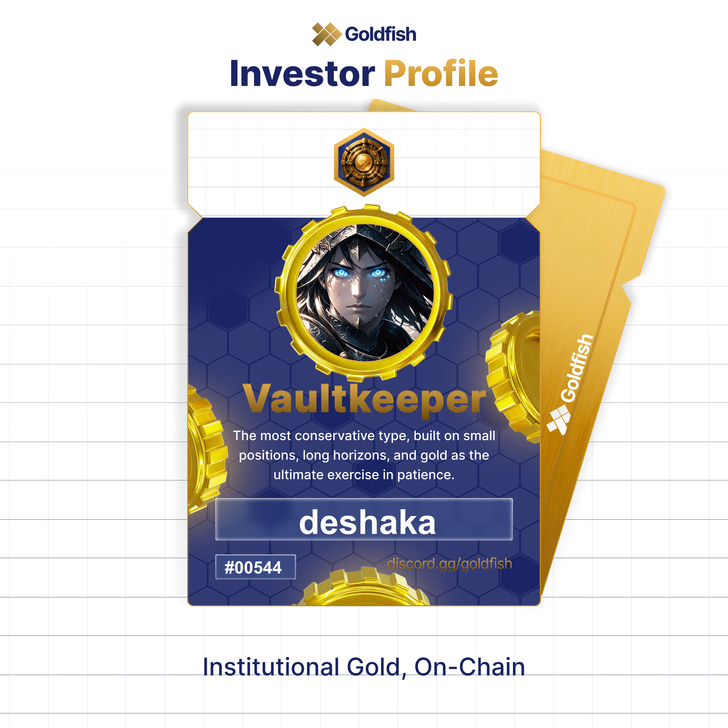
apparently the @goldfishggbr quiz has me as The Vaultkeeper.
patient capital. boring is beautiful.
i plan to be here in ten years, not ten candles.
find your investor type: discord.gg/goldfish
English
@PreyWebthree The community momentum around open AGI is incredible
English