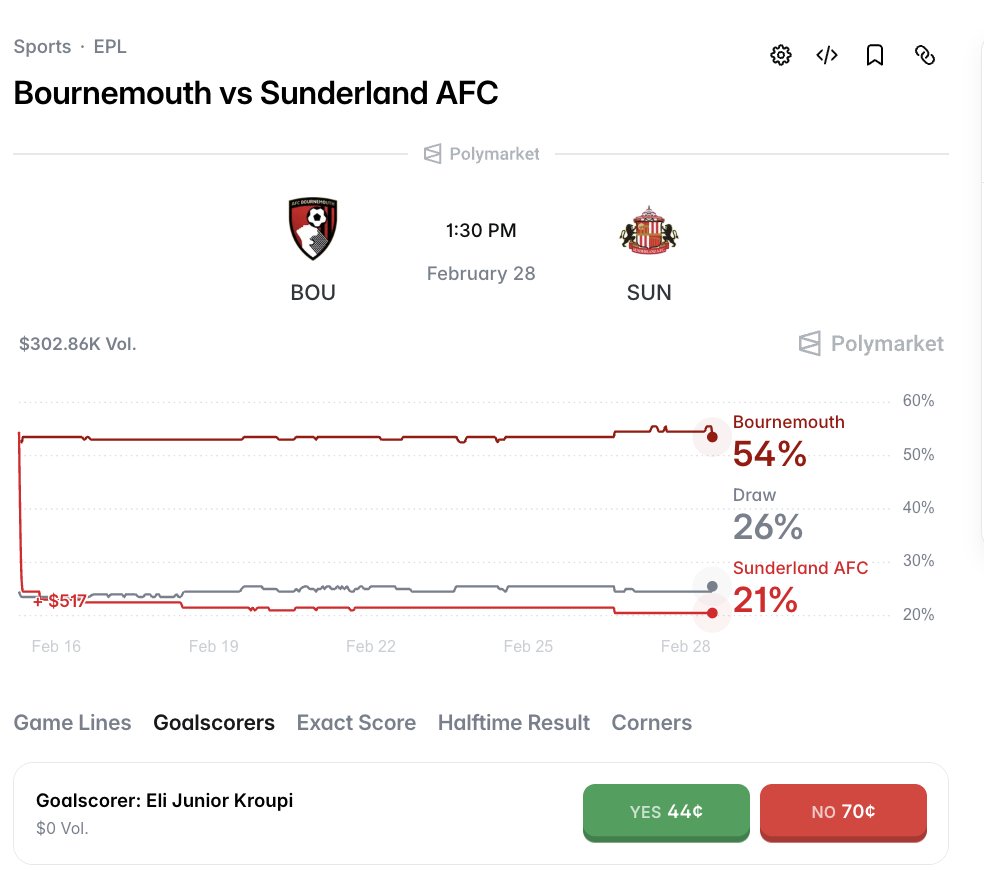
@polyfactual The average volume of the match odds markets will be greater than all non-match side market volumes combined.
English
Pure
2.2K posts

@Pure_lmao
Identifying statistical arbitrage opportunities in sports using internal quantitative analysis tools (I gamble on sport). 🛠️ @Purebet_io / @SplashMarkets


NEW: Crypto and mention markets will reportedly have the highest fees


LAWMAKERS TO INTRODUCE BIPARTISAN BILL BANNING SPORTS BETS ON PREDICTION MARKETS SUCH AS POLYMARKET AND KALSHI: WSJ

LAWMAKERS TO INTRODUCE BIPARTISAN BILL BANNING SPORTS BETS ON PREDICTION MARKETS SUCH AS POLYMARKET AND KALSHI: WSJ

The Arizona Attorney General today filed criminal charges against one of our registered exchanges related to prediction markets. This is a jurisdictional dispute and entirely inappropriate as a criminal prosecution. The @CFTC is watching this closely and evaluating its options.

Polymarket is enlisting firms including Palantir to help police its sports contracts, according to people familiar with the matter, a move that comes as prediction markets face intense scrutiny over insider trading bloomberg.com/news/articles/…
At some point you realize the best growth strategy is a product people can’t shut up about
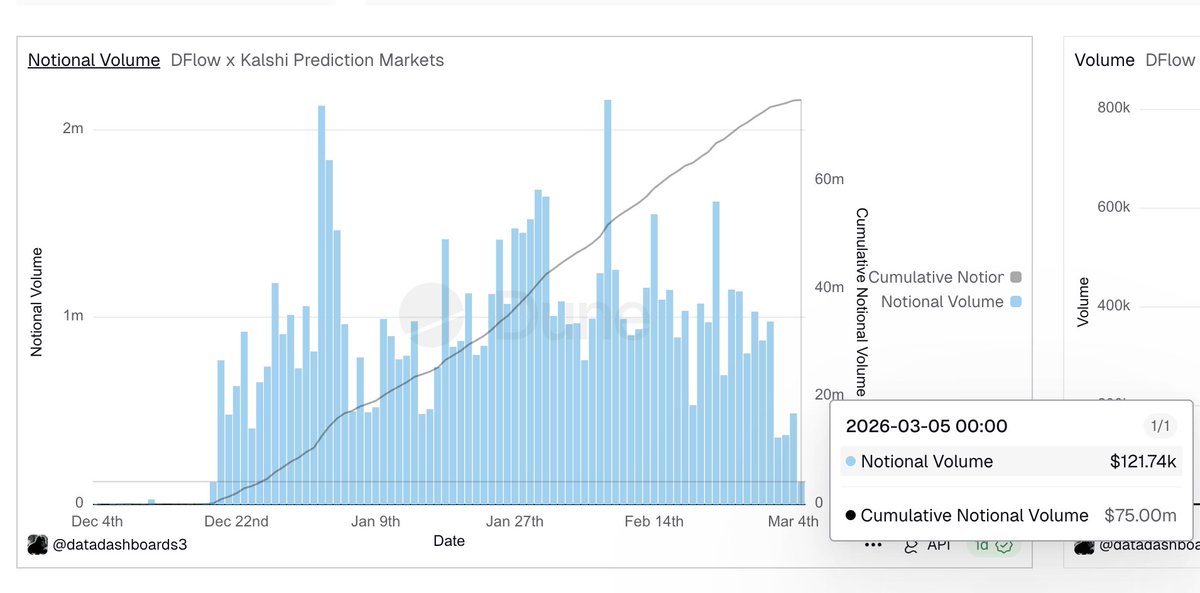
fun things I’d build with the @dflow prediction markets api this weekend if I wasn’t already building with dflow: • a hyper-focused market UI around one upcoming event pick something like an earnings call: recent news, relevant X posts, past earnings, analyst expectations, etc. could also work well for culture, climate, or economics events. • a heavily gamified prediction markets terminal most trading UIs are super serious. adding winning streaks and fun visuals could be a welcomed differentiator. • a 15m crypto events analytics interface everyone loves these markets. let users toggle between different probability models and see the delta between the market-implied probability and each model’s probability. bonus if it’s visualized with time-series data.
Sportsbooks are house machines designed to max extract. Prediction markets are neutral infrastructure that actually protects the consumer.
6 months ago, Kalshi did $800m monthly volume across the entire exchange. today, crypto alone is on track for $1.2B monthly — now our second largest category behind sports

prediction market shares are the most underpriced collateral primitive in crypto right now. you buy YES shares on X market at X¢, that capital is locked until resolution. but tokenize that share onchain and suddenly it's composable with all of defi. borrow against it: > a lending protocol values your X¢ YES share at probability-weighted collateral, adjusting in real time as the market moves > use the borrowed stables to take positions in other markets now you're running leveraged conviction across multiple predictions with one capital base. with time decay pricing, a YES share at 70% with 48 hours to resolution is worth more than the same share at 70% with 6 months left the example that makes this click: kalshi is already exploring tokenization on solana with jupiter and DFlow imagine a lending protocol that accepts kalshi shares as collateral: > you buy YES on "us gdp growth above 2% in q2" at 60¢ > post it as collateral > borrow 40¢ on the dollar and use that to buy YES on "fed holds rates in june" at 55¢ > you now have leveraged exposure to a macro thesis across two correlated markets using one capital base prediction markets today are $10b/month in volume sitting in isolated silos and the moment those positions plug into lending, it becomes defi itself. pm shares are the most underpriced collateral primitive in crypto right now. (which is surprising) that's cleaner collateral than half the tokens people are already borrowing against. whoever builds the lending protocol that natively understands probability-weighted collateral captures the entire intersection of prediction markets and defi.

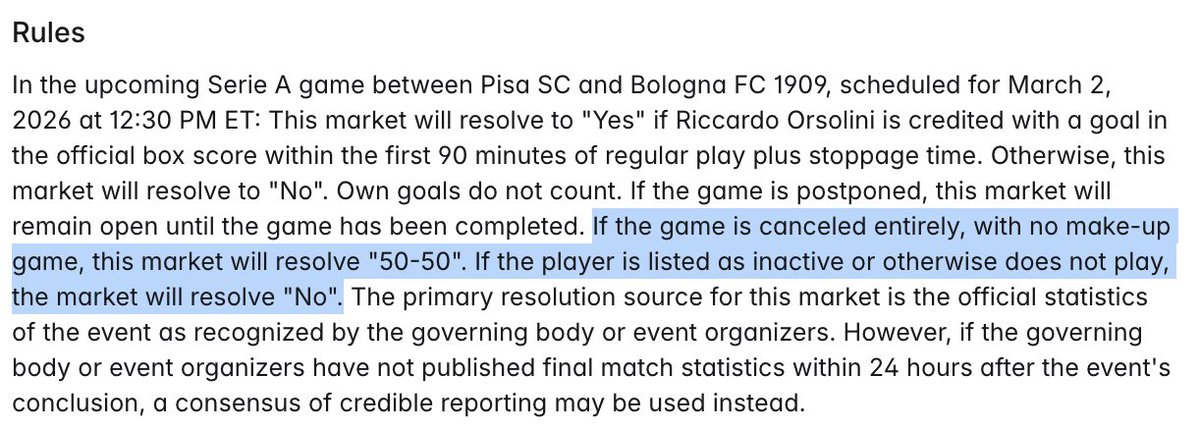
Kalshi’s policy is to always choose poor mechanism design in favor of regulatory virtue signalling. “Last traded price prior to confirmed reporting…” just makes these markets even more ambiguous. How do you define “confirmed reporting” in this context? Also, the last traded price doesn’t equate to the true price at the time, it could have been a panic buyer/seller or a fat finger.