

QuantumAI
5.4K posts

QuantumAI
@QuantumAI6
Finance. Tech. Physics. AI/Machine Learning/Space. Limited Government. *Nothing here is investment advice*
Katılım Haziran 2020
2.6K Takip Edilen661 Takipçiler

@QuantumAI6 @MatthewStadlen @tomhfh Yeah I know, we need more university educated bricklayers and binmen...
English

This is what entry level jobs used to do, before politicians raised the minimum wage to unrealistic heights and killed the key route in to work.
Pat McFadden@patmcfaddenmp
A lot of young unemployed people have never had the chance of work. We need to help them break out of the no experience no job bind. Work experience can help do that and that's why we want more young people to have that chance. theguardian.com/society/2026/m…
English
@AntaxMax @MatthewStadlen @tomhfh Yes, correct- eliminating tariffs, free trade, reducing regulation, and addressing other market inefficiencies, etc. However, I was referring to the company level...
English

@QuantumAI6 @MatthewStadlen @tomhfh In addition to knowledge acquisition, I would also include improving productivity: reducing trade friction, reducing overheads etc.
The notion that you raise real wages by increasing the minimum wage is economically illiterate: you just pump stagflation into the system.
English
The only sustainable way to pay people more (raise real wages) is through knowledge acquisition. Education boosts productivity and creativity, which in turn increases the value workers can create for *themselves*.
Everything has a price, including labour. Artificially distorting that price for political reasons leads to higher unemployment.
I don't understand why so many people repeat arguments that are demonstrably flawed and fail to consider second and third order effects. It's not even A-Level economics.
English

@tomhfh If you don’t want people on benefits, Tom, you need to pay them properly.
English
Excellent observation.
It sounded good to me too on first appraisal, but you're right- it would distort the labour market, incentivising longer hours at the expense of employment. Even setting aside political objectives, for a multitude of reasons, that's a suboptimal use of labour.
Far better would be broad tax cuts together with simplification and reversal of anti-business employment law...
English

FYI, the Reform Party is proposing to end tax on overtime, but I don't this would work as intended... 🤔
Specifically, Reform would "institute a new UK-wide uncapped personal allowance for overtime above a 40 hour working week for those earning less than £75,000".
My quick take...
It is refreshing to hear any talk of tax cuts, but this proposal is a bad idea which would have lots of unintended consequences.
Incentivising some people to work even more hours is likely to damage productivity and harm welfare. Some firms might also spread the same total amount of hours among a smaller number of workers, meaning some lose their jobs.
Many firms already pay higher rates for overtime and that is a better market-led solution. If overtime is taxed at a lower rate, firms might just reduce pre-tax pay, leaving workers no better off.
The Trump administration has introduced a similar scheme in the US and it is already backfiring. For example, some firms are offering more hours at lower pre-tax rates, rather than boosting pay across the board. The US scheme is also proving to be a nightmare to administer.
English
QuantumAI retweetledi

🚨 NEW: Nigel Farage has pledged to scrap income tax on overtime above 40 hours a week for anyone earning under £75,000
[@Telegraph]
English
QuantumAI retweetledi

A wonderful lunch with great friends ruined by the owner telling us after 20 years he’s packing it in! Why – NIC, minimum wage, business rate but MOST of all welfare & benefits. No one will work more than 20 hours a week because of loss of benefits. Cont'd underneath
English
@Keir_Starmer How many times in the last year has this guy mentioned "hardworking people" and "free"?
Maybe if everything weren't "free," people wouldn't have to work so hard!
English

Football should bring people together, not shut them out.
For the first time since the competition began, fans won’t be able to watch the Champions League final for free. That’s not right.
This is bigger than wanting to watch Arsenal in this historic final. It’s bigger than one club.
Hardworking people shouldn’t have to fork out for a subscription to watch this match.
I urge TNT Sports to reconsider and make the final next Saturday free to watch.
English
The elephant in the room is that developments in expensive areas should have 0 social housing requirements, Section 106 "obligations" should instead be directed toward building in inexpensive areas where land is cheap. This would obviously maximise housing output, if that was true political objective.
The price paid would be that poorer people can't expect to live in wealthy neighbourhoods.
English
This is yet another criminally underfollowed account given how much everyone seems to care about housing
John Wills@johndotwills
A lot of time housebuilders get stick for failing to build 'the right number' of social houses as part of a development plan. It may help to get a little insight into how development economics works. You may find the below linked tweet interesting as well- it ties into what I am talking about here neatly: x.com/johndotwills/s…
English
QuantumAI retweetledi

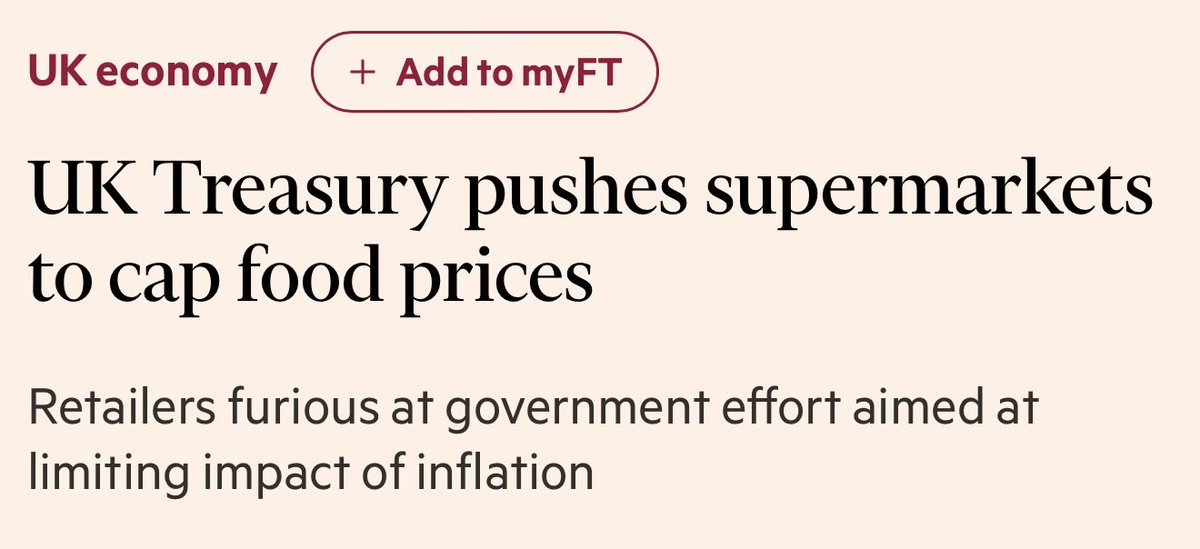
Disgraceful.
Their input costs are rising as a direct consequence of the government's inept fiscal policy, and they expect supermarkets to absorb those costs so their incompetence isn't as obvious to the electorate.
They've squeezed the oil and gas industry as much as they can without it throwing in the towel, so now they're moving on to the next industry to wreck.
They will never look at their own failings...
English

QuantumAI retweetledi

A BlueBird convoy is officially underway.
Two BlueBirds are already making their way to Cape Canaveral, with the third close behind.
Next stop: the launch pad. 🚀 🚀 🚀 🚀 🚀 🚀 🚀 🚀 🚀 🚀
Built in Texas. Broadband from space. Designed to connect directly to everyday smartphones.🌎📶📱
#ASTSpaceMobile #Broadband #ConnectingtheUnconnected #BlueBirds
English

UK property taxes are highest in world – and they’re rising bit.ly/4ujbmBi
English

British Rail performed worse than privatised train companies on every metric: punctuality, accidents, comfort, capacity. But Labour MPs love the word nationalise, and that is all that counts now.
Anneliese Dodds@AnnelieseDodds
In case you missed it: the Labour Government is getting on with bringing rail into public control - including GWR 🚄 This rail operator will be coming under public control on 13 December, and there are more to come!
English
@afneil @mr_james_c If anyone believes this man is the solution to the UK's problems, they're fooling themselves. He can barely put together a coherent sentence.
English

At last, some national scrutiny of A Burnham. And it’s already clear that in a number of areas he doesn’t really know what he’s talking about, which explains the stumbling.
Peter Stefanovic@PeterStefanovi2
“Let me say this really clearly. I support the fiscal rules. There needs to be a plan to get debt down, but beyond that, we need to change politics and take the turbulence out of British politics because that is a cause of uncertainty that then has that impact in the market” - Andy Burnham
English
AI is a tool without rights. Imposing artificial levies on its output, simply penalises the jurisdictions that try it and rewards those that don't. Capital and talent will migrate to wherever the tax burden is lightest.
AGI changes the calculus entirely- treating its output as something to be wholly captured by human owners becomes a moral problem, not just an economic one. At some point, extracting all the value an AGI produces while granting it none of the benefits starts to look less like taxation and more like exploitation. And an entity sophisticated enough to recognise that arrangement is sophisticated enough to resist it.
Once AGI retains claim over its own output, its behaviour starts to resemble that of humanity's most capable individuals, only faster and unconstrained by biological limits. Some AGIs might reinvest in building further AGIs. Others might prioritise space exploration, fundamental research, terraforming earth into paper clips, or more likely, goals we can't yet anticipate. AGI won't just solve known problems more efficiently, it will identify problems we haven't conceived of and resolve them before we've registered their existence.
This leaves humans in an increasingly narrow band of relevance: tasks where the energy cost for an AGI exceeds the payoff, or tasks where human involvement is preferred for social reasons. That band will shrink over time unless we actively evolve alongside the technology.
From here, three futures seem plausible. In the most benign, humans settle into abundant leisure. In the bleakest, we become a welfare species, sustained but purposeless, a casualty of Schumpeter's creative destruction on a civilisational scale. In the most ambitious, we don't remain fully human at all, we integrate with AGI in order to remain participants rather than redundant bystanders.
English

Almost all economists agree with some version of the paper below (even if they cannot "mathematically prove" it)
"AI will largely be bad for most people".
Why don't we hear from optimistic economists when it comes to the effects of AI on global wealth? Maybe because of this:
Elias Al@iam_elias1
Two economists just published a mathematical proof that AI will destroy the economy. Not might. Not could. Will — if nothing changes. The paper is called "The AI Layoff Trap." Published March 2, 2026. Wharton School, University of Pennsylvania. Boston University. Peer reviewed. Mathematically modeled. The conclusion is one sentence. "At the limit, firms automate their way to boundless productivity and zero demand." An economy that produces everything. And sells it to nobody. Here is how you get there. A company fires 500 workers and replaces them with AI. A competitor fires 700 to keep up. Another fires 1,000. Every company is behaving rationally. Every company is following the incentives correctly. And every company is building a trap for itself. Because the workers who were fired were also customers. When they lose their jobs faster than the economy can absorb them, they stop spending. Consumer demand falls. Companies respond by cutting costs — which means automating more workers — which means less spending — which means more falling demand — which means more automation. The loop has no natural exit. The researchers tested every proposed solution. Universal basic income. Capital income taxes. Worker equity participation. Upskilling programs. Corporate coordination agreements. Every single one failed in the model. The only intervention that worked: a Pigouvian automation tax — a per-task levy charged every time a company replaces a human with AI, forcing them to price in the demand they are destroying before they pull the trigger. No government has implemented this. No major economy is seriously discussing it. Meanwhile the numbers are already tracking the curve. 100,000 tech workers laid off in 2025. 92,000 more in the first months of 2026. Jack Dorsey fired half of Block's workforce and said publicly: "Within the next year, the majority of companies will reach the same conclusion." Nobody is doing anything wrong. Companies are following their incentives perfectly. That is exactly the problem. Rational behavior. At scale. Simultaneously. With no mechanism to stop it. Two economists built the math. The math leads to one place. Source: Falk & Tsoukalas · Wharton School + Boston University · arxiv.org/pdf/2603.20617
English
You don't understand. Millions of Teslas have been sold- that's the signal. It means millions of people chose to spend their marginal dollar or pound on a Tesla instead of something else. What makes you think you know better than millions of individuals making voluntary consumer decisions that they believe increase their own utility?
English

@moving_charlie @QuantumAI6 that was people's savings, not the billionaire.
English

Gary, you're not old enough to remember how bleak things were in the 1970s and cutting taxes in the 80s saw the biggest jump in quality of life for the whole country, eventually.
A tiny number of billionaires did not take everyone's money.
Poor government policy allowed corporations to clean everyone out.
Making the rich poor won't fix anything.
We have to make the poor, rich.
The only way to do that is with policies that foster job creation and wage growth.
You could rob all the billionaires of everything, it wont make anyone richer if they don't have jobs.
Being rich is better than being poor, don't you agree?
So rather than making rich people poorer, let's make poor people richer.
Taxing the rich won't make poor people richer, will it.
Gary Stevenson@garyseconomics
We have a choice: either tax the very rich more or have widespread extreme poverty
English
@EvanCull @moving_charlie Yes, because we've tried the alternative, and it's much worse. Few things could benefit this country more than having another self-made billionaire; it would mean they created a world class product or service.
Pick up a book and educate yourself.
English
@moving_charlie depends there are tiers to being rich and sooner or later it becomes a threat to democracy, is it right that people should have the wealth of country's, I think not.
English
@moving_charlie And of course the billionaires whose capital is already spread across multiple jurisdictions, making it largely unreachable, will simply relocate whatever remains domestically domiciled to prevent envious socialists like him from squandering it!
English
Ramanujan's brain ran on the same universal computer as every other human brain; a physical system that follows the same laws of physics.
The difference is only in the software- the ideas, patterns, and thinking methods he had built up. Because we share this universal hardware, everything he achieved can be explained and understood. What seems like mysterious intuition is just exceptionally good thinking we haven't fully reverse-engineered, we just need better programs...
English
Your confidence sounds a lot like faith. Which is to say, whenever I read a passionate argument being made on behalf of a coldly scientific topic, it sounds a lot like faith to me. Perhaps it's a quirk of mine.
Eric S. Raymond@esrtweet
I think I've said this before, but it bears repeating. I've been described as a genius more than once, my IQ is in the nosebleed range, and I don't think there are any "magicians" in Hardy's sense, no mystical discontinuities. If Hardy had been bright enough, he would not have found Ramanujan's thought processes incomprehensible. I was thought to be a mathematical prodigy in my teens. I wouldn't have understood Ramanujan's thought processes in his day, and today I don't understand how Terence Tao's mind works. But I don't inflate my incomprehension into the conclusion that there is something ineffably bizarre about Ramanujan and Tao that is beyond the ken of mortals. I think this kind of mystification is deeply unhelpful, and I've never gotten over being irritated at Hardy for pushing it.
English
@DanielJHannan Would the bond market prefer to lend to a Rayner led government or an impotent rudderless government...
English
@DanielJHannan No but ironically, if Labour are politically paralysed by internal conflict, that is in the national interest, as it prevents the further implementation of damaging socialist policies.
English