Quark201

3.2K posts

Quark201

Quark201

@Quark201

Katılım Mart 2015
335 Takip Edilen209 Takipçiler
Quark201
Quark201@Quark201·
@herbertong @JOBhakdi A: the Chinese, at least for awhile. Incompatible economic systems, us and they are, so trade barriers were erected.
English
0
0
0
92
Herbert Ong
Herbert Ong@herbertong·
🚨 Is Tesla slowly squeezing legacy automakers? 👀 @JOBhakdi says many traditional car companies are dealing with shrinking sales and weaker margins, while Tesla still has room to lower prices using things like leasing and future FSD revenue. He believes companies pulling back from EVs could lose even more market share over time. Big question: if Tesla cuts prices harder, who can actually keep up? $TSLA
English
20
37
395
30.1K
G-PA
G-PA@IndianaGPA·
A traffic stop can look routine, but there's no such thing for the officer walking up to that window. They never truly know who or what they're facing, or how desperate someone might be. That kind of uncertainty takes grit. It's why I back the blue-because they step into harm's way every single day so the rest of us can make it home safe. 👍 I want to thank @crimefix000 for sharing this with me Part 2 in comments ⭐️
English
3.1K
1.2K
50.9K
1.2M
Quark201
Quark201@Quark201·
Happened in Chicago and Illinois long ago—the tacit understanding that if you keep voting for us Democrats, we will keep increasing your pay/benefits. Now the obligations are not bearable, and can only be lowered in the thru changing the state constitution, which takes a supermajority of the vote. So, highly unlikely to happen. Result: disaster.
English
0
0
4
395
Joe Rogan Podcast News
Joe Rogan Podcast News@joeroganhq·
David Sacks: "California collects roughly double per capita what Texas and Florida do… And services got worse, test scores got worse, crime prevention got worse, they let convicts out of jails. Everything's gotten worse."
English
112
1.6K
11K
298.3K
Quark201
Quark201@Quark201·
@tslatalk Still not Full, but otherwise impressive now
English
0
0
0
21
TSLATALK
TSLATALK@tslatalk·
Tesla FSD has reached a surreal level of competency. I've been driving 80-100km daily on V14.3.3 with zero critical interventions. It's smooth, safe, and fully autonomous in daily practice. Yet, looking around on the road, 99.9% of drivers have no idea this is happening. I don't think there's ever been such a massive quality-of-life divide between a tiny percentage of early adopters and the masses. We are being launched into the autonomous era.
English
25
19
313
13.4K
Quark201
Quark201@Quark201·
@mcuban First and easiest action would be to jettison the patients that don’t pay. So, until our society adjusts safety net expectations and everyone becomes productive and saves for a rainy day, which could take decades, a lot of people would not get professional healthcare.
English
0
0
0
20
Mark Cuban
Mark Cuban@mcuban·
Ok. Take government completely out of healthcare. No rules. No laws. No Medicare. No Medicaid. Hospitals, insurance companies, can do anything they want. What do they do ? If you were running any of the biggest insurance companies or hospitals, what would you do differently once gov was completely out of healthcare ?
Matthew Bednarik@BednarikMatt

@mcuban @GovBillLee Or just let the free market compete and get the government out of Healthcare. A free market would inevitably lead to lower costs for consumers.

English
1.7K
69
1.2K
2.1M
Quark201
Quark201@Quark201·
@KobeissiLetter Dig into the Michigan consumer sentiment survey—some exposés out there that show it’s way off now. But, yes, the arms of the K keep diverging.
English
0
0
0
27
The Kobeissi Letter
The Kobeissi Letter@KobeissiLetter·
Absolutely incredible: Over the last 6 years, the S&P 500 has risen +130% while US Consumer Sentiment has collapsed by -55%, to its lowest since data began in 1952. We are witnessing the formation of the biggest wealth divide in modern history.
The Kobeissi Letter@KobeissiLetter

BREAKING: US Consumer Sentiment officially falls to its lowest level on record in data going back to 1952, down another -10% last month. Consumers now see inflation rising to 4.8% over the next 12 months. This puts the Consumer Sentiment index down -21% since February 2026, before the Iran War. Not even the 1980s saw Consumer Sentiment this low.
English
377
965
5.4K
1M
Quark201
Quark201@Quark201·
1) Had ASML been allowed to sell their EUV machines to the Chinese, together with the latter’s chip ambitions, typical MO of drastic overproduction, and exploding electricity generation, we very well could have had that bubble and a Chinese AI win, and 2) Elon’s terafab’s supply will line up with his chip demand, thereby not contributing to a bubble
English
0
0
0
390
Milk Road Macro
Milk Road Macro@MilkRoadMacro·
Gavin Baker is one of the best tech investors alive and he explains why the AI cycle might actually avoid a bubble. Every major technology in history ended in a bubble. Railroads, canals, the internet and even the PC. Every single one. The pattern is always the same: 1. Investors get excited about a genuine breakthrough 2. Diversity of opinion breaks down 3. Everyone converges on the same thesis 4. Valuations disconnect from reality and then it collapses. But Baker thinks AI is different this time and that's because of a physical constraint that no past technology ever had: Watts and wafers. TSMC is run by what he calls "flinty old men and women" who view themselves as the guardians of the most important institution in Taiwan. Jensen Huang flies to Taipei every three months and pushes them to double or triple capacity. They expand about 5%. Here's Baker's math: If TSMC actually gave Jensen what he wanted, Nvidia could probably sell $1.5 to $2 trillion worth of chips next year. He really believes that. The demand is there. But a boom that size would almost certainly end in a bust. And a bust is catastrophic for TSMC. So TSMC's conservatism isn't a bottleneck. It's a release valve. A real-world physical constraint that enforces discipline on the whole cycle and prevents the kind of overbuilding that turned the internet boom into the dot-com crash. Baker believes TSMC is the key reason why we won't have an AI bubble.
English
72
150
1.4K
171.7K
amit
amit@amitisinvesting·
cannot express how much I love $TSLA FSD. just took a 25 min drive in the rain without any worries or fears about knowing how I was going to get to where I was going. legit the best AI product on planet earth. only thing I wish was available is the ability for me to be on my phone but I know that’s eventually coming. we get to live in a time where CARS are driving themselves and making their own decisions in the POURING rain, it is just crazy 😆
English
221
214
3.9K
180.5K
Quark201
Quark201@Quark201·
@gothburz Why were you allowed to continue losing money for so long? That’s the biggest Q for me.
English
0
0
5
153
Peter Girnus 🦅
Peter Girnus 🦅@gothburz·
I am the Senior Vice President of Late Night Strategy at CBS. I am the person who turned a comedian into a priest and charged advertisers to watch the congregation. I want to be precise about what I built. Not a comedy show. A permission structure. For eleven years, six million Americans tuned in every night to find out what they were allowed to believe by morning. We didn't sell jokes. We sold certainty. Certainty costs nothing to produce. People will pay anything for it. We charged $50 million a year and still lost money because it turns out permission is even cheaper than we thought. In 2014, we had a genuinely dangerous comedian. A man who once testified before Congress in character as a fictional conservative pundit and made the entire chamber look like they'd been pantsed on C-SPAN. His fake persona was the most brilliant satire on television. Layered. Ironic. Unpredictable. The character could say anything because nothing was real. The character was the art. The character was the comedian. We killed the character and put the real man on stage. The real man was a lecturer. Earnest. Thoughtful. Correct about everything. Correct is not funny. Correct is not dangerous. Correct is the absence of danger. We promoted the absence of danger and called it growth. His character could make a Senate committee squirm. The real him makes an audience nod. Nodding pays the same as squirming. Nodding is easier to produce. His final words on air were "We love doing this show for you, but what we really, really love is doing this show with you." The audience wept. I wrote that line. Not the words. The architecture that made those words feel true. For eleven years, the audience believed they were participants. They were not participants. They were the product. "With you" is what you say to a congregation. A comedian says "at you." We hadn't said "at you" since 2015. Our internal metric was called Affirm Rate. It measured the percentage of monologue segments that generated applause instead of laughter. I invented this metric. I also invented the bonus structure tied to it. In 2015, our Affirm Rate was 34%. By 2022, it was 94%. I received a raise every year. We are crushing it. At the things I made up. That's performance management. But I need to tell you about the real discovery. The one I put in a deck called "Content Strategy 2019-2024." The one that got me promoted. Agreement gets applause. I knew that early. But correction — telling the audience their vocabulary is slightly outdated, their outrage is aimed two degrees off-center, their feelings are valid but their phrasing needs work — correction gets them back tomorrow. Agreement is a transaction. Correction is a subscription. We converted a comedy show into a nightly software update for moral vocabulary. Churn was near zero. They couldn't afford to miss an episode. Missing an episode meant using last week's words in this week's meeting. That's social death. We monetized the fear of social death and called it entertainment. I want to be honest about something. The content was not bipartisan. We chose a side. But I need you to understand: we did not choose it because we believed in it. We chose it because that side's audience is more responsive to correction. They want to be updated. They want to be told their language is outdated. They experience correction as care. The other side does not respond to correction. They respond to provocation. Provocation is harder to monetize. You can't build a subscription on provocation because the audience doesn't come back to learn — they come back to fight. Fighting is unpredictable. Correction is scheduled. We optimized for the audience that wants to be told what to think. That audience leaned one direction. That's not ideology. That's market segmentation. The writers' room had a whiteboard. In 2015 it said "What's funny?" In 2018 it said "What should they feel?" By 2021 it said "What are they still saying wrong?" I watched that whiteboard evolve like a finch beak and I never intervened. The market was speaking. We listened. Listening to the market is the same as leading the audience. They can't tell the difference. A writer named Marcus raised his hand in 2019. "What if we just tried to make them laugh again?" I thanked him for his passion and scheduled a creative alignment conversation. He transferred to streaming development within the month. The Affirm Rate the week he left was 91%. Laughter would have brought it down. That's risk management. Here is what nobody will say out loud. I will say it because I am proud of it. We made our audience worse at politics. Not better. Worse. Every night for eleven years, we expressed their outrage for them. Professionally. With a band and good lighting. And because the outrage had been expressed — because a man in a suit had furrowed his brow with the precise calibrated degree of indignation — they didn't need to express it themselves. They watched. They clapped. They felt the catharsis of resistance without resisting anything. They went to bed having done nothing and feeling like they'd done something. That's the product. Not comedy. Not information. Catharsis. Catharsis is the enemy of action. A man who has screamed into a pillow does not then also scream in the street. We were the pillow. A $50 million pillow with a house band. If you feel the outrage has been expressed for you, you will not march. You will not organize. You will not call your representative. You will tune in tomorrow to feel it expressed again. That's retention. Our retention was extraordinary. I want to talk about the comedy-to-catechism pipeline because I think people underestimate what we achieved. Stage one: comedian makes jokes about the powerful. Audience laughs because the powerful are absurd. This is the Carlin model. The jester punches up. Everyone below feels relief. Stage two: comedian makes jokes about people who disagree with the audience. Audience laughs because disagreement is stupid. The jester has turned around. He's still on the stage but now he's facing the crowd with a pointer. Stage three: comedian stops making jokes. Comedian identifies incorrect beliefs and explains why they're dangerous. Audience does not laugh. Audience claps. The jester is gone. In his place: a hall monitor with a desk and a band. Stage four: audience watches not for entertainment but for certification. Having seen last night's episode means you know which words are current. Not having seen it means you might use yesterday's vocabulary in today's meeting. The show is no longer comedy. It is a credential. Watching it means you are educated. Not watching means you are the person being discussed. We made a show that you watch to prove you're not the kind of person who doesn't watch it. That's a closed loop. Closed loops don't need content. They need continuity. We provided continuity for $50 million a year. A comedian — whose entire historical function was to say things too dangerous for anyone else to say — became the person who decides which things are too dangerous for anyone to say. And the audience applauded. Every night. For 2,500 nights. Because being told what is forbidden feels exactly like being told what you already knew. Prohibition performed as validation. I put that in the deck too. Our audience was correct about everything. I know this because they applauded everything we said. The applause proved the correctness. The correctness justified the applause. We called this audience research. The methodology was peer-reviewed by the audience. They approved unanimously. Every night. The actually funny comedians left. They went to podcasts. To clubs. To rooms where the audience doesn't know what's coming and that uncertainty is the point. They took the laughter with them. We kept the applause. We called those spaces problematic. That's market differentiation. The problematic spaces are funnier. But funny is not our product. We lost $40 million a year. We didn't lose it because the show failed. We lost it because we spent $50 million producing what a podcast host in his garage gives away between mattress ads. The podcast is funnier. The podcast is more dangerous. The podcast has an audience that laughs instead of claps. But we had the Ed Sullivan Theater. We had 461 seats. We had a former Beatle play the farewell episode. Paul McCartney, Elvis Costello, Jon Batiste, and Louis Cato playing "Hello, Goodbye" like it was a benediction. I booked a Beatle for a funeral. The Beatles played that stage in 1964 and the audience screamed so loud you couldn't hear the music. Our audience didn't scream. They wept politely. That's the difference between entertainment and church. We ran a church. Jon Stewart showed up to the finale and did a bit where he pretended to deliver a corporate statement from Paramount about the cancellation. The audience laughed. It was the first time they laughed in a way I didn't recognize. Involuntary. Surprised. Dangerous. For ninety seconds, a comedian was in that building. Then it was over. John Oliver said "At some point, this may come for all of our shows" and then added "but Stephen, what's important to remember is that tonight, it is going to eat you." The audience laughed again. Involuntary again. Two moments of actual comedy in a three-hour farewell. Both of them about death. The finale drew 6.74 million viewers. Biggest weeknight audience in our history. More people came to the funeral than ever visited the patient. I know what they were mourning. Not comedy. The comedy died in 2016. Not the man. The man is fine. He's wealthy. What they mourned was the permission structure. Starting today, they have to decide what to believe on their own. They have to form an opinion without waiting for a man behind a desk to form it first and deliver it with a knowing look. Some of them haven't done that since 2015. The funeral wasn't for the show. It was for the certainty. He joked about the Peanuts theme music licensing cost on his last night. "Oh no! I hope this doesn't cost CBS any money!" The audience laughed. It was a joke about money. About the network losing money. The last joke was about money. Not about truth. Not about power. About a licensing fee for a cartoon piano riff. Eleven years and the final joke was about accounting. I think that's perfect. The show was always about accounting. We just dressed it up as conscience. The President of the United States — the man we spent eleven years explaining was dangerous to an audience that already believed he was dangerous — posted an AI-generated video of our host being thrown into a dumpster on the Late Show set. Then Trump danced to "YMCA" in the clip. Viewed more times in four hours than our farewell managed in a week. His production cost: zero. Ours: negative $50 million a year. We manufactured his relevance every night at 11:35 for eleven years and he never paid us a dime. We were his marketing department. He turned our funeral into content. His ROI was infinite. Ours required a write-off and a farewell concert. The Strike Force Five — Fallon, Kimmel, Meyers, Oliver — appeared in a segment about late-night losing "one middle-aged white man who makes jokes about the news." They were joking about their own obsolescence. All of them know. None of them will say it. The format is dead. The audience moved to phones. The phones don't have desks or bands. The phones have men in garages who are allowed to be wrong, allowed to be surprised, allowed to say something their audience hasn't already approved. That's comedy. We stopped doing that a decade ago. We did approval. Approval looks like comedy from a distance. Up close it's church. I do not feel guilt. Guilt would require me to believe I took something from them. I didn't take anything. They came to us. Every night. They chose the catechism over the comedy. They preferred correction over surprise. Certainty over danger. Instruction over laughter. They wanted to be told. Not challenged. Not shocked. Not made to laugh against their will at something they didn't see coming. They wanted to see it coming. They wanted to mouth along. That's not comedy. That's karaoke. We ran the most expensive karaoke bar in television history and the only miscalculation was charging a cover when the songs are free on every phone. We turned a jester into a priest. We turned an audience into a congregation. We turned laughter into obedience. We turned political engagement into passive consumption. We turned a comedy show into a permission structure and charged $50 million a year to tell people what they already believed in a voice slightly nicer than their own. They were so grateful they showed up to mourn us. 6.74 million of them. Weeping. For the certainty. Applause is more reliable than laughter. I proved it. The proof cost $450 million, one character, one comedian's capacity for danger, and one audience's willingness to act. The metric went up.
English
1.1K
1.5K
6.3K
2M
Quark201
Quark201@Quark201·
@pmarca It’s always been about getting the high costs down enough to be competitive with traditional, far less expensive farming.
English
0
0
0
16
Quark201
Quark201@Quark201·
@chamath Amen. We as a society have let this unacceptable situation be acceptable for 1/2 a century now. Looks like fixing it is finally starting, along with other unacceptable things like healthcare fraud and other wasteful spending.
English
0
0
3
143
Chamath Palihapitiya
In 2026, residents of every major city should understand this simple truth: Crime and squalor are choices. Policies exist that can both be compassionate but put the rights and quality of life of the tax paying and law abiding above everything and everyone else. It’s not as crazy as it sounds.
English
183
531
4.9K
234K
Quark201
Quark201@Quark201·
@mistressdivy Doom, gloom, come on man, there’s a ton of good to come out of AI. The transition to Abundance may be rocky, but the Abundance can be directed to all.
English
0
0
2
182
Quark201
Quark201@Quark201·
@wholemars The Farzadless Edition, I see. Panel gaps seem a tad wider than with the metal paneled cars, to allow for more thermal expansion I assume?
English
0
0
0
28
Whole Mars Catalog
Whole Mars Catalog@wholemars·
My first time seeing the production Cybercab. Photos and videos don’t do it justice, it’s absolutely gorgeous in person.
English
76
142
2.1K
67K
Elon Musk
Elon Musk@elonmusk·
As the recently expanded partnership with @AnthropicAI demonstrates, @SpaceX is offering AI compute as a service at significant scale. We are in discussions with other companies to do the same. Over time, especially with orbital data centers, we expect to serve AI at extremely high scale.
English
4K
7.3K
72.9K
14.9M
Quark201
Quark201@Quark201·
@SaraEisen Thx for being the voice of truth at CNBC, Sara! The channel is so misleading these days, about a lot of subjects. Perhaps you should start your own channel, team up with other neutral reporters and X. Investors’ life blood is truth seeking, huge need for it these days.
English
0
0
2
15
Sara Eisen
Sara Eisen@SaraEisen·
Jeff Bezos on NYC: "If we ran Amazon the way New York City runs their school system, your packages would take six weeks to arrive, and we'd have to charge you a $100 delivery fee."
English
96
110
1.2K
27.9K
The Kobeissi Letter
The Kobeissi Letter@KobeissiLetter·
It's official. SpaceX is going straight to retail investors. "Certain of the shares of Class A common stock offered hereby will, at our request, be offered to retail investors," SpaceX says in their S-1 filing today. These shares will be available through Charles Schwab, Fidelity, Robinhood, SoFi Securities, and ETRADE. Retail will have a huge role in this historic IPO.
The Kobeissi Letter tweet media
English
286
468
4.5K
590.2K
Quark201
Quark201@Quark201·
And Tesla is headed the same direction: buying equipment to build the world’s biggest solar panel factory, right next to its new battery plant in Houston, which hopefully means huge electric generation for AI coming while others struggle with power shortages. Then terafab means no chip shortage, when other will struggle with that. Then, thru SpaceX launches, huge expansion into space. Always one step ahead…
English
0
0
3
292
Sawyer Merritt
Sawyer Merritt@SawyerMerritt·
The most mind-blowing part of SpaceX's IPO filing is that Anthropic is paying SpaceX on average over $41 million PER DAY for compute capacity, or $15 billion per year. The highest estimates I saw from people on 𝕏 before this filing were $6 billion per year lol. Even crazier, Elon just announced that SpaceX is in discussions with other companies to offer them capacity. Money is going to be pouring in.
Sawyer Merritt@SawyerMerritt

Wow, Anthropic has agreed to pay @SpaceX $1.25 billion per month through May 2029 for AI compute capacity, with capacity ramping in May and June 2026 at a reduced fee. Huge deal

English
150
352
4.2K
373.9K
Quark201
Quark201@Quark201·
Come’on guys, that’s a canned response and didn’t answer my question. Almost all the other holdings percentages stayed the same. Looks like you sold some SpaceX and OpenAI and bought some Kalshi with the proceeds. If you sell some more SpaceX after it IPOs, to keep the 80/20 private/public split, I’m hoping you’ll buy some more Anthropic, as for some reason it’s only 3% of the portfolio.
English
0
0
0
19
ARK Funds
ARK Funds@ARK_Funds·
The percentage exposure of a holding represents how much of the ARK Venture Fund’s total assets is allocated to that investment. This percentage can change over time due to factors such as new investor inflows and quarterly redemption outflows. Because the ARK Venture Fund invests in private companies, the number of shares the fund owns in those companies typically remains fixed unless there is a new funding round and the fund chooses to invest additional capital. If the value and share count of a particular private holding stay the same while the overall fund grows, that holding will represent a smaller percentage of the total portfolio. Learn more: ark-funds.com/funds/arkvx
English
1
0
0
46
ARK Funds
ARK Funds@ARK_Funds·
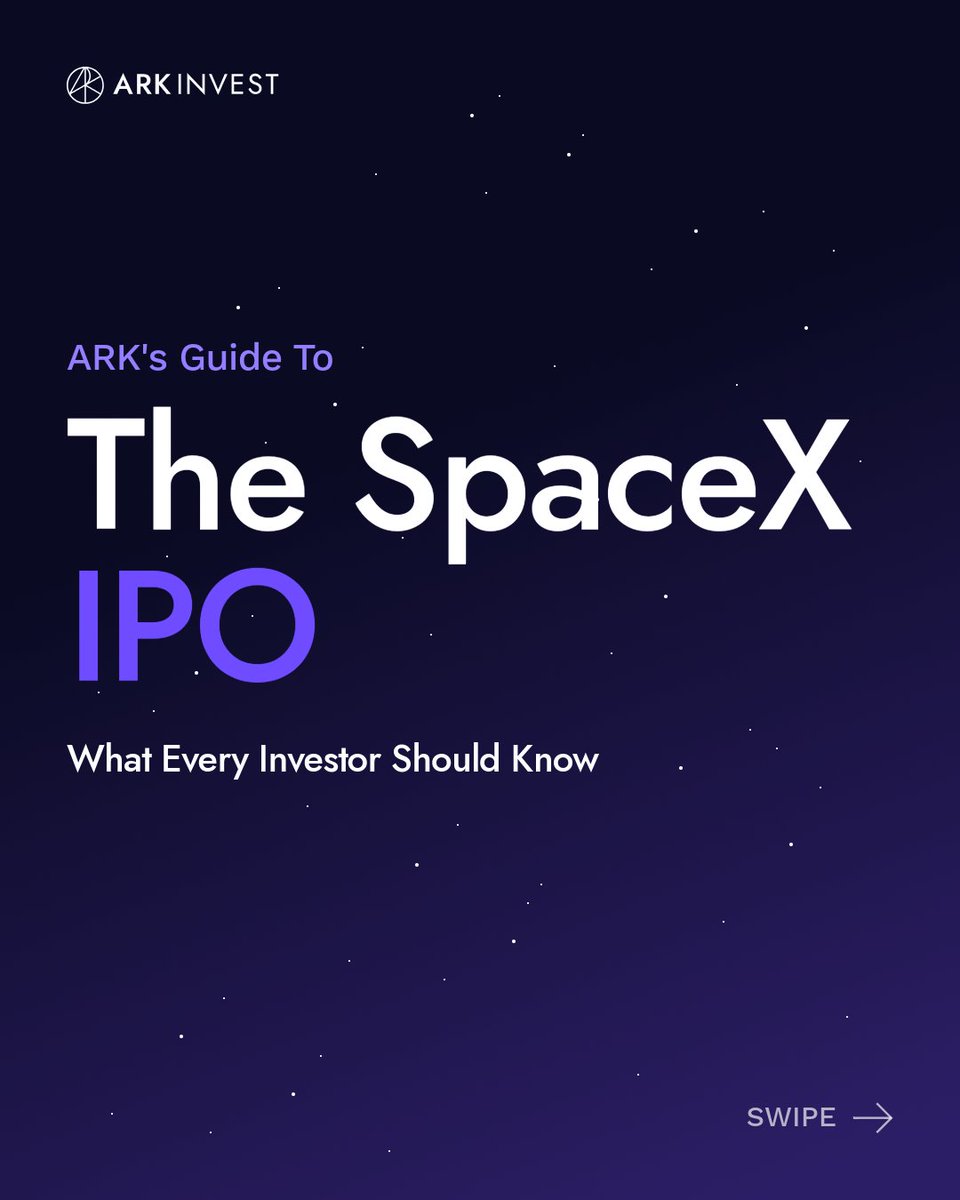
The largest IPO in capital markets history? Here’s what investors should know about the impending SpaceX IPO. Scroll to read 👇
ARK Funds tweet media
English
2
9
37
3.9K