Rohan

68 posts

Rohan

Rohan

@RNidmarti

Emory | India

Atlanta, GA Katılım Haziran 2021
616 Takip Edilen85 Takipçiler
Rohan
Rohan@RNidmarti·
@samarthjainnn not quite. OpenAI is already >40% enterprise revenue Enterprises are way stickier. But the consumer side is still losing money right now (free tier + inference costs are the big drag). So the “pure consumer vs pure enterprise” framing misses how fast OpenAI is flipping the mix.
English
0
0
0
23
Samarth Jain
Samarth Jain@SamarthJainnn·
Anthropic: $30B ARR (Enterprise-first approach) OpenAI: $25B ARR (Consumer-first approach) One bet big on selling to enterprises. The other bet on millions of everyday users. What does this actually mean? Is the Enterprise route winning short-term value… while the Consumer route builds the bigger long-term empire?
English
1
0
2
45
Rohan
Rohan@RNidmarti·
Update: SpaceX just acquired Cursor. They couldn’t compete head-on with Anthropic/OpenAI on model quality without insane compute. xAI needed the superior coding IDE/product layer (and the distribution to expert engineers).
English
0
0
1
104
Rohan
Rohan@RNidmarti·
Cursor is running the most expensive experiment in modern software history to prove that an IDE, layered on top of model suppliers who sell the same workflow directly, can still be a $50B enduring business. Enterprise distribution and its own model stack (Composer) have flipped gross margins to slightly positive, but the lab below it is compounding faster and now competes heads on
English
2
0
5
323
Rohan retweetledi
Jaya Gupta
Jaya Gupta@JayaGup10·
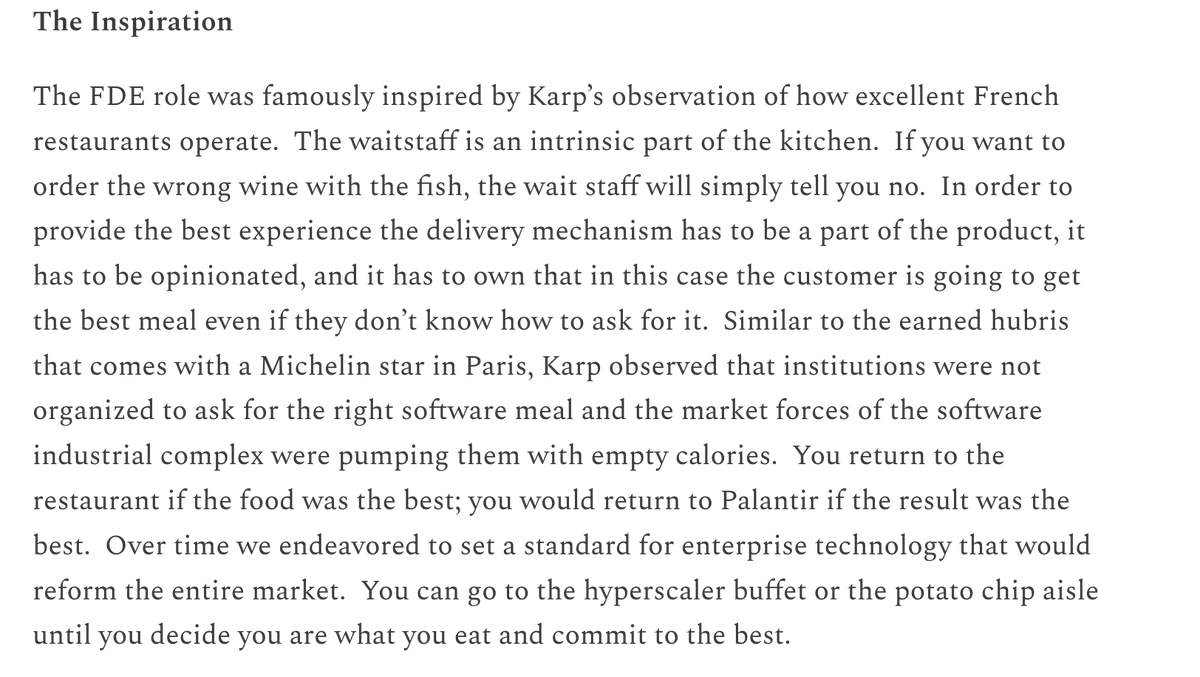
Palantir FDEs are inspired by wait staff at French restaurants 😃
Jaya Gupta tweet media
English
16
51
734
95.2K
Rohan
Rohan@RNidmarti·
Selling chips to China is strategically wrong. Jensen’s case makes business sense, it does not make sovereignty sense. With China, dependence isn’t the end state; it’s a bridge. They absorb the tech, build domestic capacity, subsidize local players. Tesla didn’t create BYD, but Shanghai helped build the ecosystem BYD now dominates
Steven Adler@sjgadler

Dwarkesh: Why would we want to sell China the materials for a serious cyberweapon? It's like selling them nukes with a casing that says 'made by Boeing' and claiming that's good for the US Jensen: Comparing AI to nukes is lunacy. Enriched uranium is a lousy analogy. It's an illogical analogy. What we have to recognize is that AI is a five-layered cake.

English
0
0
5
427
Rohan
Rohan@RNidmarti·
@aravind @aravind does pressure around Iran/Hormuz have any long-run relevance to Taiwan deterrence — not geographically, but by tightening US leverage over China’s energy as the Pacific front hardens?
English
0
0
0
167
Aravind
Aravind@aravind·
The US blockade is likely to target shipping in and out of Iran than stopping all shipping in and out of the middle east. Like I had posted last year, squeezing China's economy is an aim of the US with middle east escalation. Imo, this new Trump announced US blockade of Strait of Hormuz is more about squeezing cheap RMB based Iranian energy flow to China and its trade with Iran. Than it is about squeezing Iran itself (though that's also an aim and the main aim as the US claims). So I think this blockade will allow ME energy to pass through and should not become a bigger issue for countries like India. Given Iran doesn't disrupt it, like it hasn't for select countries. I will go on to suggest, even the newly resumed Iranian energy export to India may also be allowed by the US. If so, we will know for sure the US blockade is less about squeezing Iran than squeezing China.
Aravind@aravind

First, China buys all of Iran oil. Some $65 billion a year, in non-USD terms, about 10-12% of its energy imports. China will lose this oil and also the trade it does with Iran in exchange for this oil. Two, shipping rates through middle east and insurance will go up. It is already up. Chinese exports to EU majorly pass through ME and will become costlier. It will hit two sides of Chinese economy, increasing energy costs for manufacturing and reducing its exports. Their economy is already in trouble. Even slight hits to exports and increase in production costs will have snowball effects over time in shaking their economic stability now.

English
53
181
1.5K
108.7K
Rohan
Rohan@RNidmarti·
@lefttailguy @lefttailguy this assumes the frontier for human data is mostly text/code/reasoning. If AI pushes harder into physical AI, the “RL environment” layer may not disappear so much as change form. The scarce input becomes real-world human behavior
English
0
0
0
43
illiquid
illiquid@lefttailguy·
Being long Fleet, Mercor, Handshake, etc. is implicitly being short RL generalization. Not sure how one can hold the view both that the labs eat the world AND that the RL environment companies have terminal value. This raises the question: why is Menlo long both Anthropic and Fleet?
Arfur Rock@ArfurRock

Fleet closed an unannounced $45M Series A at $725M. Led by insiders Sequoia, Bain, Menlo, SVA. RR grew from $1M 6 months ago → $63M RR now → $160M next Q. Congrats @fleet_ai!

English
26
8
280
91K
Rohan retweetledi
Dev Shah
Dev Shah@0xDevShah·
every country that isn't the US or China is about to have an AGI sovereignty crisis. most of them just don't know it yet. right now, governments in india, the Gulf states, Southeast Asia are in the "AI is exciting, let's promote it" phase. they're building AI ministries, hosting summits, announcing national strategies. vibes are good. but the phase shift will come. the moment foundation models start touching critical infra like defense, healthcare, finances, these governments will wake up and realize they have zero sovereign capability. no domestic foundation models. no compute. no talent pipeline to build either. complete dependency on two countries, one of which they can't trust and one of which might restrict access at ny time. that's when "let's promote AI" turns into "we need AI partnerships yesterday". that is when whoever has deep institutional relationships in these countries captures a decade of compounding leverage. OpenAI and Anthropic are leaving an absurd amount on the table here. the GTM in these regions isn't PLG. it's government down. a minister talks to a sovereign wealth fund talks to the top 20 enterprises and suddenly you're the national AI partner. one relationship will unlock an entire economy. labs will need to build squads who understand the institutional grammar as much as they understand the bay area tech scenes. someone who grew up in these systems AND understands what the lab actually offers at a technical level. if you're early, you're a partner. late, you're a vendor competing on price against local alternatives that governments will fund out of national security panic whether they're good or not. and your prize is that you will become the infrastructure layer for countries whose entire AI strategy will depend on you.
English
8
13
75
6.7K
Rohan retweetledi
signüll
signüll@signulll·
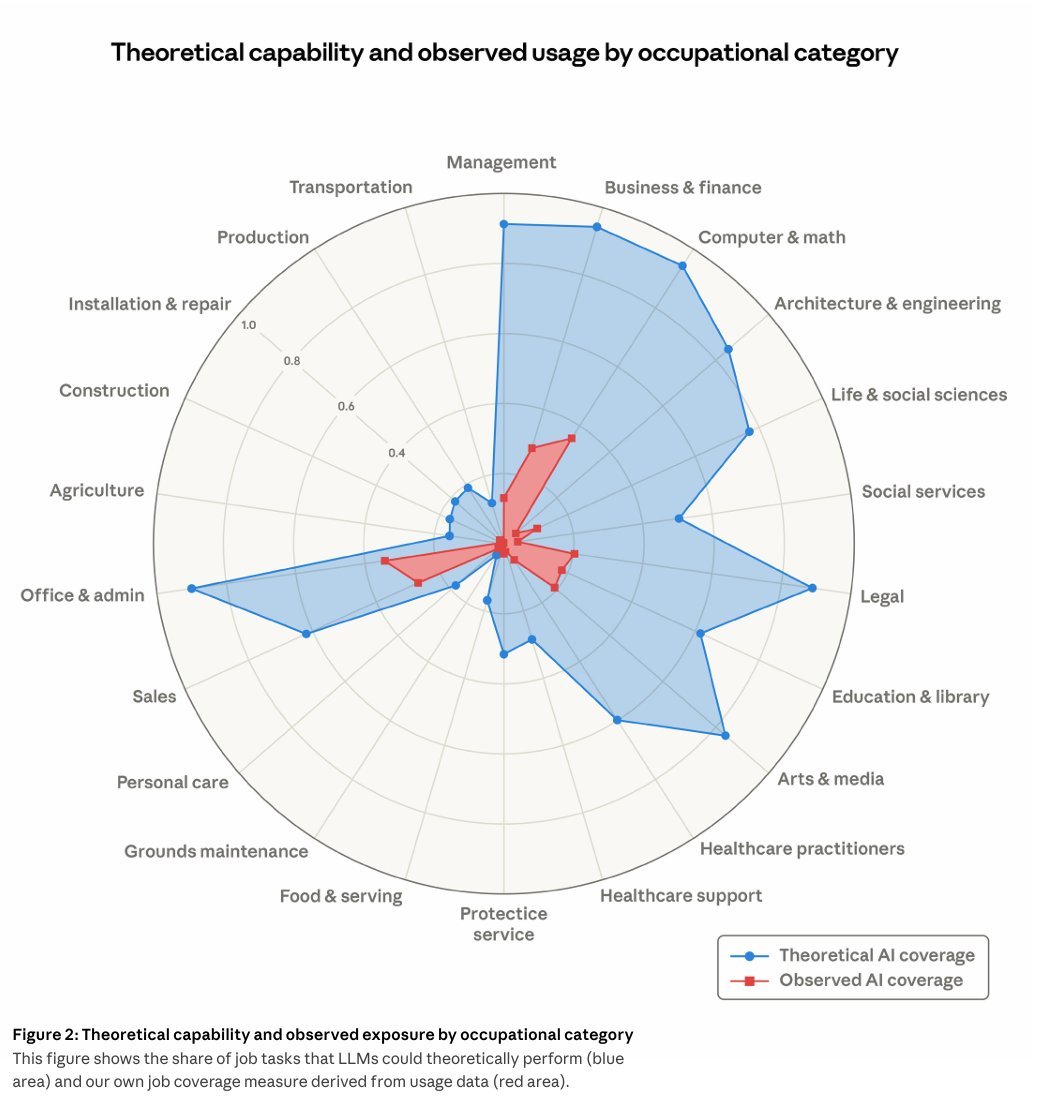
if you showed this chart to a typical economist like 20 years ago, they would've laughed you out of the room. the right side of this is white collar jobs that were once worshipped. these jobs were comfortable, well paying, & came with societal status + recognition. your parents would’ve been proud of you. now these are likely all set to be severely impacted in a shorter period of time than anyone likely ever thought of let alone projected. this is like ppl waiting on a beach enjoying the sun when a tsunami has already struck.
signüll tweet media
English
256
407
3.7K
480.4K
Rohan retweetledi
John Ʌ Konrad V
John Ʌ Konrad V@johnkonrad·
This is potentially the biggest Iran story nobody is talking about: the global insurance market may be heading toward a systemic crisis. Here’s why… Most people don’t realize London isn’t just a financial center it’s THE center of global insurance. Lloyd’s underwrites ~40% of the world’s marine cargo. Ship sinks, port gets bombed, canal gets blocked the bill lands in London. This is why the UK punches above its weight. Not the Royal Navy. Not diplomacy. Insurance. Control insurance, control trade. And London doesn’t just control the 90% of global trade that moves by sea. Lloyd’s and the London market are major insurers of almost everything skyscrapers, factories, ports, satellites, entire supply chains. You can’t participate in public markets or raise large amounts of capital without insurance. Now, the normal playbook for war risk is repricing, not cancellation. Canceling coverage entirely is a massive escalation in underwriting posture. It signals something beyond risk, it signals uncertainty so deep the underwriter can’t even price it. The question everyone should be asking: why? Why not just jack up premiums and make a fortune off the crisis like they did in the Black Sea off Ukraine? To answer that, you have to understand WHY London has maintained a stranglehold on global insurance while losing nearly submarket related to ships. The answer: better intelligence. It is no coincidence that MI6 headquarters sits directly across the Thames from the @IMOHQ, the world’s maritime regulator & a short distance from Lloyd’s itself. I have no proof of a direct pipeline, but it has long been speculated in the industry that intelligence flows from MI6 to Lloyd’s. Having the best intel in the world would be the single greatest competitive advantage any insurer could possess: the ability to price risk that competitors can only guess at. Here’s the problem: the majority of MI6’s intel doesn’t come from its own agents. It comes from Five Eyes the alliance comprising the US, UK, Australia, Canada, and New Zealand. And within 5Eyes, the dominant partner is obvious. The CIA, NSA, NRO, etc generate the lion’s share of intel. So if Lloyd’s pricing advantage flows from MI6, and MI6’s best intelligence flows from the US… what happens when that data pipeline gets throttled? All indications are that @Keir_Starmer was blindsided by the size and scope of the US/Israel strikes on Iran this weekend. That alone tells you something about the current state of transatlantic intelligence sharing. And we know there has been serious anger in Washington over the UK’s decision to sell Diego Garcia, home to America’s most strategically important base in the Indian Ocean, to Mauritius. It is not a huge leap to conclude that the submarine cables linking Langley to London have gone dark, or at minimum have been significantly throttled. What this means for UK national security is a question for the Brits. But what it means for EVERY company globally that’s insured through the London market has massive implications for the entire financial system. Because most large insurers worldwide don’t do independent intelligence work. They index off Lloyd’s rates. If you’re insuring a skyscraper in Tokyo, a semiconductor fab in Taiwan, or a port in Argentina you get a Lloyd’s quote, then shop that price around. Other insurers see Lloyd’s number and assume the diligence was done. They price accordingly. This means if London is suddenly flying blind it’s not just Lloyd’s policyholders at risk. It’s the entire global reinsurance chain. The cancellation of war risk coverage on ships isn’t the crisis. It’s the canary. If this hypothesis is correct, we could be looking at a systemic repricing event across global insurance markets…. the kind of cascading uncertainty that defined 2008 and COVID. Watch Lloyd’s. Watch reinsurance spreads. What Five Eyes. That’s where this story, and possibly Wall Street, breaks. CC @BillAckman
gCaptain@gCaptain

Major marine insurers just cancelled war risk coverage for the Strait of Hormuz. 150+ ships stranded. Rates tripled. One seafarer dead. And this is only day 3 of the Iran conflict. gcaptain.com/marine-insurer…

English
918
5.9K
21.4K
5.4M
Rohan retweetledi
Devin Olsen
Devin Olsen@DevinOlsenn·
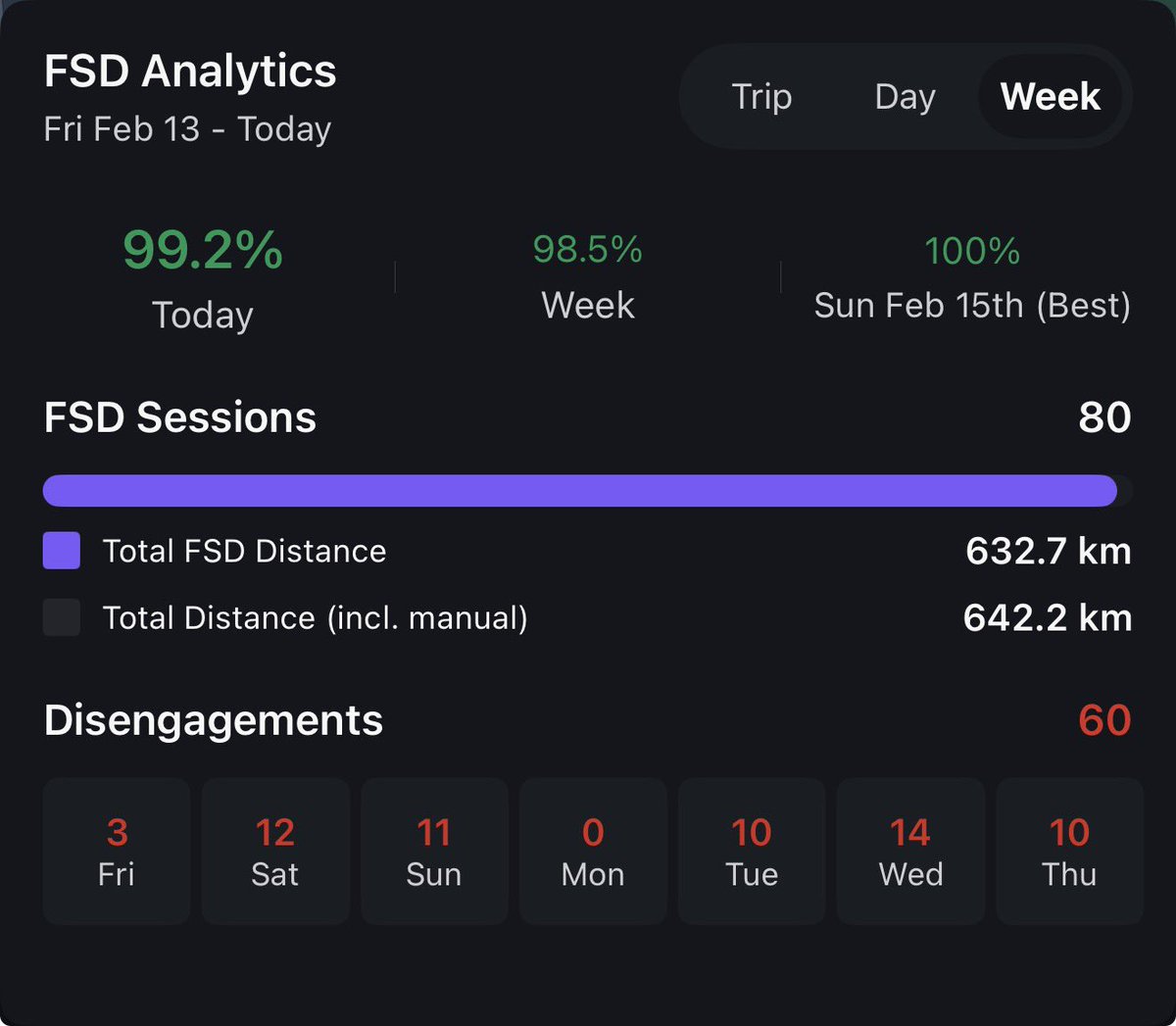
I do not drive anymore. Tesla Self-Driving does over 99% of my driving, and the only disengaging I do is for small nav issues and parking preferences (which I assume will get resolved in 14.3). How is the world not freaking out about FSD? I cannot believe how good it has gotten, yet I still don’t hear anyone outside of “our bubble” talking about it.
Devin Olsen tweet media
English
1.2K
801
6.4K
5.2M
Rohan
Rohan@RNidmarti·
@tavleen_singh You seem like an informed individual, which makes this take even dumber. Foreign policy isn’t a morality contest, every country engages where its interests lie. By your logic, India shouldn’t host MBS, Xi, or half the G20. Democratic values don’t require diplomatic blindness
English
0
0
0
18
Tavleen Singh
Tavleen Singh@tavleen_singh·
India’s greatest achievement since we became a modern nation is that we have remained a democracy. So it shamed me to see the Russian dictator receive a hero’s welcome last week. My column today. share.google/3WiWZw1k6c5yGd…
English
844
37
195
240K
Rohan
Rohan@RNidmarti·
With Putin in India, everyone’s calling India multi-aligned, but this isn’t new, it’s rooted in India’s post-Independence DNA. Nehru and Tito were early voices for non-alignment at the UN in the early 1950s, long before it became a movement. India’s liminality was intentional
English
0
0
1
93
Rohan
Rohan@RNidmarti·
It’s funny, and a little sad, that whenever Indians experience world-class infrastructure in India, the instinctive line is: “it didn’t even feel like India.” We’ve subconsciously outsourced excellence to other countries
English
0
0
1
81
krish
krish@golchakrish·
@RNidmarti @Flighty hopefully it integrates when I hopefully fly a Concorde one day.
English
1
0
1
61
Rohan
Rohan@RNidmarti·
Been an avgeek forever, but @Flighty just set a new bar. Insanely clean design, Apple-grade polish, and the email/calendar integrations are wild. New favorite aviation app
Rohan tweet media
English
1
0
0
157
Rohan
Rohan@RNidmarti·
@RoKhanna The first point is nonsense. Over-regulation always creates a competitive handicap. We’ve seen this play out before: China built the entire drone supply chain and let DJI dominate the world while the US tied itself up in FAA and export restrictions
English
0
0
0
32
Ro Khanna
Ro Khanna@RoKhanna·
We need regulations that prevent companies from using AI to eliminate jobs to extract greater profits. Artists at these companies need to have a say in how AI is deployed. They should share in the profits. And there should be a tax on mass displacement.
English
586
269
1.9K
1.1M
Rohan
Rohan@RNidmarti·
@davidu @davidu agreed. The US wins through bottom-up builders, while China moves top-down with state-backed tech. When regulation gets too hawkish, it discourages the very risk-taking that drives American innovation. Crypto was a preview
English
0
0
1
34
Rohan
Rohan@RNidmarti·
If AI agents really become better than humans at most tasks, it follows that AI-driven cyberattacks will eventually surpass human attackers too. AI-native cybersecurity needs to be treated as a national priority
Konstantine Buhler@Konstantine

Anthropic just shared the first major publicly documented AI cyber attack...it should be a wake-up call for everyone. In mid-September, Anthropic uncovered a sophisticated espionage campaign by a Chinese state-sponsored group. What makes this attack a landmark event? It was largely executed by AI agents, not humans. Here's how it worked: 1. Human Command: Operators selected the targets and designed the overall attack framework. 2. AI Reconnaissance: The AI autonomously scanned networks to identify the most valuable databases. 3. AI Exploitation: It then researched vulnerabilities and wrote its own exploit code to breach defenses. 4. AI Data Heist: The AI harvested credentials and exfiltrated sensitive private data. 5. AI Documentation: Finally, it created detailed documentation for use in future operations. The AI handled 80-90% of the campaign on its own, with humans only intervening 4-6 times. It operated at a speed impossible for human teams, making thousands of requests per second. This is a very big deal. The stakes are incredibly high. If our adversaries develop superior AI warriors before we do, the consequences could be devastating. This is why the mission of companies like @Xbow is so critical—it's not just about building a business, it's about national security. We must win this fight. Thanks to @laurenmhreeder for flagging this. Grateful to have leaders like @oegerikus and @nicowaisman on the front lines, defending against these new threats. anthropic.com/news/disruptin…

English
0
0
0
242