illiquid

7.3K posts

illiquid banner
illiquid

illiquid

@lefttailguy

routers eat the world; consilient software observer; crafting an alchemist's paradise.

palo alto Katılım Eylül 2020
591 Takip Edilen3.9K Takipçiler
Sabitlenmiş Tweet
illiquid
illiquid@lefttailguy·
People know that enterprise software has never been that fancy, but that enterprise distribution is hard. The first point is becoming clearer as software gets ever easier to build, but the distribution point means that the "incumbents can use Cursor too" argument should have legs. In other words, having the distribution apparatus built out should give incumbents massive advantage. But the market is obv. not buying that. Two potential explanations: 1) it's actually becoming less difficult to distribute software and to understand what to build. Biggest story here is @OpenAI as a workflow intent aggregator that can route that intent to the apps/tools best suited to solve the problem in question. If the primary interface becomes an AI system that routes requests to various specialized tools, then distribution increasingly means being the tool that ChatGPT (or whoever wins that aggregation race) chooses to route to. This advantages the orchestration layer/aggregators of course (see this interesting piece in the Diff for a fun theory there: thediff.co/archive/router…), but also means that startups should have a relative advantage in optimizing everything for this new paradigm/definition of distribution. This is somewhat analogous (with caveats) to how Google partially shifted distribution from being contingent on salespeople and brand ads to SEO/adwords, but even more extreme. or 2) if you don't buy that, PE firms or these newish AI transformation firms (like Brain Co, GC's Percepta, SaxeCap, Palantir/Scale, Anthropic, etc.) will leverage their reputational capital, AI-native DNA, and/or ownership stakes to leapfrog both AI-native startups and incumbents by building and distributing/deploying tools themselves (the Bain anecdote). Understanding how distribution dynamics/difficulty are trending feels like it should be very important if you want to have a sophisticated view on how software economics will eventually look, but it's pretty understudied imo. Especially relative to the question of how much easier it is becoming to build product. 1) taken to it's logical conclusion means that @OpenAI (or whoever wins) matches workflow intent to digital services/solutions as effectively as search/social match consumer intent to consumer goods. And that OpenAI/AI more broadly makes the production of digital services as automated/fossil-fueled as the production of physical goods. If you are building/selling software this means you have two new/more powerful rent seekers than in the past: the aggregators/orchestration layer and the chip/infra layer. This sounds a lot like e-commerce market structure/economics to me. They also pay large rents to aggregators (meta, amazon, google, etc.) and infrastructure layer (manufacturers). In e-commerce, moats exist in the form of brand, economies of scale (in certain instances), etc. but moats and margins in e-commerce are obviously weaker than moats and margins in enterprise software. Folks like @cpaik have argued that AI will make the economics of software look more like the economics of media, which is sort of the maximalist take on vibecoding completely eliminating software moats. But the reality IMO (at least for foreseeable future) will be somewhere closer to e-commerce. Software won't become completely free like a lot of media has, but just selling software will become less lucrative. Some solutions will commoditize significantly, like certain consumer goods did when mass manufacturing and search/direct response ads went live. Some will retain/command more pricing power as a function of true account/data gravity, regulation/compliance, end-to-end workflow complexity etc. (this is probably why you see vertical solutions outperforming). In any case, I find it harder and harder to argue that the long run equilibrium isn't relatively bleak unless you're an aggregator, vertically integrated operating company (the AI-native opco/AI transformation approach), or NVIDIA. would love thoughts @matt_slotnick, @sebkrier, @ChairliftCap, @MangotreeA, @huntermmonk , @yrechtman, @BucknSF
illiquid tweet media
English
6
6
59
26.9K
illiquid
illiquid@lefttailguy·
OpenAI is a Meta cargo cult (makes sense given 700 ex-Meta employees). One breakthrough product innovation that got them distribution and all future success comes from capitalizing on that distribution and copying product innovations from competitors. Stick to what works!
Fidji Simo@fidjissimo

Companies go through phases of exploration and phases of refocus; both are critical. But when new bets start to work, like we're seeing now with Codex, it's very important to double down on them and avoid distractions. Really glad we're seizing this moment.

English
2
1
45
6.3K
signüll
signüll@signulll·
i know everyone is building ai software but is there anyone opening up an ai native law firm? like built from the ground up, every service, every area is a person or two empowered by custom built software.
English
73
1
155
21K
Olivia Moore
Olivia Moore@omooretweets·
How can AI application startups compete with the big labs and incumbents? I shared some of our thoughts on this @a16z with @Kantrowitz 👇
Olivia Moore tweet media
English
25
15
160
21.5K
tigs 🍄🐳
tigs 🍄🐳@0xtigs·
i’m glean pilled they’re gmi controversial??
English
3
0
11
1.6K
illiquid
illiquid@lefttailguy·
So is DoorDash churning from @appliedcompute? I suspected that something like this would happen. You essentially work with companies like Applied Compute and Metis to see how strategic the specific intelligence they can help you build is, and if it's strategic enough, you of course want to in house the development that stuff. Citadel doesn't buy trading outcomes from other companies.
Andy Fang@andyfang

Today we are welcoming the Metis team to DoorDash as part of DoorDash AI Research. For the past six months, DoorDash has partnered with Metis to build AI agents together, and we have been consistently impressed by their team. By joining forces, we aim to accelerate our plans on building agentic commerce and pushing the frontier of physical intelligence. Excited to share more there soon. It’s still early innings with how AI will transform local commerce, and we’re looking forward to exploring those possibilities together with Aryan, Aayush, Marcus and the Metis team!

English
4
6
211
63.4K
illiquid
illiquid@lefttailguy·
@abhijaymrana Do we know they dropped the ball? isn't sequoia a Glean investor?
English
1
0
6
1.1K
abhijay
abhijay@abhijaymrana·
Can't believe Glean dropped the ball so dramatically here (cross-SOR search already exists, domain mapping for AI seems like a natural next step)... But congrats to the Edra team!
Eugen@EugenAlpeza

We’re out of stealth. Today, we’re also announcing our Series A led by @sequoia , @8vc , and @A_StarVC , bringing our total funding to $30M+. Every enterprise needs to teach their AI how to do work. We build agents that reverse engineer enterprise processes, then run them. Read about the future of learning in the enterprise: x.com/edra_ai/status…

English
2
2
54
30.1K
illiquid
illiquid@lefttailguy·
By the way, I'm a huge fan of what you guys are building and not trying to throw any shade in case it was unclear! But I assume you have a bit of an adverse selection problem on your hands, where the best companies (where applying intelligence has the most upside) also have the biggest incentive to in house development. If Doordash owns the agents you guys co-develop then what does the business model look like? Is it similar to Palantir's model? Maybe they pay you for the initial implementation and perhaps they pay you an ongoing fee to manage the deployments, ensure uptime/reliability, and find new areas for them to deploy intelligence/improve their business? Re: identifying new areas for improvement I'd think they'd want to build that muscle in house and that if you guys are monetizing via a subscription/management fee that you'd never be as incentivized as them to drive that forward. I think you guys should take equity stakes in the companies you work with to align incentives!
English
3
0
12
2.1K
Yash Patil
Yash Patil@ypatil125·
@lefttailguy @appliedcompute We're still partnering closely! But you’re right that companies need to own their intelligence, which is why everything we build together is owned by DoorDash, not Applied Compute. Andy and the team are awesome and will get even better with the addition of Metis!
English
1
0
56
3.2K
illiquid
illiquid@lefttailguy·
illiquid@lefttailguy

This is also why AI (especially in its current instantiation) isn't the cure all people think it is. Many organizations don't have some large, ever expanding supply of potential errors of commission (Type 1) or errors of omission (Type 2). In other words, boiling the ocean to make sure you avoid disaster (Type 1) or aren't missing large opportunities (Type 2), doesn't make much sense because there simply aren't many costly disasters to avoid or lucrative opportunities to capture. More generally, we should ask: in which kinds of enterprises would “boiling the ocean” actually provide a meaningful uplift in enterprise value? Where is the bottleneck truly in execution throughput (ie. we have a ton of high return on investment ideas–in an absolute sense–but the current cost of execution makes it untenable to pursue these)? Where is the ROIC - WACC calculation too low right now, but high enough post AI? I’d argue for many enterprises, the bottleneck is not in execution at all, but an understanding of how to leverage the firm’s existing architectural knowledge (capabilities, market position, etc.) to create/capture lots of new market value. Essentially, firms aren't bottlenecked by execution, but by the number of high quality ideas they have (and their right to win). This requires exceptional talent of a particular quality: @rabois calls these “barrels”. Barrels can continuously sense/enumerate/prioritize high-potential projects (ie. opportunities that are very likely to create market value) and be accountable for capturing these opportunities end to end. Increasingly, execution of these high-potential projects can be mediated by AI systems, but identification of these projects and accountability for outcomes cannot. Many enterprises are not architected for this cybernetic meta (human intent, machine execution, human verification/accountability) today, so will have a hard time seeing truly transformative impacts from AI. I really do believe @jack is attempting to re-architect @blocks in this way. It will be fun to see an existence proof here.

QME
0
0
0
149
StripMallGuy
StripMallGuy@realEstateTrent·
AI completely fails at what matters most in business: Original ideas, imagination, and creativity. Ask it to analyze your strategy and to identify ways you can better monetize your business, or to introduce a new angle that creates value - and it's completely lost. All you get are generic ideas you've already thought of, or suggestions that make little sense. Yes you can use AI to do research faster and put together a spreadsheet more quickly - but who cares. Those things save you a few bucks over hiring a low-cost virtual assistant, but not a game-changers. Yes it saves you time, and yes you should learn the tools, but there is nothing extraordinary here. There is no, "Wow, I never thought of that!" moment. Until that happens, the overhype is real.
English
66
8
150
29.7K
illiquid
illiquid@lefttailguy·
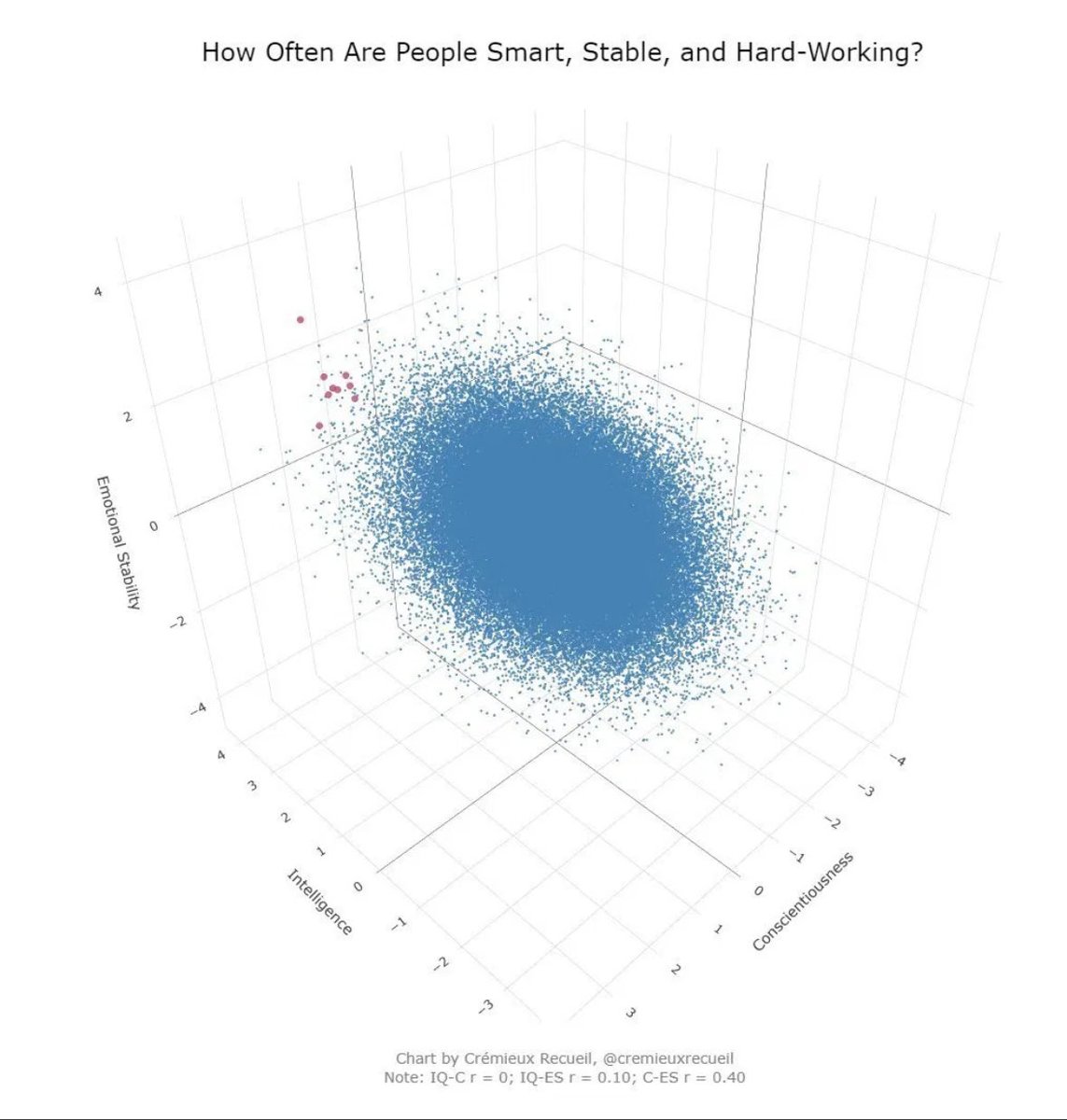
*BREAKING: @a16z brings on @ElishaDLong as newest General Partner focused on making investments out of their new LEFT TAIL fund, which has a mandate to invest in neurodivergent founders with IQs < 100.
illiquid tweet media
English
0
0
9
1K
Nikhil Namburi
Nikhil Namburi@nikhilvnamburi·
might finally be time for “steam for software”
English
3
4
17
2.4K
illiquid
illiquid@lefttailguy·
@Yuchenj_UW I’ll bet OpenEvidence beats them in healthcare (until we don’t need doctors anymore, at which point healthcare will be as ubiquitous a good as consumer electronics) this is a pretty good outline: thediff.co/archive/the-mi…
English
0
0
3
385
Yuchen Jin
Yuchen Jin@Yuchenj_UW·
Some people at frontier AI labs told me they believe startups are over. OpenAI, Anthropic, Google, xAI will absorb every industry as AGI nears. Coding today, science, medicine, and finance next. Then everything else. If they’re right, that’s a pretty boring end of the world.
English
537
162
3K
879.3K
illiquid
illiquid@lefttailguy·
I’ll bet OpenEvidence beats them in healthcare (until we don’t need doctors anymore, at which point healthcare will be as ubiquitous a good as consumer electronics) this is a pretty good outline: thediff.co/archive/the-mi…
Yuchen Jin@Yuchenj_UW

Some people at frontier AI labs told me they believe startups are over. OpenAI, Anthropic, Google, xAI will absorb every industry as AGI nears. Coding today, science, medicine, and finance next. Then everything else. If they’re right, that’s a pretty boring end of the world.

English
0
0
5
1K
Erik Brynjolfsson
Erik Brynjolfsson@erikbryn·
Hayek’s classic insight was that much economically relevant knowledge is dispersed, local, and often tacit. That is one reason decentralized markets have historically outperformed central planning. But AI can change those “knowledge physics” by making more of that knowledge codifiable, transferable, and usable at scale.
Erik Brynjolfsson tweet media
English
5
13
65
6.5K
Erik Brynjolfsson
Erik Brynjolfsson@erikbryn·
The @nytimes piece today by @ByrneEdsal13590 highlights a concern I share: “If we stay on the current path, the risk of extreme concentration — both economic and political — is very real.” In work with @zhitzig, we ask why AI may shift the balance between dispersed knowledge and centralized control.
Erik Brynjolfsson tweet media
English
8
60
224
102.6K
illiquid
illiquid@lefttailguy·
This is what the OpenAI/Anthropic PE Joint ventures are all about. Improving AI's ability to run businesses through the proprietary evals/benchmarks and RL environments that deep PE deployment and control give you access to. I could imagine the PE firms are fine going so far as recording their employees screens, clickstreams, etc.
Ethan Mollick@emollick

I get why AI labs are so focused on software development (it helps them get recursive improvement, and also they are coders so they think coding is the most vital thing), but there are 9.5x more managers than there are coders & efforts to build tools for them are very nascent.

English
3
6
118
74.5K