Ryan Rholes

495 posts

Ryan Rholes

Ryan Rholes

@RRholes

AP at the University of Mississippi studying monetary policy, CB communication, & expectations. I spend too much time learning chess and Brazilian Jiu Jitsu.

Oxford Katılım Aralık 2019
515 Takip Edilen475 Takipçiler
Ryan Rholes
Ryan Rholes@RRholes·
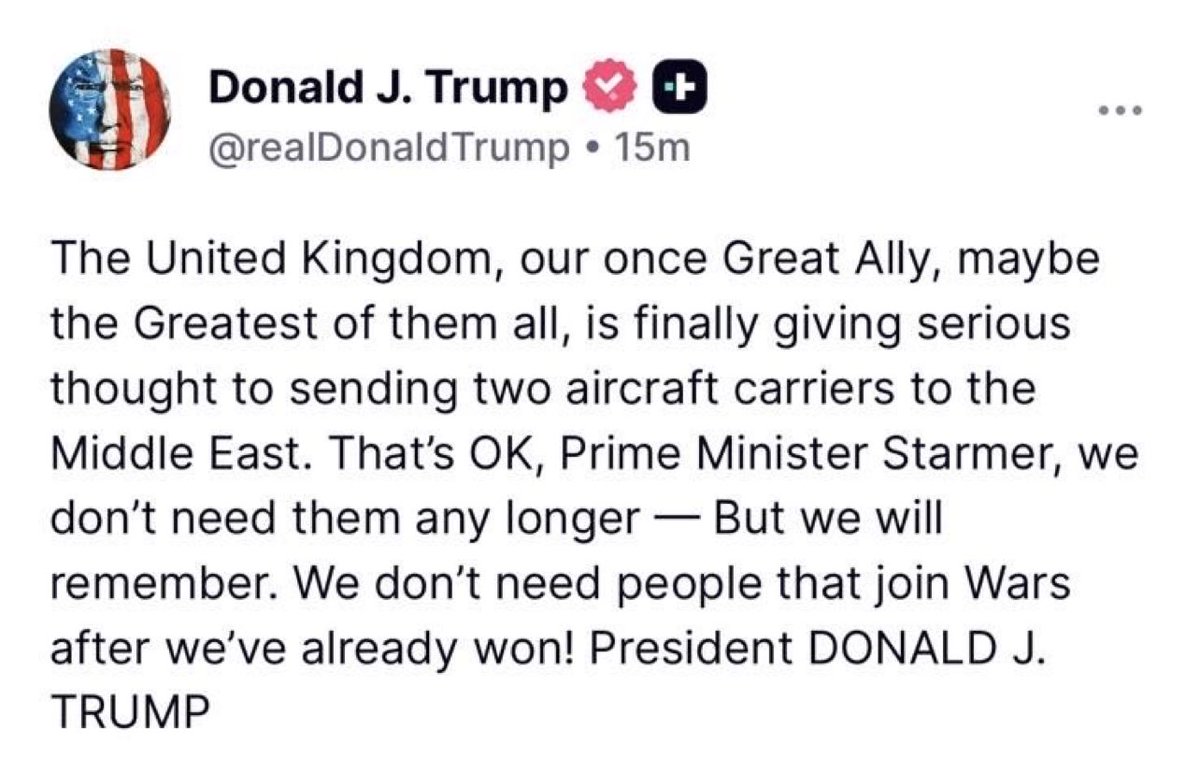
@colinrtalbot Is your argument that the U.S. became involved in those wars after the main adversarial power(s) were, from the perspective of conventional warfare, defeated?
English
0
0
0
53
Ryan Rholes
Ryan Rholes@RRholes·
@rshereme This is a strange take given that the U.S. is, by a wide margin, the largest **single-country** supplier of aid to Ukraine. Regardless of one’s view of the Trump administration, American taxpayers have underwritten Ukraine’s defense more than any other nation.
English
1
0
0
61
Roman Sheremeta 🇺🇸🇺🇦
The U.S. and other partners are asking Ukraine for help intercepting Iranian drones. It is, of course, hypocritical for the U.S. administration, which cut off Ukraine’s weapons and sided with russia in the so-called “peace negotiations.” Nevertheless, Zelenskyy said he is willing to help, adding that any assistance Ukraine provides will be on the condition that it does not weaken its own defenses. Zelenskyy: “Partners are reaching out to us, to Ukraine, for help with defense against Shaheds, expertise, and real operational support. There have been requests about this from the American side as well. Over the past few days, I have spoken with the leaders of the Emirates, Qatar, Bahrain, Jordan, and Kuwait. There will be more talks with other regional leaders. We are coordinating with our European partners. Of course, any assistance we provide will be only on the condition that it does not diminish our own defense in Ukraine and that it serves as an investment in our diplomatic leverage.” After years of facing massive drone barrages from russia, Ukraine now has the world’s most extensive real-world experience and technologies for countering drones. As one man once said: Who has the cards now?!
English
27
202
757
15.2K
Ryan Rholes
Ryan Rholes@RRholes·
Finally, a balanced and reasonable perspective.
David French@DavidAFrench

A few thoughts: 1) This attack should not have happened without Congressional authorization. This is no mere technicality -- it's the framer's foundational design for how the republic should wage war. 2) Khamenei's death is a great victory, but we've all been on this rollercoaster before. The U.S. and Israelis have taken out lots of leaders and rulers in these long wars. 3) I very very very much want the regime to fall, and I desperately want democracy to take root, but remember, we're ultimately relying in large part on civilian protesters (hopefully with the support of dissenting regime elements) to actually topple the regime. 4) If we rely on protesters (who possess magnificent courage), I'm worried we might see something like what happened to Iraqis who rose up against a defeated Saddam in 1991. It was a bloody massacre. That's a nightmare scenario. 5) Our forces have performed magnificently, and I'm hoping and praying that the Iranian response remains inept and ineffective. But it's dangerous to simply presume that it will. 6) If we take losses (or if we suffer economic disruption) that's when we'll see one of the consequences of failing to go to Congress. We're a divided country. Trump is a mercurial man. 7) Trump's temperament and character are one reason why it's silly to say, "If I'd support this under any other president, I should support this under Trump." He's not like any other president. Bad and dishonest leaders make me less confident in their plans. 8) If, however, the Iranian people can rally, if our attacks can prevent the regime from massacring civilians, then it will be a massive accomplishment and a great day for the U.S., Israel, and the world.

English
0
0
0
158
Josh Hendrickson
Josh Hendrickson@RebelEconProf·
@davereaboi What people are seeing is what happens when objectives are well-defined and what constitutes success or victory is defined. The “forever wars” were forever because they were fights against abstractions without any meaningful definition of victory.
English
3
1
22
2.1K
David Reaboi, Late Republic Nonsense
Yes and no. (1) It was not always possible technologically to do these things—that’s a pretty recent development. (2) Colin Powell’s “you break it, you buy it” stuff was utter nonsense, but it was embraced by nearly everyone of both parties—with very rare exceptions. (3) “Forever War” is a really dumb thing to confuse with “war,” because taking “forever” was always just a decision unrelated to tangible national interests: victory is not related to how tidy the place is when you leave. Hopefully that bullshit is out of our system and we won’t be retarded anymore. (4) Venezuela is one thing, but Iran is on another level. Israelis showed that outsmarting these guys is very possible if you have the intelligence.
Sam Ashworth-Hayes@SAshworthHayes

If this works out it would be such a humiliation for the foreign policy establishment. Decades of clever schemes and gameplay and all this time you could just kick the door down, kill the leader, and warn the next guy that if he doesn't behave he knows what'll happen.

English
5
9
57
6.3K
Ryan Rholes
Ryan Rholes@RRholes·
@carlbildt The idea that nations face tradeoffs when allocating scarce defense resources is not insightful. Further, the US can allocate its weaponry how it so chooses. And as a point of fact, the U.S. is by far the largest single-country supplier of support to Ukraine.
English
0
0
0
70
Carl Bildt
Carl Bildt@carlbildt·
In its new war 🇺🇸 is using hundreds and hundreds of Patriot missiles that could have been used defending the cities of 🇺🇦. Politics is about choices.
English
843
1.6K
7.2K
543.5K
Ryan Rholes
Ryan Rholes@RRholes·
October 23, 1983. 220 Marines, 18 Sailors, 3 Soldiers. The United States Marine Corps has not forgotten.
English
0
0
2
114
Cory Doctorow NO LONGER ON TWIT TER
When your rent goes up, so does GDP. Same with your salary going down (provided this results in more spending by your boss). GDP isn’t really a measure of the health of “The Economy” — it’s a measure of the parts of “The Economy” that make rich people (that is, the Epstein class) better off.
Cory Doctorow NO LONGER ON TWIT TER@doctorow

It's hard to talk about the Epstein class without thinking about "The Economy" (in the sense of a mystical, free-floating entity whose health or sickness determines the outcomes for all of us, whom we must make sacrifices to if we are to prosper). 1/

English
46
45
202
221.1K
Ryan Rholes
Ryan Rholes@RRholes·
@BrianCAlbrecht @ATabarrok Interesting! Quick question: does the chaos result rely on distribution costs being nearly symmetric? Or could starkly asymmetric costs (producing states finding it strictly cheaper to sell locally under a price cap) generate similar (but more predictable) corner allocations?
English
1
0
0
120
Brian Albrecht
Brian Albrecht@BrianCAlbrecht·
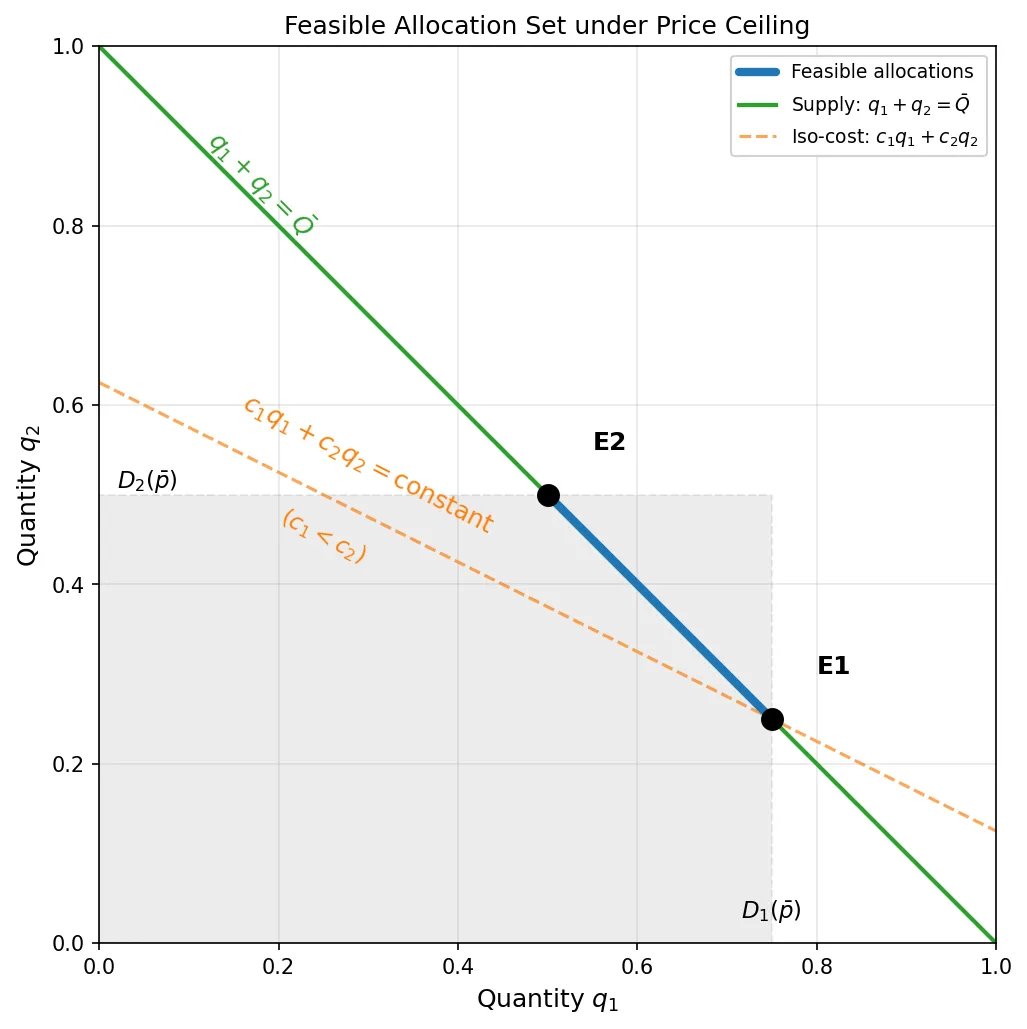
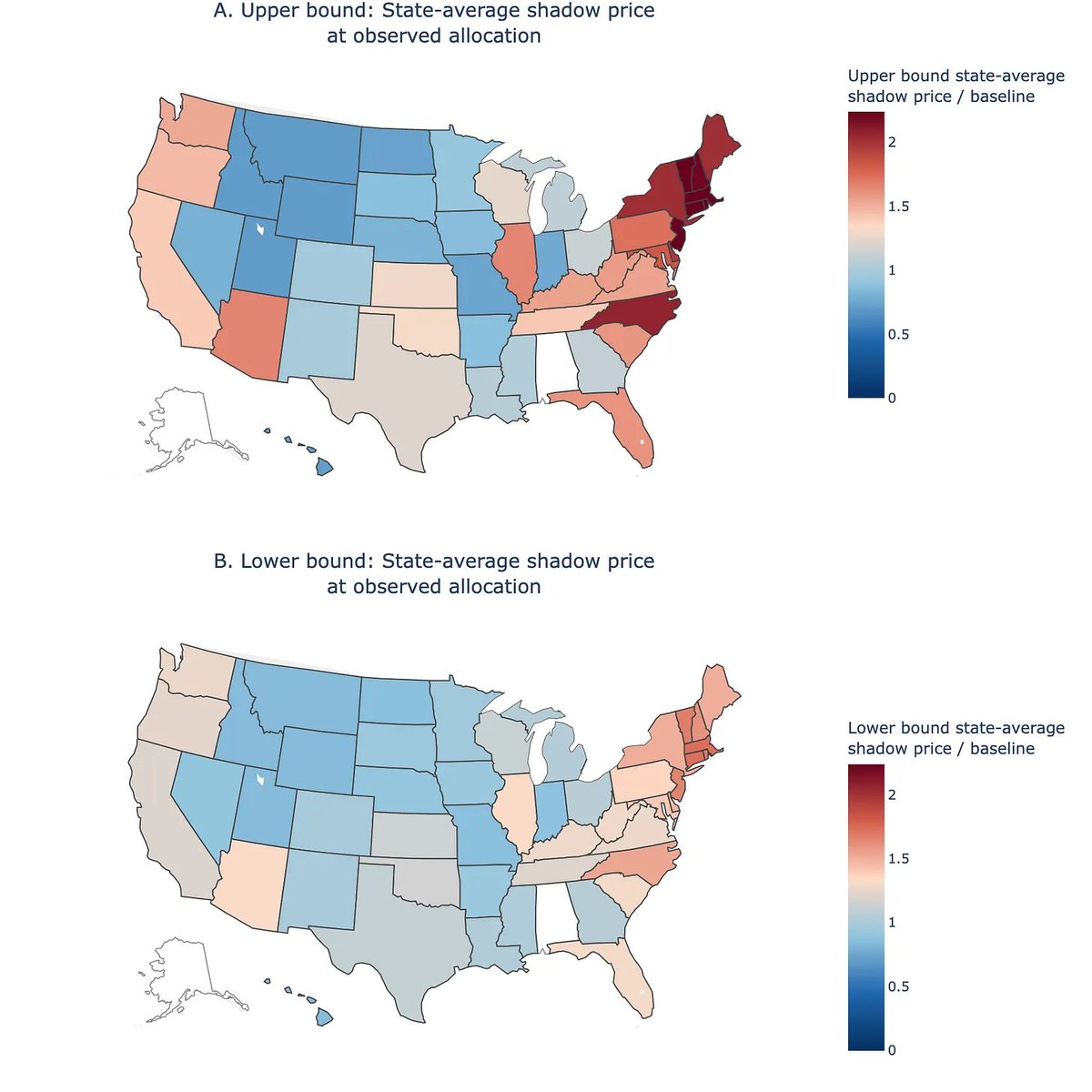
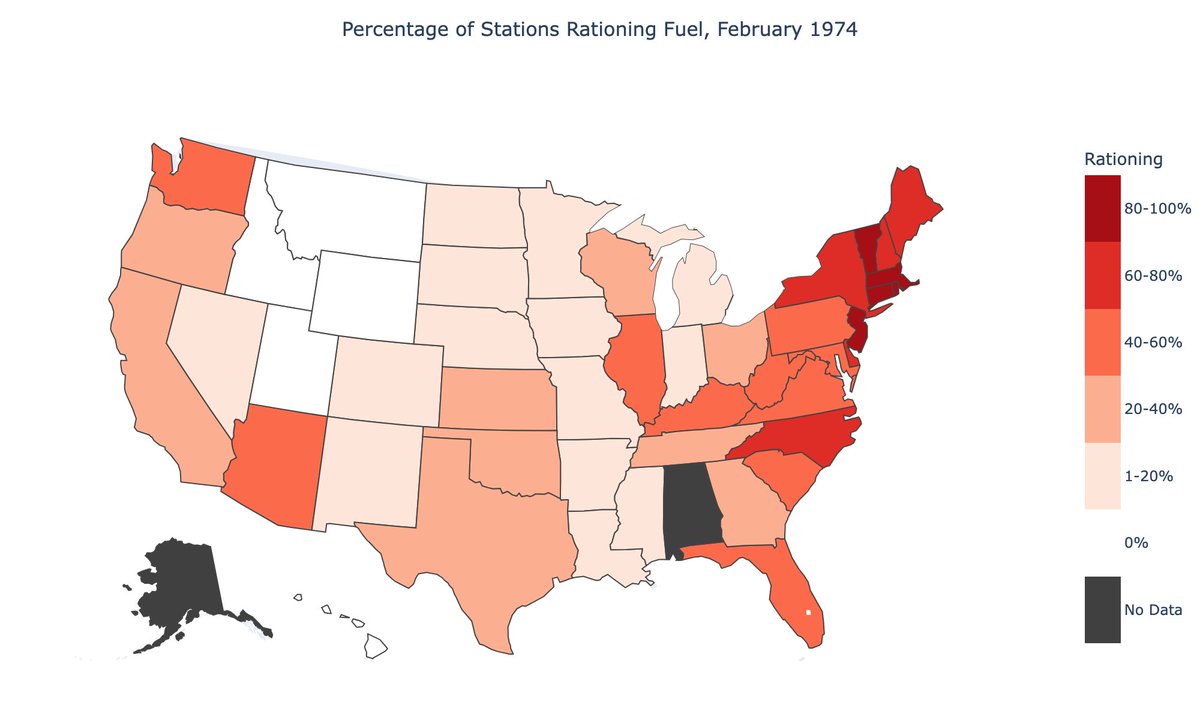
I'm super excited for my new paper with @ATabarrok and Mark Whitmeyer: "Chaos and Misallocation under Price Controls" During the 1973-74 gasoline crisis, the U.S. had about a 9 percent national shortfall. But that was far from evenly spread out. Over 90 percent of stations in Connecticut were rationing fuel somehow, limiting purchase or straight up closed. In Idaho, Montana, Utah, and Wyoming? Not a single surveyed station reported any problem. Zero. Texas and the Great Plains were "virtually awash with gasoline." How does a 9 percent shortfall produce 90 percent rationing in one state and zero in another? And how big of a deal is that misallocation? Our paper does three things. First, we prove a Chaos Theorem: price controls generically push allocations to corners where some markets get everything and others get nothing, and which corner the economy lands on is unpredictable. Second, we develop a new way to find sharp robust bounds on the welfare cost of this misallocation. Price controls destroy the demand information you'd need for standard welfare analysis, so we bound the losses across all demand curves consistent with the data. Sharp bounds. Third, we apply both to the 1973-74 crisis and show that misallocation losses are 1 to 9 times the textbook Harberger triangle. Let's go through each. Why do price controls cause chaos? Price controls kill arbitrage. Normally, if gasoline is scarcer in Connecticut than Idaho, the price rises in Connecticut, attracting supply eastward. A small cost advantage captures only a marginal reallocation, because prices push back. Freeze the price everywhere and that pushback disappears. The supplier's problem reduces to pure cost minimization. Thinking of the geometry, cost is linear in quantity. A linear objective over a feasible set with corners always lands on a corner. This is the old idea, as Thomas Sowell put it, that economy loses its capacity for incremental adjustment and instead lurches between all-or-nothing extremes The figure below shows why. The blue segment is the feasible set. The dashed orange iso-cost lines are straight because cost is linear. A straight line sliding across a line segment always hits an endpoint. Flip the cost ranking by a fraction of a cent and the allocation jumps to the other end. Freeze the price everywhere and that pushback disappears. Every gallon earns identical revenue regardless of destination. The supplier's problem reduces to pure cost minimization. And cost is linear in quantity. A linear objective over a feasible set with corners always lands on a corner. Some markets get filled to capacity. Others get nothing. The figure below shows why. The blue segment is the feasible set, all the ways to split a fixed supply between two markets. It has two endpoints. The dashed orange lines are iso-cost lines, and because cost is linear, they're straight. A straight line sliding across a line segment always hits an endpoint. Flip the cost ranking by a fraction of a cent and the allocation jumps to the other end. Corners are bad enough. But which corner the economy lands on is unpredictable. When delivery costs are nearly equal, a pipeline repair, a refinery outage, a regulatory tweak can flip the entire allocation. Small parameter changes produce discontinuous jumps. We call this the Chaos Theorem. How big of a deal is it that we end up at a corner where? Every textbook draws the Harberger triangle as the cost of a price ceiling. But that triangle assumes reduced supply still goes to the right places. It didn't. The top row below shows the textbook case: supply spread efficiently, shadow prices equalized, small welfare triangles. The bottom row shows what actually happens at a corner. One market is fully served. The other bears the entire shortage. Same total supply. Look at the map again. It's natural to focus on the Northeast. The lines. That's the problem with price controls. But actually the states with abundant fuel are a sign of the misallocation. Instead of a shortage, they are getting more than they would get without a price control. How can we estimate welfare in extreme cases? Standard welfare analysis assumes a demand curve. But price controls destroy the information you'd need to pick the right one. Elasticity estimates work near the previously estimated equilibrium. In the 1974 case, rationed stations received 68 percent of baseline quantity, and many received nothing. So we developed a bounding approach. No assumed functional form. Across all demand curves consistent with the observed data and plausible demand slopes, what are the largest and smallest possible welfare losses? No assumed functional form. The key insight: efficient allocation equalizes shadow prices across markets, which collapses what would be an infinite-dimensional problem into a one-dimensional search. How large was gasoline misallocation in 1974? This is a theory and methods paper, but we show how to use it in the context of the gasoline shortages. Using station-level AAA survey data presented to President Ford during the crisis, we find exactly the corner-solution structure the chaos theorem predicts: 62.3 percent of stations operating normally, 27.6 percent limiting purchases, and 10.1 percent completely out of fuel. The shadow price maps tell the story. The Northeast is dark red, consumers valuing gas at multiples of baseline. The Mountain West is blue, below baseline. That gap is the arbitrage opportunity price controls created and simultaneously prevented anyone from exploiting. To answer that, we need to estimate "shadow price," what consumers would actually pay for one more gallon if they could. When goods are allocated efficiently, shadow prices equalize across markets. Again, we are bounding this. How do we do that? For the upper bound, give the starved markets steep, inelastic demand, so each missing unit costs a lot of welfare. Give the oversupplied markets shallow, elastic demand, so the extra units they got didn't add much. For the lower bound, do the opposite. The real novel part that makes our multi-market welfare bounds possible is that we then impose that markets add up. That pins everything down to a one-dimensional search. The shadow price maps show the result. In the upper-bound case, Connecticut's shadow price was 2.5 times baseline. Montana's was 0.7. Shipping a barrel east would have more than tripled your money. That is the arbitrage opportunity price controls created and simultaneously prevented anyone from exploiting. In terms of WELFARE, we want to look at the misallocation relative to the Harberger triangle. In our case, the misallocation loss is 1 to 9 times the Harberger triangle. Even at the lower bound, misallocation roughly equals the standard quantity-reduction loss. At the upper bound, the triangle accounts for barely one-tenth of total welfare cost. As we move into a world where price controls are back in vogue on both sides of the political aisle, let's remember the 1970s. Yes, gasoline lines. But that wasn't everything. Chicken farmers gassed, drowned, and suffocated roughly a million baby chicks. “It’s cheaper to drown ‘em than to put ‘em down and raise ‘em,” one Texas farmer explained. Dairy farmers slaughtered cows. Hog farmers culled breeding stock. In other words, chaos and misallocation. Paper: briancalbrecht.com/Albrecht_Tabar… A bit deeper write-up on Economic Forces: economicforces.xyz/p/price-contro…
Brian Albrecht tweet mediaBrian Albrecht tweet mediaBrian Albrecht tweet mediaBrian Albrecht tweet media
English
15
70
215
46.3K
Chess.com
Chess.com@chesscom·
guess how many chess pieces are in the jar! 👇 closest guess wins a player signed #SCCFinals poster!
Chess.com tweet media
English
1.5K
40
1.3K
145.6K
Ryan Rholes
Ryan Rholes@RRholes·
@NE_SPARC Thank you for the response! My address is 413 Meadowlawn Drive.
English
1
0
0
34
NE SPARC
NE SPARC@NE_SPARC·
@RRholes Hi, our system is up and we have service crews are out working to make individual repairs for fiber. If you want to post your address I’ll be glad to check on it for you.
English
1
0
2
43
Ryan Rholes
Ryan Rholes@RRholes·
@SenSanders What about any of that makes Denmark relevant from a geopolitical perspective? Unsurprisingly disingenuous take.
English
1
0
0
47
Sen. Bernie Sanders
Sen. Bernie Sanders@SenSanders·
Our billionaire Treasury Secretary called Denmark “irrelevant.” Hmm. Unlike the US, in Denmark, health care & college are free, the starting wage is $22 an hour, paid parental leave is 1 year, paid vacation is 6 weeks & all workers get pensions. That seems very relevant to me.
English
9.9K
6.8K
37.1K
950.6K
No Lie with Brian Tyler Cohen
No Lie with Brian Tyler Cohen@NoLieWithBTC·
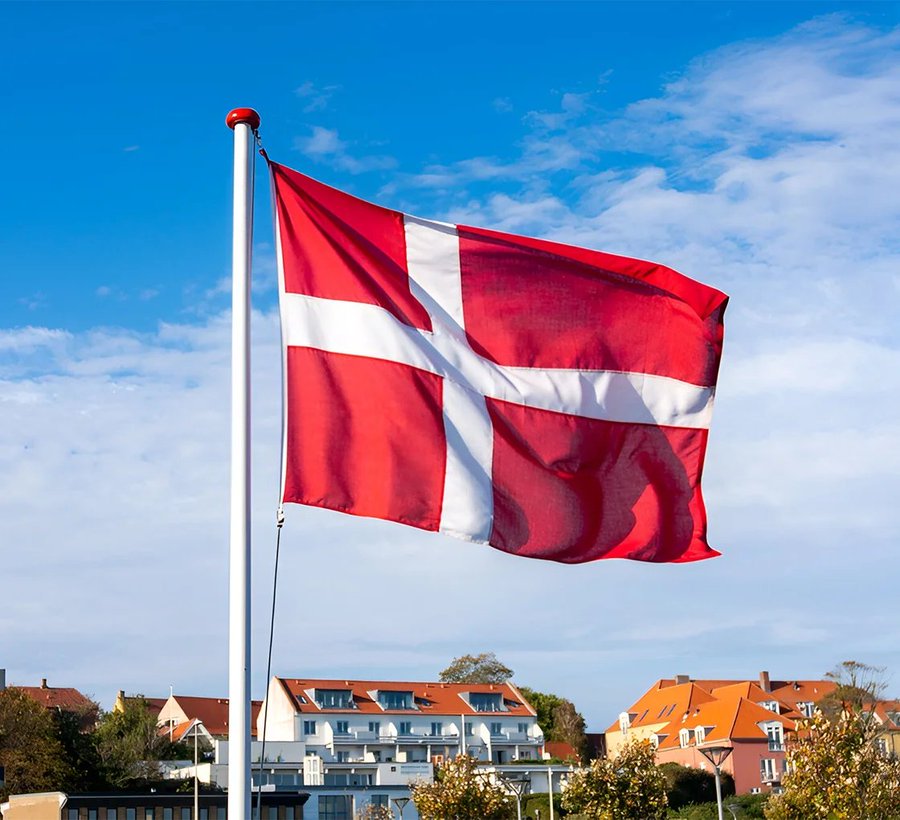
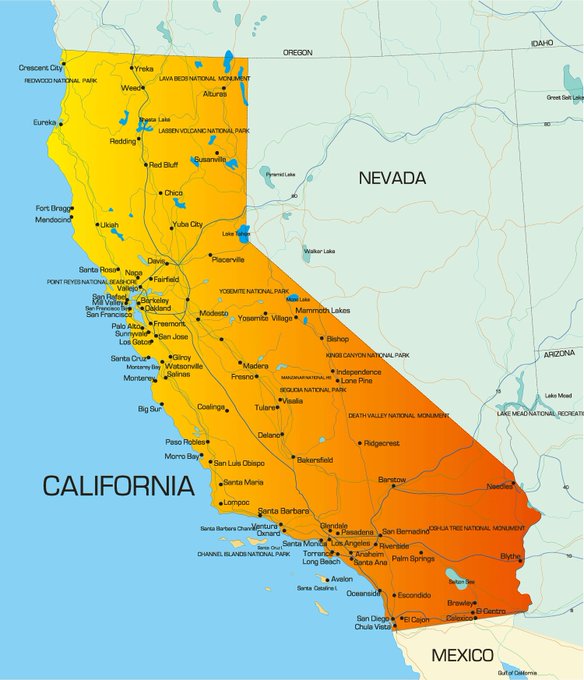
More than 200,000 Danish citizens have signed a petition to buy California as a response to Trump’s attempt to take Greenland. They say they will provide Californians with “rule of law, universal health care, fact-based politics, and a lifetime supply of Danish pastries.”
No Lie with Brian Tyler Cohen tweet mediaNo Lie with Brian Tyler Cohen tweet media
English
11.2K
23.2K
179.2K
5.9M
Mikey Smith
Mikey Smith@mikeysmith·
This is a reference to Which Way Western Man, a 1978 book by William Gayley Simpson, one of America's most prominent Nazis. The book argues Hitler was right, claims there is a Jewish plot against white people and advocates violence against Jewish people
The White House@WhiteHouse

Which way, Greenland man?

English
464
4.7K
20.6K
1.5M
Ryan Rholes
Ryan Rholes@RRholes·
@FoxNews Is that the flag of Somalia in the background?
English
0
0
0
24
Fox News
Fox News@FoxNews·
DEM GOV. TIM WALZ: "I have a very simple message: We do not need any further help from the federal government." "To Donald Trump and Kristi Noem: You've done enough." "I've issued a warning order to prepare the Minnesota National Guard. We have soldiers in training and prepared to be deployed, if necessary." "Minnesota will not allow our community to be used as a prop in a national political fight. We will not take the bait." | @TheStoryFNC
English
8.6K
3.3K
19.5K
4M
Alex Imas
Alex Imas@alexolegimas·
@huseynovecon Lived through it too. Not fun at all---Moldova had a civil war shortly after. But necessary.
English
2
0
4
580