

Raleigh_Encryp
254 posts

Raleigh_Encryp
@Rayleigh_Encryp
Web3 enthusiast | Web3 Content | On-chain creativity
Katılım Aralık 2015
1.2K Takip Edilen1K Takipçiler

Privacy isn't a feature.
It's the foundation of the next generation of Web3.
That's why Fluton is building with Fully Homomorphic Encryption (FHE), enabling applications to process encrypted data without ever exposing it.
🔹 Sensitive user data stays encrypted at every stage.
🔹 Digital assets remain protected from unauthorised access.
🔹 Smart contracts compute directly on encrypted data without decryption.
🔹 Unlocks privacy-preserving DeFi, AI, and on-chain identity.
As Web3 moves towards mainstream adoption, trust will be defined by infrastructure that delivers both transparency and confidentiality.
FHE isn't just improving blockchain privacy it's redefining what's possible.Privacy isn't a feature. It's the foundation of the next generation of Web3.
That's why @FlutonIO is building with Fully Homomorphic Encryption (FHE), enabling applications to process encrypted data without ever exposing it.
🔹 Sensitive user data stays encrypted at every stage.
🔹 Digital assets remain protected from unauthorised access.
🔹 Smart contracts compute directly on encrypted data—without decryption.
🔹 Unlocks privacy-preserving DeFi, AI and on-chain identity.
As Web3 moves towards mainstream adoption trust will be defined by infrastructure that delivers both transparency and confidentiality.
FHE isn't just improving blockchain privacy it's redefining what's possible.
#fluton #web3

English


Most security models protect data at rest and in transit.
The protection usually ends the moment computation begins.
That longstanding gap has limited what privacy systems can realistically deliver.
@FlutonIO addresses it through Fully Homomorphic Encryption.
Encrypted data can be processed and return encrypted results without ever being decrypted.
Privacy is built into the computation itself rather than added as an external layer.
As AI, decentralized infrastructure, and financial systems grow more interconnected, the ability to compute on sensitive data without exposing it becomes a practical requirement.
The direction is computation that maintains confidentiality throughout the entire process.

English
@KhaHuynh1995 @LLMTUNE_IO xịn quá bác ơi
cho e xin cái follow nhé
Tiếng Việt

Limitations of General AI: Standard AI models struggle with the specific internal processes and data of individual businesses.
Solution from @LLMTUNE_IO LLMTune: Enables fine-tuning AI on internal data (processes, documentation, domain knowledge) to build tailored Enterprise AI Assistants.
Core Benefits:
Delivers accurate answers aligned with internal standards, reducing search time.
Supports onboarding for new employees and optimizes decision-making and workflows.
Deployment Advantages: LLMTune provides an end-to-end solution (data management, training, API deployment), allowing businesses to adopt AI quickly without building infrastructure from scratch.

English

What Makes a Good Training Dataset?
When people discuss AI performance, they usually compare model sizes or benchmark scores. But after exploring LLMTune's documentation, I think the real differentiator is something much less glamorous: the training dataset.
A good dataset isn't simply a large collection of text. More data doesn't automatically produce a better model. What matters is whether the data is relevant, clean, diverse, and representative of the tasks the model is expected to perform.
If your goal is to build an AI assistant for finance, training it on random internet conversations won't create expertise. Instead, the dataset should contain high-quality financial documents, structured examples, and carefully curated instruction-response pairs that teach the model how experts actually solve problems.
This philosophy aligns with LLMTune's approach to fine-tuning. Rather than focusing only on model training, the platform supports the entire workflow from dataset preparation and fine-tuning with methods such as SFT, DPO, PPO, and RLAIF, to evaluation, deployment, and continuous iteration. The model only learns as well as the data it receives, making dataset quality the true foundation of AI performance.
To me, data is becoming the new competitive moat. Open-source models are increasingly accessible to everyone, but high-quality proprietary datasets are not. In the long run, businesses won't be separated by which foundation model they use they'll be separated by how well they teach that model with their own knowledge.
@LLMTUNE_IO

Bad Girl@badgirl_30b4
Why Generic AI Isn't Enough for Businesses The more I learn about enterprise AI, the more I realize that generic AI is only the starting point not the destination. Foundation models like Llama or Qwen are incredibly capable, but they are designed to answer questions across almost every domain. That flexibility is impressive, yet businesses don't compete on general knowledge. They compete on proprietary data, internal processes, and domain expertise. A financial company doesn't need an AI that knows a little about everything it needs one that understands financial regulations and risk analysis. A healthcare provider needs medical reasoning. A customer support team needs responses aligned with its own products and policies. These are challenges that prompt engineering alone can't always solve. This is why I find LLMTune's vision compelling. Rather than treating AI as a one-size-fits-all solution, it provides an end-to-end platform where organizations can fine-tune foundation models using their own datasets, evaluate performance, deploy models through APIs, and continuously improve them as new data becomes available. The value isn't just in training a model once it's in creating a repeatable workflow that keeps AI aligned with the business as it evolves. In my opinion, the next generation of AI winners won't simply adopt the latest open-source model. They'll build AI that reflects their own knowledge, data, and competitive advantages. Generic AI may get you started, but customized AI is what creates long-term differentiation. @LLMTUNE_IO
English

𝗕𝗨𝗜𝗟𝗗 𝗙𝗜𝗡𝗘 𝗧𝗨𝗡𝗘 𝗗𝗘𝗣𝗟𝗢𝗬 𝗦𝗖𝗔𝗟𝗘.
The image sums up something I've been thinking about for a while: building AI isn't just about choosing the best model anymore. The real challenge is taking an idea from experimentation to a production-ready application without creating a complicated workflow along the way.
That's why platforms that connect every stage of the LLM lifecycle are becoming increasingly important. Instead of switching between multiple tools for training, evaluation, deployment, and inference, everything works as one continuous process. That means less time managing infrastructure and more time building products that actually deliver value.
𝗧𝗛𝗘 𝗟𝗟𝗠 𝗟𝗜𝗙𝗘𝗖𝗬𝗖𝗟𝗘 𝗜𝗦 𝗪𝗛𝗘𝗥𝗘 𝗧𝗛𝗘 𝗥𝗘𝗔𝗟 𝗪𝗢𝗥𝗞 𝗛𝗔𝗣𝗣𝗘𝗡𝗦
Fine-tuning is only the beginning. A model still needs to be evaluated, compared against benchmarks, deployed reliably, integrated into existing applications, and monitored as real users interact with it. Missing any one of these steps can turn a promising prototype into an unreliable product.
What stands out about LLMTune is its focus on treating these stages as one connected workflow rather than isolated features. From preparing datasets to deploying production endpoints through OpenAI-compatible APIs, the platform is designed to help teams move from experimentation to real-world deployment with greater confidence.
𝗪𝗛𝗬 𝗧𝗛𝗜𝗦 𝗔𝗣𝗣𝗥𝗢𝗔𝗖𝗛 𝗠𝗔𝗧𝗧𝗘𝗥𝗦
As AI adoption accelerates, the bottleneck is no longer access to powerful models. The bottleneck is building reliable systems that can consistently perform in production while remaining easy to manage, iterate on, and scale.
Bringing fine-tuning, evaluation, deployment, security, and framework integrations into one ecosystem reduces unnecessary complexity. It creates a smoother experience for developers, data scientists, DevOps teams, and product builders who want to focus on solving problems instead of maintaining fragmented tooling.
𝗟𝗢𝗢𝗞𝗜𝗡𝗚 𝗔𝗛𝗘𝗔𝗗
We're entering an era where success won't be determined solely by who has access to the largest language model. It will be determined by who can train, evaluate, deploy, and continuously improve those models efficiently.
I'm looking forward to exploring more of the LLMTune ecosystem and sharing what I learn along the way.
The technology is exciting, but what's even more interesting is seeing how builders use it to create the next generation of AI applications. @LLMTUNE_IO

English
🚀 LLMTune supports CLI for AI development
One thing I appreciate about LLMTune is how it doesn’t force you into a single way of building AI.
As a beginner, the visual UI makes everything feel simple and approachable. You can get started without touching a line of code.
But as you go deeper, the CLI starts to matter.
-> It’s faster
-> More flexible
And built for automation
You stop clicking - and start building.
That shift is important.
Because great AI tools aren’t just easy to use.
They scale with you.
LLMTune understands that:
👉 UI lowers the barrier
👉 CLI unlocks real power
You start simple
Then grow into something much more powerful
That’s what makes the experience feel complete.
@LLMTUNE_IO

English

Maintaining a balance is the best approach between transparency and privacy.
Through this philosophy, Fluton builds an infrastructure where users can still enjoy the transparency of blockchain without sacrificing privacy.
With Encrypted Intents and Fully Homomorphic Encryption (FHE), data and transactions are always encrypted even during processing, protecting trading strategies, assets, and sensitive information from MEV bots or malicious actors.
Flington doesn't choose between transparency and privacy; Fluton offers both, creating a secure, efficient, and reliable DeFi platform for the next generation of Web3.
@FlutonIO

English

Cross-chain messaging is broken in one critical way.
Every message is public.
When protocols communicate across chains, the entire content of that communication is visible to anyone watching. Intent. Data. Instructions. All exposed.
This creates a fundamental problem for confidential DeFi.
You can encrypt a transaction on one chain. But the moment it needs to communicate with another chain, the message layer exposes everything.
The encryption is only as strong as its weakest link.
@flutonIo solves cross-chain messaging privacy completely.
Here is how:
Encrypted Payload Transmission When Fluton sends an IBC packet via Union, the payload contains only encrypted data. Source chain information, amounts, and instructions all remain ciphertext throughout transmission.
ZK Verified Delivery Union verifies EVM blocks using zero knowledge proofs. Message integrity confirmed without exposing content.
TEE Coordinated Handoff When messages move between different chain environments, TEE enclaves coordinate the transition without decrypting content.
End to End Confidentiality From origin chain to destination chain, not a single byte of message content appears in plaintext.
This means:
Private swaps stay private across chains. Confidential bridges reveal nothing mid-transit. Encrypted intents arrive exactly as submitted.
The chain does not matter. The privacy holds.
@flutonIo is not just private on one chain.
It is private across all of them.

English

Good morning - Chào buổi sáng cả nhà! ☀️
Mình và bạn đang ngồi nhâm nhi tách trà, bắt đầu ngày mới.
Chúc anh ngày đầu tuần thật vui vẻ và nhiều năng lượng nhé ☕
AE sáng nay uống gì? Comment chia sẻ đi!
#GM

Neutral View Lab@NeutralViewLab
Good morning - Chào buổi sáng cả nhà! ☀️ Mình cùng bạn đang ngồi nhâm nhi trà nóng, bắt đầu ngày mới với nhiều năng lượng. Chúc anh em một ngày CN thật tốt lành và nhiều năng lượng nhé ☕ Anh em hôm nay thế nào? Comment chia sẻ đi! #GM
Tiếng Việt


The Role of Shielding in Fluton
Blockchain is transparent by default, meaning wallet balances, transaction amounts, and on-chain activities are publicly visible. Shielding is the feature that allows Fluton to change this
Shielding converts public ERC-20 assets into encrypted assets, enabling them to be used within Fluton's Confidential Execution environment. It is not a mixer or a privacy pool - it simply transforms assets into an encrypted state while users retain ownership
This is the first and most important step in Fluton's privacy model. Once assets are shielded, users can securely access features such as:
-> Encrypted Intents for private transaction requests
-> Private swaps and cross-chain execution
-> Flutonized Vaults with confidential strategy execution
-> FHE-powered computation on encrypted data without revealing balances, transaction amounts, or investment strategies.
When users want to return to the public blockchain, they can Unshield their assets, converting them back into standard ERC-20 tokens while revealing only the minimum information required for settlement
In short, Shielding is the gateway to Fluton's confidential ecosystem. It transforms public assets into encrypted assets, making private DeFi, secure cross-chain interactions, and confidential execution possible.
@FlutonIO

English

💭 A Different Perspective on Web3 Infrastructure
✴️When people talk about Web3, the spotlight usually goes to new blockchains or fast growing applications. Yet behind every successful ecosystem, there are infrastructure projects quietly making everything work together.
✅Fluton is one of those projects.
✴️Instead of joining the race to become another Layer 1, Fluton focuses on building infrastructure that helps applications and protocols connect, scale, and operate more efficiently across a multi chain ecosystem. It is a long term approach that creates value far beyond a single network.
✴️What stands out about Fluton is its builder first mindset. By providing stronger infrastructure and better tools, Fluton empowers developers to create better products, ultimately improving the experience for every Web3 user.
✴️Fluton may not always be the loudest project in the space, but the strongest ecosystems are often built on infrastructure that works quietly in the background.
🚀 Building the foundation before building the future.
@FlutonIO

MrChuoi279@mrchuoi279
🌉 Web3 is becoming increasingly multi chain, yet the user experience remains fragmented. ✔️Swapping assets, bridging funds, and accessing DeFi across different networks often require switching wallets, changing networks, and exposing transaction data along the way. 🔥Fluton is taking a different approach. ✔️Instead of launching another blockchain, Fluton is building a Universal Confidential Execution Layer that enables private interactions across multiple chains through a unified execution environment. With Encrypted Intents powered by Fully Homomorphic Encryption, sensitive transaction details remain protected from creation to settlement. The future of DeFi is not only faster and more scalable. It should also be seamless and private. 🔥That is exactly the future Fluton is building. @FlutonIO
English

Cross-Chain Has Solved Connectivity. Privacy Is the Next Frontier.
Over the past few years, blockchain infrastructure has made remarkable progress in connecting ecosystems. Today, users can move assets between Ethereum, Base, Arbitrum, Solana, and dozens of other networks in just a few clicks.
But while interoperability has improved, privacy hasn't kept pace.
Every bridge transaction can reveal valuable information: wallet addresses, asset types, transfer amounts, destination chains, and even a user's broader investment strategy.
As cross-chain activity becomes the backbone of DeFi, these data leaks create new risks, not only for individual users but also for institutions managing large amounts of capital. This is where confidential cross-chain execution enters the conversation. Instead of exposing transaction details across multiple networks, the goal is to keep user intent, balances, routing paths, and execution data encrypted throughout the entire process.
Projects like @FlutonIO are exploring this model by combining Fully Homomorphic Encryption (FHE) with encrypted intents, aiming to make privacy a native layer for cross-chain interactions rather than an optional feature.
The future of interoperability may no longer be measured solely by how many chains are connected.
It may be defined by how securely and privately value can move between them. In the next era of Web3, interoperability and confidentiality are unlikely to compete. They will need to evolve together
#Fluton #CrossChain #FHE #Privacy #Web3 #DeFi #Ethereum #Blockchain #ConfidentialComputing

English

SIMPLECHAIN POKER EVENT
Weekend entertainment with poker from the Simplechain community
After 2 hours of brainstorming and experiencing many emotions, I finally reached the 5th position on the ranking list.
Even if the last game was unlucky, otherwise I would have been in the top 2
@SimpleChain_RWA

English
1/
LLMTune.io and Confidential AI - Why Should Businesses Care?
AI is smarter than ever, yet many companies still hesitate to upload internal data to ChatGPT or Claude.
So how is LLMTune addressing this challenge?
@LLMTUNE_IO

English

Part3: The reasons why RLNC is the proven optimal solution for decentralized data transmission.
1⃣What Makes RLNC Different ?
RLNC changes the role of every node in the network
Instead of only forwarding packets, every node can immediately generate new encoded packets from the coded packets it has already received
In other words:
-> The sender encodes once
-> Every relay node recodes without decoding the original data
-> New coded packets continue flowing throughout the network
This allows the network itself to actively participate in moving data instead of relying on a single source.
2⃣Why Does RLNC Perform Better ?
The biggest difference lies in how packet loss is handled.
Reed–Solomon
With end-to-end coding, packet losses accumulate across every network hop.
As the transmission path becomes longer:
-> More repair data is required
-> Throughput decreases
-> Ffficiency drops
RLNC
With RLNC:
-> Every relay node regenerates fresh coded packets
-> Packet losses are repaired continuously inside the network
-> Losses do not accumulate in the same way across the entire path
As explained in the discussion, this allows RLNC to maintain throughput close to the weakest individual network link instead of suffering compounded losses over every hop
3⃣Flexibility Matters
Another important difference highlighted by Optimum is flexibility
Reed–Solomon only supports certain predefined combinations of code length and repair rate because of its mathematical construction
RLNC, by using random linear combinations, offers much greater freedom in choosing coding parameters, making it more adaptable to dynamic decentralized networks
4⃣RLNC Is Built for Networks
The key takeaway is that the two technologies were created to solve different problems.
🔸Reed–Solomon was designed to protect data between endpoints.
🔸RLNC was designed specifically for networks, where many intermediate nodes cooperate to move data efficiently.
This makes RLNC particularly well suited for blockchain environments, where data must travel quickly across thousands of distributed participants.
➡️Reed–Solomon remains an excellent coding technique for storage and traditional point-to-point communication.
➡️However, blockchain networks require more than reliable data recovery - they require fast, scalable, and decentralized data propagation.
That's why Optimum builds its networking layer around RLNC:
🔸Every node contributes to forwarding data
🔸Intermediate nodes can generate new coded packets without decoding
🔸Throughput scales much better as networks grow.
The coding system is more flexible and naturally fits decentralized Web3 infrastructure
In short, Reed–Solomon protects data, while RLNC transforms how data moves across decentralized networks. According to Optimum, this is why RLNC is the foundation of its networking architecture for Web3.
@get_optimum
@aqccapital | @blockchainjeff | @ada_pegasus

Quy_Coc_Tien_Sinh@QuyCoc_TienSinh
Part 2: RLNC vs. Reed–Solomon: Speed Comparison in Real-World Scenarios A common question when learning about Optimum is: If both RLNC and Reed–Solomon protect against packet loss, which one is actually faster ? The answer depends on where they're used. Reed–Solomon is excellent for storage and simple transmission, while RLNC is designed for large, decentralized networks like blockchains. Scenario 1: Sending a File from One Device to Another Example: Downloading a file from a server. Reed–Solomon -> The sender encodes the data once -> The receiver reconstructs any missing packets -> There are few relay nodes, so packet loss is relatively easy to handle ✅ Very efficient for point-to-point communication. RLNC -> Also works well, but its additional recoding capability provides little advantage because there are very few intermediate nodes Result: Both perform similarly, and Reed–Solomon is often sufficient. Scenario 2: Large Blockchain Network Example: A validator propagates a new block to thousands of nodes worldwide. Reed–Solomon -> Only the proposer creates the encoded packets -> Relay nodes simply forward them -> As packets travel across many hops, losses accumulate -> More retransmissions or additional repair packets may be needed. Result: 👉Propagation slows down 👉Throughput decreases as the network grows RLNC -> The proposer encodes the block -> Every relay node immediately generates fresh coded packets -> Multiple network paths contribute simultaneously -> Packet loss is repaired continuously throughout the network Result: 👉Faster propagation 👉Higher throughput 👉Better scalability Scenario 3: Congested Network Suppose many packets are dropped because of congestion Reed–Solomon -> If too many packets are lost, the receiver may not have enough information to recover the data -> Additional repair data or retransmissions may be required RLNC -> Every relay keeps producing new innovative coded packets -> The receiver only needs to collect enough independent packets, regardless of which path they arrived from Result: 👉RLNC maintains smoother performance under packet loss Scenario 4: Growing Network Size Imagine expanding from 100 nodes to 10,000 nodes. Reed–Solomon As the number of hops increases: -> Packet losses accumulate -> Throughput declines -> Propagation becomes slower RLNC As more nodes join: -> More forwarding paths become available -> More nodes generate innovative coded packets -> The network can make better use of available bandwidth. Result: 👉RLNC benefits from larger decentralized networks instead of being limited by them 📌Reed–Solomon is optimized for protecting data 📌RLNC is optimized for moving data efficiently across a decentralized network For everyday file transfers, the speed difference is often small. But in large-scale Web3 networks with many relay nodes and frequent packet loss, RLNC offers a significant advantage by maintaining higher throughput, reducing the impact of losses across multiple hops, and making better use of the network as it grows. Part 3: ............................... @get_optimum @aqccapital | @blockchainjeff | @ada_pegasus
English

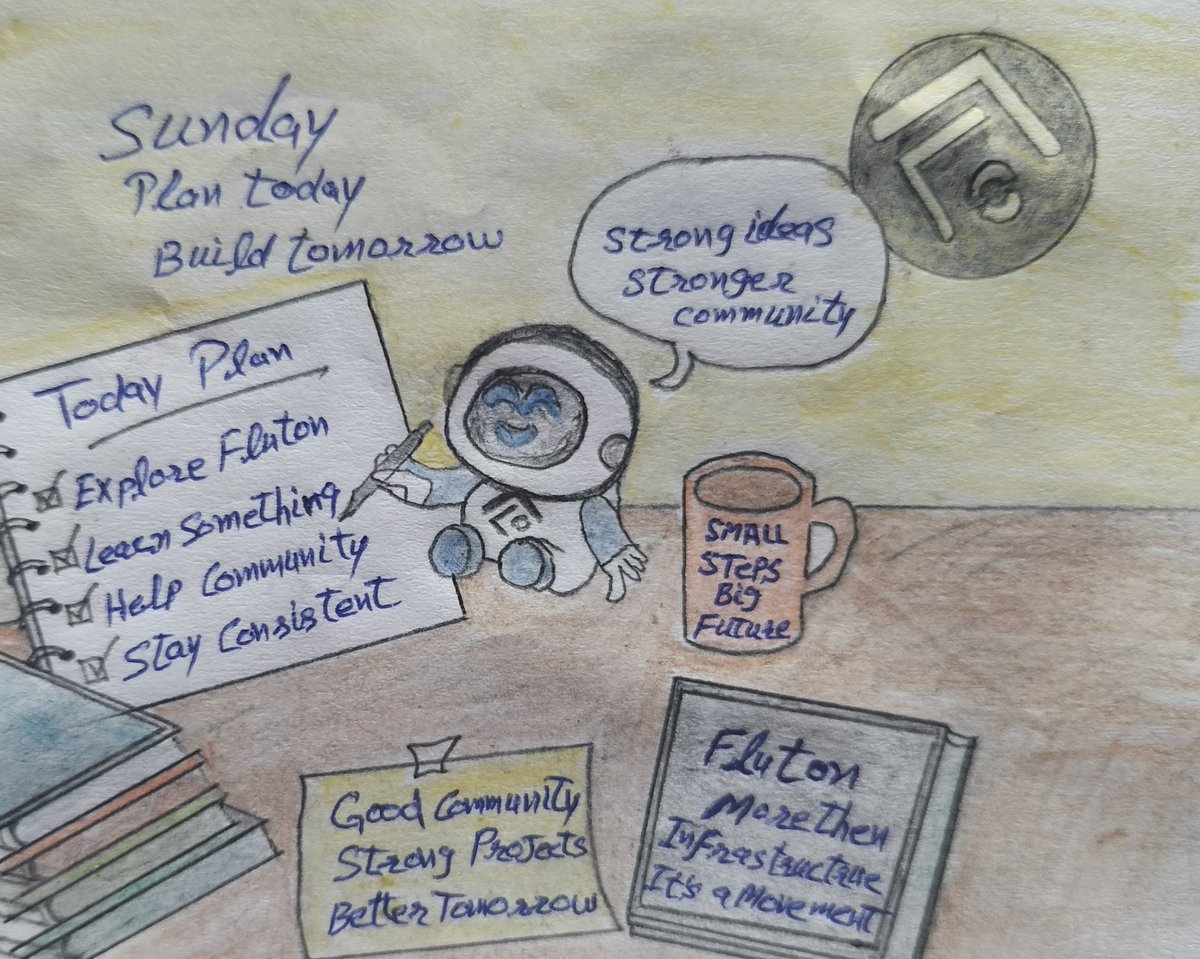
Sunday is for slowing down, learning something new and preparing for the week ahead.
Today, I am spending time exploring what @FlutonIO is building.
Strong communities are built one step at a time, and every project begins with people who are ready to learn and stay consistent.
MANIKING 🟦 Optimum (❖,❖) $BUBU@maniking5566
Curious projects are built by asking better questions, not chasing hype. @FlutonIO is focused on building infrastructure that developers can actually use. Looking forward to seeing how the ecosystem grows and what the community creates next. #Fluton #Web3 #BuildInPublic
English