Real Charts

935 posts

Real Charts banner
Real Charts

Real Charts

@RealChinaCharts

A country does not rise to the level of its innovation. It falls to the level of its industrial commons. | more 👇

Katılım Ekim 2021
197 Takip Edilen1.5K Takipçiler
Sabitlenmiş Tweet
Real Charts
Real Charts@RealChinaCharts·
🚨PLEASE ASSIST, I'm crowd sourcing A list of American inventions that America can no longer produce. Because the tech was sold, failure to cross the "valley of death" (commercialize), lack of govt support, aggressive foreign investment, or any other reason. Please reply to this X/tweet and I'll thread them. Bonus points for supporting links! I'll start...
English
4
6
17
20.1K
Real Charts retweetledi
Luca Fornaro
Luca Fornaro@LucaFornaro3·
respond to China Shock 2.0 by supporting innovation and high-tech sectors. We have tried to articulate this view here x.com/LucaFornaro3/s…, but there's much more analytical and empirical work to do, especially in terms of designing appropriate policy responses.
Luca Fornaro@LucaFornaro3

Industrial policies (IPs) are rarely connected to global imbalances. Yet, IPs are a key feature of many surplus countries. This new paper tackles three questions: Can IPs shape global imbalances? What are the spillovers to deficit countries? What policy responses are available?

English
5
4
50
2.9K
Luca Fornaro
Luca Fornaro@LucaFornaro3·
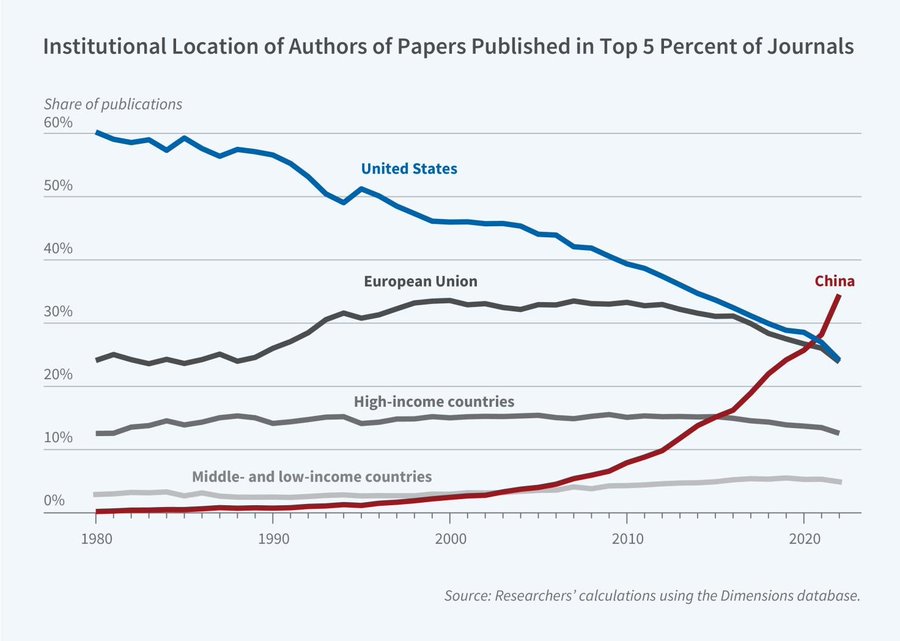
This post by @adam_tooze is excellent. There's one point missing: global imbalances are part of a struggle for technological hegemony. When China puts in place policies that foster trade surpluses in high-tech sectors, it is not only boosting its own technological development,
Luca Fornaro tweet media
Adam Tooze@adam_tooze

Global imbalances - April 2026. A new cocktail in old bottles. The latest Chartbook newsletter just dropped. Check it out here: tinyurl.com/6zwwzydk

English
9
77
344
103.5K
Real Charts retweetledi
DogeDesigner
DogeDesigner@cb_doge·
"People get confused sometimes they think an economy is money. Money is a database for exchange of goods & services. Money doesn't have power in & of itself. The actual economy is goods & services" 一 Elon Musk
English
934
2.9K
12.1K
1M
Real Charts
Real Charts@RealChinaCharts·
“This will affect the prosperity of the United States, Western countries, and democracies very broadly.” - David Autor on Yascha Mounk’s podcast The Good Fight
English
0
0
0
65
Real Charts
Real Charts@RealChinaCharts·
“However, the competition from China is now actually much more significant. It is not just about jobs making commodity products, but competition in the core leadership sectors of technology that have both civilian and military applications…”
English
1
0
0
124
Real Charts retweetledi
Aaron Slodov
Aaron Slodov@aphysicist·
robotics parts supply chain is the next chips war. if we accept "american brain, chinese body", we are giving away the farm. if we were serious we'd be plowing billions of dollars into building massive suppliers right now. there is no alternative.
Serenity@aleabitoreddit

x.com/i/article/2033…

English
33
79
657
60K
Ti Morse
Ti Morse@ti_morse·
The US vs. China Manufacturing Debate My first debate between @sdamico, founder of @ImpulseLabs, and @aphysicist, founder of @atomic_inc. Timestamps: 0:39 Introductions 11:34 Is it possible to reverse America’s manufacturing decline? 16:37 Where would Sam invest $100M in a factory today? 21:28 How California made it illegal to do chemistry w metals 25:43 Elon on Tesla's Shanghai Gigafactory 32:01 Using the data center boom to pull advanced capabilities onshore 36:51 Building Chinese level capacity in America 38:33 The US Gov hasn't incentivized companies to build base level capacity 42:54 Why space companies have to vertically integrate their supply chains 45:06 The advantage of building a Chinese supply chain 49:10 Why Apple manufactures all their products in China 59:42 Apple exports engineering expertise 1:02:19 Consumer electronics 1:07:55 How the advent of humanoid robots will shift the balance of power 1:12:29 Why Apple spent hundreds of billions building their supply chains in China
English
34
104
662
226.1K
Real Charts
Real Charts@RealChinaCharts·
Industrial commons are really impressive when you see them. China has the strongest in electronics. It’s a complete ecosystem. We’ll keep banging the drum: A country does not rise to its level of innovation. It falls to the level of its industrial commons.
Mehdi (e/λ)@BetterCallMedhi

I spent time in Shenzhen last year and when I saw Merz come back from China saying Germans need to work more I immediately knew what broke his brain because I lived the exact same cognitive shock my first week in Huaqiangbei I burned through 4 prototype iterations of a motor controller board for less than a thousand bucks total, back home a friend was working on something similar and spent over 12 thousand for a single revision that took almost two months to arrive when you live that contrast in your own hands with your own project something permanently shifts in how you see the world and it goes way deeper than speed & cost what Shenzhen actually built is a collective learning organism, imagine 20 PCB fabs 15 injection mold shops 30 component distributors and a hundred firmware freelancers all within a 2km radius, looks insanely redundant from the outside until you realize redundancy is actually information density in disguise I watched this firsthand with an injection mold supplier I was working with, this guy had seen a hundred founders iterate similar thermal designs over 6 months so he proactively modified his tooling before I even opened my mouth, he knew what I needed before I knew what I needed, the intelligence lives in the relationships between the nodes and it compounds daily the west thinks about manufacturing as a cost center you optimize by centralizing… China accidentally built a distributed neural network of manufacturing intelligence where knowledge diffuses horizontally across thousands of agents faster than any single western company can process internally so when Merz comes back and says we need to work a bit more I think he saw the problem but COMPLETELY misdiagnosed the solution, telling Germans to work harder is like telling a horse to gallop faster when the other side built a combustion engine the gap is ARCHITECTURAL it’s ecosystem density, you need a custom connector in Shenzhen you walk 200 meters, in Munich you send an email and wait 3 weeks it’s iteration speed, parallel search vs sequential optimization at the system level, it’s risk tolerance, Chinese founders ship something broken on Monday fix it Tuesday ship again Wednesday while European companies are still in the approval phase for the pilot program of the feasibility study… and Merz only saw the surface, what he missed is the tier 2 cities like Hefei Chengdu Wuhan replicating the Shenzhen model at scale right now BYD going from irrelevant to outselling every european automaker combined in roughly 5 years, Huawei building its own 7nm chip under maximum sanctions when every analyst said it was physically impossible & behind all of that a government that treats advanced manufacturing as an existential national priority while europe debates whether AI needs another ethics committee I think what we’re watching is the most asymmetric economic competition in modern history and most western leaders are still framing it as a productivity problem when it’s actually an ontological one Europe & America are optimizing variables that China stopped tracking years ago meanwhile China is compounding on dimensions the west has no framework to even measure Merz at least had the courage to name it out loud and I respect that genuinely but working a bit more inside a broken architecture just means you arrive at the wrong destination slightly faster

English
1
0
2
268
Real Charts
Real Charts@RealChinaCharts·
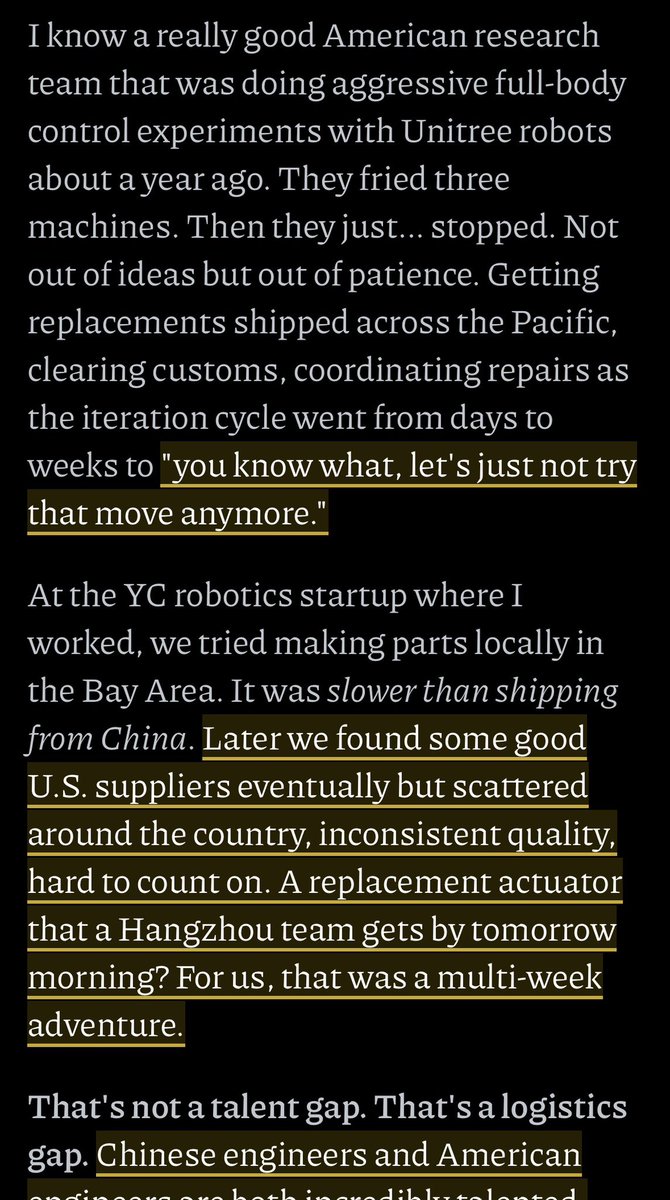
Great piece here. We’ve been banging this drum: A country doesn’t rise to the level of its innovation. It falls to the level of its industrial commons. “You know what, let’s not try that move anymore.” American robotics engineers give up because they can’t get the parts. They don’t have the industrial commons.
Real Charts tweet media
Rui Xu@xu545302

x.com/i/article/2023…

English
0
0
4
295
Real Charts
Real Charts@RealChinaCharts·
We will need hardcore vertical integration under a few big firms who can muster resources and get local support, state permitting fast track. Then the knowledge from building the verticals can diffuse and more decentralized clusters can be seeded. Will need gov support across it all.
English
0
0
0
89
Edward
Edward@somefoundersalt·
Been thinking: if the U.S gets AGI first, but our industrial base is still rotting away, then how can we capitalize on it in a meaningful way? Re-industrialization can’t occur overnight even with AGI, and if China achieves AGI before we can do it, our advantage is nullified, no?
English
33
18
528
57.3K
Real Charts
Real Charts@RealChinaCharts·
The term is industrial commons: concentrated capabilities that turn geography into a learning engine. Difficult to seed. Very possible to build. Once the flywheel spins, cost curves stop mattering and learning curves take over.
English
0
0
2
396
Real Charts
Real Charts@RealChinaCharts·
@ubiquitousnewt Of course personality has heritable components. But heritable is not destiny. Every stable civilization in history invested heavily in forming virtues precisely because raw human tendencies are not enough to sustain social order.
English
1
0
0
19
Stella
Stella@ubiquitousnewt·
Personality is heritable and stable across time. What you are doing is reciting the blank slate. That humans can be moulded into pretty much anything with the right influences. This has been completley destroyed. It isnot true. but people still believe out of blind faith. See Steven Pinker and the blank slate.
English
1
0
0
37
Rob Henderson
Rob Henderson@robkhenderson·
Rich kids and poor kids now grow up in separate Americas. If you go back to 1960, 95% of children in the U.S. were raised by two married parents, regardless of social class—rich kids and poor kids alike. Fast forward to 2005, and for upper and upper-middle-class families, that number dropped only slightly, from 95% to about 85%. So in those households, the vast majority of kids were still raised by two married parents. For working-class and poor families, it was a different story. In 1960, 95% of kids had two married parents. By 2005, that had plummeted to around 30%. And that’s exactly what I saw growing up. I was a kid in 2005, and in the neighborhoods around me, intact families were rare. I had five close friends. None of us were raised by two married parents. I was in foster homes. Two friends were raised by single moms. Another by a single dad. Another by his grandmother because his mom was on drugs and his dad was in prison. That’s a pretty common picture of working-class families in America now—a lot of family breakdown.
English
10
94
573
45.8K
Real Charts
Real Charts@RealChinaCharts·
@ubiquitousnewt Treating marriage decline as “true dispositions revealed” assumes character is fixed rather than formed, which is a very modern mistake.
English
1
0
0
18
Stella
Stella@ubiquitousnewt·
@RealChinaCharts CS Lews isn't aware that people have different moral codes because they have different personalities.
English
1
0
0
32
Real Charts
Real Charts@RealChinaCharts·
Hard disagree. “Once those constraints were removed, people began to behave in line with their true dispositions.” 👎 CS Lewis’s Abolition of Man would call that “men without chests”, intellect and appetite remain, but the trained moral core disappears. He’d point out this reply is riddled with conditioner logic = the idea that humans are just bundles of traits to be sorted, optimized, and explained… rather than moral agents formed by objective values. Virtues are trained. Self-control, fidelity, duty, perseverance are not personality quirks. They come from family, culture, religion, education… The fact a class of people lost those virtues is not a sign they were never able to do those things. It’s a sign we stopped teaching them virtues required for civilization.
English
1
0
1
38
Stella
Stella@ubiquitousnewt·
The difference in marriage rates by class reflects underlying differences in traits that were previously suppressed by strong social norms and institutional pressure. In the past, stigma, religion, and limited exit options forced many people into marriage regardless of their psychological suitability. This included people who were impulsive, promiscuous, unstable, low in self control, or poorly equipped for long term cooperation. Many of these marriages were unhappy, and stressful and destructive to childrens wellbeing. But they persisted because social constraints were strong. Once those constraints were removed, people began to behave in line with their true dispositions. Marriage became optional rather than mandatory. Under these conditions, individuals with the traits conducive to stable partnership, such as conscientiousness, emotional regulation, future orientation, and pro social behaviour, continued to marry. These traits are disproportionately concentrated in the higher and upper middle classes. Those lacking these traits increasingly opted out of marriage or failed to sustain it. As a result, marriage has become a self sorting institution that selects for psychological stability and long term orientation. The collapse of marriage in the lower classes therefore reflects not merely or primarily economic change but the expression of underlying trait differences that were always present but previously hidden by social enforcement. Modern family patterns are not an anomaly but the natural behavioural reality once major social safeguards are removed.
English
1
1
30
865
Michael Pettis
Michael Pettis@michaelxpettis·
Alan Blinder is saying the same thing I am: comparative advantage is expressed in balanced trade, when the purpose of maximizing exports is to maximize the value of imports. When an economy exports mainly in order to externalize the cost of its weak domestic demand, that is not comparative advantage. I don't understand why it is so hard to understand something so obvious.
English
7
6
159
5.8K
China Banking News
China Banking News@CBankingEditor·
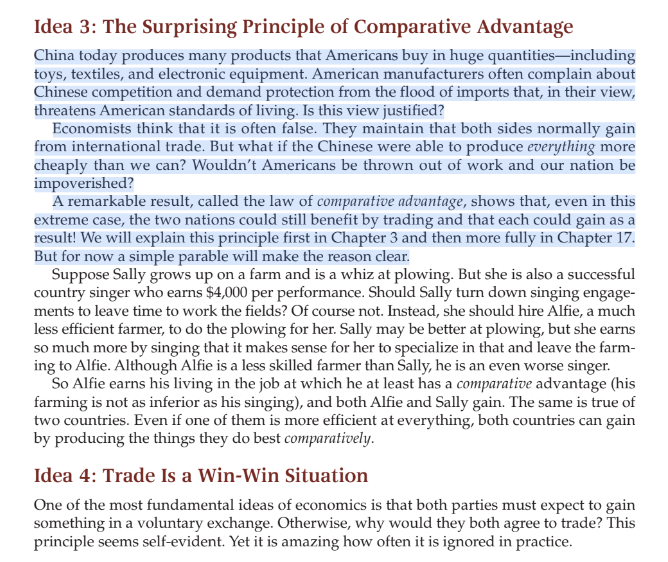
It's just fascinating to see the correspondence between textbook examples of fundamental macroeconomic principles and today's interminable discourse over China-US trade disputes. Compare Michael Pettis's latest commentary with this passage from Alan Blinder's "Macroeconomics: Principles and Policy" - first published over two decades ago.
China Banking News tweet media
Michael Pettis@michaelxpettis

David Ricardo showed in 1817 that if each country produces according to its comparative advantage, global output is maximized. Many analysts argue today that China's trade surplus reflects its comparative advantage in producing everything, and so its trade surplus is good for global growth. But that's not true, and that is certainly not what Ricardo showed. China has a competitive advantage, not a comparative advantage, largely for the same reason that it has such weak consumption – large direct and indirect transfers from the household sector, in the form of an undervalued currency, cheap credit, restricted labor, overspending on infrastructure, land and other subsidies, etc., subsidize production across the board at the expense of household consumption. The point is that these lower production costs give China a competitive advantage in producing most things, but this not the same as a comparative advantage. The former means you are able to produce more cheaply than your trade partners. The latter means that the relative "cheapness" with which you produce some goods is greater than the relative "cheapness" with which you produce other goods, so that you can only have a comparative advantage in roughly half the goods you produce. This is because comparative advantage is about relative costs, not absolute costs, and while you can have lower absolute costs in most or even all things, by definition you cannot have lower relative costs in more than half of what you produce. Ricardo's example shows this very clearly. In his model. Portugal produced both textiles and wine more cheaply than England, which meant that Portugal had a competitive advantage in all goods, and England a competitive disadvantage in all goods. But Ricardo did not argue that the world would benefit if Portugal produced both wine and textiles, with England producing neither and acquiring them by running trade deficits with Portugal. Instead he showed that because the relative "cheapness" with which Portugal produced wine was greater than the relative "cheapness" with which it produced textiles, Portugal only had a comparative advantage in producing wine, and England had a comparative advantage in producing textiles. He showed that if Portugal only produced wine, and exported some of it to England to buy textiles, and if England only produced textiles, and exported some of it to Portugal to buy wine, trade would be balanced and total output would be maximized even with Portugal's competitive advantage in both. If you do the math in Ricardo's model, you quickly see that global output is maximized only when global trade is balanced. For global production to be maximized, countries should not be net exporters of all goods in which they have a competitive advantage. They should be net exporters only of those goods in which they have a comparative advantage, and they should use the proceeds of those export revenues to import those goods in which they have a comparative disadvantage. Once you allow trade to become persistently unbalanced, you run into the problem that Keynes identified in the 1930s – trade imbalances allow countries that have become more competitive by suppressing domestic demand to export weak domestic demand to the rest of the world. When that happens, either total global production is reduced and unemployment rises, or debt must rise in the deficit country to make up for the weak demand in the surplus country and to prevent unemployment from rising. Economists often cite David Ricardo's model of comparative advantage as one of the few, great, non-trivial models in economics, and so it is worrying that so few academic economists understand the math behind the model. Ricardo's whole point was to make the unintuitive point that competitive advantage is not the same as comparative advantage, and that the world benefits from balanced trade even when one country can produce everything more cheaply. This becomes more obvious when you realize that just by changing the value of the currency you can shift competitive advantage from one country to another, whereas comparative advantage is structural, and does not shift so easily. The main point, which surprisingly few academic economists understand, is that Ricardo's model of comparative advantage is a model of balanced trade.

English
6
12
67
23.8K
Real Charts
Real Charts@RealChinaCharts·
One of his best threads. Must read.
Michael Pettis@michaelxpettis

David Ricardo showed in 1817 that if each country produces according to its comparative advantage, global output is maximized. Many analysts argue today that China's trade surplus reflects its comparative advantage in producing everything, and so its trade surplus is good for global growth. But that's not true, and that is certainly not what Ricardo showed. China has a competitive advantage, not a comparative advantage, largely for the same reason that it has such weak consumption – large direct and indirect transfers from the household sector, in the form of an undervalued currency, cheap credit, restricted labor, overspending on infrastructure, land and other subsidies, etc., subsidize production across the board at the expense of household consumption. The point is that these lower production costs give China a competitive advantage in producing most things, but this not the same as a comparative advantage. The former means you are able to produce more cheaply than your trade partners. The latter means that the relative "cheapness" with which you produce some goods is greater than the relative "cheapness" with which you produce other goods, so that you can only have a comparative advantage in roughly half the goods you produce. This is because comparative advantage is about relative costs, not absolute costs, and while you can have lower absolute costs in most or even all things, by definition you cannot have lower relative costs in more than half of what you produce. Ricardo's example shows this very clearly. In his model. Portugal produced both textiles and wine more cheaply than England, which meant that Portugal had a competitive advantage in all goods, and England a competitive disadvantage in all goods. But Ricardo did not argue that the world would benefit if Portugal produced both wine and textiles, with England producing neither and acquiring them by running trade deficits with Portugal. Instead he showed that because the relative "cheapness" with which Portugal produced wine was greater than the relative "cheapness" with which it produced textiles, Portugal only had a comparative advantage in producing wine, and England had a comparative advantage in producing textiles. He showed that if Portugal only produced wine, and exported some of it to England to buy textiles, and if England only produced textiles, and exported some of it to Portugal to buy wine, trade would be balanced and total output would be maximized even with Portugal's competitive advantage in both. If you do the math in Ricardo's model, you quickly see that global output is maximized only when global trade is balanced. For global production to be maximized, countries should not be net exporters of all goods in which they have a competitive advantage. They should be net exporters only of those goods in which they have a comparative advantage, and they should use the proceeds of those export revenues to import those goods in which they have a comparative disadvantage. Once you allow trade to become persistently unbalanced, you run into the problem that Keynes identified in the 1930s – trade imbalances allow countries that have become more competitive by suppressing domestic demand to export weak domestic demand to the rest of the world. When that happens, either total global production is reduced and unemployment rises, or debt must rise in the deficit country to make up for the weak demand in the surplus country and to prevent unemployment from rising. Economists often cite David Ricardo's model of comparative advantage as one of the few, great, non-trivial models in economics, and so it is worrying that so few academic economists understand the math behind the model. Ricardo's whole point was to make the unintuitive point that competitive advantage is not the same as comparative advantage, and that the world benefits from balanced trade even when one country can produce everything more cheaply. This becomes more obvious when you realize that just by changing the value of the currency you can shift competitive advantage from one country to another, whereas comparative advantage is structural, and does not shift so easily. The main point, which surprisingly few academic economists understand, is that Ricardo's model of comparative advantage is a model of balanced trade.

English
0
0
1
437