Sabitlenmiş Tweet

Red G
462 posts









here is the video on the Riemann hypothesis that YouTube took down


@KateXGate Thanks Katherine, 30 yrs of shouting at doors, thank the lord for X and a certain sink holder.

Rep. Eric Burlison: Says Amy Eskridge was likely MURDERED 😱 "Amy Eskridge was likely murdered by a U.S. aerospace company with a directed energy weapon" "He determined that she was the victim of a directed energy weapon and that she was likely murdered by a U.S. aerospace company." Amy was a scientist linked to the UFO Research. Should Congress investigate these scientist deaths? What do you think?

Bohm got us close. He said particles aren’t wandering in probability. They’re guided. By a real, underlying structure—a field that encodes the whole. ⸻ The implicate order. Where everything is enfolded. Connected. Already there. ⸻ But Bohm still assumes something is there- prior to the interaction. A deeper layer, hidden structure. A “thing” doing the guiding. ⸻ Wheeler removes that assumption entirely. ⸻ John Archibald Wheeler sits at a unique junction in physics history: Coined the term "black hole" Collaborated with Niels Bohr, Mentored Richard Feynman. Proposed the "participatory universe." Wheeler dropped a quiet bomb: Reality doesn’t give rise to information. Information gives rise to reality. ⸻ "It from bit.” Every particle. Every field. Every interaction— at its core, a yes/no. ⸻ Not matter → then measurement. But: Measurement → then matter. A photon is not a thing. It’s an answer. ⸻ And what it resolves into depends on the question being asked. ⸻ So now the question shifts: Not “what is reality made of?” But: What is reality answering? ⸻ If each interaction is a bit— a yes/no— then reality isn’t a thing. It’s a continuous interrogation. ⸻ And suddenly— this starts to look less like particles and more like a system selecting states from a constrained possibility space. ⸻ Not randomness. Not branching. Resolution. ⸻ Wheeler didn’t finish the story. He couldn’t. But he pointed directly at it: Reality may not exist until it’s asked into existence. ⸻ And now the real question: What’s doing the asking?


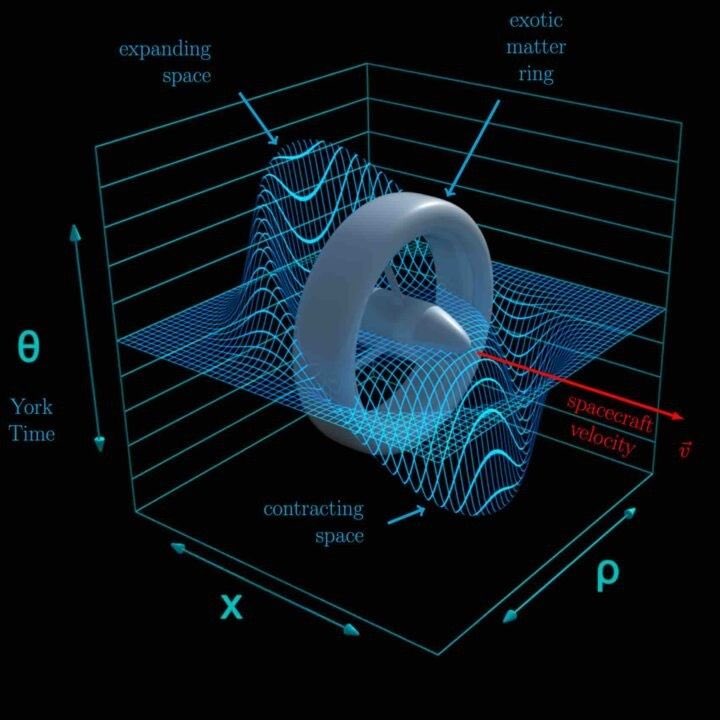


Tonight we designed the safety architecture and human-body integration plan for the QSMGS when scaled into a dedicated artificial gravity room — a zoned habitat area where astronauts can walk and stand for extended periods (4–8 hours per day) and experience an intense, Earth-like gravity-like compressive loading (~0.85 g equivalent, targeting 313 N per foot) on their lower body through the interaction between floor-embedded Halbach arrays and the ferromagnetic pads in the exosuit. The core system remains the same passive magnetostatic design from the main v4.0 paper, but we explicitly analyzed and documented how it behaves at room scale with higher sustained fields (0.5–1+ T localized to the lower extremities), longer daily exposure, and repeated gait through magnetic gradients. We confirmed that the static magnetic fields themselves are safe within ICNIRP 2009 occupational limits, with the primary physiological benefit coming from the mechanical loading aligned with Frost’s mechanostat, and only minor, manageable transient vestibular sensations possible during adaptation. To add an extra conservative layer of safety for this more intense, prolonged-use scenario, we designed an optional modular magnetic shielding undersuit (or integrated exosuit enhancement). This consists of thin, flexible high-permeability mu-metal (Ni-Fe-Mo alloy) panels or fabric composites incorporated as an inner liner, primarily around the lower legs and feet, with a lighter “skirt” section at the hips to contain fringe fields. The shielding redirects static field lines around the wearer (providing 5–20× local attenuation where applied) without interfering with the ferromagnetic pads’ ability to generate the downward loading force. It is modular and removable, adds roughly 0.5–2 kg of mass, integrates quick-release mechanisms for emergency doffing, and can be paired with existing boot design features (tapered edges, controlled compliance) and operational protocols (gradual adaptation training, real-time field monitoring). In short, tonight we designed both the conceptual safety framework for the gravity room deployment and a practical, low-impact additional protection layer that gives us extra margin for crew comfort and mission assurance while keeping the elegant, passive nature of the QSMGS intact. The result is a complete, ready-to-prototype safety specification that complements the main technical paper. @QBlazedog61029J