Reformed to Rome

53.4K posts

Reformed to Rome banner
Reformed to Rome

Reformed to Rome

@ReformedToRome

Convert to Catholicism from Reformed Protestantism. I love sharing helpful tools for Catholics to use when dialoguing with their Protestant friends and family.


Katılım Eylül 2023
1.5K Takip Edilen9.9K Takipçiler
Sabitlenmiş Tweet
Reformed to Rome
Reformed to Rome@ReformedToRome·
You can find all of my videos dealing with Protestant objections under the highlights section.
English
0
2
154
64.3K
Reformed to Rome
Reformed to Rome@ReformedToRome·
@BibleInContext1 It’s so silly at this point how theologically illiterate Pat is and refuses to learn basic use of terms above. Perhaps he will one day care about seeking truth over grifting. Pat, read a book:
Reformed to Rome tweet media
English
1
0
15
125
The Bible In Context
The Bible In Context@BibleInContext1·
Hey Liar finish the quotes: CCC 2027 No one can merit the initial grace which is at the origin of conversion. Moved by the Holy Spirit, 👉🏼we can merit for ourselves and for others all the graces needed to attain eternal life, 👈🏻 as well as necessary temporal goods. CCC 2010 Since the initiative belongs to God in the order of grace, no one can merit the initial grace of forgiveness and justification, at the beginning of conversion. Moved by the Holy Spirit and by charity, 👉🏼we can then merit for ourselves and for others the graces needed for our sanctification, for the increase of grace and charity, and for the attainment of eternal life. 👈🏻 Even temporal goods like health and friendship can be merited in accordance with God's wisdom. These graces and goods are the object of Christian prayer. Let’s see if you have the courage to join me for open Mic Wednesday, May 27 2:30 PM Pacific standard time.
Bishop@BishopJaxi

This is objectively false and directly contradicted by the Catechism. “Since the initiative belongs to God in the order of grace, no one can merit the initial grace of forgiveness and justification.” (CCC 2010) “No one can merit the grace which is at the origin of conversion.” (CCC 2027) “The grace of Christ is the gratuitous gift that God makes to us of his own life.” (CCC 1999) Catholicism does not teach “save yourself.” It teaches that salvation is entirely initiated by God’s grace through Christ, and that Christians must cooperate with the grace they receive. AND… that cooperation is all by God’s grace. Patrick is a liar, was never Catholic, and has no clue what he is talking about. Yet, charges people hundreds of dollars for people to hear is uneducated opinion. Protestantism is a circus.


English
33
10
51
8.1K
The Bible In Context
The Bible In Context@BibleInContext1·
Wes Huff Is Right! Roman Catholicism is not biblical Christianity! If you would like to see Wes Huff and I talk about Roman Catholicism, send him a message and let him know! @WesleyLHuff When you get a free moment send be a DM Brother!
English
27
4
44
963
John Douglas
John Douglas@JohnDOU59356797·
Yes that is the difference we pray in Jesus name for others that are living. We don’t extend that to prayer to saints that have passed on. Ecc 9:5-6 Also for a point of reference the only occasion in the OT was Saul calling up Samuel, was it promoted as a good thing to do. Why was it? Because God had left off speaking to Saul. Was it a permitted route to God for intercession? Even Saul knew it was abominable in the sight of God because he previously tried to remove them from the land. Deut 18:10-14
English
1
0
0
33
Baptist Clips
Baptist Clips@BaptistClips·
For there is one God, and one mediator between God and men, the man Christ Jesus 1 Timothy 2:5
Deacon Don Keane@donaldkeane

@BaptistClips We don’t worship saints. We pray to God, through them, It ain’t hard to get this Mind you, if you don’t get your facts correct then it’s no wonder your post was a piece of nonsense.

English
38
1
22
4.4K
GiGi
GiGi@ChristySimm23·
@ReformedToRome @Cee10William @whpub It is not just from Sheol. "In Judeo-Christian scripture, necromancy is explicitly defined as any practice where someone "inquires of the dead" or "calls up the spirits of the dead".
English
2
0
0
23
Tim Kauffman
Tim Kauffman@whpub·
In typical fashion, @ReformedtoRome attempts to rebut @ChristySimm23 by establishing prayers to saints and angels from antiquity (without citations), none of which hit the target. Keep in mind, Christy's objection was to "invoking the saints" in prayer to ask them to pray for us. None of RTR's claims overturn her observation that praying TO SAINTS came centuries after the apostles. What she said is true. CLAIM 1: Lot prays to an angel for intercession In Genesis 19:2, Lot says "Behold now, my lords, turn in, I pray you, into your servant's house." Yes, they were angels, yes he "prayed" to them. They had presented themselves as humans, and Lot interacts with them as human visitors. In the same context, Lot "prays" to sodomites just a few verses later, "I pray you, brethren" (Gen 19:7). Lot was talking to men and angels, but it is ridiculous to apply the passage as evidence of "praying to angels." Does Lot therefore provide ancient evidence of praying to sodomites? 🤣 CLAIM 2: Paul prayed to other believer for intercession "Brethren, pray for us." (1 Th 5:25). Not exactly praying to the departed and to angels, but ok. CLAIM 3 :Jews already held to intercession of those in heaven Perhaps RTR speaks of Tobit 12:12-15 which has the angel Raphael presenting prayers to God and being sent to Tobit and Sarah to answer their prayers. Nothing objectionable here, as angels offering prayers of the saints (Rev 8:4) and angels being sent to answer prayers (Dan 9) is Scriptural. Importantly, however, while Tobit 12 has Raphael saying he brought their prayers before the Lord, neither Tobit nor Sarah had prayed TO RAPHAEL. Here are their prayers TO GOD that Raphael was sent to answer: Tobit: "You are righteous, Lord, and all your deeds are just..." (Tobit 3:2) Sarah: "Blessed are you, merciful God! Blessed be your holy and honorable name forever!" (Tobit 3:11) There was no prayer to Raphael. The prayer was to God alone. CLAIM 4: Hermas was said to have sought and received intercession from an angel No. In Book 3, Similitude 5, chapter 4 of the Shepherd of Hermas, he did not "seek" intercession from an Angel. Hermas received intercession from an angel who strengthened him (just as Elijah received "intercession" from a raven (1 Kings 17:6)). Neither Hermas nor Elijah (in these examples) had 'sought' such intercession. Hermas had not prayed to the angel, and Elijah had not prayed to the raven. 🤣 Notable in Similitude 5 all actual prayers are addressed SOLELY to God: "Every one who is the servant of God, and has his Lord in his heart, asks of Him understanding, and receives it." "Those who are weak and slothful in prayer, hesitate to ask anything from the Lord." "the Lord is full of compassion, and gives without fail to all who ask Him." "having been strengthened by the holy Angel ... why do not you ask of the Lord understanding"? "if I were to see or hear these things without you, I would then ask the Lord to explain them." (Similitude 5). None of these are "prayers" to an angel, and the "intercession" described is God sending an angel to help, but not someone praying to an angel to come help him. CLAIM 5: Origen noted you receive angelic intercession via prayer as you pray RTR refers to Against Celsus Book 5, paragraphs 4-5, proposing this as if it were some profound insight from Origen on the ancient Church's knowledge of angels, as if Christians did not already know from the Scriptures that they are ministering spirits sent forth to minister to us (Hebrews 1:14), a verse that Origen cites in that section. But Origen's conclusion based on his Scriptural knowledge of angels is that we are therefore not permitted to pray to anyone else but to God alone: "Then this knowledge, making known to us their [angels'] nature, and the offices to which they are severally appointed, will not permit us to pray with confidence to any other than to the Supreme God, who is sufficient for all things" (Against Celsus 5.5). CLAIM 6: Cyprian agrees with John that we continue to intercede on our behalf in heaven RTR is referring here to Epistle 56 in which Cyprian is alleged to have said, "Let us on both sides [of death] always pray for one another." Cyprian uses two terms for the death of the saints in his writings—dormition, or “falling asleep” for saints who die of typical means, and gloriosae mortis, or “glorious death” for martyrs. If you wonder which word he used here for "of death", you'll be sorely disappointed: he does not use any word for "death" at all. The edited citation from Cyprian is a typical Roman Catholic ruse, inserting the words "of death" to create the impression that Cyprian believed saints prayed for each other on both sides of death. In reality, Cyprian's use of "both sides" is always in reference to two parties or two opposing thoughts, as in "the divine Scriptures being brought forward on both sides, we balanced the decision" (Epistle 51.6). In Epistle 56, Cyprian is writing to the congregation in Rome, saying the congregations "on both sides" (in Rome and in Carthage) "should not cease to be instant with all the people in fastings, in watchings, in prayers ... with constant groanings and frequent prayers." Why? So if anyone dies, the prayers of the brethren will go on on earth, and "our love may continue in the presence of the Lord, and our prayers for our brethren and sisters not cease in the presence of the Father's mercy." As Cyprian elsewhere writes, all our prayers ON EARTH are made in the presence of the Father: the Lord has bidden us to pray in secret .... that we may know that God is everywhere present" (Treatise, On the Lord's Prayer, 4) It's a request that the churches "on both sides" (Rome and Carthage) never cease to be in continual pray for each other in the presence of the Father. It is not a teaching that prayers of the saints continue "on both sides [of death]"! 🤣 CLAIM 7: [invoking the saints] was also part of early Christian liturgy Well, mentioning the departed saints was part of the ancient liturgy, but invoking them to pray for them and seek their prayers was not. The Martrydom of Polycarp mentions gathering "in memory of those who have already finished their course" (ch 18), and Cyprian refers to mentioning the names of the dead in the liturgy by way of remembrance, but not in terms of offering prayers to them or invoking their intercession on our behalf (Epistle 33). In sum, all 7 claims fail to address Christy's objection, and some of them even support her position: that we should pray to God alone. RTR may have other evidence to bring forward, but none of the seven above answer the mail.
Reformed to Rome@ReformedToRome

Lot prays to an angel for intercession. Paul prayed to other believer for intercession. Jews already held to intercession of those in heaven as did John who wrote believers both possess and present our prayers before Christ heaven. Hermas was said to have sought and received intercession from an angel. Origen noted you receive angelic intercession via prayer as you pray. Cyprians agrees with John that we continue to intercede on our behalf in heaven. It was also part of early Christian liturgy.
English
12
2
30
2.4K
Reformed to Rome
Reformed to Rome@ReformedToRome·
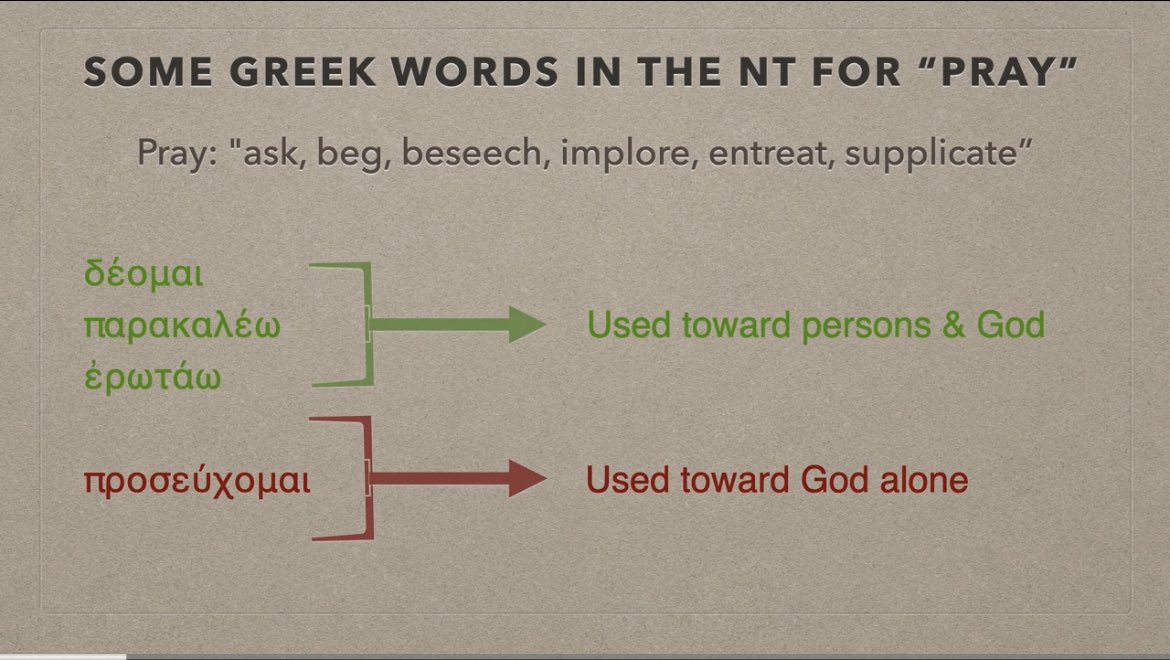
@JohnDOU59356797 @PabloLim7 @BaptistClips The Lord says much more than his description of the sense of proseuchomai. God inspired Paul to describe praying to the body of Christ for their intercession. Proseuchomai is the only sense of prayer reserved for God alone. The others are not.
Reformed to Rome tweet mediaReformed to Rome tweet media
English
1
0
2
32
John Douglas
John Douglas@JohnDOU59356797·
I could debate your opinion of that text in Timothy and what it is telling us. I will just go with what the Lord says. John 16:26 At that day ye shall ask in my name: and I say not unto you, that I will pray the Father for you: John 14:13 Whatever you ask in my name, this I will do, that the Father may be glorified in the Son.
English
1
0
0
21
Reformed to Rome
Reformed to Rome@ReformedToRome·
He didn’t affirm a particular recognized canon there because none was recognized universally yet. You’re begging the question. He’s affirming a summary. Which btw was still being debated as to what was included in each by Jews after Christ had died, raised, and ascended. You can’t question beg your way into a recognized canon.
English
1
0
0
13
么 ꜱ ᴀ ᴍ ꪜ,
么 ꜱ ᴀ ᴍ ꪜ,@___TheGOOdWitch·
Morality comes from reason. it comes from understanding consequences. from the human experience
English
15
31
140
2.6K
Reformed to Rome
Reformed to Rome@ReformedToRome·
As inspired yes of course that’s definitionally what mutually agreed upon means, but not as a universally recognized canon. For example if I say “the Torah is scripture” I’m making a mutually agreed upon statement between you and I but I’m not saying the Torah is the extent of my canon.
English
1
0
1
14
Reformed to Rome
Reformed to Rome@ReformedToRome·
@afellowheir @b1lld0zer @walkingtherange @MJKelleyII Mutually agreed upon inspired books thus far with a said group. The same would be true of any prior collections. Same as it worked for the NT canon formation. You have mutually agreed upon works and clarity until a final agreed upon universe canon is recognized.
English
1
0
0
20
GiGi
GiGi@ChristySimm23·
@ReformedToRome @Cee10William @whpub The Bible doesn’t say “Don’t conjure souls from Sheol, but feel free to pray to saints in heaven.” It gives a blanket prohibition against trying to contact the dead. Those in Heaven: souls alive, dead on earth Those in Hell: souls alive, dead on earth Who else is dead?
English
2
0
0
24
Reformed to Rome
Reformed to Rome@ReformedToRome·
@ChristySimm23 @Cee10William @whpub Nowhere in scripture says not to pray to believers in heaven. It does say not to conjure souls out of Sheol. Entirely different things. That would be a terrible place to note praying to the saints as they weren’t in heaven.
English
1
0
0
21
GiGi
GiGi@ChristySimm23·
@Cee10William @whpub @ReformedToRome If Jesus wanted to teach us to pray to dead saints, this would have been the perfect moment to say so, but He didn't. Scripture elsewhere told you not to pray to the dead but you're saying you would've listened the one time mentioned in a parable? Let's not get silly.
English
2
0
0
23
Reformed to Rome
Reformed to Rome@ReformedToRome·
@whpub @ChristySimm23 @Cee10William I already noted both the bracketed word (which I didn’t cite) and then the fuller context which is explicitly referencing death which you of course edited out because you’re a dishonest hack.
English
0
0
1
22
Reformed to Rome
Reformed to Rome@ReformedToRome·
Read his argument saying it wasn’t referencing those in heaven vs what it says: “that if any one of us, by the swiftness of divine condescension, shall go hence the first, our love may continue in the presence of the Lord, and our prayers for our brethren and sisters not cease in the presence of the Father's mercy”
English
3
0
0
37
Reformed to Rome
Reformed to Rome@ReformedToRome·
@ChristySimm23 @Cee10William @whpub He’s responding to my comment and then intentionally lying about Cyprian by slicing and dicing quotes as he always does. My comment is correcting his intentional lying. He takes the Muslim approach of lying is okay if it furthers his goals.
English
0
0
0
25
GiGi
GiGi@ChristySimm23·
Where are we disagreeing, though? The quote from Cyprian is clearly about saints in heaven continuing to pray for the Church on earth. That’s not the issue. The issue is lack of any command or example in the New Testament, or in Cyprian, for Christians on earth to pray TO departed saints and ask them for intercession.
English
1
0
0
17