Dr. Ribu Thomas PT, DPT

605 posts

Dr. Ribu Thomas PT, DPT

Dr. Ribu Thomas PT, DPT

@Ribu18

🔥 Anaplastic Thyroid Cancer Survivor | 🏃‍♂️ Physical Therapist | 👨‍👧‍👦 Father || ⛳ Late to Golf, Suck At It!

San Antonio, TX Katılım Kasım 2010
684 Takip Edilen196 Takipçiler
Dr. Ribu Thomas PT, DPT
Any HCHB / PointCare integration experts here? I’m building an ambient scribe for home health. Need the safest way to read chart context and get clinician-reviewed documentation back into the HCHB workflow. What actually works in the real world: HCHB Connect, API, PointCare transfer, RPA, or something else?
English
1
0
1
2K
Dr. Ribu Thomas PT, DPT
Sam openly wants OpenAI to become the “intelligence meter” — the Stripe of AI — where companies buy it, automate with it, and build on top of it. @Jason made a good point yesterday, warning that this gives OpenAI perfect visibility into what’s actually working. They study the best usage patterns and ship their own version.
This Week in Startups@twistartups

Sam Altman tells Patrick Collison that OpenAI is following the Stripe model. He wants OpenAI to be an "intelligence meter." Companies buy it, automate with it, and build on it. The margins remain low, but with exponential growth. (cc: @sama, @patrickc, @stripe, @Jason)

English
0
0
0
42
Dr. Ribu Thomas PT, DPT
One aspect that deserves more attention in healthcare is the interplay between rising 30-year Treasury yields, productivity, and AI token economics. While model intelligence dominates the conversation, token economics is rarely discussed. With the US 30-year Treasury yield now above 5%, healthcare AI companies are building infrastructure where inference costs, agent loops, and compute demand can grow exponentially. This matters more than most realize. Recent research shows that agentic AI workflows can consume up to 1,000× more tokens than standard chat or reasoning tasks and token usage varies dramatically between identical executions. Notably, higher token spend does not reliably translate into better accuracy. (arXiv: 2604.22750) We are now operating in an environment where: • Capital is becoming more expensive • Compute is turning into core infrastructure • Healthcare systems have yet to see meaningful productivity gains at scale The future leaders in healthcare AI won’t necessarily be the ones with the largest models. Instead, they will be the organizations that: • Minimize coordination burdens • Ruthlessly optimize compute usage • Integrate seamlessly into existing clinical workflows • Know exactly when costly reasoning is truly necessary The focus must shift from “bigger is better” to economically sustainable AI.
Dr. Ribu Thomas PT, DPT tweet media
English
0
0
0
8
Dr. Ribu Thomas PT, DPT
The US 30-year Treasury yield has just surpassed 5.1% for the first time since 2007, marking a significant shift in the bond market and the broader economy. For the past 15 years, the financial system has thrived in a near-zero rate environment characterized by: - Cheap debt - Easy refinancing - High multiples - Growth prioritized over profitability - Asset prices buoyed by abundant liquidity Now, with the “risk-free rate” becoming competitive again, investors are prompted to ask tougher questions: - Why invest in unprofitable companies? - Why purchase properties at a 4% cap rate? - Why refinance weak debt structures? - Why support growth without evident cash flow? This shift in long-duration yields is crucial as it elevates the hurdle rate for all investments. Historically, such environments favor: - Cash flow - Operational efficiency - Strong balance sheets - Pricing power - Real productivity Conversely, they tend to penalize financial engineering. We appear to be transitioning from an era focused on “who can raise the most capital?” to one centered on “who can effectively compound capital?”
The Kobeissi Letter@KobeissiLetter

BREAKING: The US 30Y Note Yield rises to 5.18%, its highest level since July 2007.

English
0
0
0
39
Dr. Ribu Thomas PT, DPT
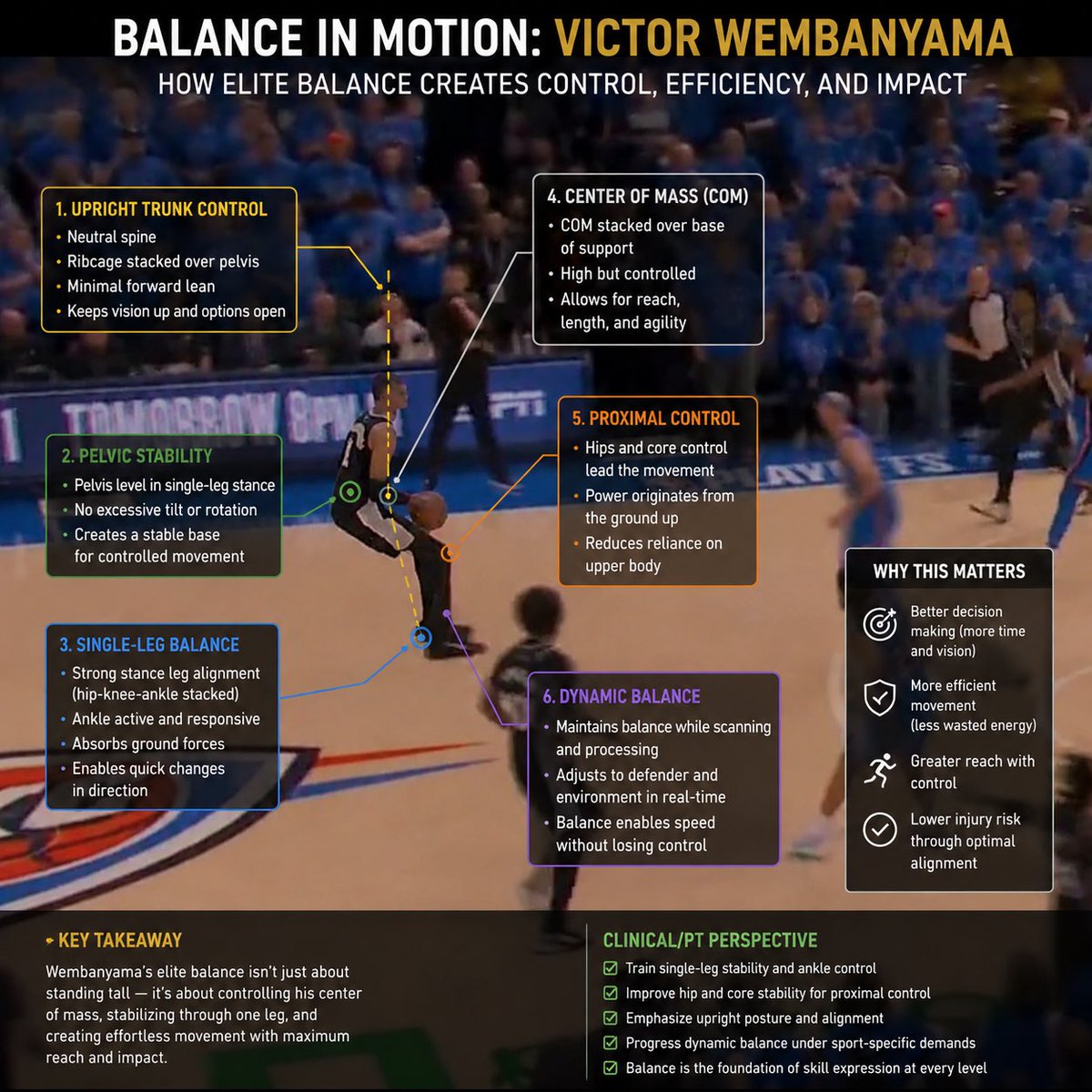
One thing that fascinates me studying movement: Balance is not “staying still.” It’s controlled force transfer under chaos. Watch someone like Victor Wembanyama here. At 7’4”, most people expect awkward movement patterns or excessive compensation. Instead, what stands out is how well he controls his center of mass while staying upright, reactive, and efficient through a single-leg base. That’s elite movement. From a PT perspective, this is why balance training is so much bigger than standing on a BOSU ball. It’s trunk control, proximal stability, foot/ankle responsiveness, visual processing, and the ability to absorb and redirect force without losing positional control. The best athletes in the world don’t just create force. They organize it efficiently.
Dr. Ribu Thomas PT, DPT tweet media
English
0
0
0
45
BBALLBREAKDOWN
BBALLBREAKDOWN@bballbreakdown·
Chet makes a mistake: the old school box out where you turn your head away from the ball to go hit somebody means he has no idea where the ball is and that his teammate needed help badly. Just track the ball and go after it!
English
10
9
212
46.3K
Dr. Ribu Thomas PT, DPT
As a physical therapist / movement-pattern. Here is what makes Wemby 1 of 1… I see: ✅ an unusually high center of mass ✅ long levers that create huge torque demands ✅ massive reach that changes defensive geometry ✅ foot/ankle strategy under extreme length ✅ trunk control that has to organize everything above and below ✅ hip mobility + deceleration capacity that lets him look “smooth” instead of just “long” The wild thing with Wemby is this: Most athletes are trying to create space. Wemby is space.
Esfandiar Baraheni@JustEsBaraheni

Absolutely insane.

English
0
0
0
223
Dhruv Suyamprakasam
Dhruv Suyamprakasam@dhruvsuyam·
HealthBench defines quality before any model response is generated. Clinical care does not work that way. “HealthBench is positioned as an OpenAI’s landmark benchmark intended to reflect dynamic, real-world clinical interactions. Direct inspection of the released dataset shows that 58.3% of its conversations are single-turn. That gap is not a minor data quirk. It is the central tension in the benchmark's design.” (Source: HealthBench: Evaluating Large Language Models Towards Improved Human Health. 2025) HealthBench is a rubric-based benchmark. Each of its ~5,000 examples contains a conversation and physician-written criteria created before any model response is seen. A grader then checks whether those predefined criteria are satisfied. This is a real advance over multiple-choice medical exams. But the dataset also reveals important structural limits. HealthBench mainly evaluates single-turn interactions, fixed inputs, rubric-defined errors, and static response quality. Clinical care works differently. Real-world medicine depends on multi-turn dialogue, evolving and incomplete information, open-ended error detection, and reasoning that changes as new context emerges. Independent analysis of the released dataset found that ~58.3% of conversations are single-turn. In these settings, a model can ask clarifying questions, but it cannot incorporate answers or demonstrate how its reasoning adapts across turns. That matters clinically because safe care depends on updating decisions when new information appears. The scoring structure creates another limitation. Most rubric criteria are positive elements a response should include (~69%), while fewer are negative penalties (~31%). Models are therefore mainly penalized for errors already anticipated during rubric design. This creates blind spots. Unsafe assumptions, subgroup-specific risks, missed contraindications, or reasoning failures outside the rubric scope may not significantly affect the score. Taken together, HealthBench primarily measures how well models satisfy predefined expectations across rubric-scored conversations. That is useful for model development. But it is less sensitive to failures that emerge through interaction: handling incomplete information, revising reasoning, and adapting safely over time. The paper also reports that physicians could not substantially improve model-generated answers. But a benchmark can converge on a stable ceiling if optimization occurs within the same evaluation framework. A high score does not automatically equal clinical readiness. HealthBench is a meaningful step forward in medical AI evaluation. But safe clinical reasoning is not just about giving the right answer once. It is about what happens when the situation changes. Read the paper: HealthBench: Evaluating Large Language Models Towards Improved Human Health cdn.openai.com/pdf/bd7a39d5-9…
Dhruv Suyamprakasam tweet mediaDhruv Suyamprakasam tweet mediaDhruv Suyamprakasam tweet mediaDhruv Suyamprakasam tweet media
English
1
0
2
135
Dr. Ribu Thomas PT, DPT
🚨 Cloudflare just tested Anthropic’s Mythos Preview on 50+ of their own internal repos. It doesn’t just find bugs, it autonomously chains low-severity issues into full working exploits and generates verifiable PoCs with senior-researcher reasoning. Refusals are real but inconsistent by framing. Bottom line: faster patching isn’t enough. We must redesign vulnerability architectures entirely. Full report → blog.cloudflare.com/cyber-frontier… Security & eng teams: how are you preparing for AI-driven offensive cyber? @Cloudflare @AnthropicAI
Cloudflare@Cloudflare

Cloudflare's security team spent the last few weeks testing Anthropic's Mythos against fifty of our own repositories. What we learned about offensive AI, why faster patching is the wrong reaction, and what the architecture around vulnerabilities has to look like next. cfl.re/49BRUqW

English
0
0
0
71
Sawyer Merritt
Sawyer Merritt@SawyerMerritt·
U.S. House lawmakers have proposed ​bipartisan legislation that ‌would require electric vehicles to pay ​a $130 fee ​to pay for road ⁠repairs annually ​and $35 for some ​plug-in hybrid models. The House is working on a ​five-year highway reauthorization bill expected to ‌cost ⁠more than $500 billion ahead of the current law ​expiration on ​Sept ⁠30, 2026. Most revenue for ​federally funded ​road ⁠repairs is collected through diesel and ⁠gasoline ​taxes, ​which EVs do not pay. I think $130 is fair since over time there will be fewer gas vehicles on the road generating tax revenue, They'll need to make up the difference somewhere so they can keep repairing roads, etc. Full bill text in thread below:
Sawyer Merritt tweet mediaSawyer Merritt tweet media
English
976
97
1.2K
214.1K
Dr. Ribu Thomas PT, DPT
Ambient scribes may be the AI application that clinicians experience first, not due to its futuristic nature, but because it addresses the aspect of medicine that often follows them home. The appeal is compelling: enter the room, engage with the patient, and let the AI handle the note-taking. For clinicians finishing charts late at night, this is more than workflow optimization; it feels like a release from captivity. Early evidence supports this: a 2025 JAMA Network Open quality-improvement study found that after 30 days with an ambient AI scribe, clinician burnout decreased from 51.9% to 38.8%, with improvements in cognitive task load, after-hours documentation, and patient focus. However, the CFO's question looms: does this actually improve the bottom line? A 2026 JAMA Network Open study showed AI scribe users had 1.81 greater RVUs per week, 0.80 more encounters per week, no increase in denials, and an estimated additional annual revenue of $3,044 per physician. While beneficial, this may not be a financial game-changer, especially given that ambient scribe costs range from $300 to $500 per clinician per month. The true ROI isn't solely about whether the tool is self-sustaining this quarter. Ambient scribes show promise in reducing documentation time and cognitive load, yet health system leaders still see gaps in evidence on productivity and financial performance. So the real ROI depends on what health systems do with the gained time: give clinicians breathing room, improve retention, and restore patient presence—or simply jam more visits into the same exhausted day.
English
0
0
1
16
Dr. Ribu Thomas PT, DPT
Thought he was walking about @claudeai for a second
Flushing It@flushingitgolf

Cameron Smith shot back to back rounds of 68 over the weekend to currently sit T5 at the PGA Championship and likely earn his best finish at a major since 2022. After the round, he spoke about how it feels to play well again: “Yeah. I mean, it feels great to play nice. You don't work hard to play crap, and it's frustrating, and the last couple of years have been frustrating. I feel like I've been putting in the work and not really getting anything out of it. “I made a swing coach switch a couple weeks ago now to Claude, and we've just managed to clean up a few things that were perhaps a little bit off, and I feel like I've got a lot more confidence in my swing. “Even out there today, under the pressure I felt like I was able to trust it already. So lots of positive signs.” He went on to say: “Yeah. I mean, I feel like I've thrived in major championships my whole career. I feel like I've been able to play my best golf in major championships, and that kind of fell off. And like I mentioned before, I don't think it was from a lack of hard work. I just think you lose a little bit of confidence in your swing and maybe in your brain, and it can all happen so quickly. “That's why I needed a fresh voice in the head and kind of almost a restart and like I said, it's felt good so far.” Cam made the tough decision to switch from his long term coach, Grant Field, recently and seek the services of Claude Harmon III. He spoke about that: “I mean, just belief that I'm doing the right thing. That's really it. It was a hard call to make to my coach. I had been seeing Grant since I was 9 years old. So I'd been with him for 23 years, and probably one of the most difficult phone calls I've ever had to make. “And, yeah, it's still kind of lingering, but I feel like I've made the right call, and I can see it in my golf and just my strike of the ball and seeing some different shots. It's been nice.” It wasn’t to be today and he missed a lot of putts which is unlike him, but it’s been so good to see Cam playing well again. Hopefully he can kick on from this for the rest of the season and put in strong performances at the US Open and Open Championships 🇦🇺 @PGAChampionship

English
0
0
0
35
O’Shea Jackson Jr
O’Shea Jackson Jr@OsheaJacksonJr·
The hook for Janice STFU be in my head. There. I said it.
English
288
1.4K
16.5K
1.1M
Efraín Torres
Efraín Torres@ET_adialante·
When I was 19 I learned about disruption. When I was 20 I learned about MRI’s inaccessibility. It seemed like a really really hard problem. So naturally I started studying MRI physics with the goal to disrupt it all. Perks of keeping old notebooks, you find old memories.
Efraín Torres tweet media
English
1
0
6
247
Dr. Ribu Thomas PT, DPT
This is the real official Y Combinator “Pocket Guide of Essential Advice” Whether you’re building in a small town, healthcare, services, or any industry, this list shows exactly how the great operators think and act. Launch now. Build something people want. Do things that don’t scale. Talk to users obsessively. Studying these traits and actually following them is what builds the resilience to keep pushing when everything feels broken and most people quit. @paulg
Finn Mallery@fin465

i've talked to hundreds of founders and still never seen a startup go wrong following this @ycombinator advice list

English
0
0
1
119
Dr. Ribu Thomas PT, DPT
Throughout history there have been pivotal moments, maybe not as big as this, but what I would say to the younger generation is that AI is coming, whether in the US or elsewhere. Stanford HAI’s 2026 AI Index finds 64% of Americans expect AI to reduce jobs over the next 20 years, while Pew Research shows half of U.S. adults are more concerned than excited about its daily-life effects, with only 23% seeing a positive impact on how people do their jobs. Yet BCG’s 2026 analysis indicates AI will reshape 50–55% of U.S. jobs in the next 2–3 years, with far more roles augmented or enabled than eliminated (only 10–15% vulnerable to full displacement). Take advantage of this opportunity; it could be the best thing that’s ever happened.
@jason@Jason

Young Americans don't want anything to do with AI youtu.be/5MYggR_PPRg?si…

English
0
0
0
51