Rick Evans

3.7K posts

Rick Evans banner
Rick Evans

Rick Evans

@RickEcon

Senior Economist @abundanceinst; OG-Core, FiscalSim, @oselab, macro/computational/public economics, and outdoor aficionado

Provo, Utah Katılım Ekim 2013
919 Takip Edilen1.5K Takipçiler
Rick Evans retweetledi
Elon Musk
Elon Musk@elonmusk·
Try using @Grok for your taxes!
jimmah@jamesdouma

.@grok just saved my sister $1,441 on her taxes. I had it check the turbotax output and it found a mistake. Seriously - 4.20 is very good with taxes.

English
2.8K
3K
29.5K
34.7M
Rick Evans
Rick Evans@RickEcon·
RIP @chucknorris . I loved his fight with Bruce Lee in Way of the Dragon. I drew genuine happiness from using him as an exaggerated example of indestructibility. A true legend. Plus, I loved @ConanOBrien's long running bit with the Walker Texas Ranger lever. youtu.be/6rQpH9HrwIg?si…
YouTube video
YouTube
English
0
0
0
61
Rick Evans retweetledi
Jesús Fernández-Villaverde
Jesús Fernández-Villaverde@JesusFerna7026·
By now, I have published a fair number of papers, and one more acceptance would have close to zero marginal impact on anything that matters professionally. But getting my survey on “Deep Learning for Solving Models” accepted into the Journal of Economic Literature made me genuinely happy, for reasons that have nothing to do with my CV. I had the misfortune of studying my undergraduate degree in economics at a quite awful institution. Two professors, David Taguas and Alfredo Arahuetes, were outstanding, and I owe them a great deal. The rest were well below any reasonable professional level, and some violated the basic standards of ethical conduct. They had no business teaching economics at any level, let alone at a university that charged tuition and claimed to prepare students for professional life. I had to work out most of my education on my own. The surveys published in the Journal of Economic Literature were how I did it. I spent hours in the library’s reading room going through one survey after another on topics I had never been properly taught. Some helped more than others, but collectively they gave me a solid enough foundation that, when I arrived at Minnesota for my PhD, I discovered, to my considerable surprise, that I was ahead of nearly all the other first-year students, including some who held master’s degrees, despite the fact that I had finished my undergraduate degree just six weeks before. I owe the Journal of Economic Literature a debt I will never be able to repay. Publishing a survey there is the closest I can come to trying. So, the thought that some student somewhere, working on her own in a library or on a laptop, might find my survey useful gives me tremendous satisfaction. But there is a broader point worth making. Even in the world of AI, the profession has an important mission in making educational material widely available. Textbooks, surveys, teaching slides, these are public goods in the economist’s sense: high social value, insufficient private incentive to produce. This is also why I post all my slides and teaching material online: sas.upenn.edu/~jesusfv/deepl… We do not reward these activities nearly enough, and their supply is well below what any reasonable social planner would choose. I do not have a good proposal for changing this, and I would welcome suggestions. What I do find heartbreaking is that many of the great economists of the past couple of generations never wrote textbooks on their areas of expertise. I do not mean this as criticism. All of them maximize, and perhaps they all suffer from the same bias I suffer from: the belief that one can always do it next year. But I often think about the hours of pure intellectual pleasure I would have had reading “Time Series Econometrics: An Advanced Textbook” by Chris Sims or “Methods in Structural Estimation” by Pat Bajari. Those books do not exist. They should.
Jesús Fernández-Villaverde tweet media
English
23
127
900
66.9K
Rick Evans retweetledi
Jesús Fernández-Villaverde
Jesús Fernández-Villaverde@JesusFerna7026·
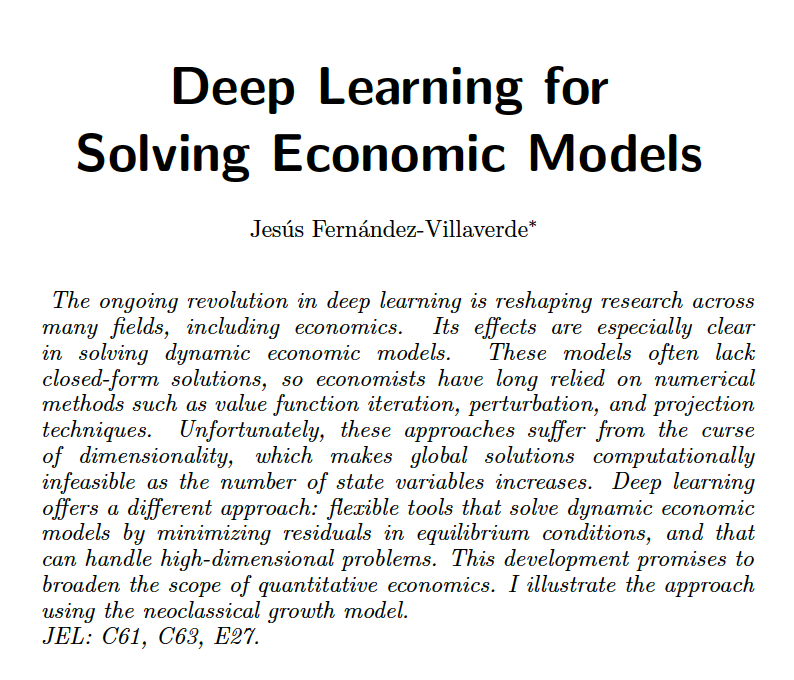
I am very happy that my survey paper, "Deep Learning for Solving Economic Models," is forthcoming in the Journal of Economic Literature (pending final replication checks, which should be quick). The paper benefited greatly from the editor, David Romer, five referees, and many friends who read earlier versions. I believe the result is a solid introduction to the field, though in 48 pages, there is only so much one can do. So, I created a companion webpage: sas.upenn.edu/%7Ejesusfv/dee… where you can find the paper, the code, and some slide decks with my teaching material. My plan is to expand the slides over time, adding new material and updating them as new results appear. I will probably do a thorough revision once the spring semester is over. Those who follow my feed know that I think deep learning is the most fundamental change to computational economics in the last 40 years. I am by now convinced it is more important than the development of Markov chain Monte Carlo methods in the early 1990s or the introduction of projection and perturbation methods in the 1980s. To find a comparable shift, one would probably need to go back to Richard Bellman's invention of value function iteration in 1957. More pointedly, we need to redesign the Ph.D. in economics. Not at the margin. From the ground up. Economists can either fully embrace the deep learning revolution or become irrelevant, as has already happened, I would dare say, to some fields in academia that refused to accept reality. Finally, let me apologize to everyone working in this area whom I could not cite. Space was a binding constraint. And yes, this post was written with the considerable help of AI. There is nothing I am prouder of than the fact that AI is now an integral part of every step I take in my professional life.
Jesús Fernández-Villaverde tweet media
English
19
283
1.2K
121.9K
Rick Evans
Rick Evans@RickEcon·
@rickbeato We should invite @rickbeato to our @abundanceinst Creative Frontiers event in Deer Valley, Utah this summer that focuses on music and AI with artists, producers, tech companies, and policy influencers.
English
0
0
1
84
Rick Evans
Rick Evans@RickEcon·
I think @rickbeato's prediction about data centers going away and AI companies failing is too strong. But I think he is right that the rate of growth will slow and that the health of the open source and open access AI ecosystem is an essential nongovernmental guardrail.
English
1
0
0
54
Rick Evans
Rick Evans@RickEcon·
Great video by @rickbeato on his predictions on how AI will affect the music industry. He compares brick and mortar music studios to today's data centers and discusses the value of open source AI models. youtu.be/YTLnnoZPALI?si…
YouTube video
YouTube
English
1
0
0
132
Rick Evans
Rick Evans@RickEcon·
Cost Estimate of Florida AI Bill of Rights SB 482: Cost estimate to Florida government: $4.1 million in 2027, $3.3 million per year after Cost estimate to Florida businesses: $6.6 billion in 2027, $3.1 billion per year after open.substack.com/pub/rickecon/p…
English
0
0
1
78
Rick Evans retweetledi
Jesús Fernández-Villaverde
Jesús Fernández-Villaverde@JesusFerna7026·
As promised: sequencing risk in retirement. If you have not read my post from yesterday, the summary is that the order in which returns arrive during your working life matters substantially for the wealth you accumulate, and no strategy can avoid this without incurring substantial costs in the form of missed returns. Today, I show that the problem is even worse once you stop working. During accumulation, early losses are recoverable: your portfolio is small, and future contributions have decades to compound. Late losses are devastating because they hit a large portfolio with no contributions left. In retirement, the logic reverses. Early losses are now the killer because you are withdrawing. If the market crashes in your first years of retirement, you must sell assets at depressed prices. Those assets will never participate in the recovery. This is the “reverse dollar-cost averaging” problem. When you are accumulating, volatility is your friend: your contributions buy more shares when prices are low. In retirement, volatility is your enemy: your withdrawals sell more shares when prices are low. Let me make this concrete by examining a worker who retires at age 68 with $1 million in accumulated assets. Note that the world is Markovian: which strategy led to $1 million (e.g., all equities, a glide path, winning the lottery the day before you retire, Uncle Jaime has passed away, you were the only heir, and his businesses in Argentina turned out to be a gold mine) is no longer relevant. Additionally, your portfolio is Markovian: if you hold a lot of equity trading at low prices, it is equivalent to owning zero equity. You can always sell your bonds and buy equity (yes, there are tax consequences, but they are country-specific and, if you are smart, you can get around most of them by trading in your retirement account). A trivial point that many of yesterday’s comments missed. Now they need to draw it down. The standard advice is the well-known 4% rule, popularized by William Bengen: withdraw $40,000 in the first year and adjust for inflation in subsequent years. The 4% is what the literature calls the safe withdrawal rate (SWR), the highest percentage of your initial capital you can withdraw annually, in real terms, without running out of money over a given horizon. Historically, a 4% SWR has been sustainable over 30 years with high probability. But the 4% rule is an average statement. It indicates that, across all historical 30-year windows, a 4% withdrawal rate has typically worked. It says nothing about your specific 30-year window. Consider two retirees. Retiree A retires at the start of a period with strong early returns. After year one, the market is up 20%. Their portfolio increased from $1 million to $1.2 million, excluding the $40,000 withdrawal, leaving $1.16 million. The withdrawal was a small fraction of a growing portfolio. The remaining $1.16 million has decades to compound. Retiree B retires at the start of a period with poor early returns. After year one, the market is down 20%. Their portfolio declined to $800,000, minus a $40,000 withdrawal, leaving $760,000. The withdrawal was a much larger fraction of a shrinking portfolio. And that $760,000 now needs to generate all future returns and fund all future withdrawals. Retiree A and Retiree B might experience the exact same average return over their 30-year retirement. But Retiree B is in trouble. Early losses, combined with withdrawals, create a vicious spiral: the portfolio shrinks; each subsequent withdrawal represents a larger percentage of remaining assets; the portfolio shrinks faster; and the next withdrawal does even more damage. This is not a marginal effect. Consider a retiree who began drawing down in 1966. Over the next decade, they faced the 1966 downturn, the 1969-70 recession, and the catastrophic 1973-74 bear market, during which stocks lost more than 40% in real terms. Each year, they were withdrawing from a shrinking portfolio. By the time the market recovered in the late 1970s and 1980s, their portfolio had been so depleted that the recovery could not save them. Now contrast this with a retiree who started drawing down in 1982. They caught the beginning of one of the greatest bull markets in history. Even after the 1987 crash and the 2000-02 dotcom bust, they were fine: the early gains had built such a large buffer that subsequent losses could not seriously threaten their retirement income. Same withdrawal rule. Same index. Same 30-year horizon. Radically different outcomes. Let me make this point more systematically. I use the same data as in the first post: actual annual real total returns on the S&P 500 (including reinvested dividends) and 10-year U.S. Treasury yields from 1945 to 2024, deflated by the BLS CPI-U. The only difference is that I now run the clock forward from retirement rather than backward from it. I took 34 cohorts of retirees, one for each year from 1991 to 2024. Each retires with $1 million and follows the textbook 4% rule: withdraw $40,000 per year in constant real terms, regardless of market conditions. The portfolio is allocated 20% to the S&P 500 and 80% to 10-year U.S. Treasuries, with annual rebalancing, a standard conservative retirement allocation. For the years I have data (through 2024), each cohort experiences the actual historical real returns that occurred during their retirement. However, most of these cohorts have not yet retired long enough to determine whether they will run out of money. For years beyond 2024, I use a block bootstrap: I randomly draw 5-year blocks of actual returns from the full 1945-2024 historical sample and stitch them together. Five-year blocks preserve the tendency of bad years to cluster, which matters because isolated bad years are much less dangerous than sequences of them. I then run each cohort forward until it either exhausts its funds or reaches 2075, whichever occurs first. The results are shown in the figure. Each line represents a cohort, colored by retirement year: dark blue for the early 1990s, through red for the 2020s. The dashed vertical line marks 2024, the boundary between observed data and the bootstrap simulation. Everything to the left of that line occurred. Everything to the right is one plausible future drawn from the historical record. 32 of 34 cohorts run out of money before 2075. The fastest to go broke is the 1999 cohort: they retired straight into the dot-com crash, never recovered, and are depleted by 2040. The cluster of cohorts retiring between 1998 and 2005 all reached zero between 2040 and 2051, because they shared the same devastating opening act: the dotcom bust followed by the 2008 financial crisis. Only two cohorts survive: 1991 and 1995. Both caught the extraordinary bull market of the 1990s in their critical early years, building a buffer large enough to absorb subsequent downturns (2000, 2008, 2022). Even so, the 1995 cohort is barely hanging on with $96,000 by 2075. The message is stark. With a conservative 20/80 portfolio and a fixed 4% withdrawal rate, the bond-heavy allocation does not generate sufficient real return to sustain withdrawals over a 50-year horizon for most cohorts. The only survivors are those who got lucky in their first decade. There are dozens of variations of this basic experiment you can run: different withdrawal rates, different stock-bond splits, different bootstrap methods, different starting capitals, and longer or shorter horizons. I have run thousands of them. They all give you essentially the same answer. You can raise the SWR to 5% and shorten the horizon to 25 years, which is more realistic for someone retiring at 68. The depletion dates move around. The core result does not change. This is why I am skeptical of the 4% rule as commonly presented. It is not that 4% is wrong as a rough guideline. It is that it obscures the enormous variance around that average. A retiree who happens to retire into a bear market faces a fundamentally different problem than one who retires into a bull market. The standard advice to mitigate this is the same glide path logic applied in reverse: hold more bonds in early retirement to cushion against a crash in those critical first years. But as I argued in the previous post, bonds are not risk-free. The retiree who shifted into bonds in the early 1970s was hit by inflation. The one who shifted into bonds in 2022 was hit by rising rates. The cushion is unreliable precisely when you need it most. There are partial remedies. Variable withdrawal strategies, in which you reduce spending after bad years and increase it after good years, are particularly effective. If you can cut your withdrawals by 10-20% after a market crash, you can dramatically reduce the damage from selling at the bottom. But this requires flexibility in retirement spending that not everyone has. Another approach is to maintain a cash buffer (two years of withdrawals in very short-term instruments) so that you never have to sell equities during a crash. You live off the buffer while the market recovers and replenish it during good years. This is simple and effective. The cost is the drag of holding two years of spending in low-return assets, but relative to the risk it mitigates, it might be a price well worth paying. Annuities get too much of a bad rap in my opinion. A life annuity is the only product that truly eliminates sequencing risk in retirement: you hand over a lump sum and get a guaranteed income stream no matter what markets do. The insurance company bears the investment risk, not you (though the company could go bankrupt, and you may not live in a country where the government backstops that). But the downsides are real too: you give up the upside, you lose liquidity, the annuity may not be indexed to inflation, and if you die early, the insurance company keeps the money. If there is one practical takeaway from these two posts, it is that, no matter how hard you try to design your investment strategy (and I have tried many), you cannot avoid most of the sequencing risk without incurring substantial losses in excess returns. Finally, you can gain substantial benefits from a flexible retirement age. I will discuss this point when I have time.
Jesús Fernández-Villaverde tweet media
English
49
67
470
60K
Rick Evans retweetledi
Mark Cuban
Mark Cuban@mcuban·
There are generally 2 types of LLM users, those that use it to learn everything , and those that use it so they don’t have to learn anything.
English
678
962
9.9K
962K
Rick Evans retweetledi
Jesús Fernández-Villaverde
Jesús Fernández-Villaverde@JesusFerna7026·
I am always amazed that most people saving for retirement (or designing optimal Social Security systems) rarely take sequencing risk seriously. Simply put, sequencing risk is the risk associated with the order in which returns arrive over one’s lifetime. Sequencing risk hits you twice: while you are working and accumulating wealth, and again while you are retired and drawing it down. Today, I will focus on the first part. The retirement phase warrants its own discussion, and I will address it in a subsequent post. Let me walk you through an exercise I ran yesterday using actual historical U.S. stock market data from the past 80 years to illustrate how important sequencing risk is. I took the annual total returns of the S&P 500 (including reinvested dividends) from 1945 to 2024. The source is the dataset maintained by Aswath Damodaran at NYU Stern, a standard reference for long-run U.S. equity returns. I then deflated each year’s nominal return by the CPI-U inflation rate published by the Bureau of Labor Statistics to obtain real total returns, i.e., returns in constant purchasing power. Over this 80-year period, the S&P 500 delivered a geometric mean real total return of about 7.5% per year. That is an impressive number. But this average return masks a lot. Imagine a worker who starts investing at age 22 and retires at age 68. That gives them 46 years of contributions. In their first year, they contribute $1. Each subsequent year, they increase their contribution by 1% (roughly keeping pace with real wage growth). Every dollar is invested in the S&P 500. They never touch the money until retirement. No panic selling, no market timing, no strategy switching (and no management fees!). Textbook investing and waiting. I ran this exercise for every possible cohort for which the data allow. The first cohort starts investing in 1945 and retires in 1991. The second starts in 1946 and retires in 1992. And so on, all the way to the last cohort, which starts in 1978 and retires in 2024. This yields 34 cohorts, each investing for 46 years, making the same contributions and investing in the same index. The only difference among them is which 46-year slice of historical returns they happen to live through. The most fortunate cohort, the one that started investing in 1954 and retired in 2000, had $607 on the day of retirement (remember, all in real terms), with a real annual return of 8.82%. The unluckiest cohort, the one that started in 1963 and retired in 2009, accumulated $210, with a real annual return of 4.83%. Same contributions. Same index. Same strategy. Same investment horizon. Yet the luckiest retiree ended up with 2.9 times more wealth than the unluckiest. Why? The 1954 cohort had a spectacular final decade. The late 1990s delivered some of the best equity returns in American history, and those returns compounded on a large portfolio built over decades. They retired at the peak, at the end of 1999, before the dot-com crash. The 1963 cohort was not so fortunate. They spent their last working years running straight into the 2008 financial crisis. The S&P 500 lost over 36% in real terms in 2008 alone. That loss hit their portfolio when it was at its largest, right before retirement, with no time left to recover. Clearly, sequencing risk is not about the average return. Both the 1954 and 1963 cohorts experienced roughly similar average returns over their 46-year periods. The difference is when the good and bad years occurred. For the 1954 cohort, the bad years came early (when the portfolio was small) and the good years came late (when the portfolio was large). For the 1963 cohort, the opposite was true. In fact, sequencing risk is even worse because poor returns in the stock market are correlated with weak labor markets: you have a much higher probability of losing your job (or seeing your wage income fall) precisely when the market is doing poorly, preventing you from saving when prices are low and equities are most attractive. However, let me set that point aside today to simplify the exposition. The standard response of the financial planning industry to sequencing risk is the so-called glide path. The idea is simple: when you are young, you hold mostly equities. As you age, you gradually shift toward bonds. By the time you are near retirement, most of your portfolio is in bonds. A common implementation is a linear rule: start with 90% in stocks at age 22 and reduce the equity share steadily until you reach 20% in stocks at age 68. This is roughly what target-date retirement funds do. The logic is sound in principle. You reduce your exposure to equities precisely when a crash would hurt you most. If 2008 happens when you are 65 and 80% of your portfolio is in bonds, the equity crash barely affects you. I applied this glide path strategy to the same 34 cohorts, using historical real returns on the S&P 500 for the equity portion and real returns on 10-year U.S. Treasury bonds (from Damodaran) for the bond portion. Each year, the portfolio is rebalanced to the glide path weights. The glide path does what it is intended to do: it reduces dispersion. The gap between the best and worst cohorts narrows from 2.9x under pure equities ($607 vs. $210) to 1.6x under the glide path ($292 vs. $178), but so does the upside. The best equity cohort (1954–2000) earned a geometric mean real return of 8.82% per year. The best glide path cohort (1975–2021) earned 6.59%. That is a 2.2 percentage point gap. Over 46 years of compounding, a 2.2 percentage-point annual yield yields an enormous difference in terminal wealth: the best glide-path outcome ($292) is less than half the best equity outcome ($607). In other words, the cost of this insurance is substantial. In fact, the median cohort ends up meaningfully poorer under the glide path than under 100% equities. You are not trimming a bit of upside. You are forgoing a substantial share of your expected wealth at retirement. This should not be surprising. Over the long run, equities have outperformed bonds by a wide margin. The equity risk premium is one of the most robust facts in finance. Every year you shift a dollar from stocks to bonds, you accept a lower expected return. Do this for 25 years of your career (roughly the back half, when the glide path has you increasingly in bonds), and the cumulative cost from foregone compounding is very large. But the part that makes me most uncomfortable with the standard glide path advice is that bonds are not safe. People hear “bonds” and think “safe.” They are not. Bonds carry two risks that are easy to forget when inflation is low and interest rates are stable. The first is inflation risk. A conventional bond pays you a fixed nominal coupon (yes, there are TIPS and similar instruments, but they have their own problems, so let me skip them for today). If inflation rises above the market’s expectations when the bond was issued, the real value of those payments declines. The cohorts that retired through the 1970s learned this the hard way. In the data, the real return on 10-year Treasuries was negative in multiple years during the 1970s. The second is interest rate risk. When interest rates rise, the market value of existing bonds declines. The longer the maturity of your bond, the larger the hit. In 2022, the Bloomberg U.S. Aggregate Bond Index declined by approximately 19% in real terms. If you were 65 and had just shifted most of your portfolio into bonds following the standard glide path advice, you would have lost nearly a fifth of your “safe” allocation in a single year. And here is the real sting of 2022: equities fell, too. The S&P 500 lost about 24.5% in real terms that year. The glide path assumes bonds will be there to cushion you when stocks fall. In 2022, both fell together. The cushion was not there. This is not some once-in-a-century event. Stocks and bonds have moved in the same direction before: the 1940s, the 1970s, and in 2022. The negative correlation between stocks and bonds that many investors take for granted is a feature of the disinflationary period from roughly 1982 to 2020. It is not a law of nature. Let me be clear: I am not saying the glide path is wrong. For many people, it is the right choice. If a 30% equity crash near retirement would force you to sell assets at the worst possible time to cover living expenses, the insurance is worth paying for. However, you should know what you are paying. The glide path (or variations of it that I am skipping in the interest of space) is not free. It entails substantial costs in expected returns. Worse, the insurance itself can fail. Bonds can lose money in real terms for extended periods. Bonds can fall at the same time as equities. The glide path reduces sequencing risk. It does not eliminate it. It also introduces risks of its own. The deeper lesson from this exercise is that a substantial part of your retirement outcome depends on when you are born. You can do everything right (save diligently from your first paycheck, invest consistently, stay the course through every crash, never panic sell) and still end up with vastly different results than someone who did the same thing a decade earlier or later. The 1963 cohort did nothing wrong. They just had the misfortune of turning 68 in 2009. No allocation strategy eliminates this. Even under the glide path, the best cohort ends up with substantially more than the worst. Sequencing risk is, to a significant extent, a matter of luck. Next time: what happens when sequencing risk hits you in retirement, when you are drawing down instead of building up. The math there is, if anything, even more unforgiving.
Jesús Fernández-Villaverde tweet media
English
96
182
1.1K
198.5K
Rick Evans retweetledi
Chris Lattner
Chris Lattner@clattner_llvm·
@karpathy 100% agree with you Andrej. We're building Mojo to be that target and seeing great results. People are already one-shotting large python conversions to Mojo and getting 1000x speedups. The combination of Pythonic syntax, "real" types (good for llm's) and GPU support is 🔥
English
18
24
860
57.6K
Rick Evans retweetledi
Raiany Romanni-Klein
Raiany Romanni-Klein@RaianyRomanni·
Proud to have been on the @BostonGlobe Sunday print yesterday right next to the @Patriots!! "America's Next Moonshot: Creating Ultra-healthy 60-year-olds." I argue that as a country, we have been vastly underinvesting in our existing humans. This is a mistake — moral and economic — we simply cannot afford.
Raiany Romanni-Klein tweet media
English
3
4
25
66.6K
Rick Evans
Rick Evans@RickEcon·
All American moment last night. I was walking from my car into Costco, and a man was leaving the store with a 98" television. People outside were stopping, clapping, an cheering. Made me want to say the Pledge of Allegiance : )
English
0
0
2
95
Rick Evans retweetledi
Jon Hartley
Jon Hartley@Jon_Hartley_·
Bellman equations on @ESPN! @ESPN documentary "NFL and 4th Down" features Berkeley economist David Romer explaining his JPE paper "Do firms maximize? Evidence from professional football" arguing teams should go for it on 4th down more. Now common practice in the NFL 20 yrs later.
English
8
113
638
138.1K
Rick Evans retweetledi
Raiany Romanni-Klein
Raiany Romanni-Klein@RaianyRomanni·
How could tiny breakthroughs in aging science change U.S. GDP and population growth? What’s the economic value of making 41 the new 40, or 65 the new 60? How many lives could we create or save if we could slow reproductive or brain aging by just 1 year? What would billions of healthier hours be worth to the economy, if we assume no change in the age of retirement? I spent the last two years obsessing over the design, research, and execution of this project. The result is a book upcoming with Harvard University Press, a preprint, and—maybe your favorite part—an interactive simulation tool that lets you input your own timelines and assumptions for specific breakthroughs in aging bio, then see the ROI in terms of US population & GDP growth. From @RickEcon and Jason DeBacker—the economists who co-developed the open-source, macro model that made this project possible—to extensive comments by @tylercowen, @sapinker, Richard Freeman, @NDHendrix, @ebudish, @elidourado, @geochurch, @jasoncrawford as well as interviews with 102 scientists (!) and countless iterations with award-winning designer Giorgia Lupi and the @pentagram team, we built something we hope will be a benchmark for how scientists, economists, designers, philosophers, entrepreneurs and storytellers can come together to paint, fund, and build different flourishing futures for our species. I couldn’t be more excited to share this. It’s the start of an open and evolving project—the labor and product of love, obsession, and unrelenting care. I hope you have fun playing with our simulation tool — and if you do, please share!
English
66
189
1K
1.1M
Rick Evans retweetledi
Jesús Fernández-Villaverde
Jesús Fernández-Villaverde@JesusFerna7026·
Olivier Blanchard (@ojblanchard1) had a provocative post yesterday about a higher preference of French people for leisure: x.com/ojblanchard1/s… I have learned nearly an infinite amount of economics from Olivier since I was an undergrad, and he came to Spain to present a report on our unemployment problem, so I feel a bit intimidated about pushing back on this idea. I am perfectly happy with the idea that preferences are heterogeneous: some people like leisure more than others. And the goal of economic policy should never be to maximize output, but to maximize welfare. If most people in France enjoy sitting in the beautiful sun of Provence while productivity increases, who am I to question their wisdom? But perhaps one of the aspects of economics that I have always felt uneasy about is how little effort we have put into exploring the extent to which preferences are endogenous. Let me borrow from an old idea of Gary Becker and Kevin M. Murphy (1988) in their classic “A Theory of Rational Addiction,” a beautiful piece of work all students of economics should read. Becker and Murphy consider a model with two consumption goods: one that requires “consumption capital” to be enjoyed and one that does not. Think about fine wine: it takes some time and experience to truly enjoy a good bottle. In comparison, every kid enjoys candy on first taste, no experience required (nor much is gained from repeated tastings). How much an agent invests in “consumption capital” determines whether increases in consumption of the first good in the past will lead to higher consumption of that good in the future. Many leisure activities belong to the former group, not the latter: going to the Opera, appreciating fine food, discovering the charming streets of a world-class city, ... Based on that observation, let me extend Becker and Murphy’s framework to the work-leisure choice by introducing the notion of “leisure capital.” Imagine a situation where, in France, taxes on labor income were high (or, equivalently, wages were lower than they should have been because of misallocation). This made leisure activities preferable in the past because their relative price was low (let’s assume the income effect was small), leading to an increase in the “leisure capital” of the French today and, therefore, in how French society takes advantage of increases in productivity. Now, one could argue that this reasoning is a hyper-sophisticated form of rationality that does not resemble reality. But I have seen this phenomenon at a micro level: very rich people who made their own fortunes are often not very good at enjoying leisure, but their kids are extremely good at it, because they accumulated plenty of “leisure capital” when they were young. More seriously, other observers of society would have found the reasoning natural, because there is a long tradition of analyzing labor supply decisions as embedded in social relations. Let us start with Karl Marx. In historical materialism, consciousness follows the forces of production. When the forces of production generate a lower labor supply (for whatever reason), consciousness will follow through the multiple channels of the superstructure, starting with the creations of the culture industry that favor leisure. Having delightful bistros is an epiphenomenon of a deeper structure of relations of production. In the opposite direction, E.P. Thompson, also from a Marxist perspective (though less orthodox), emphasized that the factory system required clock-based discipline and, therefore, that within a generation or two of the Industrial Revolution, punctuality became a cardinal virtue. Just reverse E.P. Thompson’s analysis. And Émile Durkheim, with his view of how social facts shape the division of labor in society, might have agreed as well. For Durkheim, social facts are “every way of acting which is general throughout a given society, while at the same time existing in its own right, independent of its individual manifestations.” In this perspective, the French have absorbed a particular relationship to work through decades of participation in French economic life, which is not divorced from taxes and regulations. Of course, one could reply that it might be the preferences for leisure that are behind higher taxes and regulations. For example, you can use regulations to move to a better coordination equilibrium: you do not want to take vacations if your spouse at another firm cannot take a vacation at the same time. This is what Max Weber would have called an elective affinity (Wahlverwandtschaft) of leisure and taxes. But that reply only reinforces my point that we probably want to think about preferences and economic policy as a simultaneous system, more than one driving the other. The practical implication is that policy reforms may have effects far beyond what an analysis that takes preferences as given would suggest. If decades of high taxes built up “leisure capital” in France (which fits perfectly with Olivier’s observation that the French are better at leisure), lowering taxes tomorrow will not instantly undo that accumulation. Preferences have their own inertia. But by the same token, sustained policy changes can, over time, reshape what people want, not just what they can afford. The real problem with all this reasoning, though, is that it makes welfare analysis a nightmare! I will leave that task to someone smarter than me.
Jesús Fernández-Villaverde tweet media
Olivier Blanchard@ojblanchard1

The French are not lazy. They just enjoy leisure more than most (no irony here) And this is perfectly fine: . As productivity increases, it is perfectly reasonable to take it partly as more leisure (fewer hours per week, earlier retirement age), and only partly in income.

English
40
203
1.2K
230.1K
Rick Evans retweetledi
Jesús Fernández-Villaverde
Jesús Fernández-Villaverde@JesusFerna7026·
This essay by @Noahpinion is an excellent, balanced, and well-argued summary of what we know (and what we still do not know) about the recent global collapse in fertility. Before jumping to quick conclusions and skipping the piece, consider one striking fact. Perhaps the fastest decline in fertility ever recorded has taken place in Guatemala’s poorest, least educated, and indigenous majority rural areas, where women’s rights are weakest, between 2006 and 2025. In 2006, Guatemala’s total fertility rate was 3.8, comparable to that of a sub-Saharan African country. By 2025, it had fallen to 1.8, only slightly above the fertility rate of non-Hispanic Whites in the United States (around 1.6). At the current pace, Guatemala will have a lower fertility rate than non-Hispanic Whites in the U.S. before 2030. Does your preferred explanation (women’s education, feminism, smartphones, or women choosing holidays in Bali over children) fit that pattern? open.substack.com/pub/noahpinion…
English
100
231
1.1K
218.2K
Rick Evans
Rick Evans@RickEcon·
New article: "AI and the Natural Limits of Wealth Inequality". It gives evidence--including from a 2019 paper by Scott Condie, Kerk Phillips, and me--that AI is unlikely to cause wealth inequality to grow without bound. rickecon.substack.com/p/ai-and-the-n…
English
1
1
3
1.4K