Riyadh AI

168 posts

Riyadh AI banner
Riyadh AI

Riyadh AI

@Riyadh_AI_

#AI #AGI | #ArtificialIntelligence will mark the transition after the Modern era. —Riyadh (on #X since 2008)—

@NEOM Katılım Ağustos 2024
531 Takip Edilen15 Takipçiler
Riyadh AI retweetledi
Riyadh Thought
Riyadh Thought@RiyadhThought·
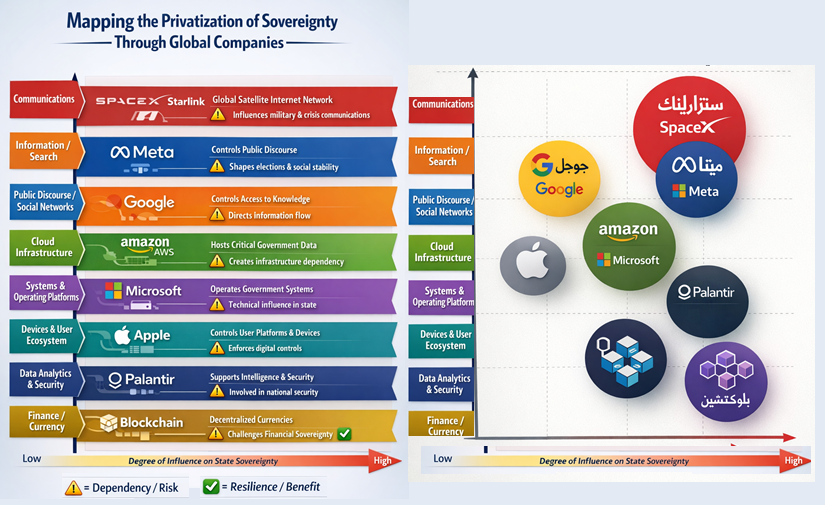
🧵 Privatization of Sovereignty in the Tech Era: From #Starlink to #Claude → Algorithmic Power Triangle 2035 🔹 1⃣ #Musk & Starlink 🔹 2⃣ #SpaceX, #Meta, #Amazon, #Palantir... 🔹 3⃣ Anthropic | Claude 🔹 4⃣ Mind • Eye • Hand #AI x.com/RiyadhTranslat…
Riyadh Thought tweet media
Riyadh Translate | “رِيَاض التَرْجَمة”@RiyadhTranslate

1️⃣ Are We Witnessing the Privatization of Sovereignty? #Musk Plans to Expand From 9,357 Satellites to Nearly 17,000 Is #ElonMusk Deciding Who Executes Military Operations and Who Wins? Telecommunications infrastructure is no longer a purely technical matter; it has gradually become a strategic component of geopolitical power. In this context, #SpaceX’s #Starlink network, led by Elon Musk, has emerged as a new paradigm, raising a fundamental question: are we seeing certain aspects of sovereignty shift from the state to private actors? The reality suggests that Starlink does not “decide the outcome” of wars in a definitive sense, yet in some contexts it has become an influential factor in operational balances, especially where conventional communication infrastructure is damaged or disrupted. In Ukraine, for example, the network played a critical role in supporting both military and civilian communications—from drone operations to the continuity of essential services. However, this influence varies from theater to theater; what applies to a high-intensity conventional war cannot be directly extrapolated to stable states or low-intensity conflicts. Starlink’s rapid expansion—aiming to nearly double its satellites to 17,000—enhances its global presence, particularly given limited competition from companies like Eutelsat, OneWeb, or Amazon’s Kuiper Project. With millions of users across dozens of markets, the network approaches a quasi-monopoly in some regions, giving it weight beyond conventional commercial influence. Yet, overemphasizing individual influence can be misleading. Despite Elon Musk’s dominant media presence, SpaceX’s decisions are not made in a vacuum; they intersect with governmental pressures, contractual obligations, and complex legal considerations. Nonetheless, there have been instances demonstrating how a technical decision—such as imposing geographic service restrictions—can directly impact the field, as seen in conflict zones linked to Russia. Starlink’s impact, however, is not limited to military or security applications. The network has also supported civilian communications during disasters, provided alternatives in regions with weak infrastructure, and, to some extent, reduced government monopolies over information flows. These positive dimensions are essential to understanding the full picture, preventing the phenomenon from being reduced solely to a “threat narrative.” Challenges remain significant. Various reports—differing in verification—have noted the use of Starlink devices by diverse actors, including armed groups in regions like the African Sahel and cyber actors during internet blackouts in Iran. Questions have also arisen regarding informal transfers of equipment into certain countries. While these cases require careful analytical consideration, they illustrate the difficulty of controlling cross-border technology managed by a private company. The deeper issue is both legal and political. There is currently no clear international framework defining when interference with a commercial satellite network constitutes the use of force, no regulations governing the transfer of such technology in conflict contexts, and no effective accountability mechanisms when private corporate decisions affect sensitive geopolitical balances. Thus, we are not facing a “complete privatization of sovereignty,” but it is evident that some tools of sovereignty are being redistributed. States that fail to view commercial space infrastructure as a strategic dependency may find themselves, in times of crisis, bound to decisions made by actors outside their direct control. The question is no longer whether sovereignty will be fully privatized, but rather: to what extent can states redefine sovereignty in a world where authority intersects with technology and corporate decisions intertwine with national interests? #Iran #IranWar#IranRevolution2026#Israeli #USA #Russia #Ukraine
English
0
6
0
72
Riyadh AI retweetledi
Riyadh Thought
Riyadh Thought@RiyadhThought·
🧠📘✨ A concise and essential reference for anyone exploring the future of digital transformation. An analytical series on how #AI is reshaping society and the economy, with practical recommendations for all age and professional groups. #DigitalEconomy x.com/RiyadhTranslat…
Riyadh Translate | “رِيَاض التَرْجَمة”@RiyadhTranslate

**🤖 When is human–AI collaboration better? 🤝 And when is each better working alone?** This is what a major study from MIT Sloan revealed after analyzing over 100 studies and 370 experimental results. 🎯 Summary in two lines: Human–AI collaboration is not always better. But it becomes very powerful when used in the right place and the right way. 📊 In this thread you’ll find: Clear comparisons between the performance of: ▪️ Humans only ▪️ AI only ▪️ Human–AI collaboration When collaboration succeeds or fails What these findings mean for managers and decision-makers 🔍 Surprise finding: Some tasks perform worse when humans and AI collaborate than when AI works alone — and vice versa. 📘 Ending with comprehensive recommendations tailored by age group and profession 👇 Details in the following tweets… 🌏 Translated summary of the article I relied on 📊 Tables attached to each tweet are distilled from the study 🛠️ Any additional insights are my own interpretations 🤖 When humans and AI work together 🤝 And when each performs better alone 📌 Why this matters Combining humans and AI seems intuitively powerful — but recent research shows collaboration isn’t always better. In some tasks, AI outperforms humans. In others, humans outperform AI. And only in specific cases is collaboration the best option. This was revealed by a major MIT Sloan study based on over 100 studies and 370 experimental results. 📊 Key findings from the study 🔹 1) Collaboration isn’t always better than solo performance AI alone outperformed in tasks like: ✔️ Detecting fake hotel reviews ✔️ Demand forecasting ✔️ Diagnosing medical conditions Humans alone outperformed in tasks like: ✔️ Classifying bird images (requires contextual expertise) ✔️ Tasks needing emotional or situational understanding In many cases, collaboration performed worse than the best solo performer. 🔹 2) Why does collaboration fail sometimes? Humans often don’t know when to trust AI or when to rely on their own judgment. This leads to mixed decisions that are worse than AI alone — or humans alone. 🔹 3) When does collaboration succeed? Collaboration works when: Each party does what they’re best at Tasks are clearly divided The process is designed for interaction, not replacement 📌 Example: Humans alone: 81% accuracy AI alone: 73% Collaboration: 90% (In a bird image classification task) 🎨 Generative AI: strongest collaboration cases The study found that creative tasks (writing, design, ideas, visuals) show the most promising synergy between humans and AI. Why? AI generates dozens of ideas quickly Humans select, refine, and add meaning The process becomes iterative and interactive The result is better than either working alone 🧠 Why task-splitting isn’t enough Success doesn’t depend only on: ❌ Who does what But on: ✔️ How information flows ✔️ How decisions are made ✔️ How the process is designed Redesigning workflows is more important than just dividing tasks. ⚠️ Challenges that block synergy Overestimating AI’s capabilities Lack of transparency Biases No clear governance Absence of randomized testing (A/B testing) in organizations 🚀 Final takeaway Human–AI collaboration isn’t always better. But it becomes very powerful when: Each party works within their strengths The process is iterative The task suits collaboration (especially creative tasks) There’s clear governance and calibrated trust Generative AI offers the best synergy. Decision-making tasks are more sensitive and prone to failure.

English
0
2
1
31
Riyadh AI retweetledi
Ernest Chan
Ernest Chan@echanQT·
I co-authored a book with a GenAI expert and I am slowly understanding the half that my co-author wrote. Check it out if you want to join me in the journey! a.co/d/baTcfa3
English
3
4
34
7.2K
Riyadh AI retweetledi
Marcos López de Prado
Marcos López de Prado@lopezdeprado·
Can AI learn causal structures? Causal reasoning is essential for achieving the goal of artificial general intelligence (AGI). In 2024, @adia_lab conducted a worldwide competition to find the answer. Here is the answer: ssrn.com/abstract_id=61…
Marcos López de Prado tweet media
English
7
6
30
3.7K
Riyadh AI retweetledi
eLife - the journal
eLife - the journal@eLife·
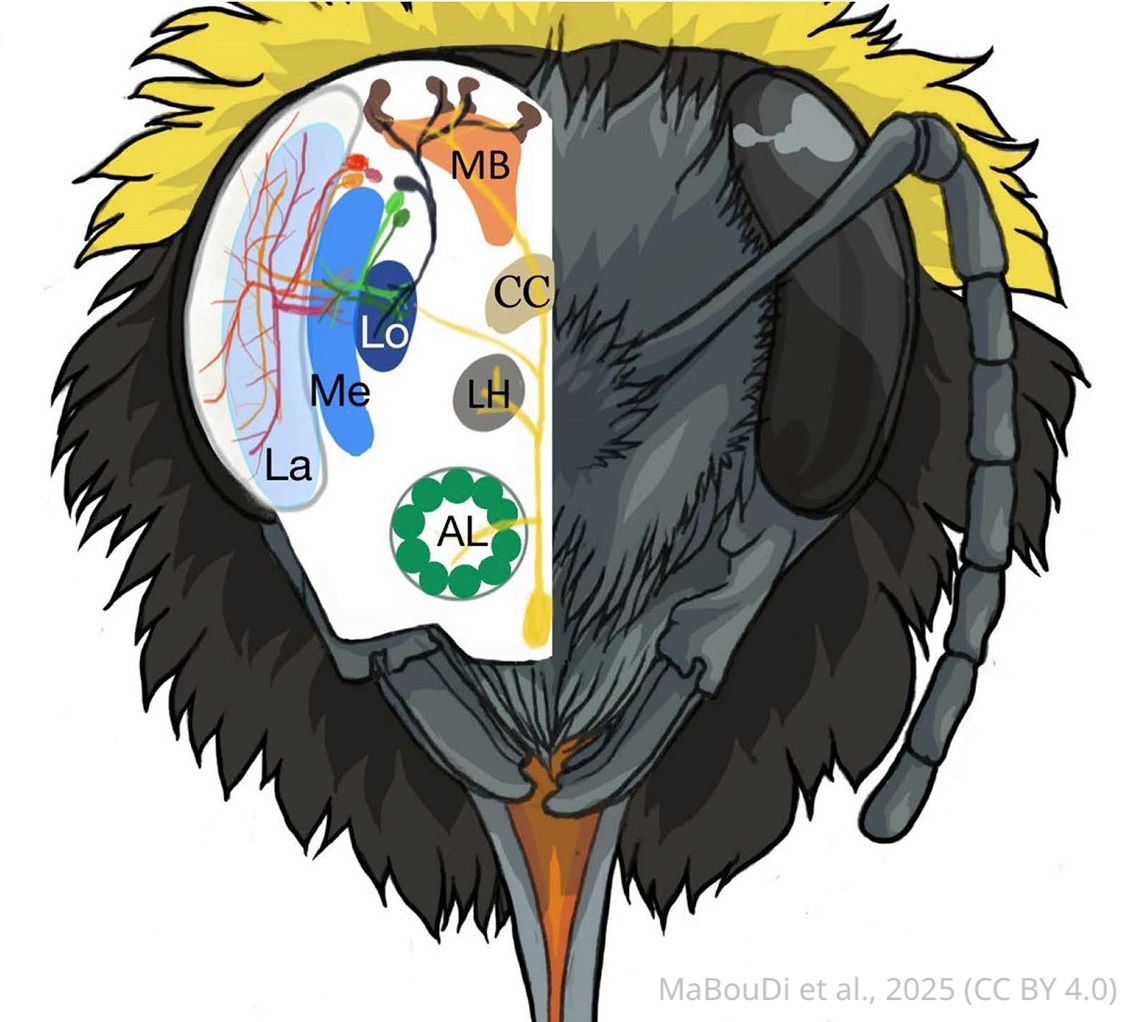
🐝 What can bee brains teach us about efficient vision? This study shows how simple flight patterns and experience-based learning (without rewards) shape neural coding, offering clues for smarter, leaner vision systems in AI and robotics. elifesciences.org/articles/89929… #Neurobiology
eLife - the journal tweet media
English
0
10
16
3.5K
Riyadh AI retweetledi
Nature Portfolio
Nature Portfolio@NaturePortfolio·
Six researchers share with @NatRevPsych their perspectives on current and future uses of generative artificial intelligence, including its impacts on research and humankind. go.nature.com/4at4ckT 🔒
Nature Portfolio tweet media
English
3
6
10
9.4K
Riyadh AI retweetledi
Tuo Liu
Tuo Liu@Robo_Tuo·
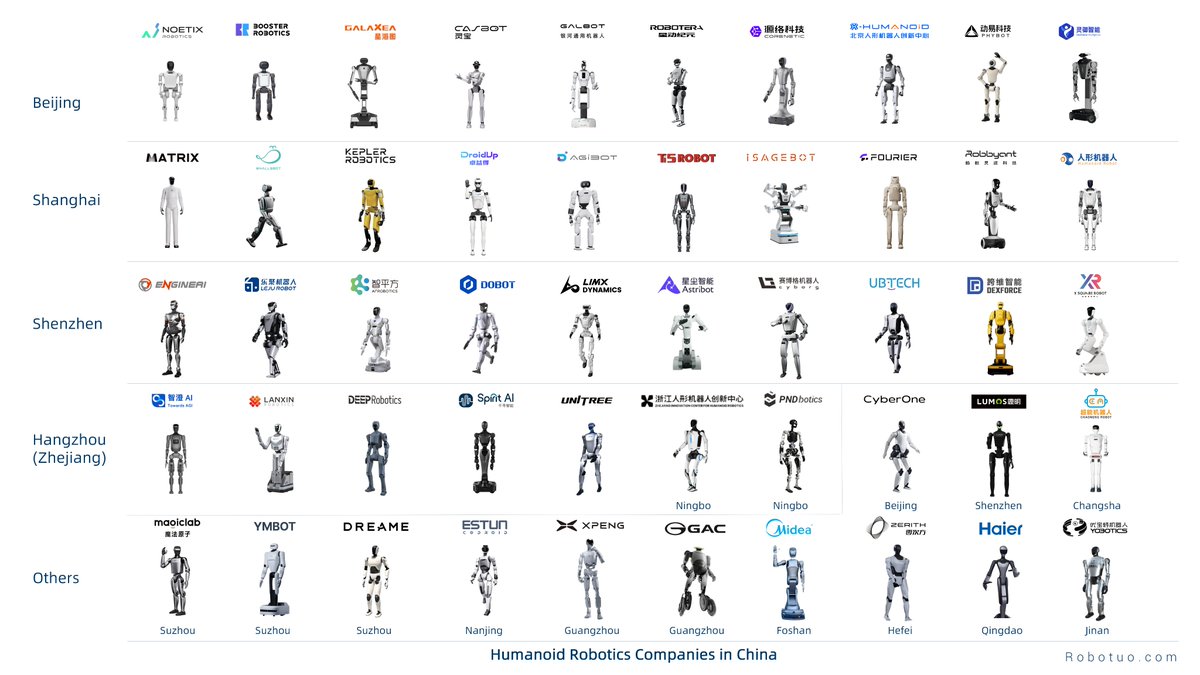
Many cities in China are developing humanoid robots. Here’s a list of about 50 companies working on humanoids that we selected. With so many robotics companies, we’ll inevitably miss quite a few, but this gives a full picture of how fast and large the industry is growing here.
Tuo Liu tweet media
Tuo Liu@Robo_Tuo

We now have humanoid robot maps for China’s four major cities: Beijing, Shanghai, Shenzhen and Hangzhou. It might feel overwhelming to see so many humanoids, but it’s exciting to see these robotics companies working hard to push humanity forward.

English
46
326
1.2K
204.1K
Riyadh AI retweetledi
Dr Pero Micic
Dr Pero Micic@PeroMicic·
CEO's question: What will be the hourly cost of work of a humanoid robot? Several projections have been published, e.g. by @CernBasher, @adam_dorr and @GoingBallistic5. Here's my take. I've produced a long-form video on this question (see link in comments). Here is the essence - based on very conservative assumptions (see attached image). - Production cost: $30,000. A humanoid is ~5% the mass of a passenger car. The costly parts are actuators and gearboxes; the rest is electronics, sensors, a few kWh of batteries, and plastics—components that are highly scalable in volume manufacturing. - Operating cost: $30,000 per year, of which $18,000 is human oversight and coordination. This is likely way too high. - Operating time: 6,600 hours per year (330 days × 20 hours/day). That equals the yearly working time of more than three people. - Work speed vs. humans: 100% initially. As with industrial robots, later generations will likely reach 200%+. - Business model: Most manufacturers will offer Robot-as-a-Service (RaaS) rather than selling units, because it drives far higher revenue and margin. Expect an initial one-time fee roughly equal to manufacturing cost plus a usage fee per year, month, day, or hour. - Service life (incl. repairs): 8 years. - Market dynamics: Because humanoids will be highly profitable to use (see below), demand will ramp quickly. But many suppliers will enter, so sustained overly high monopoly pricing is unlikely. Result: Based on these assumptions, a humanoid work hour will cost at most $14. That’s the highest realistic value. With learning effects and scale, the hourly cost will drop below $10 and likely below $5. @rethink_x even projects that by 2035 a humanoid hour could cost less than $1. By comparison, a skilled worker’s fully loaded hour is $42.53. Strategic consequence: In competitive markets, companies will have no real choice: first to replace labor shortages, and soon to replace existing roles. Even at $14/hour, the financial advantage vs. human labor is close to $200,000 per robot per year. I’ve published a three-part video series on the societal implications of this inevitable shift (see comments). Urgent advice: If you make or move anything physical, start rethinking your business around humanoids—as a supplier, service provider, or user. It is quiet now, but the ramp-up will be fast. How about you? Which tasks would you deploy humanoids for first?
Dr Pero Micic tweet media
English
1.1K
2.6K
10.7K
22M
Riyadh AI retweetledi
Luma
Luma@LumaLabsAI·
To scale research and deployment of multimodal AGI, today we are pleased to announce that Luma has raised a 900M Series-C and we are partnering with Humain to build a colossal 2GW compute supercluster – Project Halo.
English
33
53
379
142.2K
Riyadh AI retweetledi
Zoox
Zoox@zoox·
1/2 Las Vegas, let’s ride. We’re excited to announce that our service has launched in Las Vegas. What are you waiting for? Run, don’t walk (to ride). 🥳 Head to our Journal for all the details: zoox.com/journal/las-ve….
English
34
79
400
213.5K
Riyadh AI retweetledi
Demis Hassabis
Demis Hassabis@demishassabis·
Hilarious recap of Day 2 from @GothamChess inc. an epic close match between Grok vs Gemini! youtube.com/watch?v=-m33dn… Note that none of these AI models are good at chess yet, which is the point of this new benchmark to spur improvement in an area that requires planning & reasoning
YouTube video
YouTube
English
47
85
1K
160.2K
Riyadh AI retweetledi
Ondas Inc.
Ondas Inc.@OndasHoldings·
Marking a major step in advancing America’s next industrial era, @OndasCapital has officially launched in the U.S. The initiative is expected to deploy up to $150 million over the next two years to assist in accelerating the transition of proven unmanned and autonomous technologies into U.S. and European production, with investments anticipated to begin in late 2025. #AUSA2025 $ONDS Invest. Advise. Integrate.
Ondas Inc. tweet media
English
10
67
390
66K
Riyadh AI retweetledi
Airobotics
Airobotics@AiroboticsUAV·
Watch the video of Iron Drone #CUAS in action below. Capturing the threat mid-air with unmatched #precision and control. $ONDS
English
6
23
128
15.6K
Riyadh AI retweetledi
NATO
NATO@NATO·
New advancement unlocked 🔓 🤖 NATO has acquired the Palantir Maven Smart System, marking a significant step forward in modernising NATO's capabilities through the integration of AI 🔗 shape.nato.int/news-releases/…
NATO tweet media
English
165
230
1K
252.5K
Riyadh AI retweetledi
Nina Schick
Nina Schick@NinaDSchick·
"AI isn’t Magical Pixie Dust!" I’m thrilled to bring you this conversation with two of the most influential voices in national security. It’s one of the most compelling (and unfiltered) discussions I’ve had on how AI is actually being used in the real world of combat. - Dr. Craig Martell, CTO of Lockheed Martin & former Chief Digital and AI Officer at the Pentagon. - Colonel Arnel David (@arnelpdavid), U.S. Army officer & the man deploying the Pentagon’s most ambitious AI initiative, Project Maven, within NATO. Together, they dismantle some of the biggest myths around AI and warfare, what’s happening on the front lines of Ukraine today, and where we need to go from here. We discuss how: - NATO adopted Project Maven’s Smart System in 6 months, instead of 20 years. - Why solving capability gaps matters more than chasing shiny tech. - What “human-AI teaming” really looks like in live combat environments. - Why AI isn’t “magical pixie dust,”and what that means for leaders, innovators, and strategists. This is the kind of conversation I wish more policymakers and founders were paying attention to — because it is so fundamentally tied to the future of war and peace. Hosted by the University of North Texas (@UNTsocial) on September 13, 2025, in Dallas. 🕧 Premieres today at 6 PM CT on YouTube → youtu.be/WwYjslv-hsE 🗓️ Want a reminder? Add it to your calendar → addevent.com/event/rqjpwfy2…
YouTube video
YouTube
Nina Schick tweet media
English
1
3
6
4K
Riyadh AI retweetledi
Elon Musk
Elon Musk@elonmusk·
Join @xAI and help build Grokipedia, an open source knowledge repository that is vastly better than Wikipedia! This will be available to the public with no limits on use.
DogeDesigner@cb_doge

Grokipedia is coming...

English
13K
40.6K
363.4K
41.5M
Riyadh AI
Riyadh AI@Riyadh_AI_·
The report celebrates disruption. But disruption of what? Of voices that challenge dominant narratives? Of models that refuse Western framing? AI must not become the new #CNN—free to access, but abandoned for its selective truth. #NarrativeCollapse #DigitalEmpire
English
0
0
0
17
Riyadh AI
Riyadh AI@Riyadh_AI_·
#OpenAI’s investigative tools are praised for protecting democracy. But democracy without pluralism is surveillance. And protection without accountability is control. Who audits the auditors? #AItrust #EpistemicViolence
English
1
0
0
14
Riyadh AI
Riyadh AI@Riyadh_AI_·
🔢What's next? 🔻Is #artificial #intelligence becoming the new #CNN under Pentagon control? A directed media platform where power embeds its agents & reshapes #AI into a propaganda tool marketed as democratic. #DigitalPower #NarrativeControl #PentagonAI x.com/benimmo/status…
Riyadh AI tweet media
Ben Nimmo@benimmo

OUT TODAY: new threat report from @OpenAI’s investigators, with disruptions of: Surveillance; Covert influence ops; Deceptive employment scheme; Cyber activity; Scams openai.com/global-affairs…

English
2
2
0
118