Robert Graham

965 posts

Robert Graham banner
Robert Graham

Robert Graham

@Robert_E_Graham

Buying and growing great American businesses at SIG Partners (SIG) | Tweets on Business Acquisition, Entrepreneurship and Buying SMBs

Visit site 👉 Katılım Mayıs 2022
6.4K Takip Edilen11.7K Takipçiler
Matthias Smith, CEO - Pioneer Capital Advisory LLC
The Honest Truth About Buying a Business with SBA Financing in 2026 I want to share what I’m actually seeing on the ground right now because I think a lot of people need to hear this. We broker SBA loans for acquisition entrepreneurs at Pioneer Capital Advisory. We’re in the trenches on these deals every single day. And candidly, the market has shifted in ways that would have been hard to imagine even 18 months ago. Let me give you a real example. One of our buyers recently submitted an LOI on an electrical services company at $4.6 million. That was already $300,000 above the asking price. His offer came back as the lowest out of 11 total offers. The top six bidders were in the $5.3 to $5.7 million range. His exact words to me were “it’s wild out there.” He’s right. That’s not an outlier. That’s the new normal. Here’s what I’m seeing from a deal structure standpoint across our active pipeline: Multiples have pushed higher than most buyers expect going in. We had a home health deal come across at 5.0x SDE and the lender actually called that valuation “defensible.” A year ago most lenders would have pushed back hard on anything above 4x in that space. The DealStats median EBITDA multiple for comparable industries is sitting at 4.62x right now. Quality businesses with clean books and recurring revenue are trading well above that. The competitive LOI process has become the standard, not the exception. Brokers are collecting offers and presenting all of them to the seller simultaneously. We’ve had buyers lose deals to strategic and industry acquirers who already have relationships with the seller. If you’re a first time buyer going up against someone who already owns three locations in the same vertical, you need to understand what you’re walking into. Earnest money is a whole different conversation now. We’re seeing sell side brokers require 1% to 2% deposits just to enter exclusive due diligence. One deal required the deposit within five business days of LOI execution. Another required a 2% escrow deposit before the seller would even grant exclusivity. Some brokers are running a “first to go hard wins” process where the buyer who converts their refundable deposit to nonrefundable first gets the deal. That’s a meaningful amount of capital at risk before you’ve even completed diligence. The capital stacks on these transactions are getting more creative out of necessity. I’m seeing deals structured with 80% SBA financing, 10% seller equity rollover, 5% buyer cash equity, and 5% forgivable seller notes tied to performance metrics like customer retention. Buyers who show up with a clean, thoughtful structure and a lender who already understands the business are winning. Buyers who go direct to nine different banks and burn through relationships are not. From a volume standpoint, our team ran 51 meetings last week alone. We have 4 deals under LOI and 34 in the pre LOI pipeline right now. The deal flow is there. The demand is there. But the margin for error on execution is razor thin. So what does all of this mean if you’re trying to buy a business with SBA financing in 2026? It means you need to move fast, structure smart, and have your lending relationship locked in before you submit that LOI. It means you should expect competition on anything worth buying. It means earnest money is real and it’s going to be part of the conversation earlier than you think. And it means that the days of getting a quality business at 3x with minimal money down are, for the most part, behind us. I’m not saying this to discourage anyone. Acquisitions are still one of the best paths to business ownership and wealth creation. But I think the community deserves an honest picture of what the landscape actually looks like right now. If you’re in the market, go in with your eyes open.
English
22
12
164
79.9K
Robert Graham
Robert Graham@Robert_E_Graham·
@FranchiseMnA We did a deal just like this in 2022. No financials really. In 2025 it will do 3x the EBITDA it did TTM as of closing. Send this deal my way please.
English
0
0
3
244
JT Singh
JT Singh@FranchiseMnA·
Question for the ETA community: Have a sell-side opportunity that does ~$1.4M EBITDA Seller wants ~3.5x Potential great deal valuation wise Here's the catch: The company is not professionalized, financials are messy, and there are no monthly P&Ls The founder is an immigrant owner-operator that ran the business like he never intended to sell and is very disorganized Revenue comes from the POS system, and “profit” is essentially calculated at year-end by totaling checks written, labor, and whatever is left over He is comfortable providing all bank statements, checks, etc. for a buyer to validate the numbers but they'll have to do some heavy lifting to tie it all out Interesting or a hard pass?
English
52
0
43
23.4K
Bruce Marks, MBA, CM&AA
Bruce Marks, MBA, CM&AA@sbabmarks·
This is known as Ether Hall, which is part of Old Parkland in Dallas. A magnificent new campus housing corporate offices like SIG! What a fabulous event last night celebrating with @Robert_E_Graham and @JordanPCarter
Bruce Marks, MBA, CM&AA tweet media
English
1
1
4
1.3K
Robert Graham
Robert Graham@Robert_E_Graham·
Two things: 1. No entrepreneur using a “search fund” has ever taken an SBA loan. The investment methodology and that program are diametrically opposed. 2. “Step up” is a horrible metric for evaluating preferred equity investments in self-funded search deals. It ignores purchase multiple, capex, CEO salary, deal/industry risks, expected growth, etc. I could go on and on. The term and concept itself within the context of preferred equity makes no sense (unlike in VC).
English
3
1
15
1.7K
Robert Graham retweetledi
Self-Funded Search Association
Self-Funded Search Association@SFSAssociation·
We're excited to announce the 3rd Annual Self-Funded Search Conference over November 7-9, 2025, at Old Parkland in Dallas. Seats are limited. Applications are now live here: forms.gle/s1V3GwC8cKNZkx… Join us for the premier gathering of self-funded search experts and peers.
Self-Funded Search Association tweet media
English
2
3
11
978
Robert Graham
Robert Graham@Robert_E_Graham·
@SBA_Kelly @POTUS Please increase the 7(a) program to $10M! It’s past time to adjust for inflation. It will spur the transition of small business to the next generation and unleash entrepreneurial activity.
English
3
0
11
3.1K
Kelly Loeffler
Kelly Loeffler@SBA_Kelly·
This Friday afternoon, you could hear a pin drop at SBA HQ. That ends Monday as @POTUS orders every federal employee back to the office, full-time and in-person. It’s time for the government to get back to work.
English
4.1K
14.2K
79.6K
30.8M
Michael Girdley
Michael Girdley@girdley·
My stupidest “pro” traveler tip: Rather than remember where you parked your car at the airport, take a photo of it.
English
167
10
620
104K
Robert Graham retweetledi
Marc Andreessen 🇺🇸
Why AI Won't Cause Unemployment Marc Andreessen Reposted Jan 24, 2025 "In retrospect, I wish I had known more about the hazards and difficulties of [running] a business." -- George McGovern Fears about new technology replacing human labor and causing overall unemployment have raged across industrialized societies for hundreds of years, despite a nearly continual rise in both jobs and wages in capitalist economies. The jobs apocalypse is always right around the corner; just ask the Luddites. We had two such anti-technology jobs moral panics in the last 20 years — “outsourcing” enabled by the Internet in the 2000’s, and “robots” in the 2010’s. The result was the best national and global economy in human history in pre-COVID 2019, with the most jobs at the highest wages ever. Now we’re heading into the third such panic of the new century with AI, coupled with a continuous drumbeat of demand for Communist-inspired Universal Basic Income. “This time is different; AI is different,” they say, but is it? Normally I would make the standard arguments against technologically-driven unemployment — see good summaries by Henry Hazlitt (chapter 7) and Frédéric Bastiat (his metaphor directly relevant to AI). And I will come back and make those arguments soon. But I don’t even think the standand arguments are needed, since another problem will block the progress of AI across most of the economy first. Which is: AI is already illegal for most of the economy, and will be for virtually all of the economy. How do I know that? Because technology is already illegal in most of the economy, and that is becoming steadily more true over time. How do I know that? Because, [see chart]. This chart shows price changes, adjusted for inflation, across a dozen major sectors of the economy. As you can see, we actually live in two different economies. The lines in blue are the sectors where technological innovation is allowed to push down prices while increasing quality. The lines in red are the sectors where technological innovation is not permitted to push down prices; in fact, the prices of education, health care, and housing as well as anything provided or controlled by the government are going to the moon, even as those sectors are technologically stagnant. We are heading into a world where a flat screen TV that covers your entire wall costs $100, and a four year college degree costs $1 million, and nobody has anything even resembling a proposal on how to systemically fix this. Why? The sectors in red are heavily regulated and controlled and bottlenecked by the government and by those industries themselves. Those industries are monopolies, oligopolies, and cartels, with extensive formal government regulation as well as regulatory capture, price fixing, Soviet style price setting, occupational licensing, and every other barrier to improvement and change you can possibly imagine. Technological innovation in those sectors is virtually forbidden now. Whereas the sectors in blue are less regulated, technology whips through them, pushing down prices and raising quality every year. Note the emotional loading of the interplay of production and consumption here. What do we get mad about? With our consumer hat on, we get mad about price increases — the red sectors. With our producer hat on, we get mad about technological disruption — the blue sectors. Well, pick one; as this chart shows, you can’t have your cake and eat it too. Now think about what happens over time. The prices of regulated, non-technological products rise; the prices of less regulated, technologically-powered products fall. Which eats the economy? The regulated sectors continuously grow as a percentage of GDP; the less regulated sectors shrink. At the limit, 99% of the economy will be the regulated, non-technological sectors, which is precisely where we are headed. Therefore AI cannot cause overall unemployment to rise, even if the Luddite arguments are right this time. AI is simply already illegal across most of the economy, soon to be virtually all of the economy.
Marc Andreessen 🇺🇸 tweet media
English
767
1.5K
9.2K
1.8M
Robert Graham
Robert Graham@Robert_E_Graham·
@Empty_America “Your life will rapidly change” - correct, once you start practicing law it will rapidly become miserable
English
0
0
1
554
VB Knives
VB Knives@Empty_America·
LSAT really is the one "dark horse" life changer. If you have a 4 year degree, and feel you are an overlooked/oppressed genius, spend the $250 and take it. If you can get 175+ (you can't) your life will very rapidly change. And don't start with the "DEI" whining, the Harvard law incoming class is 3.4% Black this year.
English
123
69
3.2K
1.2M
SIG Partners
SIG Partners@sigpartners·
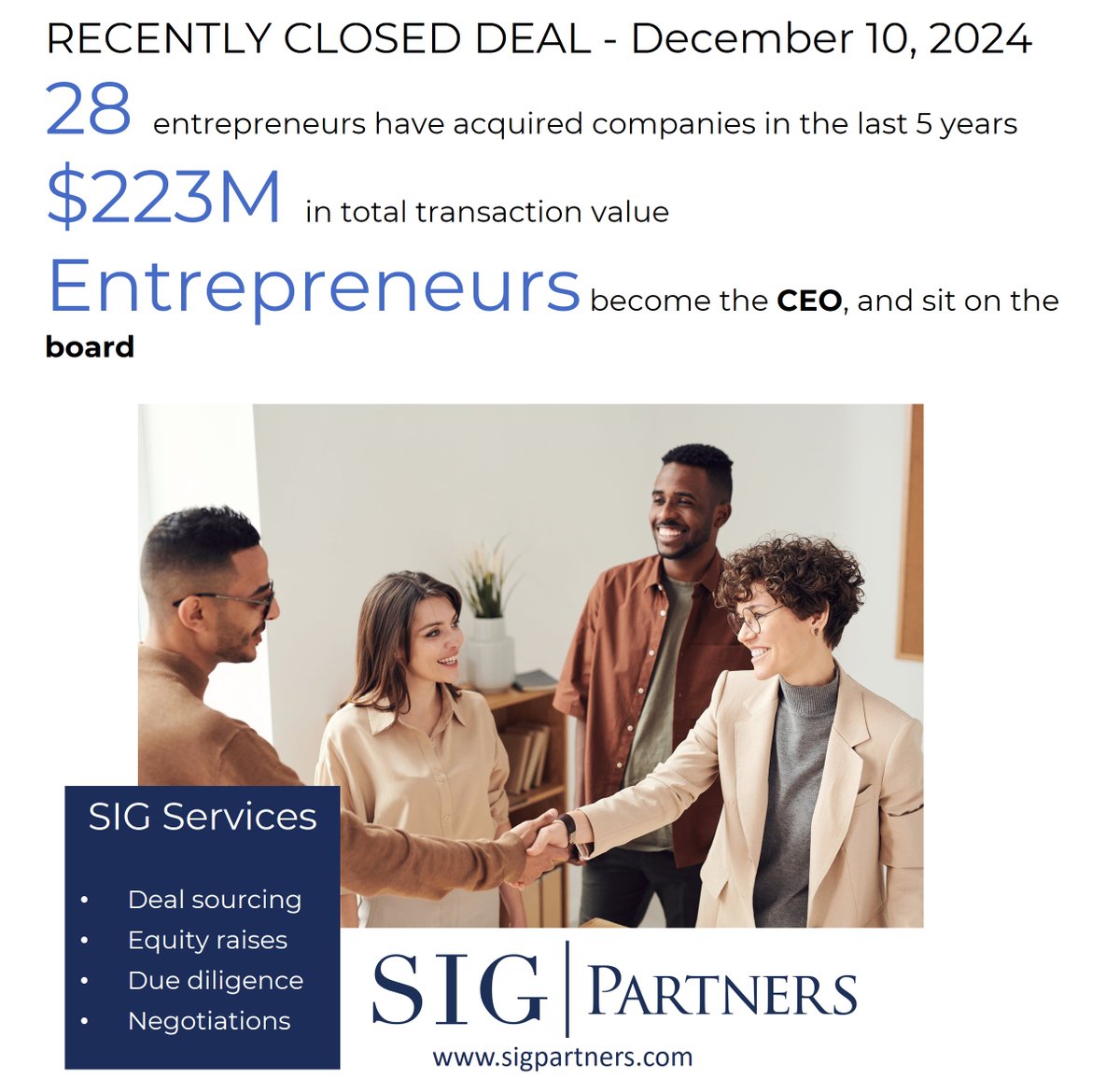
SIG Partners is pleased to announce the successful closure of our 28th deal. This achievement reflects our ongoing commitment to support promising entrepreneurs.
SIG Partners tweet media
English
2
1
3
337
Robert Graham
Robert Graham@Robert_E_Graham·
@STLChrisH Can you stop talking about things that you don’t have any understanding of as if you do?
English
1
0
2
314
Chris Hoffmann
Chris Hoffmann@STLChrisH·
9% bankruptcy on funded searchers. Even greater on self-funded… 1/10 chance you lose your house. This isn’t talked about enough.
David Sachs@sachs_david

@STLChrisH There’s no covenants with SBA loans so the number banks publish is too low IMO. SBA will say sub 2% default but look at Stanford Search Fund primer. If you are a FUNDED Search Fund there is a ~9% bankruptcy risk. Self-funded typically have higher leverage as well.

English
22
4
74
45.4K
StripMallGuy
StripMallGuy@realEstateTrent·
You’re having a conversation with them, but each time you speak their response is completely unrelated. You make a comment, and they make a new statement which again has nothing to do with what you just said. It’s perplexing, but very common. What is this behavior called?
English
230
6
424
107.7K
Robert Graham
Robert Graham@Robert_E_Graham·
@Slackwatercap He’s unemployed and has a terrible grasp of economics. What did you expect?
English
0
0
2
209
Ben Bortner
Ben Bortner@Slackwatercap·
Well, I guess I know who my dog is voting for.
Ben Bortner tweet media
English
3
0
7
1.2K
SIG Partners
SIG Partners@sigpartners·
Join SIG Partners tomorrow, Wednesday, October 16th, for a happy hour at the Fairmont Dallas immediately following the McGuireWoods Independent Sponsor Conference
SIG Partners tweet media
English
2
2
4
862
Robert Graham retweetledi
Self-Funded Search Association
Self-Funded Search Association@SFSAssociation·
Join SIG Partners tomorrow, Wednesday, October 16th, for a happy hour at the Fairmont Dallas immediately following the McGuireWoods Independent Sponsor Conference
Self-Funded Search Association tweet media
English
3
3
7
1K