Sabitlenmiş Tweet
Rogue Equity
813 posts


@PEoperator Still nothing? Mind shooting me a DM and seeing if that works
English

Interviewed a guy yesterday for an open leadership role.
We had talked on the phone before (we had a mutual connection). He’s sixty, has related experience, and says his current job is boring. He’s looking for a challenge.
So far so good.
He asks if he could swing by the office to introduce himself. Sure.
We sit down to chat. I asked him to tell me about his current role.
He proceeds to regale me with just how good he is. It’s an interview so I try to overlook all the chest puffing… I mean, he’s supposed to tell me about his accomplishments.
When he finishes, I ask the obvious question… “sounds like you are in a great spot, why would you want to leave?”
With a smug grin, he then proceeds to say “I want to go where I’m wanted. Our friend asked me if I would submit a resume. I said no. I won’t. Because look I don’t need the money. I want to go somewhere that sees how valuable I am and pursues me.”
Again, picture that response said in the smuggest, most condescending way you can.
It was kind of a shocking response tbh. I was taken aback.
So I said, “well look I need people who want to be here, people who are passionate, who want to build.”
He sort of retraced his steps but the damage was done.
We don’t need a prima donna on our team. We need humble builders serving their customers and employees.
One thing that can be difficult in interviews is balancing talking about yourself and your accomplishments with not coming across as arrogant.
My advice there is to be matter of fact on accomplishments. I look for people using the word “we” instead of “I”. That conveys a sense of team and humility.
I also think asking questions is a good sign. When I asked this guy if he had any questions, you can guess his response (he already knew everything).
Another thing is balancing wanting the job with not seeming desperate. In my experience, showing some desperation- how bad you want THIS job- resonates.
I think I’m a good judge of character, but it can be hard in a brief interview to evaluate.
So anyway, back to the story… I passed on that guy.
English

@endowment_eddie Any interesting new funds you’re tracking in NYC?
English

The last four Fund Is or institutional Fund Is I did:
- All fund size $125-250
- 1/4 founder, 2/4 operator, 2/4 had prior vc exp
- 3 of 4 started as outbound cold emails from me
- My bite ranged from $10 to $40
- 1 was an existing relationship/spin out
- track record total invested was $12 to >$1B
- GP age was ~30 to ~50
- All west coast
- preseed to A
TL;DR: don’t think there’s a pattern
English

Alright here we go. I’m giving away a free driver.
30-50mph winds on Pac Dunes. Pouring rain. The green tees (about 6,200 yards).
Guess what I shoot & if you’re right you enter to win a free @TaylorMadeGolf Qi35 driver. I’ll send it to you myself.

English

I’ll speak for myself in saying that I guess I don’t understand how lonely and difficult a $10 million guarantee and 20% slope must feel.
Hope I find out someday.
Fund_GM@Fund_CDM
Junior analysts imagine the top as the promised land. In reality, it’s quieter, lonelier, and full of doubt. They see the rewards of being a PM. Few see the weight of decision-making and what it feels like when every decision is yours and there’s nowhere to hide. It’s the same in most big jobs. The view looks better from below than it feels from above.
English

The invisible made visible.
Breakthrough companies are built when we learn how to measure new things.
A huge part of human progress is simply learning to measure something new, notice what is happening, and refine our approach based on new information.
The mind is a frontier of critical-yet-vague information.
Proud to be an early investor in this team of scientists building "Whoop for Brains"
Follow them for the coming launch...
Atlas@atlaswearable
We track steps, heart rate, sleep… But nothing has ever helped us understand the mind, our most vital organ. Until now.

English

The private equity industry has become commoditized.
Folks inside the industry will point out how different one firm is to another.
But from the outside, they are indistinguishable.
Buy a company with debt, cut costs, try to grow, avoid investments that don’t pay back in 3-5 years, sell.
And selling is often a shell game where one private equity firm hands off a portco to the next, bigger fish.
There are some differentiators- Thrive, Silver Lake, Alpine - all have differentiated playbooks. The LMM guys often have an angle too, providing the first phase of sophistication for SMBs.
But the truth is most traditional PE firms exist at this point because they generate ~S&P500 returns while old school LPs (often the GPs alma mater endowment) feel “diversified”.
The only people consistently getting outsized returns are the GPs.
Many “pre-partners” inside the industry dream of launching their own fund, doing things their own way. But the promise of more money - the payoff - keeps them around.
Those folks should be careful. There are no guarantees. Past performance may not indicate future.
There is no doubt PE is in a tough spot right now, but it is an industry made up of very smart, rich people. They will fight.
The endgame here is going to be interesting.
English

@housetechnolove @BoringBiz_ Mind sending me a DM? interested in learning more
English

@BoringBiz_ Look at Courtyard. Tokenized card market with interesting structures and explosive numbers
English

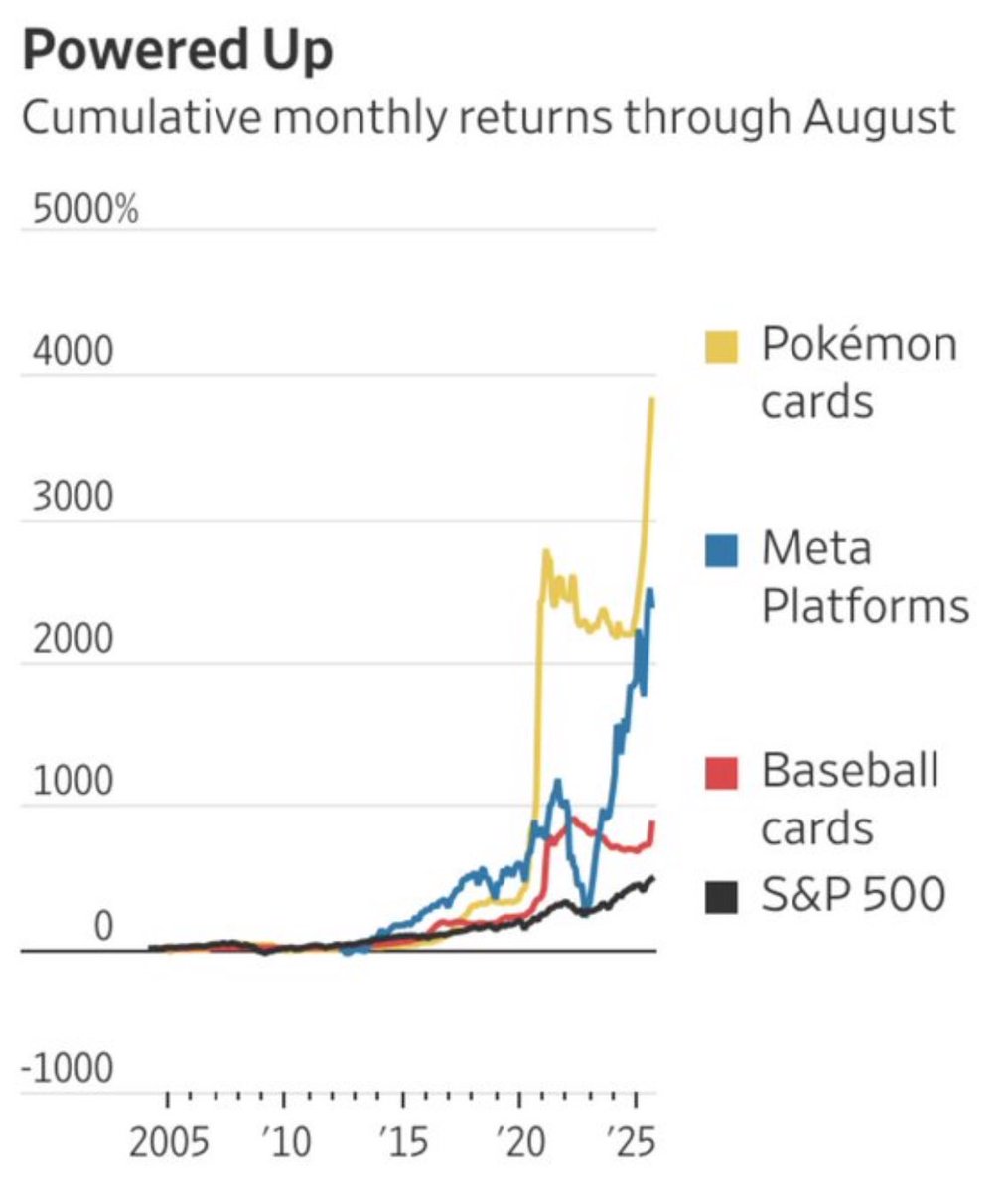
After spending a couple days looking into this market, I have actually turned a lot more bullish on investing in Pokémon cards
These are preliminary thoughts so feel free to point out where I am wrong
> Pokémon released in 1996 and the majority of early viewership came from people who are just entering the workforce or their peak earnings years. The folks who actually have a nostalgia factor from the franchise are yet to fully delve into the asset class. My guess is that we have therefore not seen the peak of the market yet
> Average household where pokémon was viewed or played was wealthier. This makes sense since you likely had to buy a console or TV, and your parents required discretionary income to purchase these (especially in the 90s and early 2000s). The probability that you end up with high income coming from an already above average income household is quite high, based on statistics. My point is that folks with a nostalgia factor for the franchise likely earn above average income and net worth. This is a fantastic setup in a world that is becoming more bifurcated between have and have nots
> Pokémon is by far the largest franchise in the world. Star Wars has 2/3 the franchise value and Mario stands at 1/3.
> During the last eBay earnings call, management directly mentioned Pokémon trading card volume as having a material impact on revenues. I think the volume of cards and amount of money moving around in pokémon cards is underestimated
> Despite these, the biggest challenge I see today in this market is liquidity. It’s hard to move this product without paying fees to ebay or selling at discount to local game
stores or collectors. However, I think there is tons of opportunity for the franchise to get better at this. We are already seeing new platforms such as Whatnot add tremendous amounts of daily GMV in this category.
> Graded cards (through PSA) are also interesting and I don’t see any reason why you would not be able to put these into the blockchain. Tokenization is a hot topic right now in Ethereum (@fundstrat ) and I see no reason why Pokémon should not be the perfect target to put on the blockchain
Again, all of this is purely speculative, not investment advice and just my initial thoughts. Feel free to poke holes where you think it makes sense

English