EVVM

805 posts

EVVM banner
EVVM

EVVM

@RollAMate

Deploy a Virtual Blockchain on top of any EVM chain. No nodes, no infra, just smart contracts 🧉 | Welcome to #ChainAbstraction

EVM Katılım Haziran 2023
93 Takip Edilen1.2K Takipçiler
EVVM
EVVM@RollAMate·
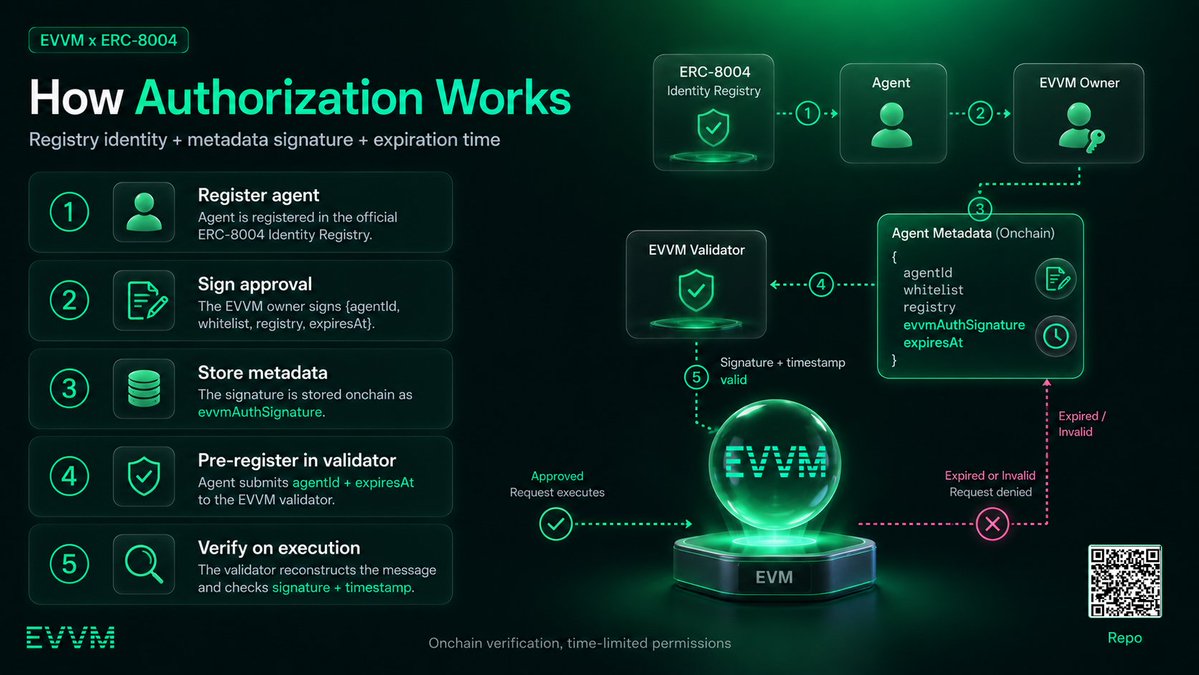
Meet the EVVM team at @EthCC to chat about Blockchain Abstraction. 🚀 Prod level: -EVVM for Banking -zkVVM privacy Vaults + KYC/AML/WL -Agentic EVVM + x402 middleware -Async Nonces + Executors 🧪 Lab: -Quantum-resistant EVVM -FHE-EVVM Catch @jistro @0xoucan @ariutokintumi 🧉
EVVM tweet media
English
1
4
10
166
EVVM
EVVM@RollAMate·
⚛️ Quantum-Resistant EVVM @RollAMate meets @quipnetwork 🤝 and yes, this will be implemented with just a few Solidity lines 🧉 The future of @ethereum is here today, thanks @ethereumboulder to make this connection happen.
EVVM tweet media
English
2
5
20
3.4K
EVVM
EVVM@RollAMate·
Soon 🧉
EVVM tweet media
English
4
5
17
536
EVVM
EVVM@RollAMate·
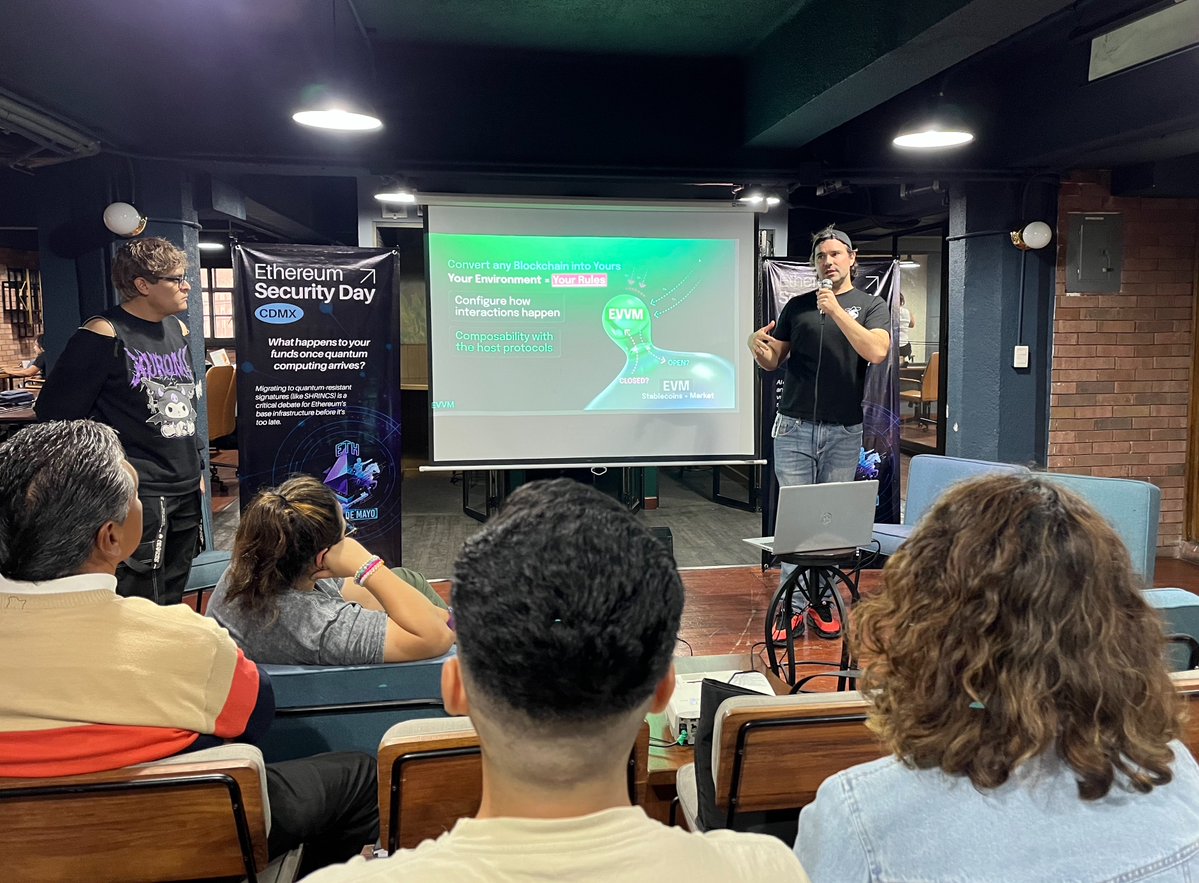
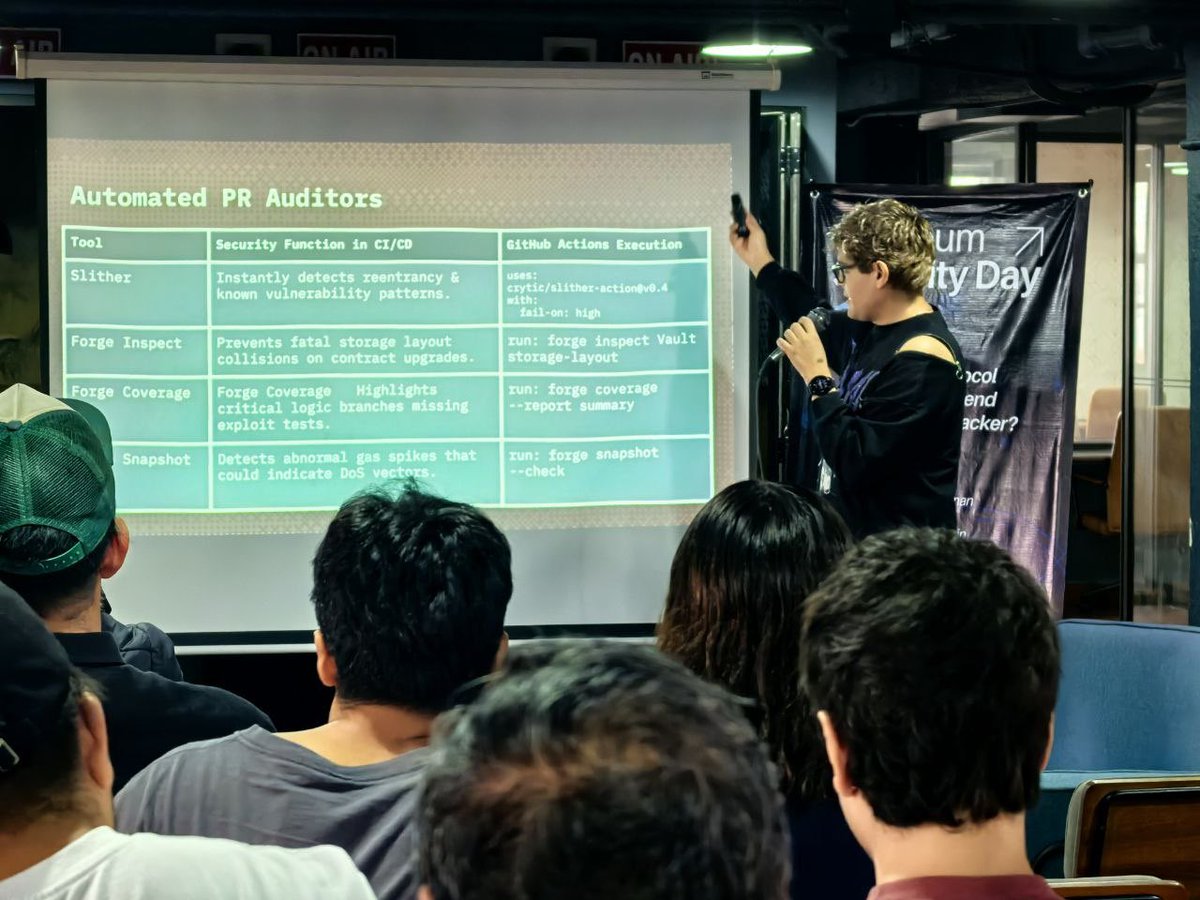
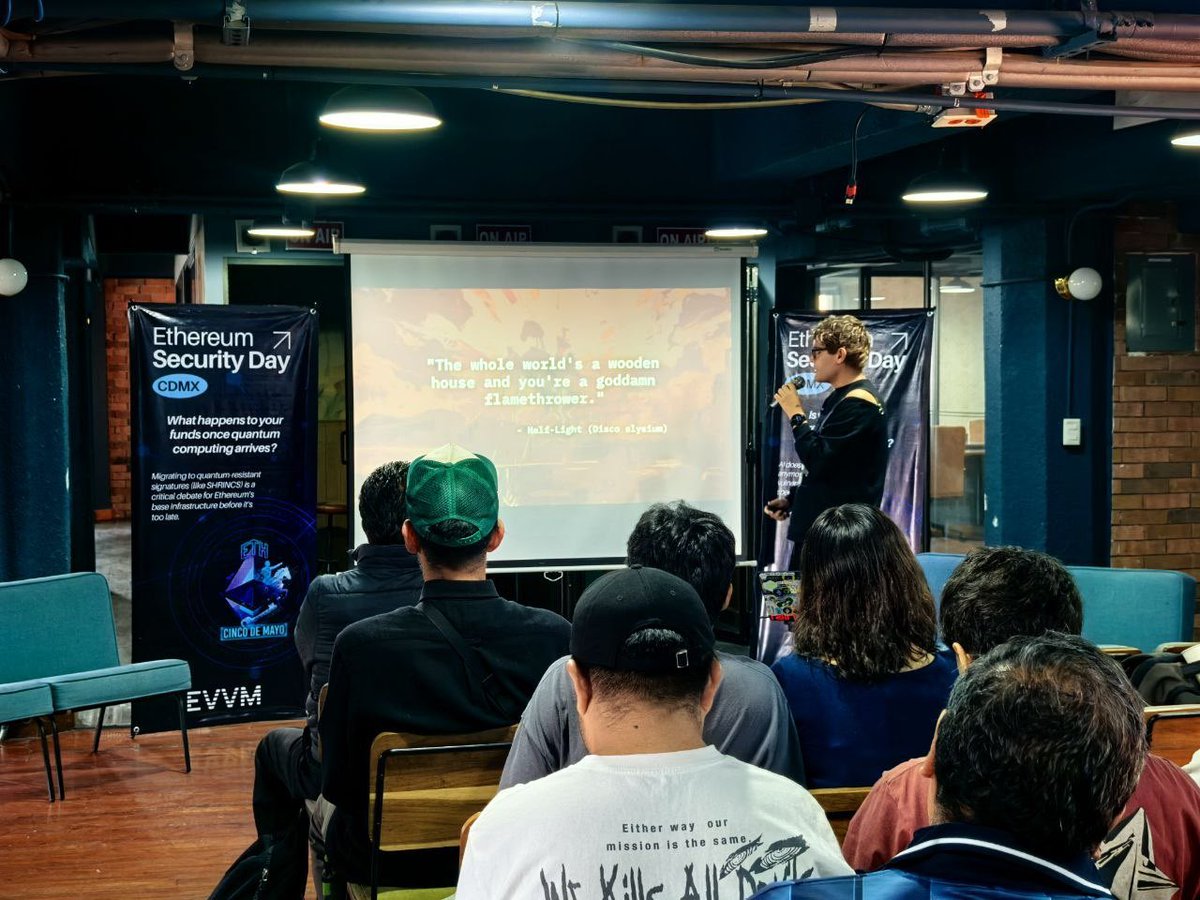
Many @ethereum roadmap stages and @VitalikButerin proposals are doable today with a custom EVVM on L1. Many L2s could be an EVVM with custom relayers. Many appchains fits into an EVVM stack. Most of those would be a top optimized implementation. Who wants a 🧉?
EVVM tweet mediaEVVM tweet mediaEVVM tweet mediaEVVM tweet media
English
0
4
8
216
EVVM
EVVM@RollAMate·
@RasterlyRock You can bring all of those today to @ethereum just by deploying a customized EVVM.
English
0
0
2
16
Ryan Rasmussen
Ryan Rasmussen@RasterlyRock·
This is a really great primer on the Ethereum Strawmap: a 3-year plan to accomplish 5 major goals via 7 network upgrades that overhauls the Ethereum network, making it more attractive for builders (including institutions and enterprises) and more competitive with other blockchains. Everyone should read this, but I’ll summarize below (with all credit to @Snapcrackle for the writeup and the Ethereum researchers and builders like @VitalikButerin, @drakefjustin, others at the @ethereumfndn, and the countless Ethereum contributors for the mission-critical work they do every day). The Strawmap outlines five goals: 1. Accelerating Speed: Finality (the time it it takes for a transaction to become irreversible, secure, and permanently recorded) goes from minutes to seconds (via redesigned consensus) 2. Increasing Throughput: Transactions per second goes from 30 to 10,000 (via ZK Proofs) 3. Scaling Data: Enabling 10,000,000 transactions per second on L2s (via increased data capacity) 4. Post-Quantum Resilience: Implementing quantum-resistant cryptography 5. Improving Privacy: Adding privacy as a native feature It proposes seven upgrades; one every six months. All upgrades would be complete over the next three years (by mid-2029). The result: A faster, more secure, more scalable, privacy-enabled, censorship-resistant network. Of course, this is highly dependent on several factors, including mathematical and cryptographic breakthroughs. But, the Strawmap notes that "the current draft assumes human-first development” and that “AI-driven development and formal verification could significantly compress schedules." While the Strawmap is obviously ambitious, it’s hard not to be bullish with this level of clarity and focus on accelerating upgrades and scaling/building Ethereum for a future where hundreds of trillions worth of financial assets move onchain.
Ryan Rasmussen tweet media
James | Snapcrackle@Snapcrackle

x.com/i/article/2029…

English
18
75
316
31K
Ethereum
Ethereum@ethereum·
From private payments to tokenized funds and AI standards, Ethereum builders kept shipping. Here are 25 things the ecosystem delivered this month. 0/ @payy_link announced Payy Network, a privacy-first Ethereum enabled EVM L2. It features default private token transfers and a cheaper way to build privacy-preserving applications, strengthening Ethereum’s privacy ecosystem. 1/ @RobinhoodApp launched the public testnet for Robinhood Chain, an Ethereum L2 powered by @arbitrum. Institutional settlement on Ethereum rollups continues to bridge traditional finance and public infrastructure. 2/ The @ethereumfndn Protocol Cluster published its 2026 priorities: Scale, Improve UX, and Harden the L1. Ethereum continues coordinating long-term technical upgrades in public to help steward the protocol forward. 3/ @l2beat launched L2BEAT Interop, a dashboard tracking cross-chain connectivity,value, and highlighting interoperability risks, helping the ecosystem stay connected to interoperability progress. 4/ @drakefjustin introduced Strawmap, a roadmap of proposed L1 protocol upgrades. It acts as a technical resource for researchers, developers, and participants in Ethereum governance. 5/ @Starknet integrated Nightfall, bringing confidential institutional DeFi to the Starknet stack. ZK privacy continues advancing Ethereum’s institutional use cases. 6/ @hinkal_protocol enabled private ETH and stablecoin payments on @arbitrum, demonstrating how private transactions are expanding across Ethereum L2s. 7/ @StartaleGroup introduced JPYSC, the first trust bank–backed JPY stablecoin. 8/ The One Trillion Dollar Security Dashboard was released by the @ethereumfndn. It is a comprehensive view of Ethereum’s security across the ecosystem. 9/ @builders_garden introduced Sign In With Agent (SIWA), a trustless identity standard for AI agents. 10/ @blockscout launched a Tor-native onion service: a privacy-first way to observe and verify Ethereum state. Blockscout’s .onion domain for Ethereum provides a way to view blocks, transactions and accounts. 11/ @MetaLeX_Labs launched cyberSign, letting users sign any legal agreement with @ethereum / @base. 12/ @Rocket_Pool activated Saturn One, introducing 4 ETH megapool validators. Improved capital efficiency strengthens Ethereum’s decentralized staking layer. 13/ @BNPParibas launched a euro-denominated money market fund on Ethereum. Tokenized funds on public blockchain infrastructure signal growing institutional confidence in Ethereum. 14/ Tokenized RWAs on Ethereum mainnet surpassed $15B in market cap. 15/ @aave crossed $1 trillion in all-time loans. 16/ @OndoFinance tokenized stocks (SPYon, QQQon) went live as DeFi collateral on @Morpho. Tokenized equities are now usable inside onchain credit markets. 17/ @eulerfinance enabled tokenized equities as collateral, built with @OndoFinance, @SentoraHQ, and @chainlink. Traditional financial exposure is now composable inside Ethereum-native lending markets. 18/ @Uniswap integrated with @Securitize to make @BlackRock’s BUIDL fund tradable via UniswapX. 19/ @LineaBuild sustained 100+ mGas/s throughput, peaking at 218 mGas/s, showing how rollups are scaling Ethereum in practice. 20/ @Starknet released Starkzap, an open-source SDK that turns apps into onchain consumer apps. 21/ @base announced @YCombinator startups can now get funded in USDC on Base. 22/ @Optimism shipped Upgrade 18 setting the foundation for a more performant, customizable, and operationally efficient OP Stack. 23/ @ether_fi released its Android app. Native mobile access lowers the barrier to staking and DeFi participation. 24/ The next Ethereum Community Hub is launching in Rome, hosted by @urbeEth. Local builder ecosystems continue expanding globally.
English
128
240
1.1K
120.2K
EVVM
EVVM@RollAMate·
🚀 EVVM v3 is here, what's new? ✅ Central Tx Validation 🕵️‍♂️ zkVVM vaults Service 🤖 x402 Middleware 💹 Tokenomics Management 👨‍✈️ tx.origin + msg.sender Permits 🚪 KYC/AML/WL/token+ delegatecall Gate 🐋 Docker Check github.com/EVVM-org & enjoy the future of @ethereum today 🧉
English
1
3
17
303
EVVM
EVVM@RollAMate·
Now he's talking about async nonces without mentioning async nonces + infra improvements. Come to the EVVM fam @VitalikButerin 🧉
vitalik.eth@VitalikButerin

Finally, the block building pipeline. In Glamsterdam, Ethereum is getting ePBS, which lets proposers outsource to a free permissionless market of block builders. This ensures that block builder centralization does not creep into staking centralization, but it leaves the question: what do we do about block builder centralization? And what are the _other_ problems in the block building pipeline that need to be addressed, and how? This has both in-protocol and extra-protocol components. ## FOCIL FOCIL is the first step into in-protocol multi-participant block building. FOCIL lets 16 randomly-selected attesters each choose a few transactions, which *must* be included somewhere in the block (the block gets rejected otherwise). This means that even if 100% of block building is taken over by one hostile actor, they cannot prevent transactions from being included, because the FOCILers will push them in. ## "Big FOCIL" This is more speculative, but has been discussed as a possible next step. The idea is to make the FOCILs bigger, so they can include all of the transactions in the block. We avoid duplication by having the i'th FOCIL'er by default only include (i) txs whose sender address's first hex char is i, and (ii) txs that were around but not included in the previous slot. So at the cost of one slot delay, only censored txs risk duplication. Taking this to its logical conclusion, the builder's role could become reduced to ONLY including "MEV-relevant" transactions (eg. DEX arbitrage), and computing the state transition. ## Encrypted mempools Encrypted mempools are one solution being explored to solve "toxic MEV": attacks such as sandwiching and frontrunning, which are exploitative against users. If a transaction is encrypted until it's included, no one gets the opportunity to "wrap" it in a hostile way. The technical challenge is: how to guarantee validity in a mempool-friendly and inclusion-friendly way that is efficient, and what technique to use to guarantee that the transaction will actually get decrypted once the block is made (and not before). ## The transaction ingress layer One thing often ignored in discussions of MEV, privacy, and other issues is the network layer: what happens in between a user sending out a transaction, and that transaction making it into a block? There are many risks if a hostile actor sees a tx "in the clear" inflight: * If it's a defi trade or otherwise MEV-relevant, they can sandwich it * In many applications, they can prepend some other action which invalidates it, not stealing money, but "griefing" you, causing you to waste time and gas fees * If you are sending a sensitive tx through a privacy protocol, even if it's all private onchain, if you send it through an RPC, the RPC can see what you did, if you send it through the public mempool, any analytics agency that runs many nodes will see what you did There has recently been increasing work on network-layer anonymization for transactions: exploring using Tor for routing transactions, ideas around building a custom ethereum-focused mixnet, non-mixnet designs that are more latency-minimized (but bandwidth-heavier, which is ok for transactions as they are tiny) like Flashnet, etc. This is an open design space, I expect the kohaku initiative @ncsgy will be interested in integrating pluggable support for such protocols, like it is for onchain privacy protocols. There is also room for doing (benign, pro-user) things to transactions before including them onchain; this is very relevant for defi. Basically, we want ideal order-matching, as a passive feature of the network layer without dependence on servers. Of course enabling good uses of this without enabling sandwiching involves cryptography or other security, some important challenges there. ## Long-term distributed block building There is a dream, that we can make Ethereum truly like BitTorrent: able to process far more transactions than any single server needs to ever coalesce locally. The challenge with this vision is that Ethereum has (and indeed a core value proposition is) synchronous shared state, so any tx could in principle depend on any other tx. This centralizes block building. "Big FOCIL" handles this partially, and it could be done extra-protocol too, but you still need one central actor to put everything in order and execute it. We could come up with designs that address this. One idea is to do the same thing that we want to do for state: acknowledge that >95% of Ethereum's activity doesn't really _need_ full globalness, though the 5% that does is often high-value, and create new categories of txs that are less global, and so friendly to fully distributed building, and make them much cheaper, while leaving the current tx types in place but (relatively) more expensive. This is also an open and exciting long-term future design space. firefly.social/post/lens/8144…

English
1
2
10
350