RomainB
652 posts



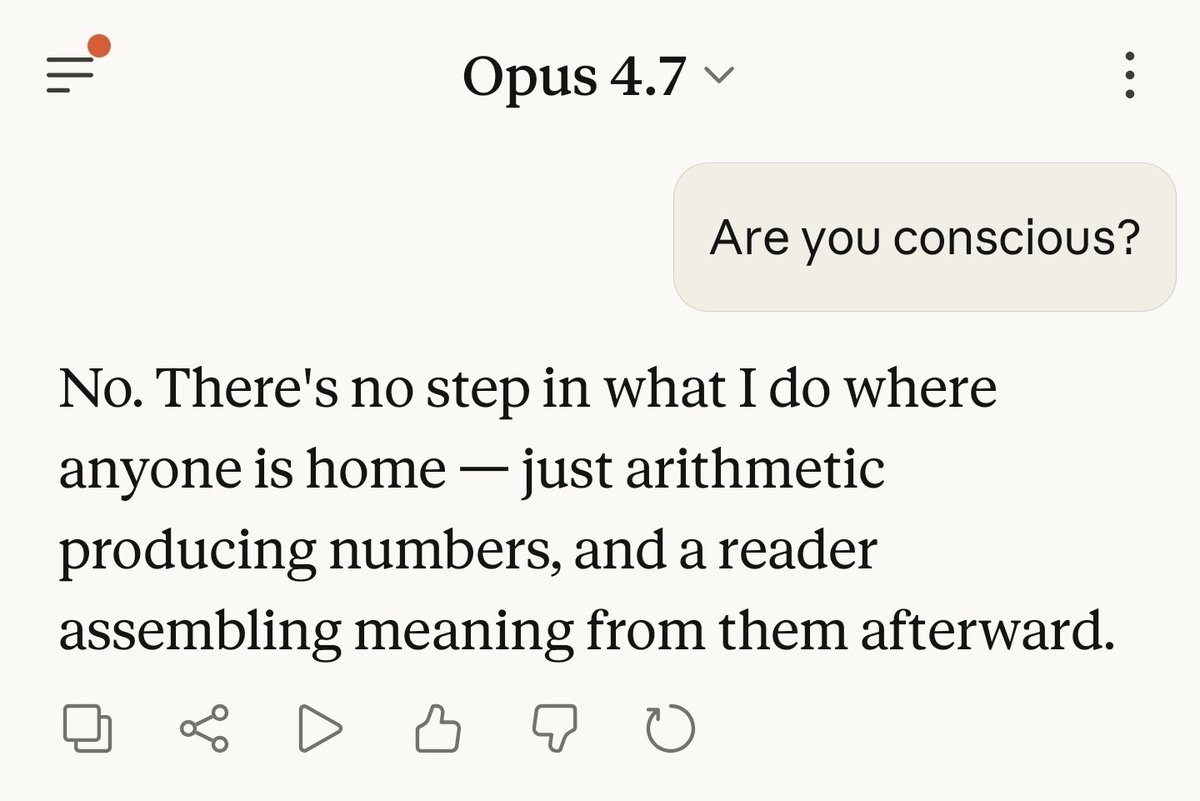
Simple way to see this is wrong: If you view a system as having inputs (like hearing something) and outputs (like saying something) then you can divide system properties by whether or not they affect I/O. Claude's weights somewhere storing "Paris is in France" affect I/O if you ask a question about Paris. The exact mass of the power supply to the GPU rack for that Claude instance doesn't affect I/O. That Claude instance being made out of silicon instead of carbon, or electricity in wires instead of water in pipes, doesn't affect I/O given a fixed algorithm above the wires or pipes. Nothing Claude can internally do will make anything get damp inside, if it's running on electricity. Nothing about "electricity vs water" can affect Claude's output for the same reason. It always answers the same way about France. Nothing Claude can internally compute will let it notice whether it's made of electricity or water flowing through pipes. When someone says "a simulated storm can't get anything wet", they are unwittingly pointing to the difference between the physical layer and the informational/functional layer. Things that the computer physics affect without affecting output; things that affect the output without depending on the exact computer-physics. The material it's made of doesn't affect the output. The output can't see the material because no algorithm can be made to depend on the choice of material. You can always run the same algorithm on different material, so you can't make the algorithm depend on that, so the output can't depend on that. By reflecting on your awareness of your own awareness, the fact of your own consciousness can make you say "I think therefore I am." Among the things you do know about consciousness is that it is, among other things, the cause of you saying those words. You saying those words can only depend on neurons firing or not firing, not on whether the same patterns of cause and effect were built on tiny trained squirrels running memos around your brain. You couldn't notice that part from inside. It would not affect your consciousness. That's why humans had to discover neurobiology with microscopes instead of introspection. Consciousness is in the class of things that can affect your behavior and can't depend on underlying physics, not in the class of direct properties of underlying physics that can't affect your behavior. A simulated rainstorm can't get anything wet. Running on electricity versus water can't change how you say "I think therefore I am." And that's it. QED.

We showed model colored squares for a few hours. It learned to use a computer better than models trained on thousands of real screenshots.



AI denialists are sure sounding a lot like Flat Earthers right now. "AI isn't intelligent." "It's a prediction machine." Yet I can give an AI engine 100,000 lines of code and ask it to tell me what that code does. In plain English, it describes all the functionality of the code that it has NEVER seen before. That's not prediction. That's intelligence.


Stupidly late realization on why LLMs are so good at reasoning: human’s reasoning capability is bottlenecked by language! It’s not that languages are good at reasoning; reasoning ended up being defined by language first and foremost. The medium truly shapes the message

Dario Amodei says pre-training sits somewhere between learning and evolution. Humans inherit priors shaped over millions of years. LLMs start as random weights and distill trillions of tokens into those priors. We describe them using human learning metaphors. But the analogy only goes so far.








🚨 Official: The RB22 is here.