Roy Jaquez

995 posts

Roy Jaquez banner
Roy Jaquez

Roy Jaquez

@Royformed

It is a trustworthy saying and deserving full acceptance: that Christ Jesus came into the world to save sinners, among whom I am foremost. 1 Timothy 1:15 LSB

Texas Katılım Şubat 2026
173 Takip Edilen53 Takipçiler
Roy Jaquez retweetledi

Charles A Vaughn
Charles A Vaughn@CharlesAVaughn·
"A living faith always produces a living obedience. But producing fruit is not the same as securing the verdict. Works prove the faith is real. They don’t make the righteousness sufficient. The verdict has already been rendered." reformeddogmatika.com/john-piper-fin…
English

0
2
9
341
Roy Jaquez
Roy Jaquez@Royformed·
@heidelcast I can’t find the Heidelvideo for last week. Did y’all not post it, or were there issues posting?
English
1
0
0
7
Heidelcast
Heidelcast@heidelcast·
Did you know we’re on YouTube? Click the link to find us, and be sure to subscribe and enable all notifications by clicking the bell: buff.ly/4fHilvL
English
3
13
25
5.6K
📖Matthew Everhard
📖Matthew Everhard@matt_everhard·
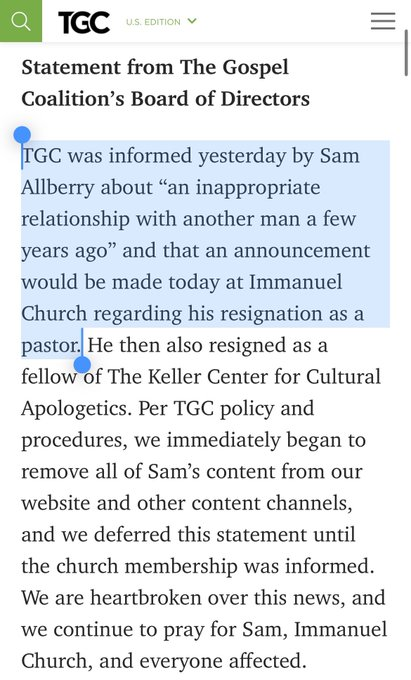
An "inappropriate relationship" is when your barber gives you legal advice or your lawyer sells you insurance. This sounds more serious than that. We need to start speaking truth and stop using euphemisms if we are ever going to confront sexual sin. @TGC
📖Matthew Everhard tweet media
English
30
29
366
10.2K
Roy Jaquez
Roy Jaquez@Royformed·
@CalvinistGoku @RockWallBibles It’s in the last section of his book everyone’s a theologian if you want to reference it but that book all came from his teaching series on that.
English
1
0
1
12
SupralapSaiyan
SupralapSaiyan@CalvinistGoku·
@RockWallBibles I wish I could find the sermon I got this from but here's Dr Sproul's reading order for beginners or new converts:
SupralapSaiyan tweet media
English
1
0
0
24
Rock Wall Bibles
Rock Wall Bibles@RockWallBibles·
What is your best tip for a new Bible reader?
Rock Wall Bibles tweet media
English
26
1
17
2.4K
Roy Jaquez
Roy Jaquez@Royformed·
“I acknowledged my sin to you, and I did not cover my iniquity; I said, “I will confess my transgressions to the LORD,” and you forgave the iniquity of my sin. Selah” — Psalm 32:5 ESV
David@David_wthebeard

English
0
0
1
25
Roy Jaquez retweetledi
Malcolm Yarnell
Malcolm Yarnell@MusingsOnChrist·
“If we fail to distinguish between what faith is from what faith does do we not conflate faith and works and compromise the doctrine of justification by faith alone? … the historic Reformed tradition is saying something different than Piper …” JV Fesko journal.rts.edu/article/a-hist…
English
1
3
22
1.5K
Josh Barzon
Josh Barzon@JoshuaBarzon·
What seat would you choose on this flight?
Josh Barzon tweet media
English
620
17
218
69.5K
Roy Jaquez retweetledi
R. Scott Clark
R. Scott Clark@RScottClark·
@PastorPerks on some of the problems associated with Piper's doctrine of final salvation: So then, why is there debate about Piper’s view of final salvation? Do these straightforward affirmations of the Protestant view of justification and works as evidence of faith somehow square with his more recent assertion that we do not attain heaven by faith alone? There are places where Piper causes some tensions with the two sound premises noted above. First, he makes perseverance in faith a condition for justification. After quoting Jonathan Edwards to this effect, he stated in his own words “Thus it is proper to speak of the moral effectiveness of justifying faith not merely because it brings us into a right standing with God at the first moment of its exercise, but also because it is a persevering sort of faith, whose effectiveness resides in its daily embrace of all that God is for us in Jesus.” (pg. 25; emphasis added) We should all affirm that true faith is persevering faith, so Piper is correct on that point. On the other hand, to say that “justifying faith” – which I take to refer to faith’s role in respect to justification – has “effectiveness” – which I take to mean truly bringing about its corresponding result of justification – in a daily renewal seems obviously to shift justification from one definitive and punctiliar act of God in permanently declaring a sinner righteous upon their taking hold of Christ for salvation to a grant that is always in question. Some might object that it is obvious that if we hypothetically were to lose faith, we would no longer be justified. Apart from the only hypothetical nature of that thought experiment, which I suppose has a valid conclusion from an unreal premise, Piper’s definition of faith fosters an understanding that true faith can ebb and flow, perhaps suggesting it might ebb so low as not to be effective anymore. I will treat the issue of Piper’s understanding of faith in the next section, but it is worth flagging here. Piper does seemingly have a construction that undermines the sure permanency of justification and makes it contingent upon our perseverance in good works. In this sense, works are no longer simply evidence as he stated elsewhere in Future Grace. Piper does explicitly explain justification as “conditional,” but this is a very mixed discussion, since he argues for numerous conditions that vary in kind. For example, expositing Romans 8:28, he named two conditions as having love for God and being called according to his purpose, which he noted are both given in regeneration (pg.231-33, 236-37). So, in this sense, regeneration is a condition – something that must be in place – for justification. This particular condition should not be controversial, even if the language might be unusual to some, since traditional Reformed theology affirms that we are justified by faith, which is given in effectual calling. Elsewhere Piper wrote, “The condition of final glorification is persevering in this same faith and hope.” (pg. 234; italics original) Even this instance as it stands is not controversial since of course someone who lost their faith, if that were possible, would not enter everlasting life. Apart from other aspects of Piper’s understanding of the nature of faith, discussed below, the statement simply affirms that Christians remain Christians to the end, which Piper says that God’s grants. Piper listed several conditions for receiving future grace that are arguably similar to the kind given in regeneration, but it will be most helpful to consider his discussion of “those who keep his covenant” as a condition (pg. 247-49). He states, “Both the old covenant and the new covenant are conditional covenants of grace. They offer all-sufficient future grace for those who keep the covenant.” (pg. 248) Depending on this statement’s meaning determines its usefulness, since it is rather vague as it stands. What are these conditions, if they are different from the ones Piper has already named that are given in regeneration? What does it mean to keep the covenant? “It meant a life of habitual devotion and trust and love to the Lord, one that turned from evil and followed him in his ways.” (pg.247) In this respect, “almost all future blessings of the Christian life are conditional on our covenant-keeping.” (pg. 248) If future grace is, as Piper defined it, “All that God promises to be for us in Jesus” (pg. 1), then it seems clear that the blessings of what God will be for us in Christ are contingent upon your continuation in good deeds. And as always, the question is, how much is enough? What amount of works reveal that I am truly satisfied with God? Piper affirmed that God sovereignly works this continuation in covenant keeping in those who are justified by faith. Fine, but it still seems to make final salvation contingent upon even our Spirit-enabled, God-ordained works, leaving works no longer as simply evidence. Some readers might protest that this reading is too hard on Piper since he clearly affirmed some traditional formulations as his doctrinal starting points. Charity could possibly demand that we take those firm premises as his true belief and these outworkings as aberrations that are merely inconsistent. That may be the case, but I would simply restate now that my main thesis about this book is that it provides a helpful premise to encourage believers but several confused definitions make it inconsistently useful. This is an examples where confused categories have made it inconsistently useful, which does not seem too much to claim. To avoid leaving this as an abstract discussion, as important as those are sometimes, there is a side of Piper’s views on these matters that also raises questions about pastoral approach. He recounts an encounter during a small group Bible study during his seminary days. One of the young wives said that she could not and would not forgive her mother for something she had done to her as a young girl. We talked about some of the biblical commands and warnings concerning an unforgiving spirit…But she would not budge. I warned her that her very soul was in danger if she kept on with such an attitude of unforgiving bitterness. (pg. 265) This story, in some ways because of a perhaps fitting lack of detail, fails to do justice to the complexity of a believer’s struggle with sin and how to address that pastorally. If the woman was angry that her mother did not give her candy when she demanded it and would hold that against her forever, perhaps that is an instance to probe to see if someone is truly intransigent in an unforgiving heart. If that is blatantly true, perhaps there is need for serious spiritual care to assess someone’s profession of faith. But what if there is more to it than that? When I pastored in Northern Ireland, there was a dear man in my church who was godly, kind, eager to learn about his faith, involved as could be, and had a great heart for service. He once told me the story of how his brother had been ambushed and brutally murdered during The Troubles. He also confessed that he had no idea how he would ever forgive the men who committed this crime. I could never bring myself to threaten this man with hell or to question his faith in any capacity although I think this issue is still with him. If someone suggests otherwise, I believe we must have very different models of what pastoral care is and how to provide it. This man had significant levels of evidence of a sincere faith. He even knew that a lack of forgiveness was wrong. Yet, this man, like the woman in Piper’s story, struggled to be forgiving in regard to a terrible, horrific, and personally devastating crime. It fails to reckon with the reality of horrendous pain and with the tensions that can wrack a believing heart instances like this if we simply respond to those who struggle to measure up to our spiritual expectations with the threats of damnation, despite a continually credible profession of faith. We are not yet glorified. Piper should know better how to incorporate that reality into his pastoral responses. heidelblog.net/2021/09/john-p…
English
5
13
43
2.3K